Perfume extraction
Capturing the scent of flowers
Contents
- 1Wooden frame of the chassis
- 2Glass plate
- 3Layer of purified fat on each face
- 4Fresh flowers laid on the fat
- 5Pomade scraped into a jar
Perfumers draw the scent out of flowers, peel and spices without a still in three main ways: by soaking them in oil or fat, by washing scented fat with alcohol, and by pressing the oil out of citrus peel. Tablets from Girsu, in Sumer, already record the making of scented oil around 2400 BCE, and the oldest step-by-step recipes, from Assur, date from around 1200 BCE.
What it is
The scent of a flower or a fruit peel comes from small amounts of volatile oils held in its cells. Perfumers have long had several ways to collect them. Distillation carries them off with steam. The other methods work without a still. Maceration soaks the plant material in warm oil or melted fat. Cold enfleurage lays delicate flowers on a layer of fat that slowly takes up their scent. Alcohol then washes the scent out of the perfumed fat. Expression squeezes the oil out of citrus peel.
Each method suits different materials. Orange blossom and cassie were steeped in warm fat. Jasmine and tuberose go on giving off scent for a day after picking, and heat spoils it, so they were laid on cold fat instead. The peel of oranges, lemons and bergamots is so rich in oil that pressing alone releases it.
How it works
The fragrant compounds of plants dissolve far more readily in fats, oils and alcohol than in water. In maceration, the flowers are left in fat melted over a water bath, then strained out and replaced with fresh ones, again and again, until the fat is strongly scented. The perfumer G. W. Septimus Piesse described flowers left in warm suet and replaced with fresh ones several times. The French houses sold the resulting pomades by number, the higher numbers being the stronger.
In cold enfleurage, a wooden frame holds a pane of glass coated on both faces with purified fat, usually a mixture of lard and tallow with almost no smell of its own. Fresh, dry flowers are spread on the upper face, and the frames are stacked, so that each layer of flowers lies in a closed space between the fat beneath it and the fat under the glass above. A wet flower would turn the fat rancid. After about a day the spent flowers are picked off, by hand and with tweezers, and fresh ones laid on. In Grasse a season of jasmine lasted two months or more. The saturated fat, scraped off the glass, was sold as pomade.
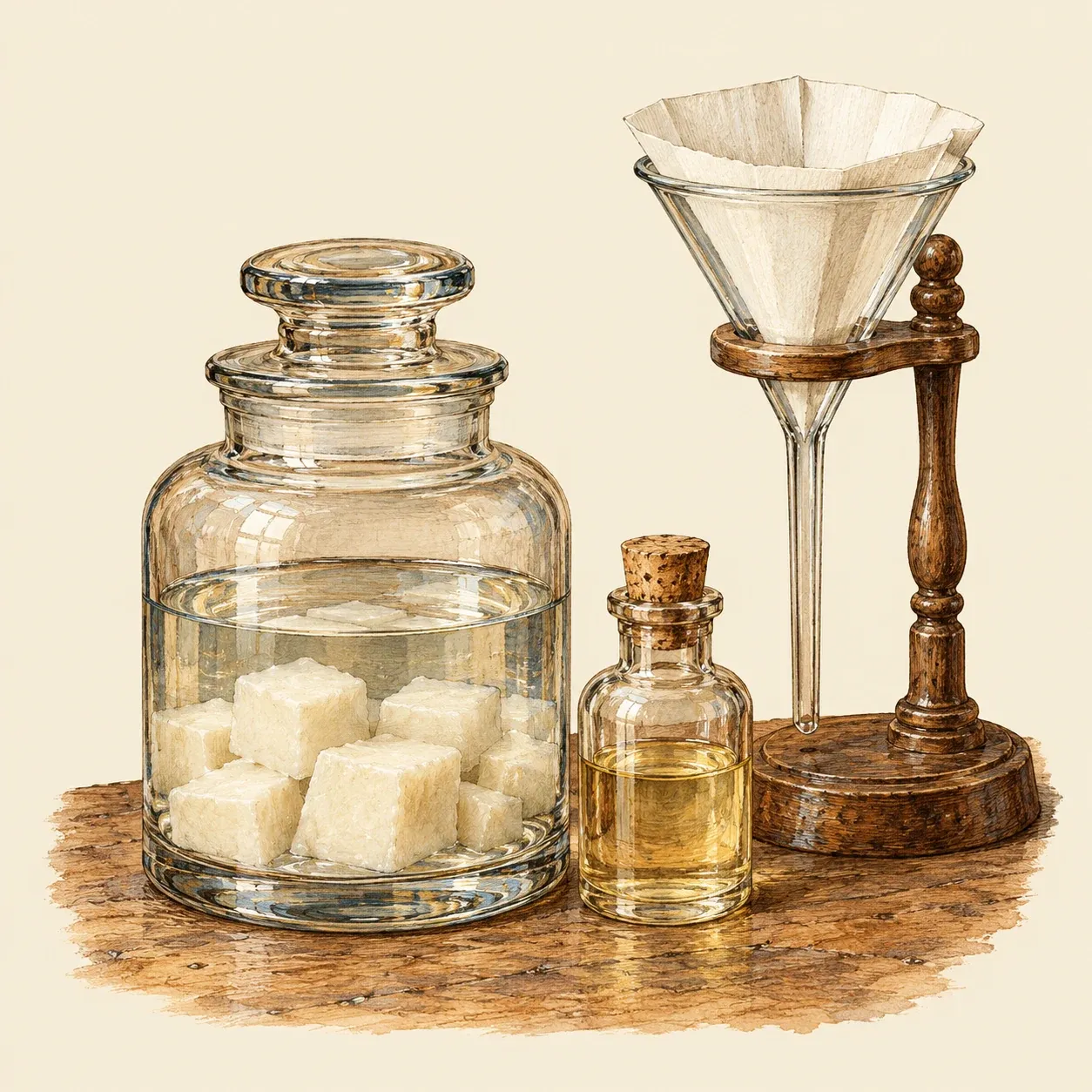 Washed in strong alcohol, the pomade gives up its scent and the fat stays behind.
To turn a pomade into a liquid perfume, perfumers cut it up and left it in strong alcohol. The scent passes into the alcohol and the fat does not, so the alcohol is poured off and filtered. Piesse soaked jasmine pomade in rectified spirit, and the washed fat was not wasted: remelted, it went into pomades for the hair. Removing the alcohol gives the concentrated product called an absolute. Strong alcohol and the volatile solvents that later replaced enfleurage catch fire easily, and their vapour can explode, so this stage belongs in an equipped workshop.
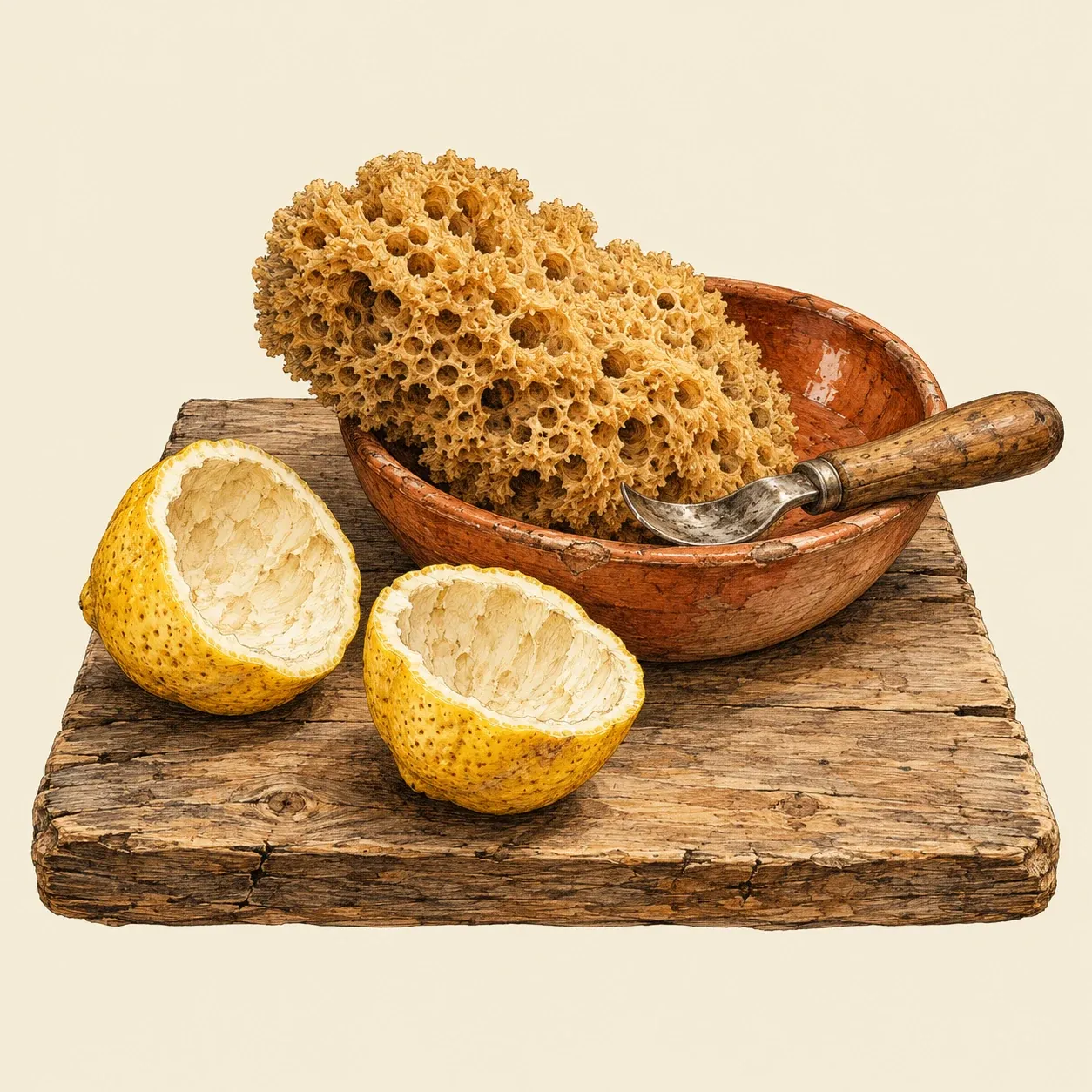 In the old Sicilian method, the peel was pressed against a sponge, which was then wrung out into the bowl.
Expression is the simplest method. The oil of citrus fruit sits in small sacs just under the coloured surface of the peel, and bending, pressing or rasping the peel bursts them. In the old Sicilian method, the fruit was halved, the pulp scooped out with a curved spoon-knife, and each half pressed against a sponge, which was wrung out into a clay bowl. Rolling the whole fruit over blunt points in a bowl did the same job, and machines that rasp the fruit and wash the oil away with a spray of water took over later. The oil is then separated from the water.
How to do it
A cold enfleurage can be tried at home with no heat and no alcohol. You need two clean panes of glass or a glass dish with a lid, plain lard or another solid fat with no smell, and strongly scented flowers picked when they are dry, such as jasmine, tuberose or any garden flower with a strong scent. Spread the fat over the glass in a smooth, even layer and draw a fork across it to roughen the surface, as the Grasse workers combed their fat to give it more surface.
Lay the flowers face down on the fat without overlapping. Cover them with the second pane, fat side down, or with the lid, and keep the dish in a cool, dark place. The next day, lift the flowers off one by one with tweezers and lay fresh ones in their place. Repeat every day for as long as you have flowers. Each batch adds a little scent, and the more often the flowers are changed, the stronger the fat smells. Scrape it into a small jar with a lid and keep it in the cool. It is a smelling sample of a perfumer’s pomade, not a cosmetic.
Expression is easier still. Fold a fresh strip of orange or lemon peel, coloured side out, a few centimetres above a sheet of glass or a dark plate: a fine mist of oil shoots out, and the droplets on the glass smell strongly of the fruit.
Citrus peel oil stings the eyes, so squeeze the peel away from your face. Fragrance substances, including natural extracts and the oxidised limonene of citrus oil, are among the commonest causes of contact allergy, so do not rub the pomade or the oil on your skin.
History and evolution
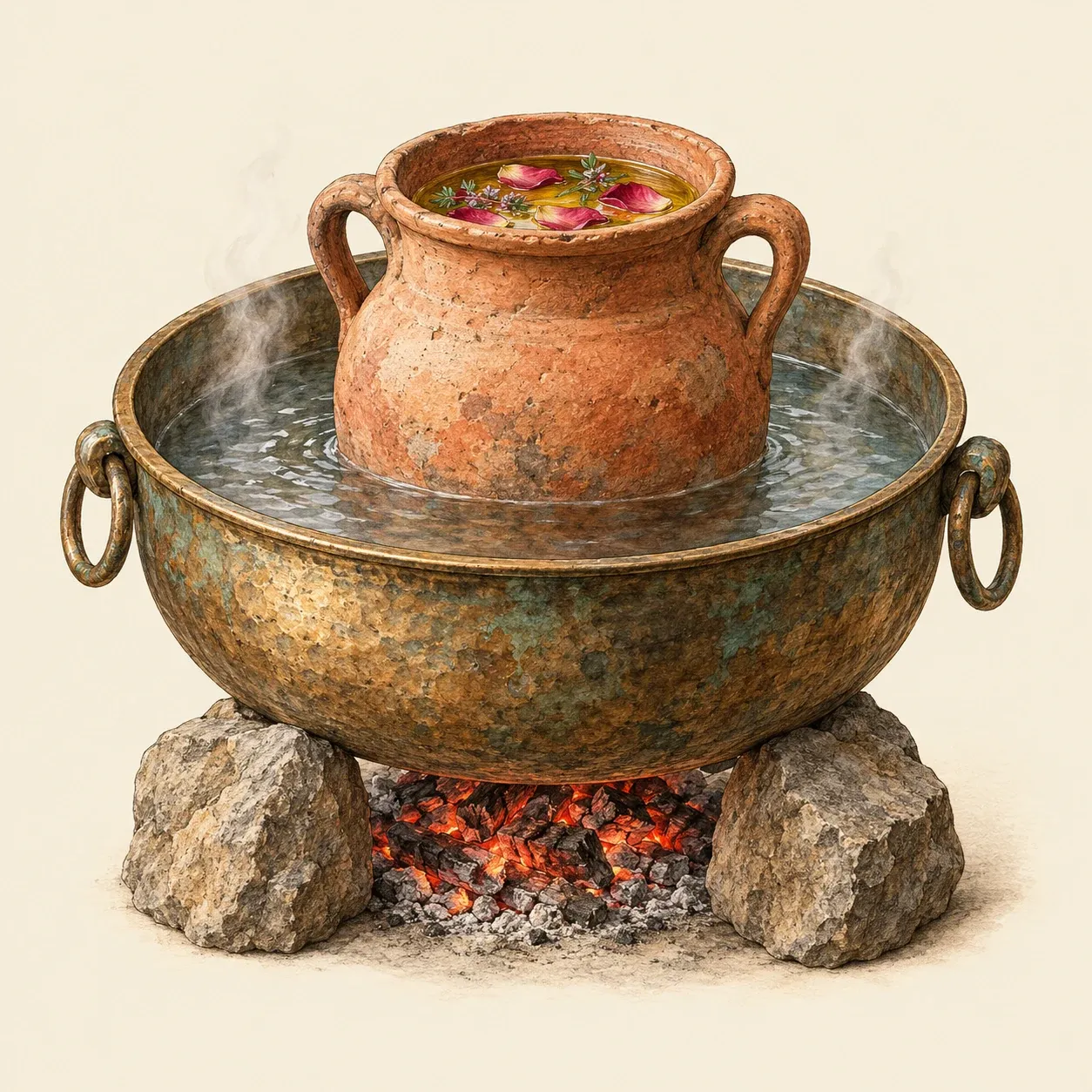 The ancient way: aromatics heated gently in oil, in a pot standing in water rather than on the fire.
Perfumed oil was already being made in Sumer. Administrative tablets from Girsu, in the state of Lagash, written around 2400 BCE, record makers of scented goods and the butterfat used to prepare scented salves. Tablets of the Third Dynasty of Ur, in the twenty-first century BCE, list the woods, resins and other aromatics to be added to a given quantity of oil, without saying how the work was done. The oldest step-by-step recipes come from tablets found at Assur and dated to around 1200 BCE. In them, aromatic plants and resins were soaked in water, then steeped in oil, heated and filtered, over many days. One of them, KAR 220, now in Berlin, names a woman perfumer, Tappūtī-bēlet-ekallim. Some writers see an early form of distillation in one of its steps.
The Greek philosopher Theophrastus wrote a short treatise on odours. He explains that perfumers prepared the oil before adding the scented material, then heated the aromatics in vessels standing in water, never directly over the fire, because a strong heat wasted the material and made the perfume smell burnt. Rose, gillyflower and lily perfumes were made from the flowers, and quinces were put into the oil in batches and taken out before they began to rot.
Strong alcohol, a product of distillation, gave perfumers a solvent that takes the scent and leaves the fat behind, and the handkerchief perfumes Piesse described are scents dissolved in spirit. Cold enfleurage was practised on a large scale in the region of Grasse, in Provence, where Piesse describes it. Volatile solvents, which dissolve the scent of flowers directly, later largely replaced it. In 2018 UNESCO inscribed the perfume skills of the Pays de Grasse, from growing the plants to composing the scent, on its list of intangible cultural heritage.