Animal domestication
Breeding wild animals into herds
Contents
- 1Coarse hair coat of the wild mouflon
- 2Pale belly of the mouflon
- 3Short tail of the mouflon
- 4White fleece of the domestic sheep
- 5Long tail of the domestic sheep, reaching the hock
Domestication is the slow process by which people brought wild animals to live and breed under their control, until they became different from their wild ancestors. The dog came first: ancient DNA identifies dogs at Pınarbaşı in Türkiye about 15,800 years ago. Sheep, goats and cattle followed in southwest Asia about 10,500 years ago, kept first for meat and later for milk, wool and pulling power.
What it is
A domestic animal lives, feeds and breeds under human control, and over many generations it has come to differ from its wild ancestor in behaviour and body. The change took centuries or millennia, as people took a growing share in the life of a species. Husbandry is the daily work that keeps it going: choosing which animals breed, feeding and protecting them, and deciding which are killed for meat and which are kept for milk, wool or work.
Archaeologists describe three routes into domestication. Wolves, and later cats and chickens, came close to human camps and villages for food scraps or for the mice drawn to stored grain, and the relationship grew from there. Sheep, goats and cattle were first hunted; as they grew scarce, people managed the wild herds and then kept them. Horses, donkeys and camels were taken in deliberately by people who already kept other animals, mainly to carry loads and riders.
The two rams drawn side by side show some of what breeding changed in the sheep. On the left is the Asiatic mouflon, the wild sheep from which domestic sheep are thought to descend. On the right is a hornless long-wool ram of the Leicester type, a breed that goes back to eighteenth-century England.
How it works
Herding works by choosing which animals produce the next generation. Hunters tend to kill large adult males. A managed herd leaves a different pile of bones: females kept to an older age for breeding, and young males killed for meat. At Ganj Dareh, in the Zagros mountains of Iran, goats killed about 9,900 years ago show this pattern, although they are no smaller than wild goats. Smaller bodies and new horn shapes appear only 500 to 1,000 years later, in herds taken down to hotter, drier lowlands.
Behaviour changed first. Animals that tolerated people and handling did better and bred more under human care, and over generations herds became calmer. Body changes followed, in size, colour, horns and coat, as herders kept the animals that suited them best.
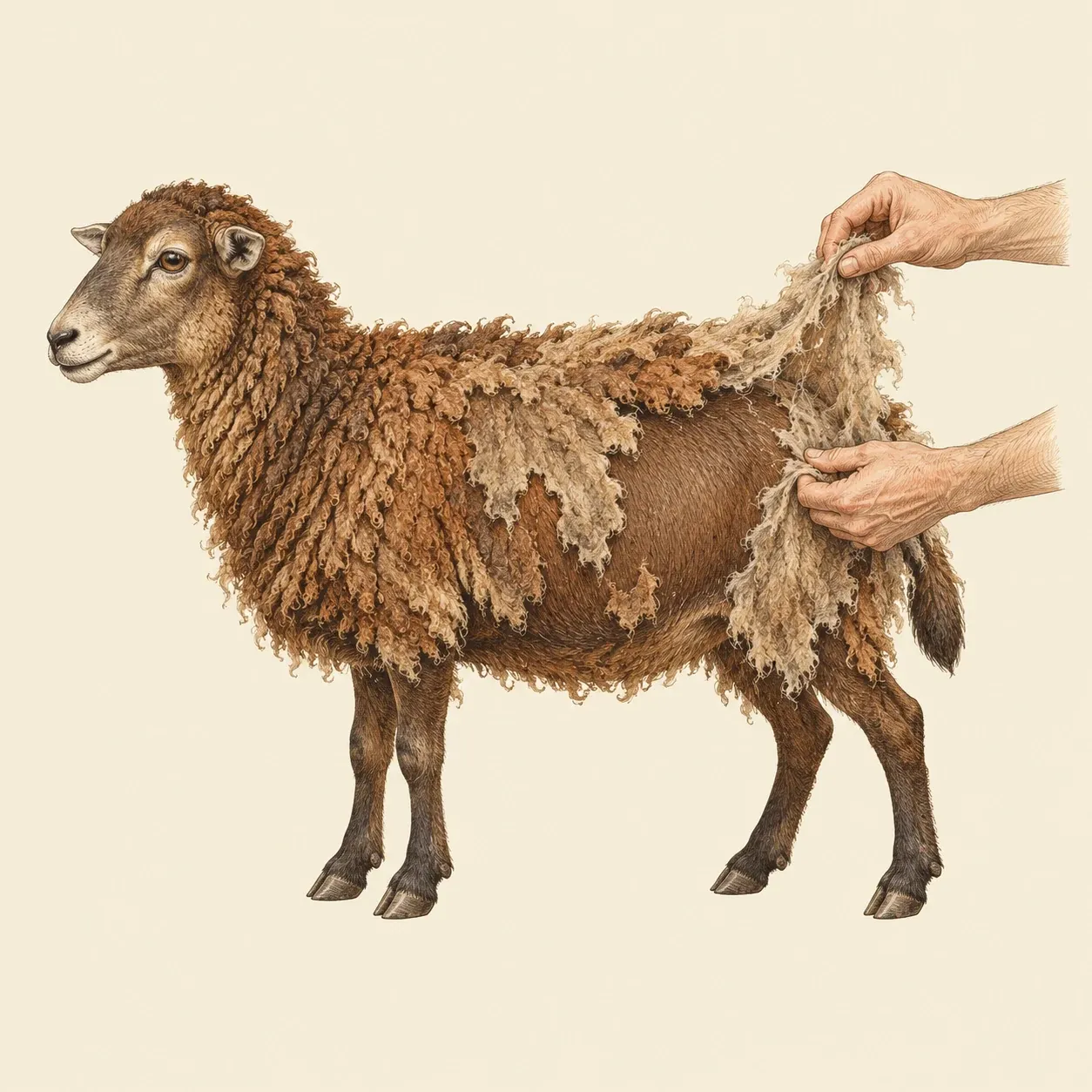 A sheep that still moults can be plucked by hand, as the wool comes away on its own in spring.
The sheep shows the result well. The mouflon has a short tail and a coat of long, coarse hairs over a short, fine underwool, with a pale belly, and it sheds the whole coat each spring. The first domestic sheep were short-tailed, hairy animals of the same kind, kept for their meat. Breeders then favoured animals with more fine wool and fewer coarse hairs, white fleeces that take dye, and fleeces that keep growing instead of falling out. While sheep still moulted, their wool was gathered by plucking; once the moult had been bred out, it had to be shorn. Almost all modern breeds have long tails.
How to do it
Shepherds penned and moved their flocks with hurdles: light panels of woven hazel that are quick to set up as a fold and easy to carry to fresh grass. A traditional sheep hurdle is about 1.8 m long and 1 m high, with ten uprights.
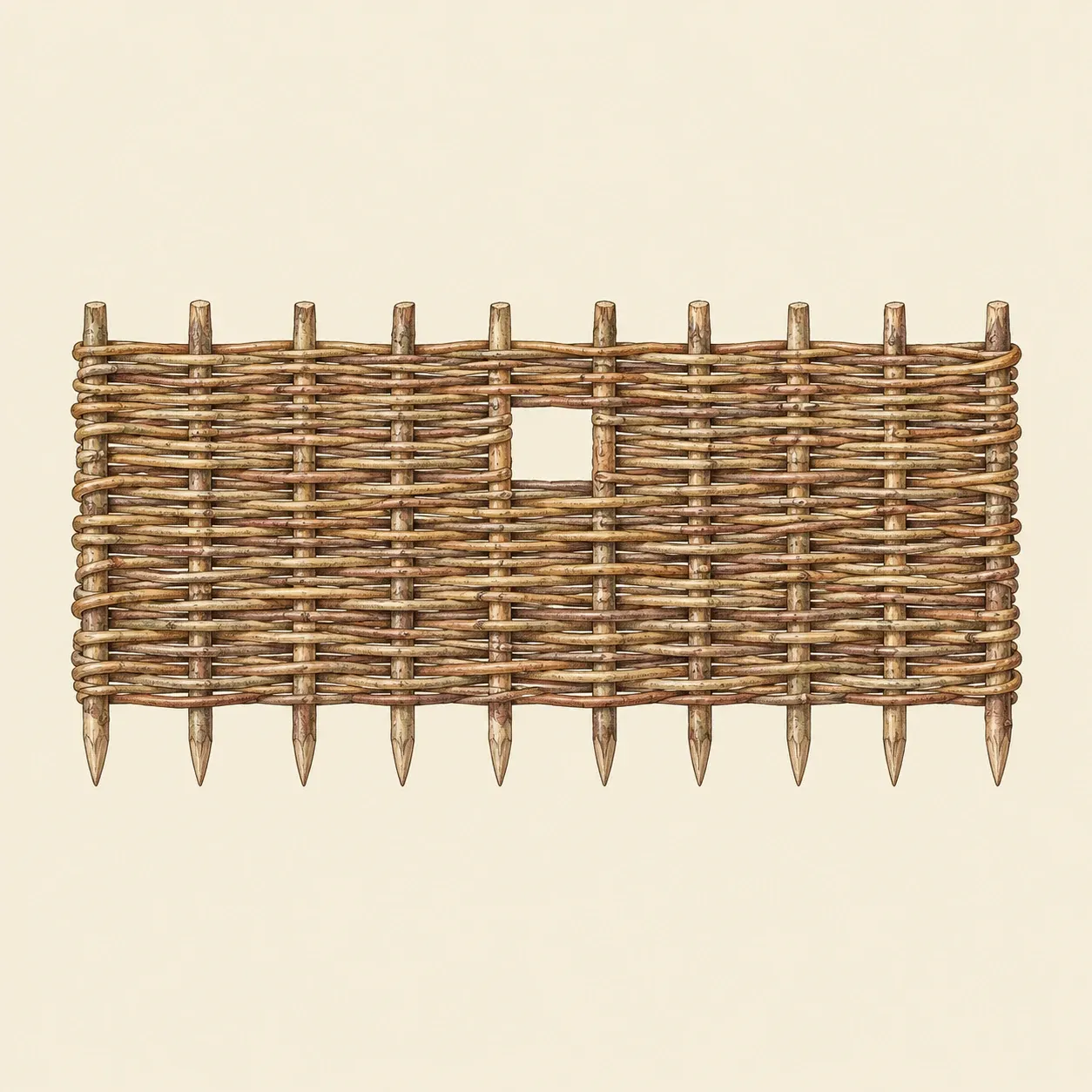 Twisted round the end uprights, the rods lock the weave, and the gap in the middle lets the shepherd carry the hurdle.
You need straight hazel rods, from 12 to 30 mm thick for weaving and from 20 to 40 mm for the uprights, a billhook, a saw, loppers, a chopping block and a mould. The mould is a heavy beam about 2.4 m long with ten holes in a row to hold the uprights, fixed firmly to the ground. Sharpen the thick end of each upright on the block, chopping downwards, so that it goes at least 12.5 cm into its hole, and cut it to length. The two end uprights are whole rods; split the others from thicker stems. Split the weaving rods in two along their length with the billhook, starting at the cut end and levering the blade from side to side.
Set the uprights in the mould and weave each rod in front of one upright and behind the next, tapping the rows down as you go. At each end, twist the rod as you bend it round the end upright: the fibres open and it wraps like a rope, where a plain bend would snap it. Leave an open space between the two middle uprights, about a third of the way down from the top, to put an arm or a stake through when carrying the hurdle. When it is full, lift it off the mould, trim the ends of the rods and let it dry for about a week.
History and evolution
The dog was the first domestic animal and the only one tamed by hunter-gatherers before farming began. It descends from the grey wolf. In 2026, whole genomes showed that canid remains found with human remains at Pınarbaşı in central Türkiye, about 15,800 years old, and at Gough’s Cave in England, about 14,300 years old, were dogs, closely related to each other. At Bonn-Oberkassel in Germany, a grave found in 1914 held a man, a woman and two dogs, about 14,000 years old. Canid skulls from Goyet in Belgium, more than 30,000 years old, and from Eliseevichi in Russia have been put forward as dogs, while a 2015 study of their shape classes them as wolves. Genetic estimates of when dogs split from wolves range from about 11,000 to 32,000 years ago, depending on the mutation rate used.
Herding began in the Fertile Crescent of southwest Asia, among people who were also starting to cultivate cereals. Between about 11,000 and 10,000 years ago, sheep, goats, cattle and pigs came under human management there. From DNA in ancient bones from Iran, Ruth Bollongino and her colleagues estimate that today’s taurine cattle descend from about 80 female aurochs, domesticated about 10,500 years ago. Early farmers took all four species by boat to Cyprus.
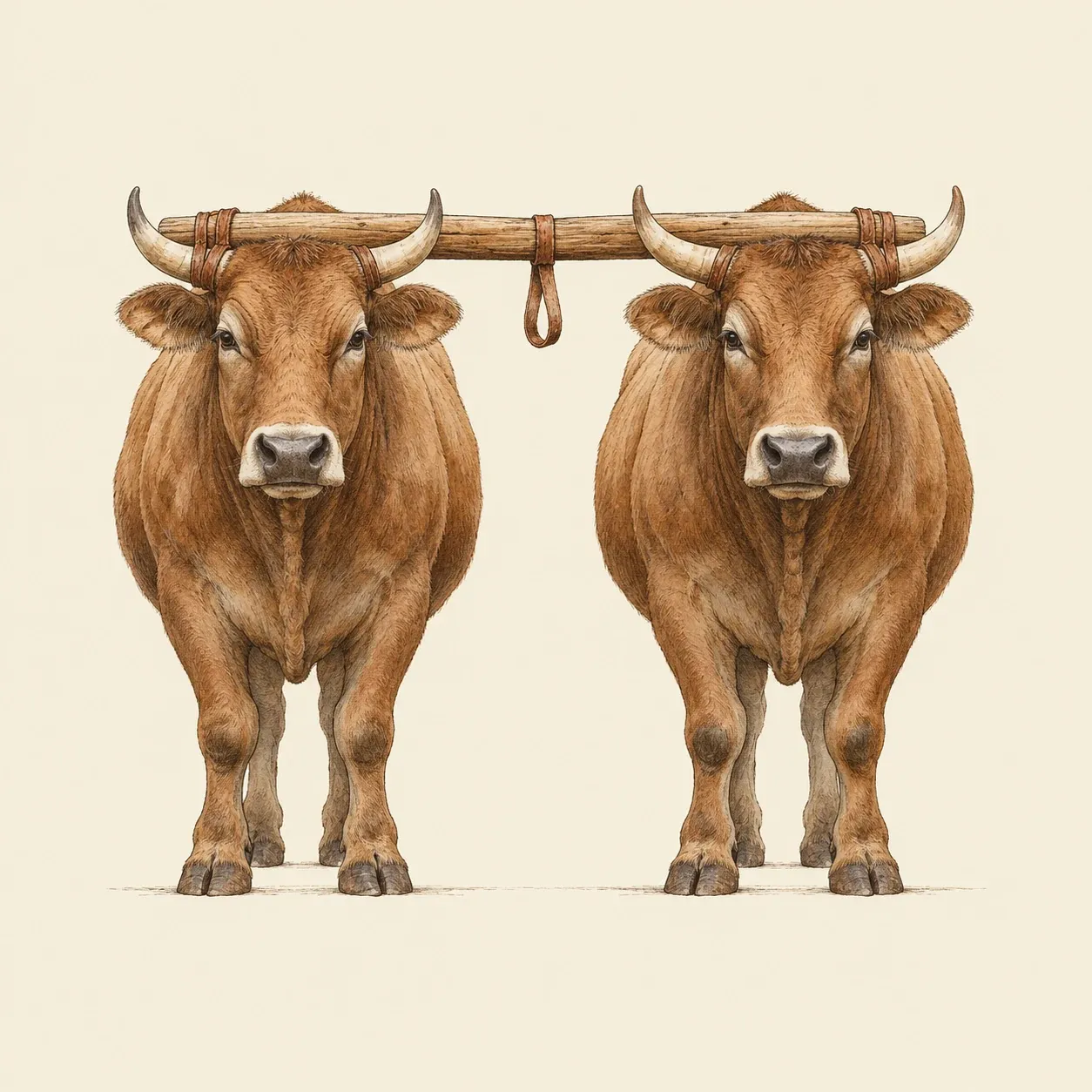 A wooden yoke joins two oxen so that they pull together.
For thousands of years herds were kept mainly for meat. A study of fat residues in more than 2,200 potsherds shows that milk was processed in the seventh millennium BC, most of all in northwestern Anatolia, where cattle were common. Milk could then be kept as cheese. Changes in the foot bones of cattle from Neolithic sites in the western Balkans, between about 6100 and 4500 BC, point to animals that sometimes pulled heavy loads. A wooden yoke from Arbon-Bleiche in Switzerland, of about 3380 BC, is the oldest direct evidence of a pair of cattle yoked together, as they were to draw the plough. Wool appears in textiles of the Early Bronze Age, and white wool in the Iron Age.
The horse was domesticated later. Ancient DNA traces modern domestic horses to the steppes of the lower Volga and Don, around 2200 BC, from where they spread across Eurasia after 2000 BC. The horses kept at Botai in Central Asia around 3500 BC were not their ancestors. The horse collar and the horseshoe later made horses more useful for heavy work.
Breeding for chosen traits became systematic much later. The Merino of Spain, valued for its fine wool, is perhaps the first recognised breed, from the late Middle Ages. In eighteenth-century England, Robert Bakewell of Dishley chose the parents of each generation with method and bred close relatives to fix the type he wanted. He bred his Leicester sheep for meat rather than for wool. Instead of selling his best rams, he let them out to other farmers for a season, and the breeders who followed his methods formed the Dishley Society, a forerunner of the later breed societies.