Horseshoe
An iron rim nailed to the hoof
Contents
- 1Wavy outer edge, pushed out by the countersinkings
- 2Countersunk nail hole, three on each branch
- 3Calkin, the heel turned down for grip
- 4Fiddle-key nail head
- 5Clinch, the nail tip bent over on the wall
- 6Hoof wall of insensitive horn
A horseshoe is a curved plate of iron nailed under a horse's hoof, so that the metal wears away on hard or stony ground instead of the horn. The nails pass through the outer hoof wall, which has no feeling. The Romans tied iron soles called hipposandals onto hooves; the oldest securely dated nailed shoes come from Europe in the ninth and tenth centuries, among them one from Winchester.
What it is
A horseshoe is a plate of iron or steel bent to the outline of the hoof and fixed under it with nails. It is open at the back. Its front is the toe, its two arms are the branches, and their ends are the heels. A farrier fits it to each foot and nails it on, then takes it off and refits it as the hoof grows.
The shoe drawn here is of a kind made in England between the late eleventh and late thirteenth centuries, about 5 mm thick or more, with a narrow web and three nails on each branch. Each nail hole sits in a countersinking, a hollow punched into the iron that pushes the metal outwards and gives the shoe its wavy edge. Most of these shoes had calkins, heels thickened or turned down for grip. The nails had broad half-round heads, called fiddle-key heads, which stood proud of the shoe and gripped the ground; the countersinkings kept them from wearing away too fast.
How it works
The hoof wall is horn, like a very thick nail, and it grows down without stopping from the band at the top of the hoof. Gravel, roads and other hard surfaces can wear it faster than it grows and leave the horse footsore. The shoe takes that wear instead, and its heels and nail heads help the foot grip.
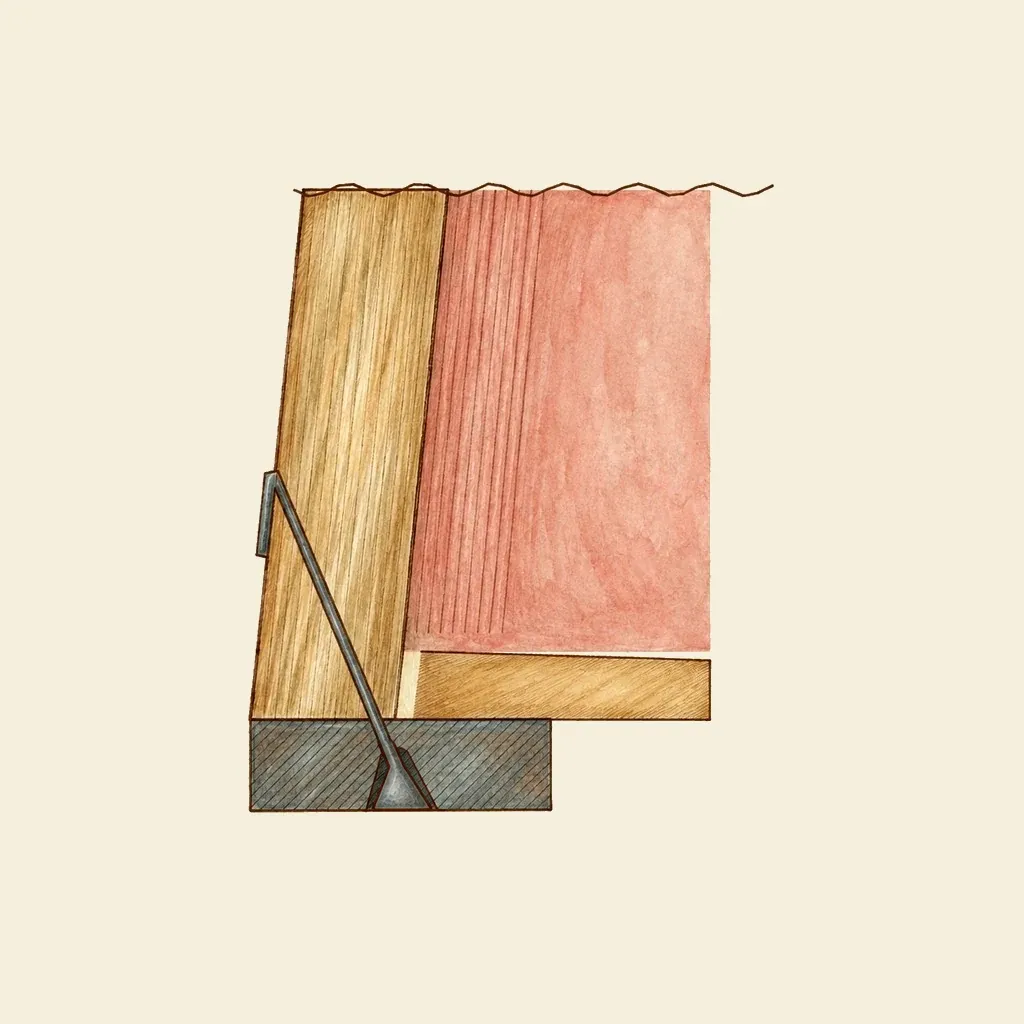 The nail passes through the outer part of the wall, which has no feeling; its point, bent down, forms the clinch.
The nails are driven up through the outer part of the wall, which has no feeling, and come out on its outer face a short way up. The protruding point is bent down flat against the wall to form a clinch, and the clinches hold the shoe. A nail driven too far in reaches the living tissue inside the hoof and lames the horse. The wall is thinner towards the heels and on the inner side of the foot, so the nails go mainly into the front half, and the holes are set further from the edge at the toe than at the heels. Because the wall keeps growing under the shoe, the shoe has to come off at regular intervals so that the hoof can be trimmed and the shoe refitted.
How to do it
This is a forging exercise. It makes a practice shoe, an object of the right shape that must never be nailed to a horse. Fitting and nailing a shoe is a farrier’s trade: a misplaced nail lames the animal, and in Great Britain it is a criminal offence for anyone who is not a registered farrier, apart from a few legal exceptions, to shoe a horse, even their own.
You need a flat bar of mild steel 6 to 8 mm thick, 19 mm wide and about 30 cm long, a forge, an anvil with a horn, a hammer and tongs, and for the nail holes a stamp and a pritchel, a thin punch that opens the hole from the other side. Mark the middle of the bar with a centre punch: it will be the toe. Heat one end to bright red, hold the bar in the tongs and round it off on the anvil to make a heel.
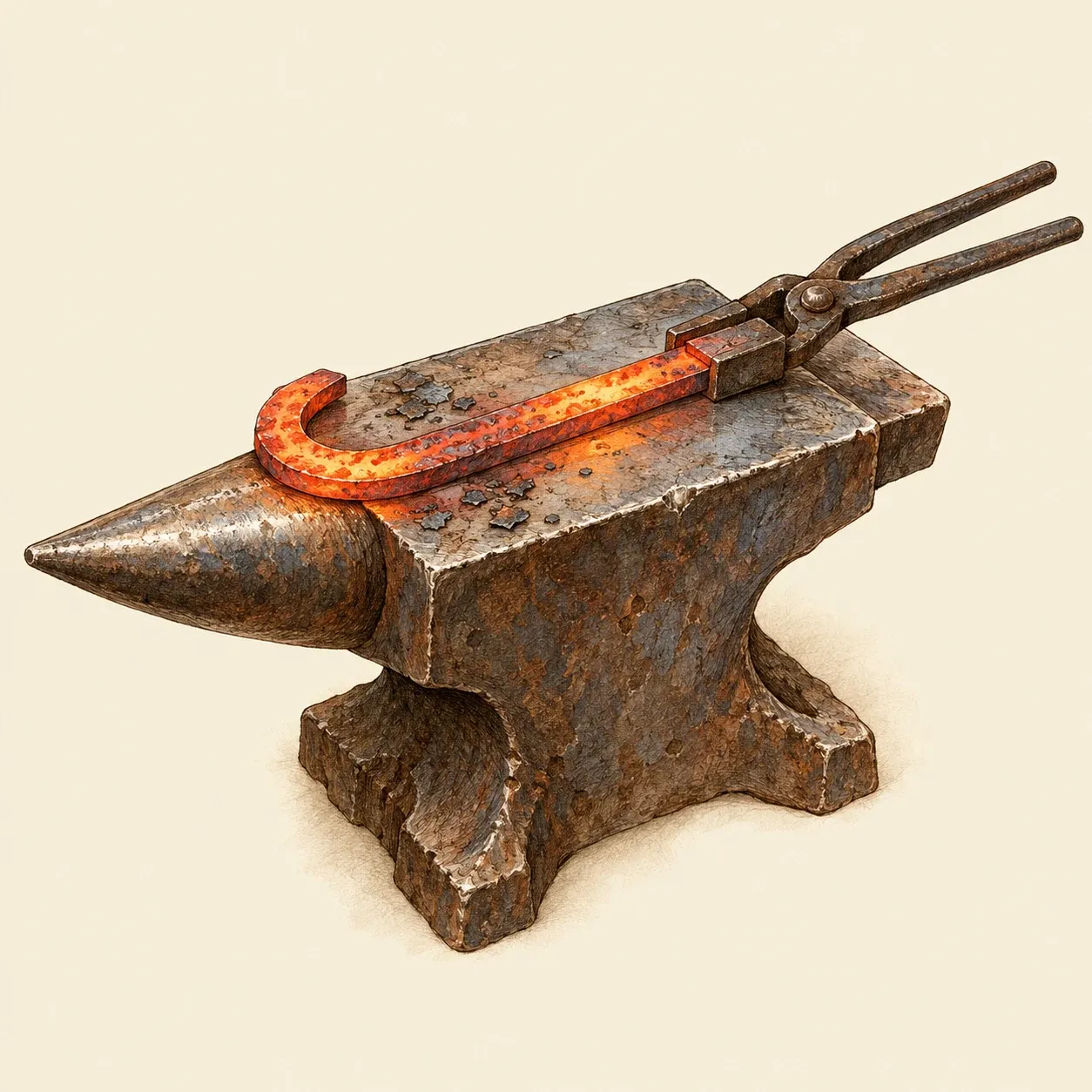 One branch at a time, the hot bar is bent round the horn of the anvil from the middle towards the heel.
Heat that half again and bend it over the horn with light blows, working from the middle towards the heel, until it forms one side of a U. Round off the other end and bend the second half the same way. Lay the shoe flat on the face of the anvil, hammer out any twist and adjust the branches until they match. Steel loses its heat quickly, so put it back in the fire as soon as its colour fades. To finish the shoe, punch four holes in each branch with the stamp, keeping clear of the toe and of the heel ends, and open each one from the other side with the pritchel. Let the shoe cool in the air or in a bucket of water.
Safety. Forged steel stays hot enough to burn long after it stops glowing and looks no different from cold metal, so pick up every piece with tongs and keep cooling water close by. A forge burns fuel and gives off carbon monoxide, a gas with no smell that can kill: work outdoors or in a well-ventilated forge, and never in a closed room.
History and evolution
No nailed shoe is known from before the Christian era. Xenophon, writing on horsemanship in the fourth century BC, gives ways to harden the hoof and says nothing of shoes. The Romans had the hipposandal, an iron sole slipped under the hoof and tied on with leather straps.
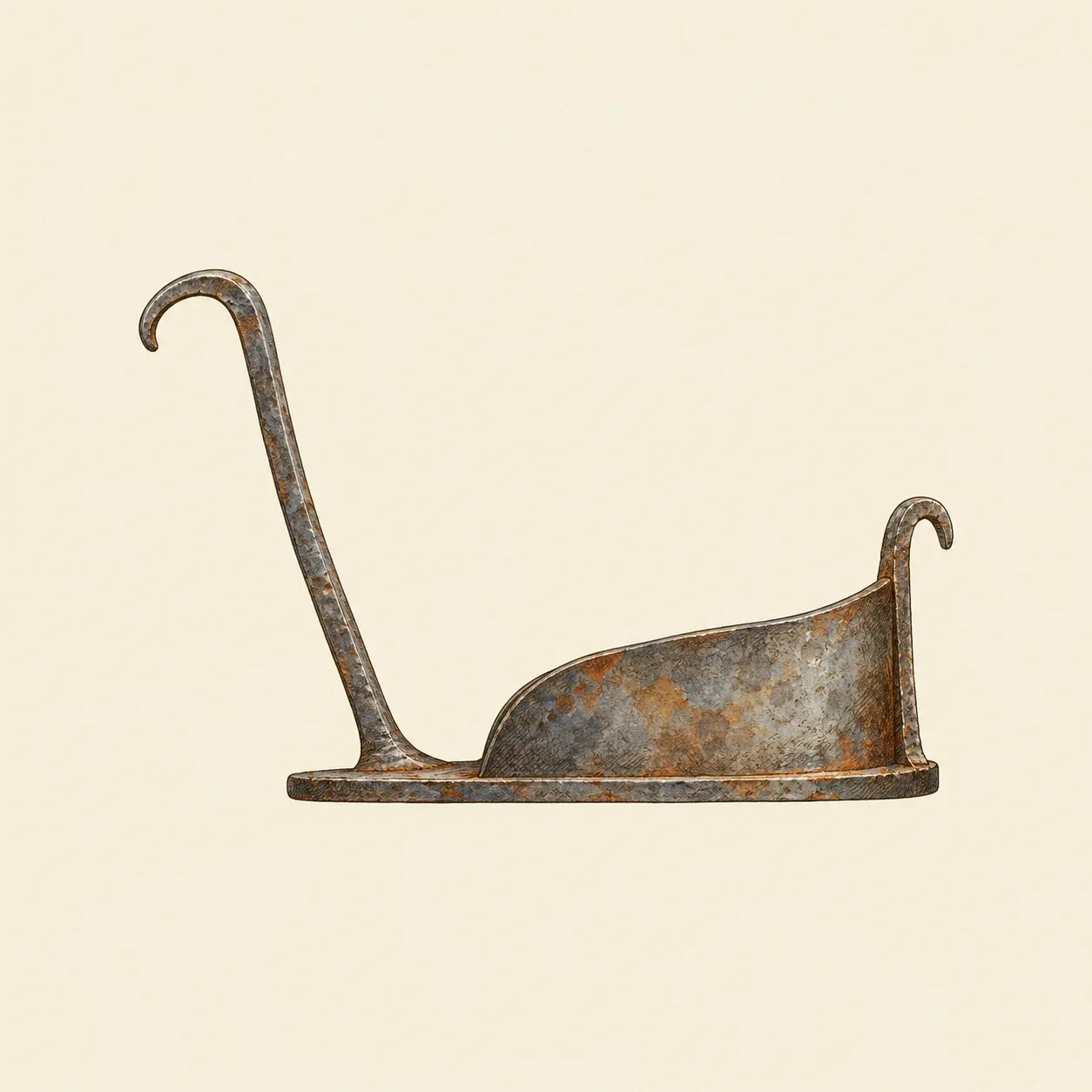 Tied on with straps, a hipposandal could be taken off again on soft ground.
It had a hooked rod at the front, wings at the sides and a raised heel with a hook, and the London Museum suggests it protected the feet of animals pulling carts and wagons on hard gravelled roads, to be removed on softer ground. Three were found in the ruts of a Roman road near Liverpool Street in London.
Whether the Romans also nailed shoes on has been argued since the nineteenth century. In 1934 A. D. Fraser cited shoes found under Roman street paving at Virunum, in present-day Austria, which no one had disturbed in the Middle Ages, as proof that they did. The guide of Britain’s Portable Antiquities Scheme, following John Clark’s work on medieval horse equipment, says that nailed shoes are first attested in the ninth and tenth centuries. A shoe described in 1655 from the grave of Childeric, a fifth-century Frankish king, at Tournai, broke apart while it was being cleaned and was later lost, and the antiquarian Abbé Cochet took it for a fitting from a box.
One of the earliest nailed shoes comes from a late ninth-century layer at Winchester. In Switzerland the oldest shoes, from Bellinzona, date from the ninth or tenth century, and a charter of the abbey of St Gall dated 1 March 826 already lets the farm of Rüeterswil pay its rent in horseshoes. The first text to describe them is the Tactica of the Byzantine emperor Leo VI, who reigned from 886 to 912: among the equipment of a cavalryman it lists crescent-shaped iron shoes and their nails. The nailed shoe spread in the same centuries as the horse collar, which let horses pull heavy loads.
Medieval shoes changed slowly. Shoes found in England from the tenth to the twelfth century are thin, 2 to 3 mm, with wide webs. The thicker wavy-edged type followed from the late eleventh century, then heavier shoes with smooth edges and three or four holes on each branch, and from the fourteenth century wide shoes with no countersinkings. From the seventeenth century shoes grew larger and heavier, with more nail holes, often punched along a groove called a fuller, and the toe clip appeared. By the late nineteenth century some farriers bought machine-made shoes or ready-grooved bar. Most shoes today are of mild steel with eight nail holes, alongside shoes of aluminium or plastic.