Pedal boat
A boat driven by the legs of its crew
Contents
- 1Twin floats
- 2Seats
- 3Pedals and crankshaft
- 4Paddle wheel
- 5Wheel housing
A pedal boat is moved by the legs of the people on board, who push pedals or tread on a wheel that turns a paddle wheel or a propeller. Pedalling leaves the hands free. Chinese histories say that Li Gao, a Tang prince and provincial governor who died in 792, had warships built with two wheels that the crew trod. Wheel boats fought on Chinese lakes in the 12th century. Today pedal boats are mostly small pleasure craft, and a pedal-driven hydrofoil reached 18.5 knots in 1991.
What it is
A pedal boat is a boat moved by the leg muscles of the people on board. They sit and push pedals, or stand and tread, and the movement turns a paddle wheel or a propeller under the boat. Unlike rowing, pedalling leaves the hands free.
The common pedal boat of beaches and lakes, the pedalo, is a light craft with two floats joined by a deck. Two people sit side by side and pedal a crankshaft that carries a paddle wheel, which turns in the open space between the floats under a housing. Other pedal boats drive a propeller through a belt or gears.
How it works
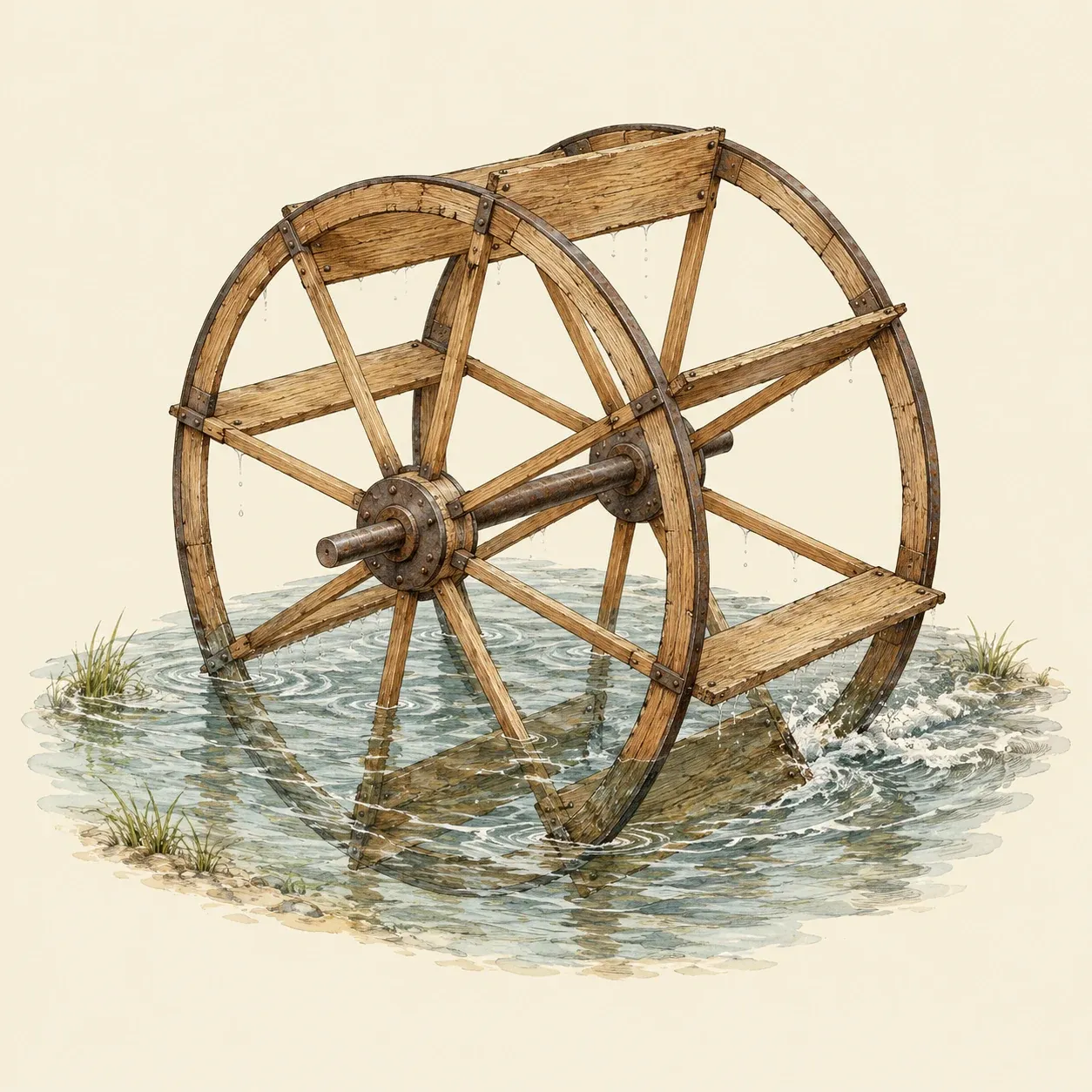 Only the lower blades push on the water; the others come round through the air.
The pedals are fixed to cranks at the two ends of a horizontal shaft across the boat, and the paddle wheel is fixed to the same shaft. As the people pedal, the shaft and the wheel turn together. The lower part of the wheel is under water, and its blades move backwards along the bottom of the turn. Each blade pushes water backwards, and the water pushes back on the blade with an equal force, which drives the boat forwards. The upper blades come round through the air and do no work.
The deeper a blade enters the water, the more water it moves, but the harder it is to push. A pedalo carries its wheel so that only the lower blades dip in, and the housing over the wheel keeps hands, feet and spray away from it. Pedalling backwards turns the wheel the other way and moves the boat astern.
A propeller works on the same principle. Its twisted blades push water backwards along the shaft as it turns, and it stays entirely under water, so none of its turn is wasted.
How to do it
A small boat with a paddle wheel driven by a twisted rubber band shows how the wheel pushes water. You need a clean plastic food tray or a piece of polystyrene about 15 cm by 8 cm, two wooden sticks about 15 cm long, two pieces of stiff plastic cut from a bottle or lid, about 4 cm by 6 cm, a strong rubber band, waterproof tape, scissors and a bath or a large basin of water.
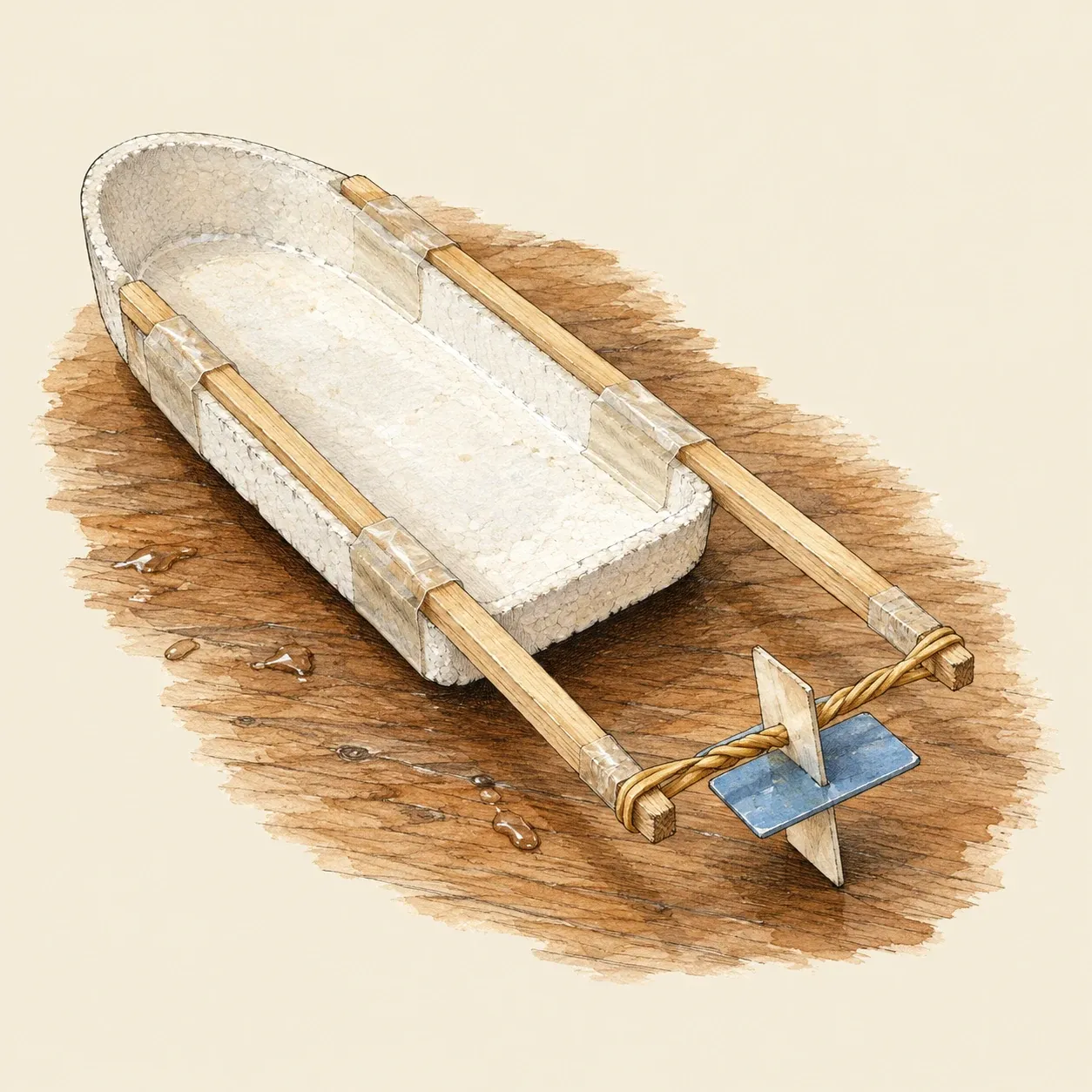 As the rubber band unwinds, the blades push water backwards and the boat forwards.
Tape the two sticks along the sides of the hull so that they stick out about 8 cm behind it, parallel. Cut a slot halfway along the middle of each plastic piece and slide the two pieces together to make a cross of four blades. Stretch the rubber band between the ends of the two sticks, slip the blade cross into the middle of the band and tape it in place. Wind the blades round twenty or thirty times, put the boat in the water and let go. When the lower blades move towards the stern, the boat goes forwards; wind the band the other way and it goes backwards. Try longer or shorter blades and count how far the boat goes.
History and evolution
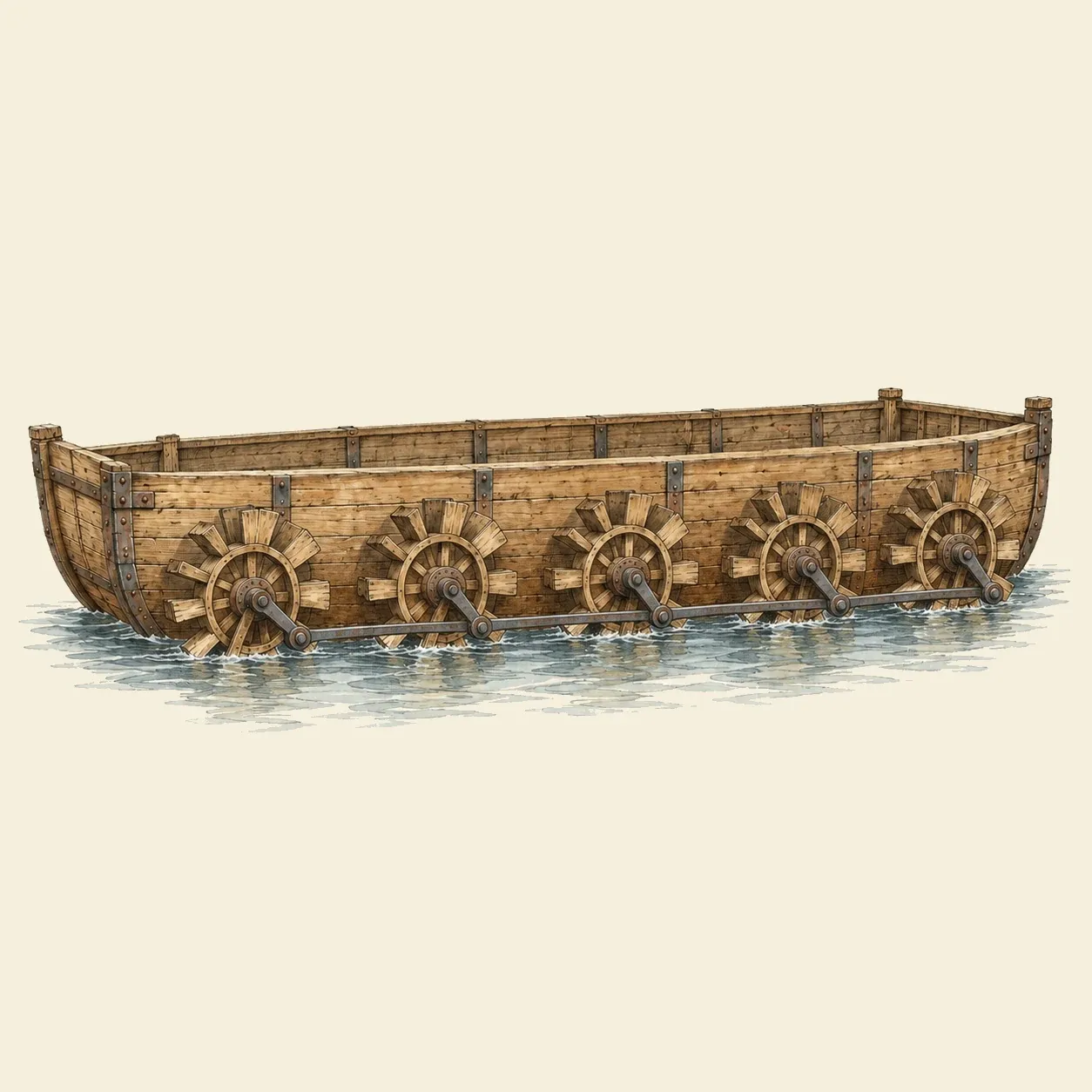 A paddle-wheel war barge of the kind drawn in Roberto Valturio’s book printed in 1472.
The Old and New Tang histories describe warships built by Li Gao, Prince of Cao, a provincial governor who died in 792. Each ship had two wheels that the crew trod. The Old Tang history says the ships went as fast as if they had hoisted sails, and the New Tang history that they were faster than charging horses. The Cefu yuangui, a Song encyclopedia, says he had them built while he governed Hongzhou, in the early 780s.
In the 1130s rebels led by Yang Yao fought the Song government on Dongting Lake from wheel boats. The Song history says that their wheels beat the water and that the boats moved as if flying, and the writer Lu You recorded that the government fleet copied the rebels’ wheel boats and built larger ones, which were still in service when the Jin emperor Wanyan Liang invaded the south. The general Yue Fei put down the rebellion.
In Europe, boats with paddles turned by men appear in engineers’ manuscripts from the 14th century. In his Texaurus regis Francie of 1335, Guido da Vigevano described a boat that folded up to be carried on horseback and was driven by crossed paddles fixed to the ends of two shafts, joined by an iron crank and turned like a hand mill. In the 15th century an anonymous engineer of the Hussite wars drew a covered boat with paddle wheels, each turned by a crank from inside; the historian Franz Maria Feldhaus dated the manuscript to about 1430, and Massimo Corradi to 1470–1480. Roberto Valturio’s book on warfare, printed at Verona in 1472, shows a barge with five pairs of paddle wheels whose cranks are joined by a single rod, and Leonardo da Vinci sketched paddle-wheel boats worked by hand or foot. Pedal boats later became pleasure craft, with a paddle wheel or a propeller under the seats. On 27 October 1991 Mark Drela pedalled the Decavitator, a hydrofoil built at MIT, at 18.5 knots over 100 metres on the Charles River in Boston. It is driven by an air propeller, and its hull rises clear of the water on underwater wings.