Woodblock printing
A carved block that repeats a page
Contents
- 1Wooden block
- 2Raised design
- 3Inking brush
- 4Sheet of paper
- 5Rubbing pad
Woodblock printing transfers text or an image from a wooden block carved in relief. Ink covers the raised parts; paper is laid over them and rubbed from the back. The same block can produce repeated impressions.
What it is
A woodblock page stays with its block: the lines of the text and picture are carved into one wooden surface. Once a sheet has been printed, the printer inks that surface again and takes another impression. The shapes are not dismantled to compose a different text.
The movable types used with a printing press are separate pieces that can be rearranged. A woodblock keeps an entire page ready for another printing. It can also reproduce a design without any writing. The paper must conform to the raised surface and survive rubbing without tearing.
How it works
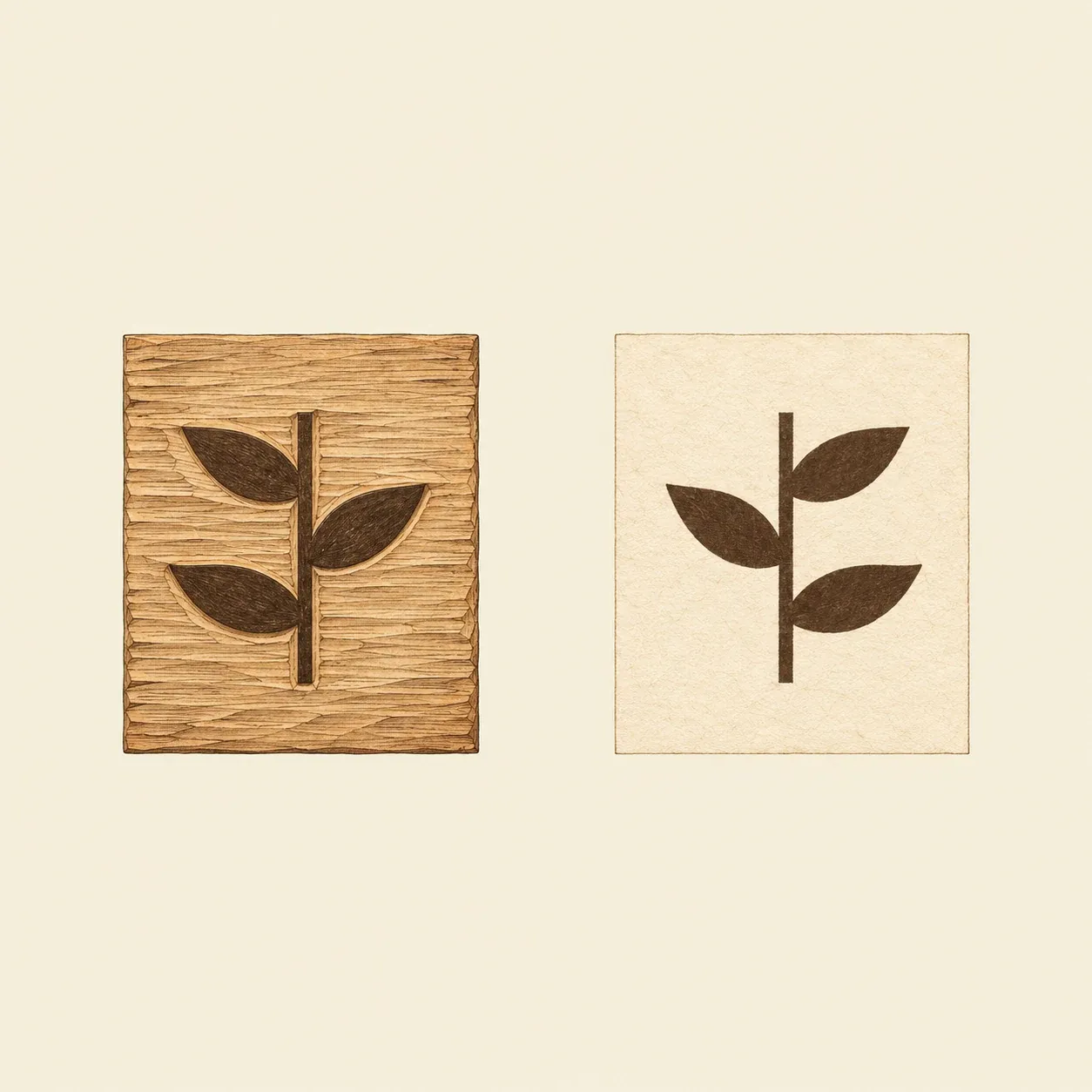 The impression reverses the left and right sides of the carved design.
The carver removes the areas that are to remain white. Lines intended to print stay in relief at the original surface level of the wood. A brush distributes ink over these high parts. Recessed areas remain below them and should leave no mark on the paper.
The sheet is laid on the inked block. A rubbing pad moving across its back supplies local pressure, bringing the paper into contact with the design. The block rests on the table and the hand supplies the force. Printing by rubbing therefore needs neither a screw nor a platen. If the sheet moves after picking up ink, the impression can become doubled or blurred.
Contact gives a mirror image. An asymmetrical design makes the reversal easy to see. Text has to be reversed on the block for the impression to read correctly. In some methods, a paper drawing is pasted face down onto the wood to guide the carving.
Keeping the block preserves the page, although the raised lines wear with use. Print quality also depends on ink coverage and contact. A line missing from one impression may still be perfectly intact on the block.
How to do it
For a modern single-colour trial, use a small dry, flat board, a steel gouge, a brush, ready-made water-based ink, flexible paper and a smooth rubbing pad. Choose a simple design whose sides differ. Drawing straight onto the block avoids a separate gluing stage.
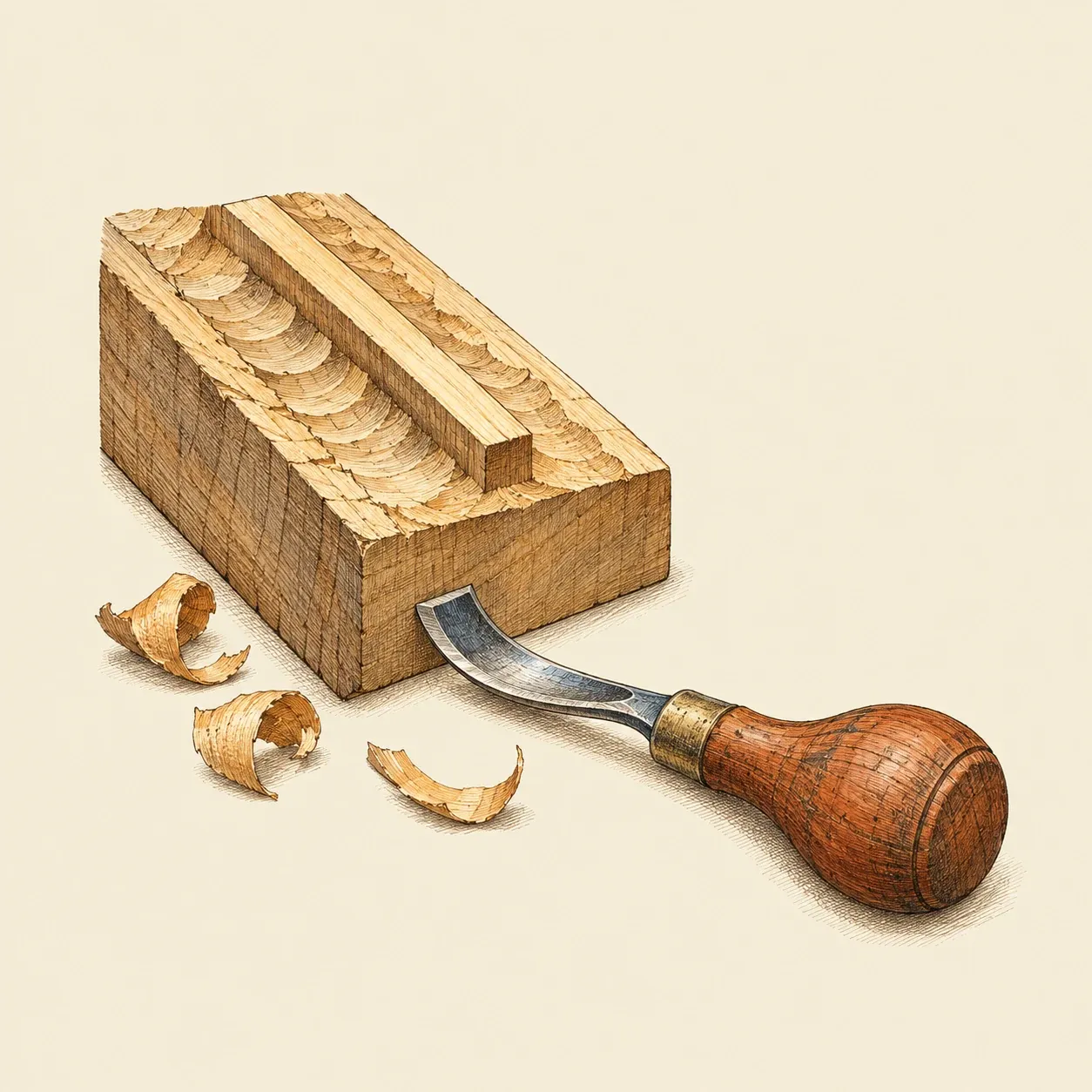 Removing the surrounding wood leaves one raised line on this practice block.
Draw the design while allowing for its eventual reversal. Cut around the areas that should print, keeping their tops level with one another. Rest the wood on a stable support and keep the holding hand out of the gouge’s path. Remove loose shavings before applying ink.
Brush an even film of ink onto the raised parts, then lower the sheet without sliding it. Rub across its back while supporting the whole block underneath. Lift the impression carefully and let it dry. Ink the block again before printing another sheet.
Compare the print with the block. Ink in blank areas can indicate that the surrounding wood has not been cleared sufficiently. Missing lines may come from uneven inking or incomplete contact. Identify the cause before cutting deeper across the whole design: removed wood cannot simply be put back.
History and evolution
Printing on cloth preceded printed texts on paper. Chinese woodblock impressions on paper survive from the seventh century; the University of New England’s museum describes a Buddhist text dated to 650–670. Seals and rubbings of inscriptions also belong to the earlier history of transferring marks.
The Diamond Sutra held by the British Library is dated 11 May 868. This roll is a complete dated printed book, preceded by older printed material. Buddhist texts and images made extensive use of reproduction from blocks.
In Japan, printing texts from blocks is attested in the eighth century. Later colour printing used several blocks with registration guides to align successive impressions. Woodblock printing continued after movable type appeared: a page stored in its block could be printed again without a new round of typesetting.