Writing ink
Colour carried onto a surface
Contents
- 1Wooden body of the palette
- 2Well containing black ink remains
- 3Red ink well, with almost no colour left
- 4Longitudinal brush compartment
Writing ink leaves colour on a surface. Carbon inks, plant dyes and iron gall inks produce different kinds of marks. In Egypt, vessels bearing ink inscriptions come from tomb U-j at Abydos, towards the end of the fourth millennium BCE. Invisible inks later served the needs of secret correspondence.
What it is
Writing ink is a coloured material applied to a surface to form signs. Carbon inks carry fine black particles in a binder. Inks coloured with plant dyes belong to a different family. The presence of plant-derived constituents does not put every ink in the same category: iron gall ink behaves differently on the writing surface.
An Egyptian scribe’s palette held ink and the tools used to apply it. A wooden example at the Metropolitan Museum of Art still has black ink remains, while its red ink has almost entirely disappeared. The museum describes Egyptian writing brushes as reeds with a frayed end that holds ink.
How it works
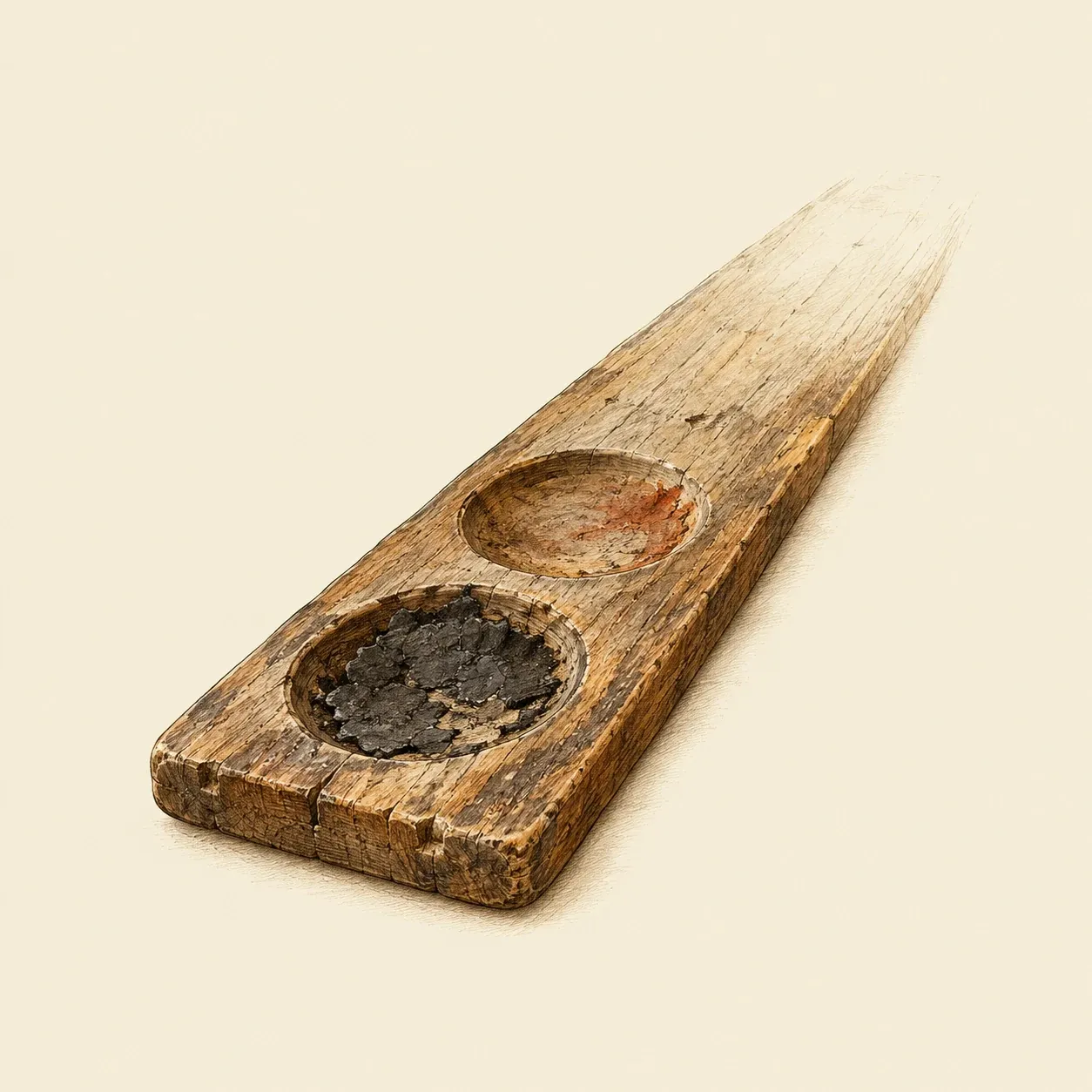 Black ink remains are still visible in one of the palette’s wells.
In carbon ink, dispersed particles carry the black colour and a binder holds them. The coloured material stays on the surface of the paper. Chemical stability does not necessarily protect it from rubbing or water: a mark can keep its black colour yet disappear when the layer bearing it comes away. Binder and colouring matter have separate jobs within that mark.
Plants also supply dyes for inks, textiles and paints. Calling an ink plant-based describes the source of its dye; it does not mean that it behaves like suspended carbon particles. This matters when comparing old objects. Similar colours alone cannot establish which ink family was used.
Iron gall ink penetrates and colours paper fibres, whereas carbon ink remains more on the surface. The durability of the written mark helps explain the historical appeal of permanent inks. Sometimes, though, the support deteriorates. Acidity and oxidation can weaken paper or parchment until material is lost along the strokes. Conserving a manuscript means attending to its ink as well as its pages.
Invisible inks conceal a message instead of making it immediately visible. They were used in secret correspondence during the American Revolutionary War, including intelligence sent to George Washington. Such a message carries both the words the sender wishes to communicate and the concealed fact that there is writing to be read at all.
How to do it
Carbon ink needs soot, gum arabic and water. Soot forms when a flame burns with too little air, and it settles as a black film on whatever the flame touches. The lamp-black recipe published by the Bodleian Libraries takes the soot of a linseed-oil lamp. The Ancient Inks Lab at Columbia University describes soot as a residue collected from a flame.
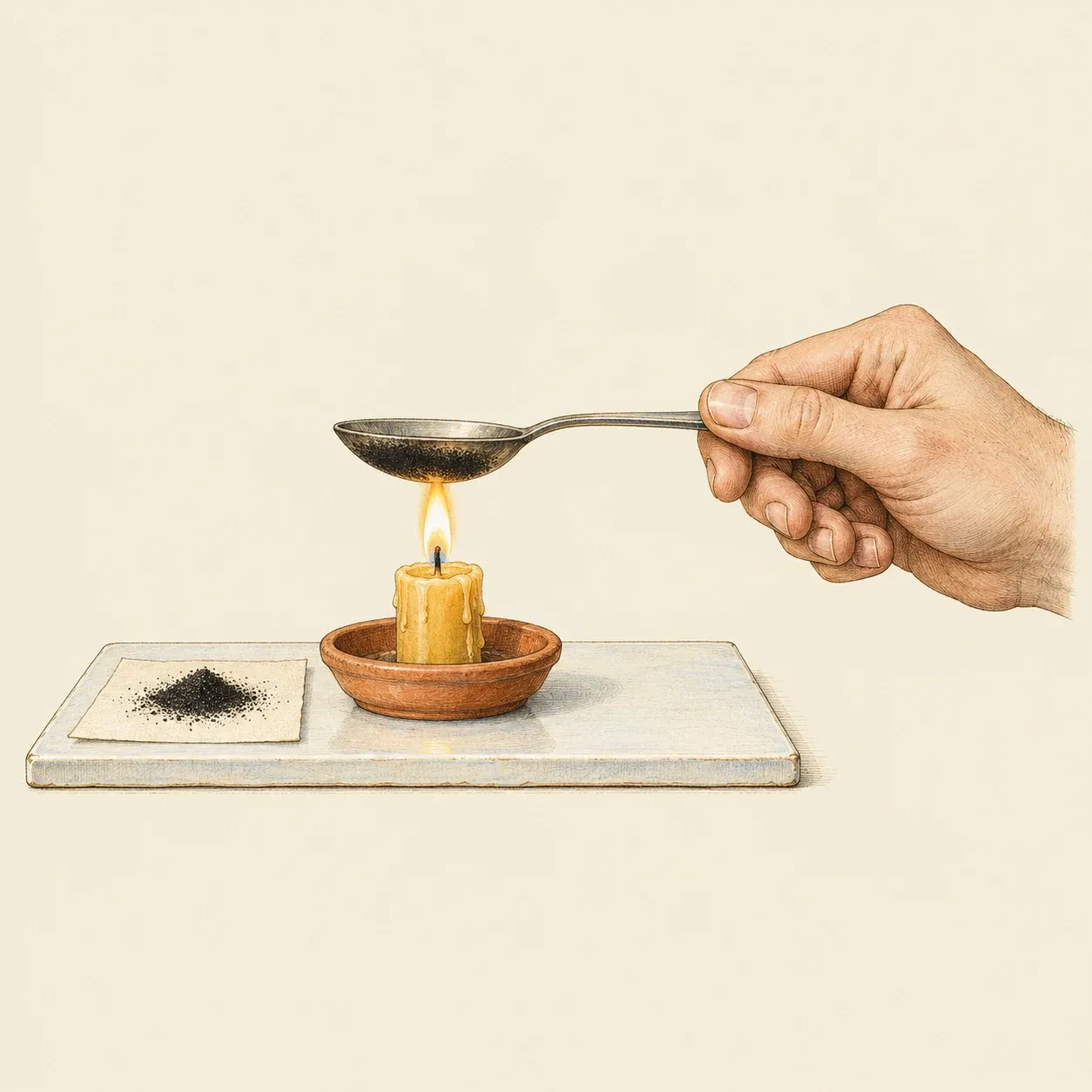 Held in the tip of the flame, the back of a spoon gathers a black film of soot.
Light a candle or a small oil lamp on a non-flammable surface. Hold a cold glazed tile or the back of a metal spoon in the tip of the flame until a black film forms, let it cool, then scrape the soot onto a sheet of paper. A candle gives very little at a time, so repeat until you have a small heap. Dissolve powdered gum arabic in water, stirring and waiting until no lumps remain. The Columbia lab uses one part gum to ten parts water by weight, then nine parts of this solution to one part soot. The Bodleian recipe uses 5 g of soot, 5 g of gum arabic and 30 ml of water.
Grind the soot into the gum solution on a smooth tile or in a small mortar until the black is even; the Bodleian recipe grinds for a full hour. Add water a drop at a time and test the ink on paper with a pointed reed or a brush. If the stroke is grainy, grind longer. If it spreads into the paper, add a little more gum solution.
Safety. An open flame burns skin and can set fire to hair, sleeves and paper. Use only soot, gum and water. Do not try historical recipes that heat acids or iron salts, or that call for lead or mercury pigments such as minium or cinnabar.
History and evolution
Tomb U-j at Abydos, excavated by the German Archaeological Institute, contained pottery vessels with ink inscriptions, along with sealings and small incised tags. The Institute for the Study of Ancient Cultures Museum dates the tomb to around 3320 BCE. Reporting on the same finds in 1999, Archaeology magazine said that the excavation director, Günter Dreyer, dated the tags and the ink-inscribed vessels to about 3200 BCE from their context and from radiocarbon results. Ink was thus among the means of inscription used in Egypt by the end of the fourth millennium BCE. The University of Copenhagen places Egyptian use of writing inks at least as early as 3200 BCE, with black for the main text and red to distinguish headings and important words.
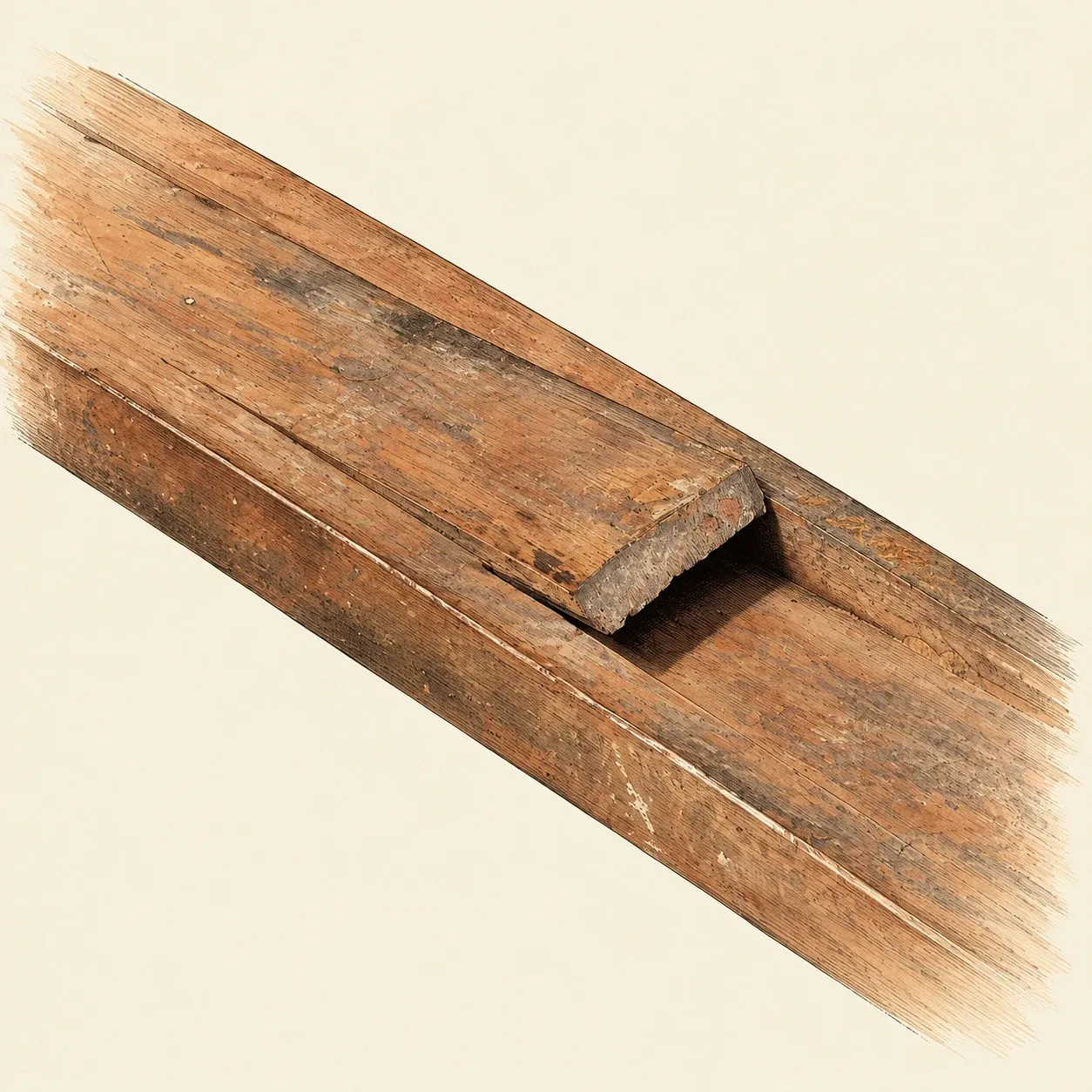 The palette combined ink wells with storage for brushes.
A much later palette, now at the Metropolitan Museum of Art and dated to around 2030–1550 BCE, preserves traces of those two colours. Its wooden body brings the ink wells and brush compartment together. According to the museum, the form of these palettes changed little between the Middle Kingdom and the New Kingdom.
Persian tradition distinguishes carbon inks, metal gall inks and mixed inks combining the two families. The American Philosophical Society describes the long use of iron gall ink from the fourth to the twentieth century, along with the difficulties it now presents to conservators. Plant dyes also remain a subject of study and display in botanical collections, including Cambridge University Botanic Garden.
Military correspondence from the American Revolutionary War records another purpose for ink: hiding the writing. The Clements Library documents invisible ink use by both British and American forces. A material that makes text readable could also help restrict its reading to an intended recipient.