Playing cards
A pack of suits and ranks with identical backs
Contents
- 1Woodblock cut in relief with two card figures
- 2Sheet printed with the black outlines
- 3Stencil cut out where the red goes
- 4Four pasted sheets that make one card
- 5Five of hearts
- 6King of hearts
A pack of playing cards is a set of stiff paper cards with identical backs, each face marked with a suit and a rank. The first certain record comes from China in 1294, when two gamblers were caught at Enzhou with paper cards and the blocks used to print them. Mamluk Egypt had packs of 52 cards in four suits, and cards reached Europe in the 1370s.
What it is
A pack of playing cards is a set of identical rectangles of stiff paper. Every back looks the same, and every face carries two pieces of information: a suit, shown by a repeated sign, and a rank, shown by the number of signs or by a figure. The usual pack today has 52 cards in four suits of thirteen: number cards from the ace to the ten, then a jack, a queen and a king. Many regional packs are shorter or use other signs, and tarot packs add a separate series of trumps.
The same pack serves a great many games. In some, players win tricks by playing the higher card of the suit that was led. In others, they bet on the value of a hidden hand, as in poker. In patience, one person plays alone against the order of the shuffled pack. Cards have also been used for fortune-telling, for teaching and as luxury objects that were never played with.
How it works
The backs do the main work. Because they are all alike, a card held face down gives nothing away, and each player sees a hand that the others cannot. Shuffling mixes the order, so the deal is a random draw, like a throw of dice, with one difference: a card dealt to one player can no longer reach another. A pack loses this property as soon as one card can be recognised from the back. A nick, a stain or a bent corner is enough, which is why cheats marked cards and why players throw out worn packs.
Suits split the pack into equal families, and ranks put the cards of each family in order. Games are built on that double structure: follow suit, beat the higher rank, collect cards of the same rank or runs in one suit. The court cards usually rank above the number cards, though many games change the order or make one suit trumps over the others.
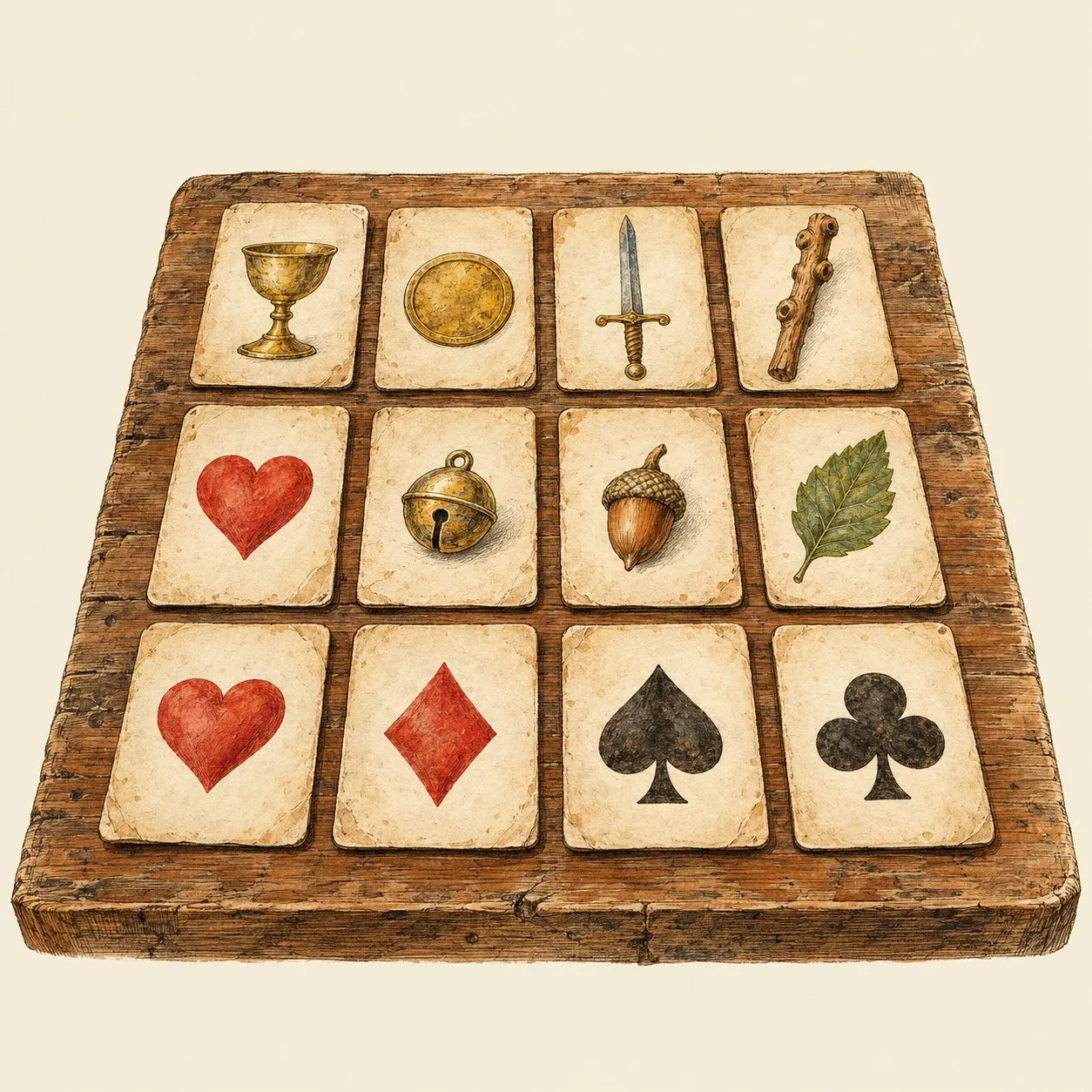 Latin, German and French suit signs, from top to bottom.
Three families of suit signs are still in use. The Latin suits, cups, coins, swords and batons, survive in Italy and Spain and are the closest to the suits of the Mamluk pack. German packs use hearts, bells, acorns and leaves. The French suits, hearts, diamonds, spades and clubs, need only two colours, red and black, which saved work in the colouring.
A card has to be stiff, flat and smooth. In sixteenth-century Lyon, card makers cut the figures in relief on a wooden block, several cards to a block, and printed the outlines in black on a sheet of paper. Each card was made of four sheets pasted together: the printed face, two inner sheets that stiffened it and a sheet for the back. The colours were brushed on by hand through stencils, one stencil for each colour. The sheets were then cut into cards, and the faces were rubbed with soap and polished on a marble slab so that the cards would slide easily in the hand.
How to do it
A small pack of twenty cards, the ace, king, queen, jack and ten of each suit, is enough for several old games, including the earliest form of poker. You need thin white card, all from the same packet so that the backs match, a pencil, a steel ruler, a craft knife with a fresh blade, a cutting mat, red and black water-based paint, a short stiff brush or a small sponge, and a sheet of acetate or thin card for the stencils.
Cut one card first and use it as the template for all the others, drawing round it instead of measuring each card. Cut on the mat, along the steel ruler, with several light strokes rather than one hard one. Safety: a craft knife cuts skin as easily as card. Keep the fingers that hold the ruler well back from its edge, cut away from your body, retract or cover the blade each time you put the knife down, and change a dull blade, as it slips more than a sharp one. Children should cut only with an adult beside them.
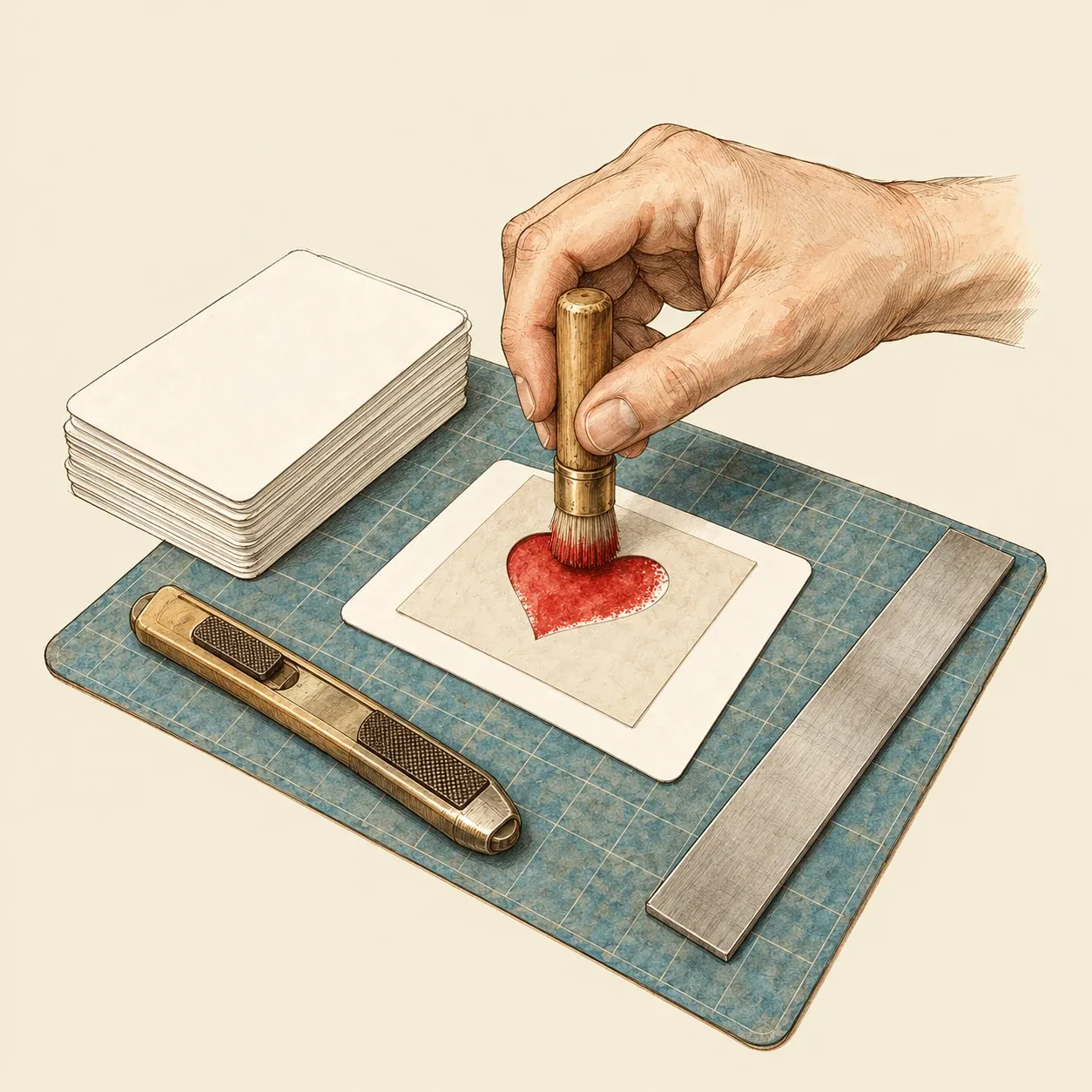 A nearly dry brush dabbed straight down keeps the edge of the sign sharp.
Draw a heart, a diamond, a spade and a club on the stencil sheet and cut out each sign. Lay the stencil on a card, take up very little paint and dab straight down through the opening; a wet brush pushes paint under the edge and blurs the sign. Hearts and diamonds go in red, spades and clubs in black. Repeat the same arrangement of signs on every card of the same rank, so that a ten of clubs looks like a ten of hearts in another colour. Draw the king, queen and jack by hand, with the suit sign beside each figure.
Leave the backs plain, or give them all the same pattern. When the paint is dry, lay the pack face down and look for any card that can be recognised by its back, its size or a mark on its edge, and remake it.
History and evolution
Writers of the Tang dynasty mention a “leaf game”, and a later history of the Liao dynasty says that the emperor Muzong played it with his ministers on the eve of the lunar New Year in 969. Whether it was a card game is disputed. In the eleventh century the scholar Ouyang Xiu wrote that nobody still knew how to play it and explained the leaves as the pages of a book of dice rules; the historian Andrew Lo concludes that it was probably a board game. The first certain record dates from 17 July 1294, when two men were caught gambling with paper cards at Enzhou, in present-day Shandong. Nine cards and the wooden blocks used to print them were seized. Chinese cards were narrow strips, and the money-suited packs of later centuries are not firmly attested before the late sixteenth or early seventeenth century.
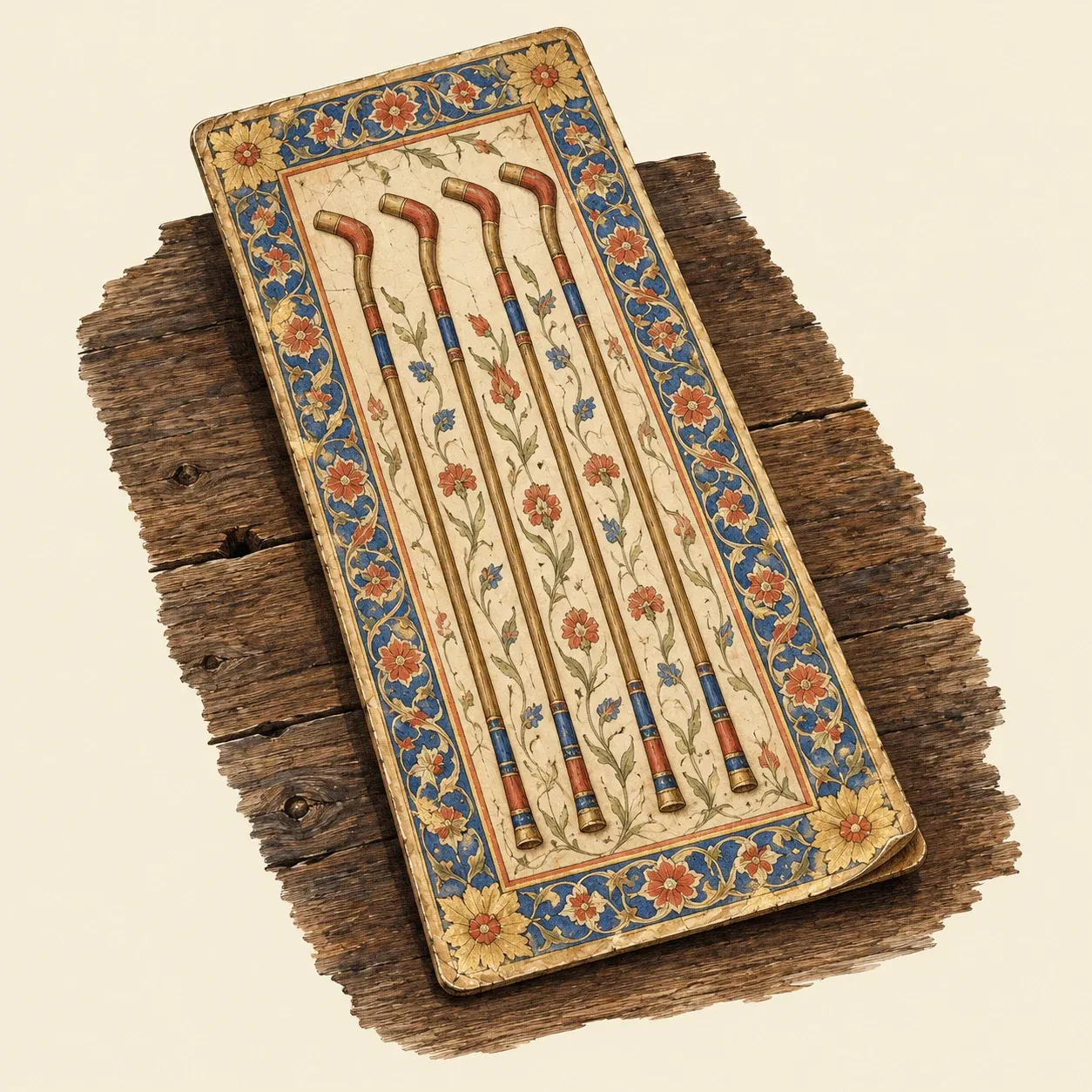 Polo sticks, one of the four suits of the Mamluk pack, beside cups, coins and swords.
In Mamluk Egypt, cards were painted in ink and colours on paper. Fragments from the thirteenth or fourteenth century are the oldest cards to survive from the Islamic world. A hand-painted pack of the fifteenth or early sixteenth century, identified in the Topkapı Palace in Istanbul by the scholar Leo Mayer, keeps 47 of its 52 cards. Its four suits are cups, coins, swords and polo sticks, each with ten number cards and three court cards. The court cards show no human figure: an inscription names the king and his two deputies.
Cards appear in Europe in the 1370s, first in Mediterranean trading towns. The Catalan word naip, “playing card”, is recorded in 1371 in a rhyming dictionary by Jaume March. In 1377 the authorities of Florence and Siena took measures against the new game. In the same year John of Rheinfelden, a Dominican friar of the Upper Rhine, wrote a treatise that uses the game as a picture of society; it is the oldest known European description of cards, and it already describes packs with four, five or six suits. The word passed into Spanish as naipe. One proposal derives it from the Arabic nā’ib, “deputy”, the title of the Mamluk court cards; the etymologist Joan Coromines found the Arabic derivations put forward unconvincing and judged its origin uncertain.
The first European cards were painted by hand. The Este court at Ferrara paid a painter to restore four packs in 1422 and bought a press for printing cards in 1436. Cheaper packs came from woodblocks: in Ulm, Augsburg and Lyon, card makers cut several figures on one block, printed whole sheets, coloured them through stencils and cut them apart. The first card maker known in Lyon, James Duboys, is recorded in 1444, and woodcut spread further there after 1482 with the first illustrated books from the printing press. A sheet of the 1490s in the Victoria and Albert Museum, probably from Lyon and probably cut by Gilles Savouré, repeats the knaves of hearts and diamonds in stencilled colours. The French suits had appeared around 1480, while German makers kept hearts, bells, acorns and leaves.
Luxury packs were still painted. The Cloisters pack in the Metropolitan Museum, made in the southern Netherlands around 1470–1480, is the only complete set of illuminated ordinary cards known from the fifteenth century. Its 52 cards take their suits from the hunt, with horns, dog collars, hound leashes and game nooses, and each suit has a king, a queen, a knave and ten number cards.