Gaming dice
Marked faces for a draw left to chance
Contents
- 1Sheep knucklebone (astragalus)
- 2Tetrahedral die from Ur with two inlaid corners
- 3Long stick die numbered one to four
- 4Cubic die with opposite faces adding up to seven
- 5Pip drilled as a shallow hollow
- 6Centre of mass at the middle of the cube
Dice are objects with marked faces, thrown so that chance picks the result. A fair cubic die gives every face the same chance because its six faces are alike and its weight sits at the centre. Cubic dice appear in the third millennium BCE: a fired clay die from Tepe Gawra, in northern Iraq, dates to 2800–2500 BCE. Casting sticks marked on one face, the main means of drawing chance in Egypt from the Predynastic period, are older.
What it is
A die is a small object shaped to be thrown, with marked faces, that lets chance decide: how far a piece moves on a board, who takes a stake, or which answer a diviner reads. The familiar form is a cube carrying one to six dots, called pips. Other dice are tetrahedra with four triangular faces, or long sticks with four numbered sides. Knucklebones, the ankle bones of sheep and goats, casting sticks and flat pieces marked on one face only were thrown for the same purpose, and in Egypt casting sticks were in use before any known die.
Each shape gives its own set of outcomes. A cube gives six. A knucklebone can come to rest on any of four long sides, and they do not come up equally often. A casting stick or a flat piece marked on one face behaves like a coin, so players threw several together and counted the marked faces.
How it works
A die tumbles and bounces before it settles, and the thrower cannot choose or foresee the face that ends on top. Whether every face has the same chance depends on the die itself. A cube with six faces of the same size, and with its weight spread evenly so that its centre of mass lies at its centre, has no reason to favour any face. Each then comes up once in six throws on average.
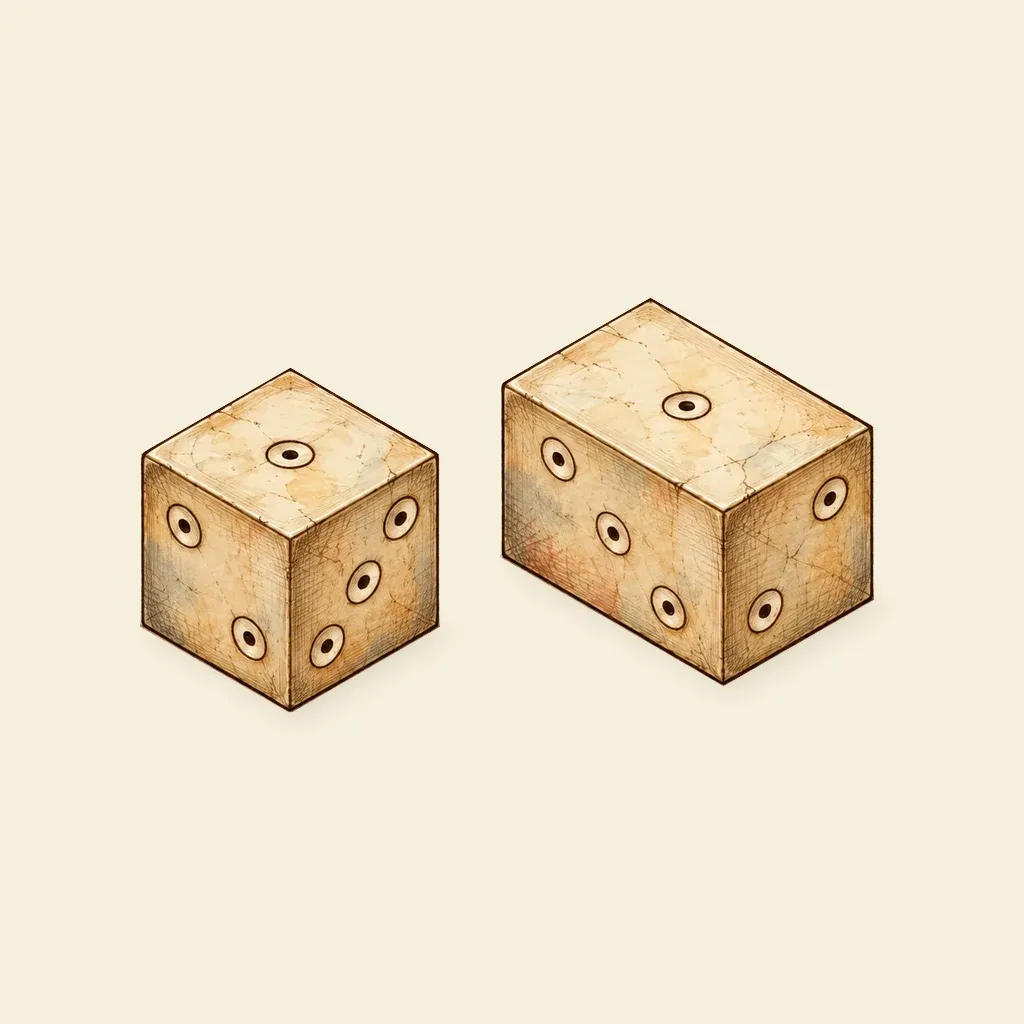 Many ancient dice were slightly brick-shaped.
Ancient dice were rarely so regular. Most were slightly brick-shaped, some with one side up to half as long again as another, and such a die settles more often on its larger faces. Of 28 Roman dice from the Netherlands studied by the archaeologists Jelmer Eerkens and Alex de Voogt, 24 were visibly lopsided, and the 1 and the 6 often sat on the two largest faces.
Pips matter too. When they are hollowed out, the face with six loses more material than the face with one opposite it and becomes slightly lighter. In 1894 the biologist Walter Weldon reported 26,306 throws of twelve dice with more fives and sixes than chance would explain, and Karl Pearson used these figures in 1900 to present his goodness-of-fit test. In 2009 Zacariah Labby repeated the experiment with a throwing machine and ordinary dice, and found no such excess.
Older dice follow the same rule with fewer faces. Greek and Roman players gave the four long sides of a knucklebone the values 1, 3, 4 and 6, with 1 opposite 6 and 3 opposite 4, and threw four bones at a time; the best throw, called Venus, showed four different sides. The tetrahedral dice of Ur always land on a face with one corner pointing up. Two of the four corners carry an inlaid dot, so each die scores with two chances out of four.
Many games are built on these chances. In the scoring game played to 1,000, 5,000 or 10,000 points, called Farkle in English, each player throws six dice, or five in some versions. A 1 scores 100 points, a 5 scores 50 and three of a kind a hundred times the face shown, with a special value for three 1s. The player sets aside the scoring dice and then either banks the points of the turn or throws the remaining dice again. A throw that scores nothing wipes out the whole turn, so each extra throw puts at risk what the turn has already earned.
How to do it
A fair die can be made from a strip of hardwood with hand tools, a try square and callipers. Choose a dense, close-grained wood without knots, such as maple, beech or boxwood, and let it dry well so that it does not shrink unevenly later.
Plane a strip about 2 centimetres square. Check with the try square that neighbouring faces meet at right angles, and with the callipers that the width is the same in both directions along the whole strip. Saw off a piece a little longer than it is wide, then rub the two sawn ends on abrasive paper glued to a flat board until the length matches the other two sides. Measure the three dimensions again at several points, since a die that is wider one way favours two of its faces. Round all twelve edges with the same few strokes of fine paper so that no corner is sharper than the others.
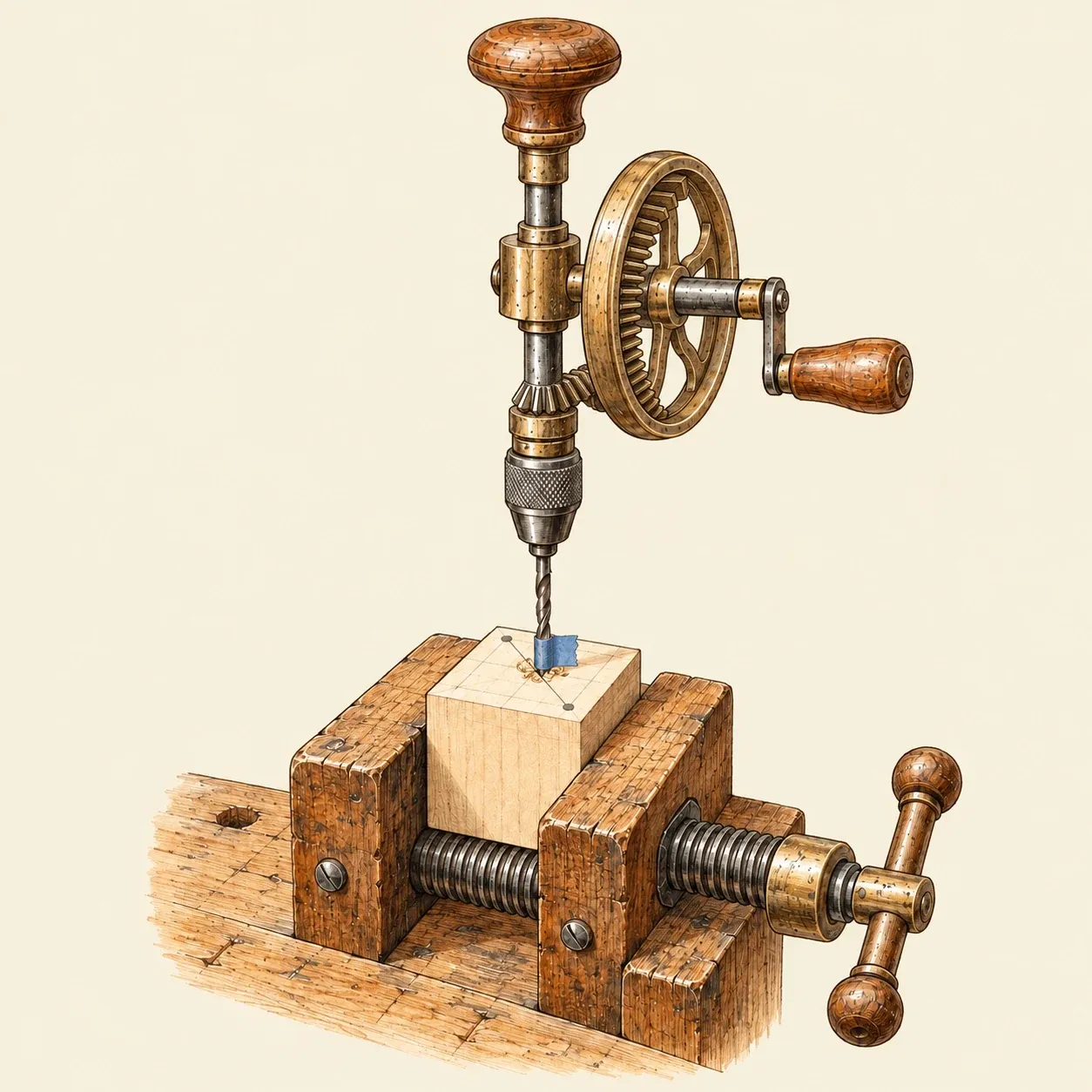 A flag of tape on the bit stops every hollow at the same shallow depth.
Draw a light grid on each face and mark the pips: one in the centre, two and three on a diagonal, four at the corners, five at the corners and in the centre, six in two rows of three. Place them so that opposite faces add up to seven, with 1 opposite 6, 2 opposite 5 and 3 opposite 4. Hold the cube in a small vice and drill each pip with the same small bit, with a flag of tape wrapped round it as a depth stop, so that the hollows are shallow and alike. A drop of paint in each hollow makes the pips easy to read and puts back a little of the weight removed.
Test the die by throwing it a few hundred times into a tray lined with felt and tallying each face. A fair die gives roughly equal counts, and the chi-square test introduced by Karl Pearson shows whether the differences are larger than chance would explain. For each face, square the difference between its count and the expected count, which is the number of throws divided by six, divide by the expected count, and add up the six results. For a six-sided die the critical value at the usual 5% level is 11.07: a larger total means that a fair die would give counts so uneven less than once in twenty tests. In that case, look for a fault in the shape or the drilling before making the next one.
History and evolution
The Greek historian Herodotus wrote that the Lydians claimed to have invented dice, knucklebones and ball games during a famine of eighteen years, playing all day on one day and eating on the next. Sheep and goat ankle bones turn up in many prehistoric sites, but it is rarely possible to tell whether they were thrown in games. In 2026 Robert Madden argued in the journal American Antiquity that small flat bone pieces from Folsom sites in the western United States, more than 12,000 years old, were two-sided dice like those of later Native American games. Jelmer Eerkens replied that, without their find context, such objects could be dice but need not be. In Egypt, according to Anne-Elizabeth Dunn-Vaturi of the Metropolitan Museum of Art, casting sticks were the main means of drawing chance from the Predynastic period, about 4400–3100 BCE.
Cubic dice appear in the third millennium BCE. The Penn Museum dates a fired clay die about 2 centimetres across, from Tepe Gawra in northern Iraq, to 2800–2500 BCE. Terracotta dice also come from the Indus cities of Harappa and Mohenjo-daro, between about 2500 and 1900 BCE, and those described by the excavator John Marshall at Mohenjo-daro put 1 opposite 2, 3 opposite 4 and 5 opposite 6. The Assyriologist William Hallo placed the earliest dice in the second half of the third millennium, in the Indus Valley and in Mesopotamia. Dunn-Vaturi thinks cubic dice most likely began in the Indus Valley.
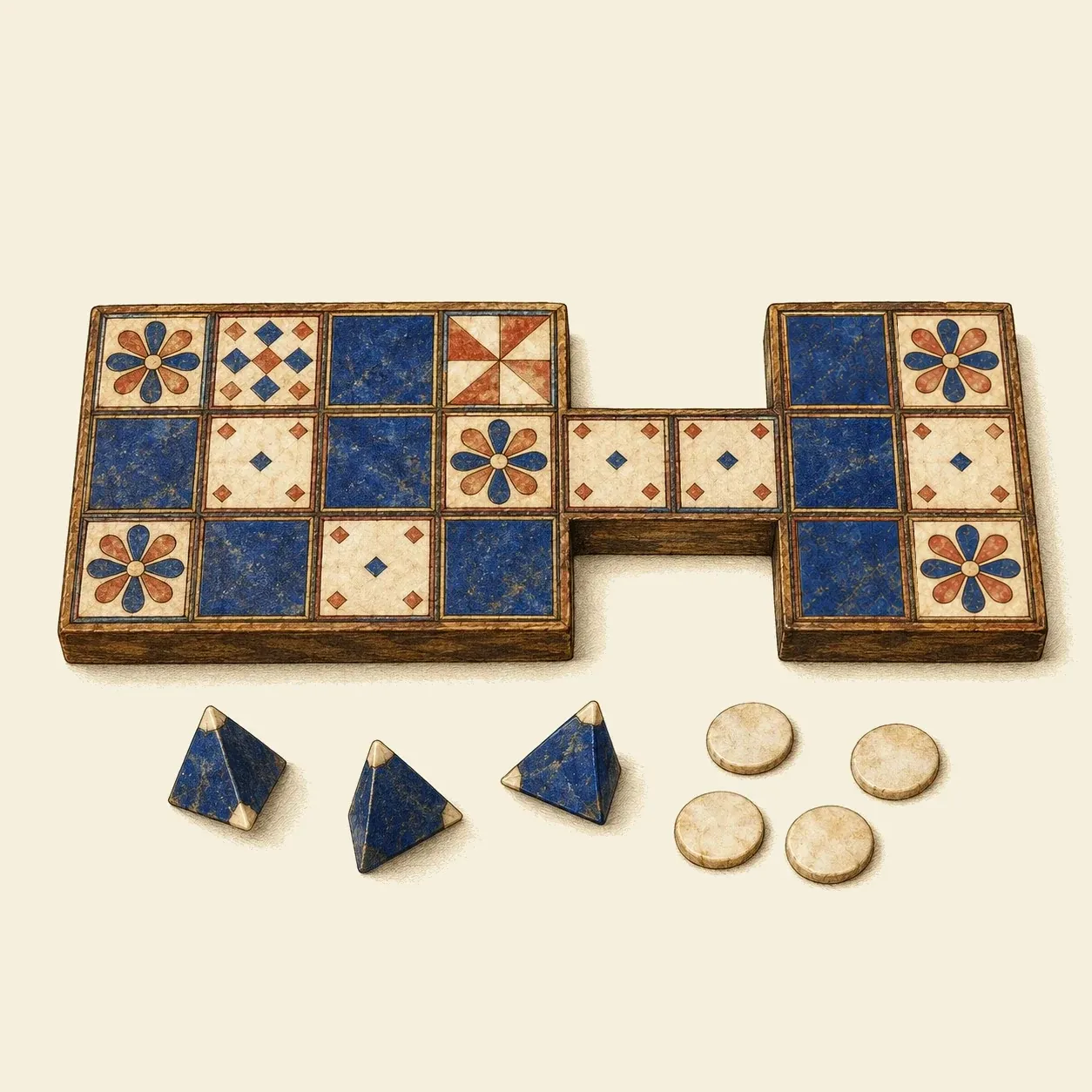 A board of twenty squares from Ur with its four-cornered dice.
In the Royal Cemetery at Ur, in southern Iraq, Leonard Woolley found gaming boards of twenty squares made between 2600 and 2400 BCE. Their dice were tetrahedra of stone or lapis lazuli with two inlaid corners, and Woolley also found ten long stick dice numbered one to four. Irving Finkel of the British Museum notes that tetrahedral dice of this kind do not reappear in later Mesopotamian sites. In Egypt, ivory throw sticks were cast like dice for senet and the game of twenty squares, and knucklebones are better attested from the Seventeenth Dynasty onwards.
Greek and Roman players threw knucklebones, real or copied in ivory, bronze and glass, and cubic dice of bone, metal and clay. In the sixteenth century the Italian physician Girolamo Cardano wrote a book on games of chance, the Liber de ludo aleae, which worked out the odds of throws with dice. It was published only in 1663.