Poker
Betting on a hidden hand of five cards
Contents
- 1Stock: the undealt cards, face down
- 2Pot of counters
- 3An opponent's hand, face down
- 4Discards
- 5Full house: three kings and two fives
- 6Flush: five hearts not in sequence
Poker is a family of card games in which each player bets on a hand of five cards that the others cannot see. Hands are compared by a fixed ranking based on rarity, and a player can win without showing a card if everyone else folds. The oldest eyewitness account describes a game on a Mississippi steamboat in December 1829, played with only twenty cards.
What it is
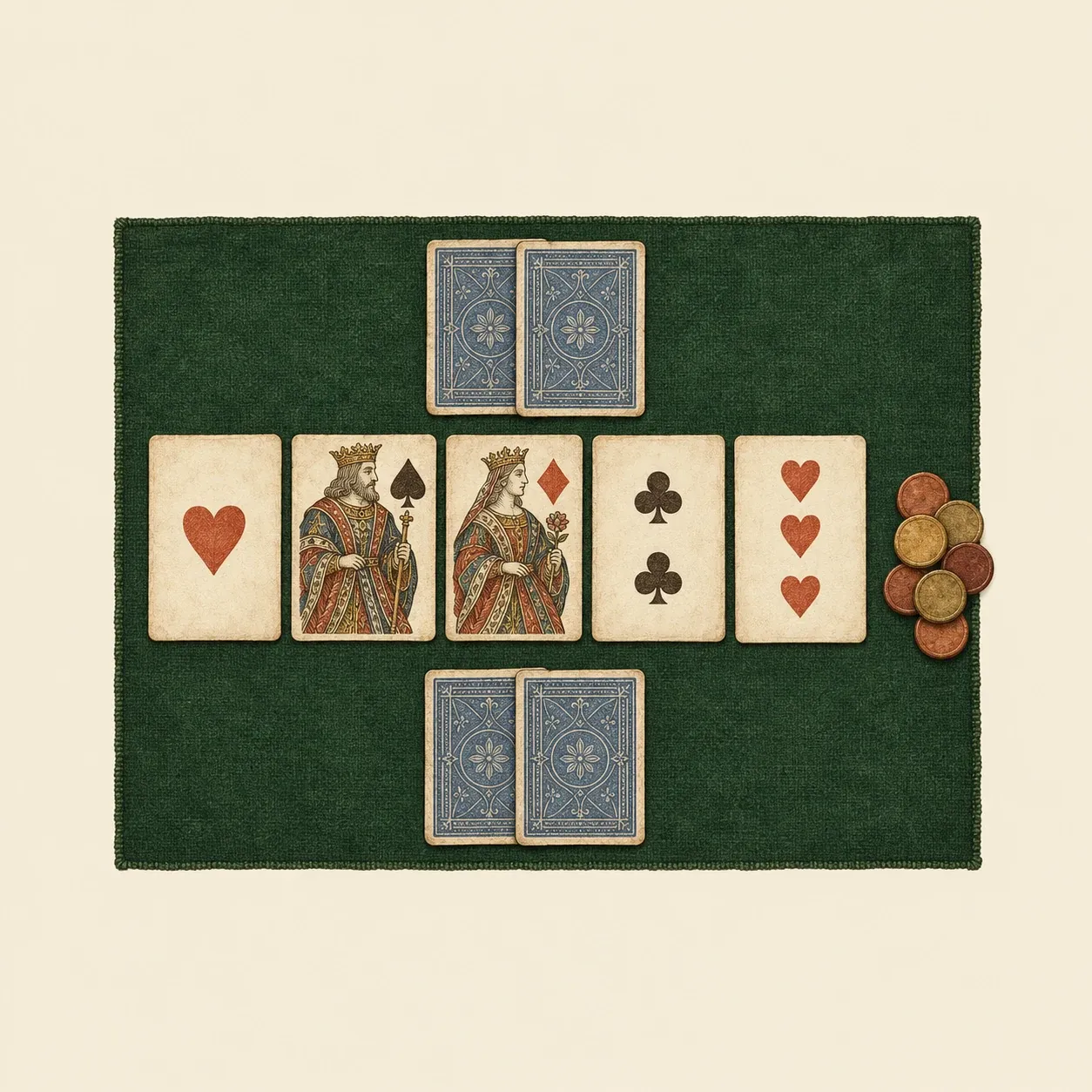 In community-card games such as Texas hold’em, players combine their own cards with cards laid face up in the middle and shared by all.
Poker is a family of card games played with an ordinary pack of playing cards. Each player holds a hand that the others cannot see and bets on it. Hands are compared by a fixed ranking, from the straight flush down to a single high card, and the counters or money staked in the centre, the pot, go to the best hand still in play when the betting ends. A player who will not match a bet drops out and loses what he has already put in. A hand can therefore be won without being shown: if everyone else gives up, the last player takes the pot.
The forms of poker differ in how each player gets his cards. In draw poker, everyone receives five cards face down and may exchange some of them once. In stud, part of each hand is dealt face up, so the others can see some of it. In community-card games such as Texas hold’em, players combine a few cards of their own with cards laid face up in the middle of the table and shared by all. All of them share the ranking of hands and the basic betting actions.
How it works
The ranking follows rarity. Of the 2,598,960 different five-card hands that can be dealt from a pack of 52, only 40 are straight flushes, five cards in sequence in one suit, and 624 are four of a kind. Then come the full house, three of one rank with two of another (3,744 hands), the flush, five cards of one suit (5,108), and the straight, five cards in sequence of mixed suits (10,200). Below these are three of a kind, two pairs and one pair. About half of all hands, 1,302,540, hold no combination at all and are ranked by their highest card. Two hands of the same type are compared by the ranks of their cards, so three kings beat three queens.
Betting turns the ranking into a contest of judgement. Each hand starts with forced stakes, so that there is always something to win. In draw poker each player usually puts in a small amount before the deal, the ante; in hold’em the two players to the dealer’s left post forced bets instead, the small blind and the big blind. When betting begins, each player in turn may bet, call by matching the highest bet so far, raise by matching it and adding more, or fold by throwing in the hand. A round ends when everyone still in has staked the same amount. If two or more players remain after the last round, they show their hands, and the best one takes the pot.
Because the cards are hidden, a bet also carries a message. A large bet may come from a strong hand, or it may be a bluff, made in the hope that the others will fold rather than pay to see the cards. Players watch how the others bet, how many cards they exchange and how they behave, and try to give nothing away themselves. Over many hands, the better player is the one who judges more accurately the chance of improving a hand and the likely strength of the others. In a single hand, the luck of the deal often decides.
How to do it
For a first game of five-card draw you need a standard pack of 52 cards, two to six players, and counters with no money value, such as dried beans or buttons, twenty for each player. Agree before you start that the counters are worth nothing and will be shared out again at the end. The game needs no table equipment beyond a flat surface large enough for each player to keep a hand out of sight of the others.
Each player puts one counter in the middle as the ante. The dealer shuffles, offers the pack to the player on the right to cut, and deals five cards face down to each player, one at a time, starting on the left. Players look at their own cards without showing them. In the first betting round, starting on the dealer’s left, each player may check, which means passing without betting and is allowed only while nobody has bet, or bet, call, raise or fold. Agree a limit: each bet or raise is one or two counters, with at most three raises in a betting round. Nobody can then put more than 17 counters into a hand, so nobody is knocked out in the first one. As a house rule for later hands, a player who has too few counters to call may put in all he has left and stay in; he can then win from each other player only as much as he has staked himself, and any larger bets are settled among the others.
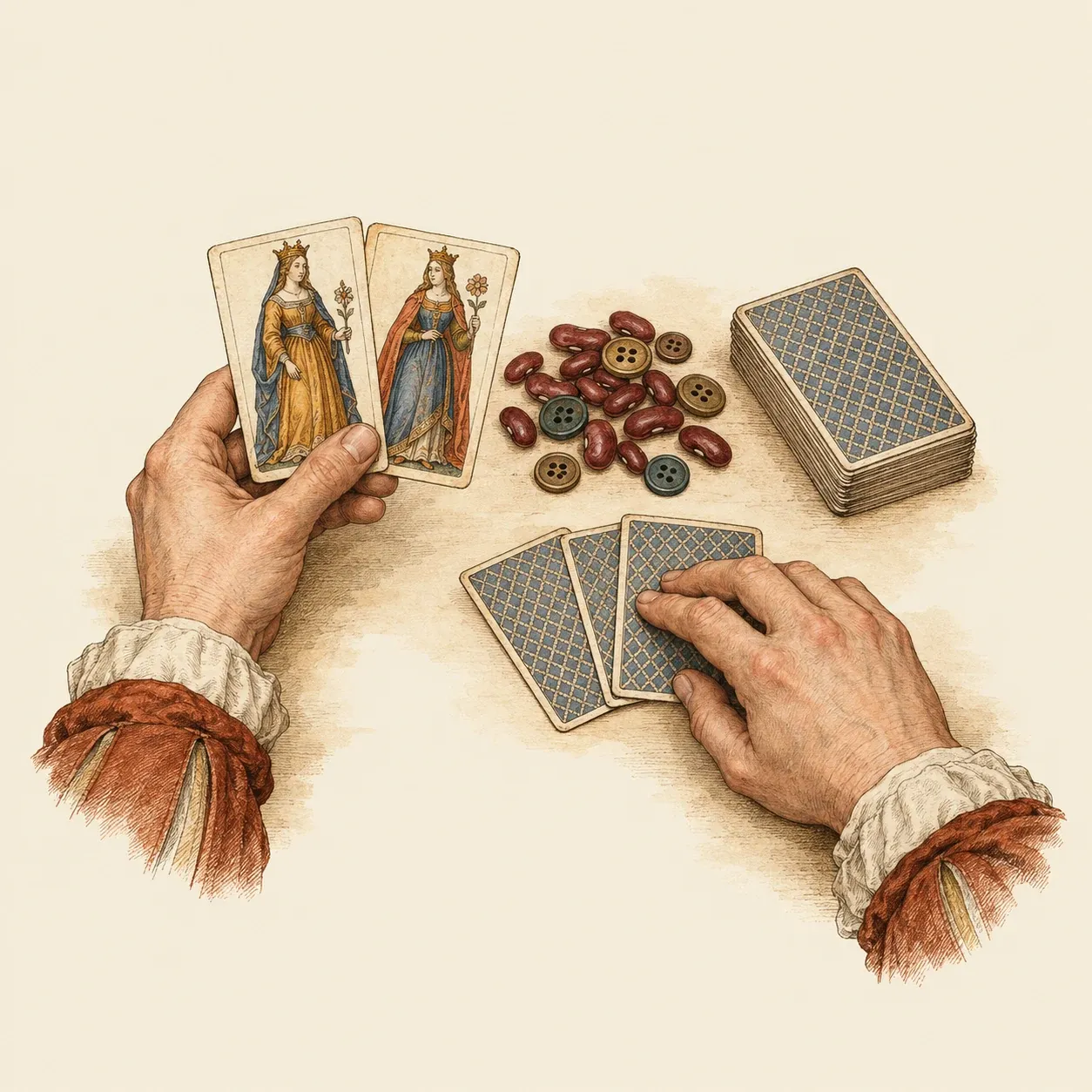 Keeping a pair and exchanging the other three cards.
Each player still in then discards up to three cards face down and receives the same number from the top of the stock, again starting on the dealer’s left. A player holding a pair usually keeps it and exchanges the other three. A second betting round follows in the same way. Those still in at the end turn their hands face up, and the best hand by the ranking takes the pot. If two hands are exactly equal, they share it. The deal then passes to the left, and the next player shuffles.
Played for money, poker is gambling. Gambling is regulated by law, often with a minimum age, and it can turn into an addiction that damages money, health and family life. Betting more than you can afford, chasing losses and borrowing to play are warning signs. Keep the counters worthless.
History and evolution
Poker grew up in the lower Mississippi valley in the early nineteenth century, among the gamblers of New Orleans and of the river steamboats. It resembles older games in which players bet on their cards and bluff, the French poque, the German Pochen and the English brag, and the actor Joseph Cowell, writing in 1844, called it a game founded on brag. A Persian game, as nas, is sometimes named as its ancestor, but it was first described only in the 1890s.
Cowell gives the oldest eyewitness account. In December 1829 he travelled from Louisville to New Orleans on the steamboat Helen M’Gregor and watched four men play with only the aces, kings, queens, jacks and tens, twenty cards, all dealt out at five to each player. There was no exchange, four aces could not be beaten, and the bets rose from an ante of one dollar to a thousand dollars; a cheat had stacked the pack while the passengers were distracted. A dragoon’s memoir published in 1836 notes that an officer lost several hundred dollars at poker, which a footnote calls a favourite card game in the South and West.
In the 1840s the reformed card cheat Jonathan Green warned that the small number of cards, twenty, made it easy to stack the pack, and he also described “full deck poker” played with all fifty-two. The full pack let more people play and brought the flush into the ranking. The draw, an exchange of cards between two rounds of betting, followed around 1850, according to the games historian David Parlett.
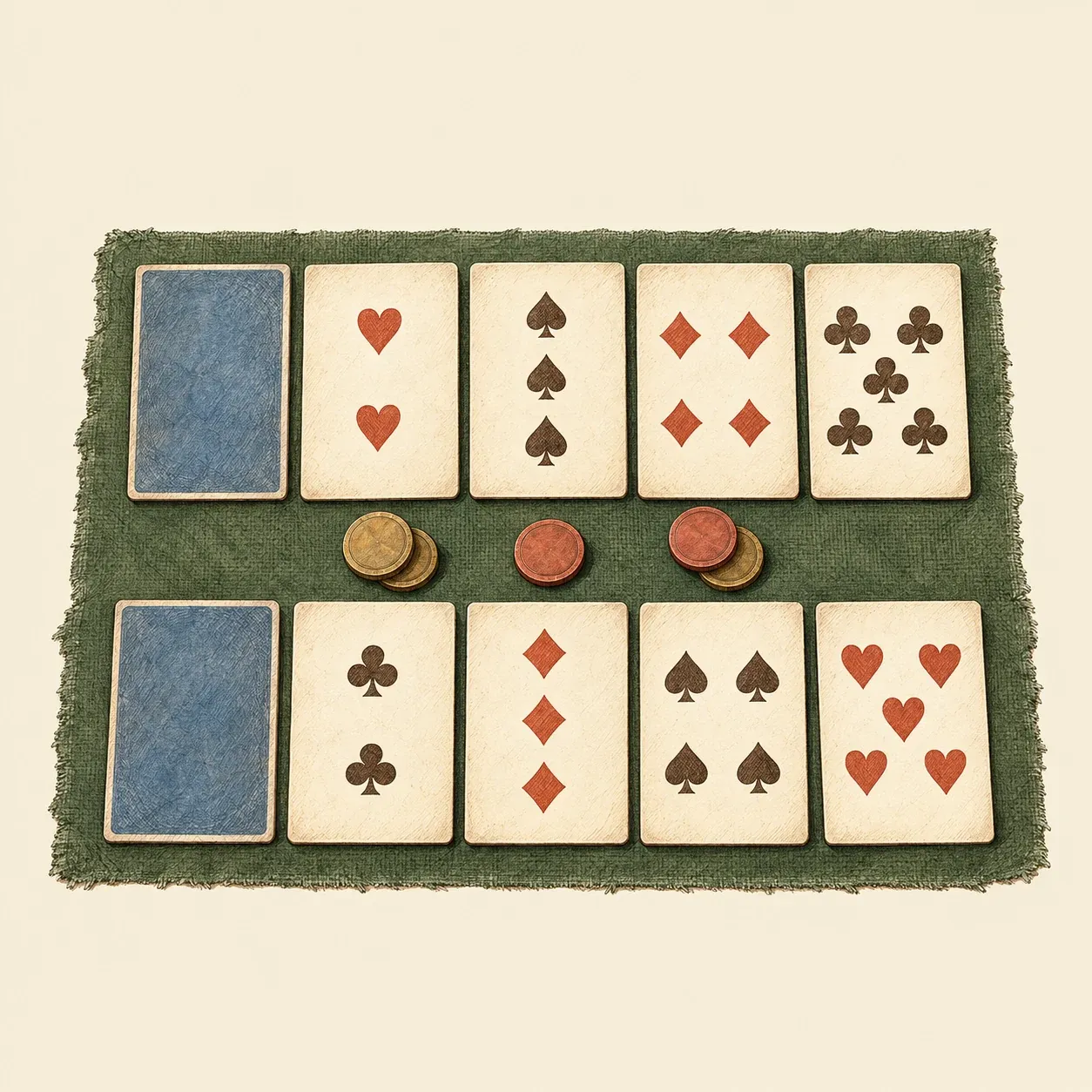 Stud: the first card stays hidden and the others are dealt face up.
According to Parlett, The American Hoyle, a New York book of games first published in 1864, already described stud. Its fourth edition of 1867 added laws for draw poker and describes stud as five cards dealt one at a time, the first face down and the rest face up, so that each player sees most of the other hands. The same edition says that straights are played only in some places and must be agreed on before the game, and that in some circles a straight flush outranks four of a kind.
Hold’em, the best-known community-card game, is said by Texas tradition to have been first dealt in Robstown in the early 1900s, and the Texas Legislature recognised the town as its birthplace in 2007. Players brought the game to Las Vegas, where the Golden Nugget casino first offered it in 1967. From 1970 the casino owner Benny Binion held an annual World Series of Poker at his Horseshoe casino in Las Vegas, and its time-limited format later allowed the tournament to be shown on television.