Staff notation
Pitch and duration written on lines
Contents
- 1The five lines of the staff
- 2Clef naming one line
- 3Notes on a line and in the next space
- 4Note shapes of different lengths
- 5Rest
- 6Custos showing the first note of the next staff
Staff notation writes music on a set of parallel lines. The height of a note on a line or in a space gives its pitch, a clef at the start names one line, and the shape of the note gives its length. The oldest staff, one line for each step of the scale, is in the Musica enchiriadis, a treatise of the late ninth century, and Guido of Arezzo brought lines and clefs into chant books in the early eleventh century.
What it is
Staff notation writes music on a staff, a set of horizontal lines, today five. Each line and each space between two lines stands for one step of the scale, so a note written higher stands for a higher sound. A sign at the start of the staff, the clef, gives the name of one line, and the names of the others follow from it. The shape of each note tells how long it lasts, and other signs, the rests, mark the silences.
The staff is read from left to right. Notes written one above the other on the same staff sound together, and the parts of a piece for several voices can be written on separate staves. A melody set down this way can be sung by someone who has never heard it. Neumes, the older signs written above the words of chant, showed the rise and fall of the voice without fixing its intervals.
How it works
The lines and spaces form a ladder. On a five-line staff, a note on the bottom line, a note in the space above it and a note on the next line up are three neighbouring notes of the scale. The clef fixes where the ladder sits. The G clef curls round the second line from the bottom and makes it the G above middle C. The F clef places its two dots on either side of the fourth line, which becomes the F below middle C. Notes too high or too low for the staff are written on short ledger lines added above or below it. A sharp written before a note raises it by a semitone and a flat lowers it by a semitone.
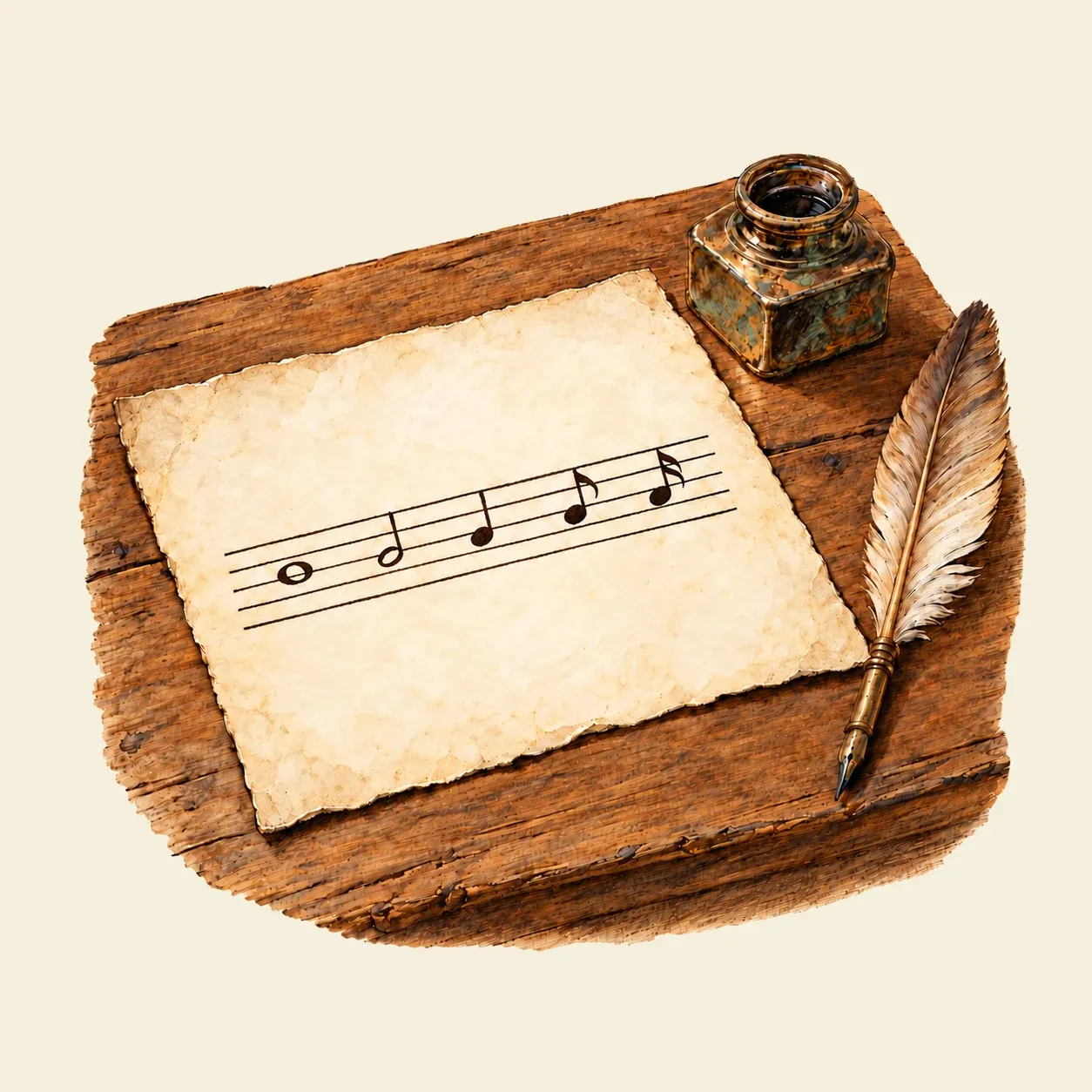 Whole note, half note, quarter note, then one flag and two: each shape lasts half as long as the one before.
Length is written in the shape of the note. In modern notation a whole note is an open oval, a half note adds a stem to it, and a quarter note has a filled head and a stem. Each flag added to the stem halves the length again. A dot after a note makes it half as long again, and every length has a rest that lasts as long. Bar lines divide the music into bars holding the same number of beats, set by the time signature at the start.
Older music used other shapes. In mensural notation, used from the thirteenth to the sixteenth century, the main notes were the long, a square with a tail, the breve, a square, and the semibreve, a lozenge. In the system of Franco of Cologne, each of these was normally worth three of the next shorter note. Many manuscripts end each staff with a small sign, the custos, placed at the height of the first note of the next staff so that the singer can find it after the line break.
How to do it
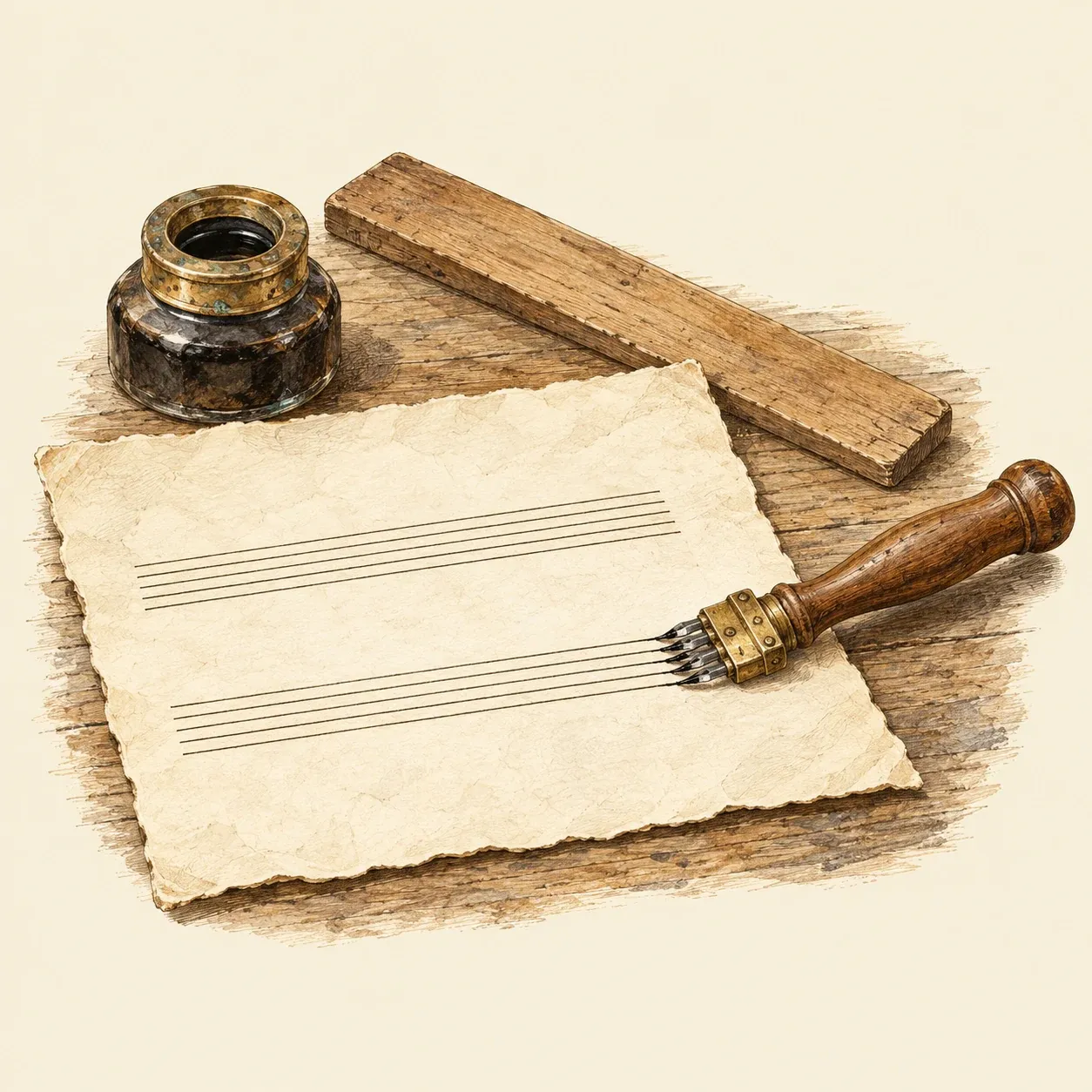 A rastrum, a pen with five nibs, rules the five lines of a staff in a single stroke.
Rule a staff on plain paper with a ruler and a sharp pencil: five parallel lines, evenly spaced, with room for a note head between two lines and a wide gap before the next staff. A rastrum, a pen with five nibs, draws all five at once. Tools of this kind are mentioned for ruling music from the sixteenth century, and the oldest that survive date from the eighteenth.
Choose a short tune you know well and an instrument that gives clear, fixed notes, such as a keyboard or a recorder. Draw a G clef at the start of the staff. Find the first note of the tune on the instrument and write it on its line or space, then go on note by note, counting how many steps each one rises or falls. Write the notes outside the staff on ledger lines.
Then add the lengths. Tap the beat while you sing, write a note lasting one beat as a quarter note, two beats as a half note and half a beat as an eighth note, and add a bar line each time the tune’s pattern of strong beats starts again. At the start, write the time signature as two numbers, one above the other: the number of beats in a bar on top and, below it, the note that counts as one beat, 4 for a quarter note. A tune with three quarter-note beats to the bar takes 3 over 4.
Test the result by giving the sheet to someone who does not know the tune and asking them to sing or play it. Where their version differs from the tune, check the height or the length of the notes at that place and correct them.
History and evolution
Melodies were written down long before the staff. Clay tablets from Ugarit, in Syria, of about 1350 BCE give the words of a Hurrian hymn with musical instructions in Babylonian terms, which Jay Rahn reads as numbered strings of a harp or lyre. Greek musicians wrote pitches as letters above the syllables, as in two hymns to Apollo carved on the Treasury of the Athenians at Delphi in the late second century BCE. Medieval chant books marked melodies with neumes. From the second quarter of the tenth century, scribes began to set neumes at heights that matched the intervals, and in southern France they often added one line, drawn in ink or scratched into the parchment with a dry point, as a reference pitch.
The oldest staff is in a music treatise, the Musica enchiriadis, usually dated to the late ninth century; Sarah Fuller places it around the middle of that century. To show organum, chant sung in two or more voices at once, it draws a set of lines, one for each step of the scale, with a sign for the pitch of each line in a column at the left. The syllables of the text are written on the lines where they are to be sung, and syllables stacked one above the other sound together. Most copies of the treatise are of the eleventh century, with one fragment of the ninth, and the abbey library of Einsiedeln keeps a copy of the tenth. This staff stayed in learned treatises.
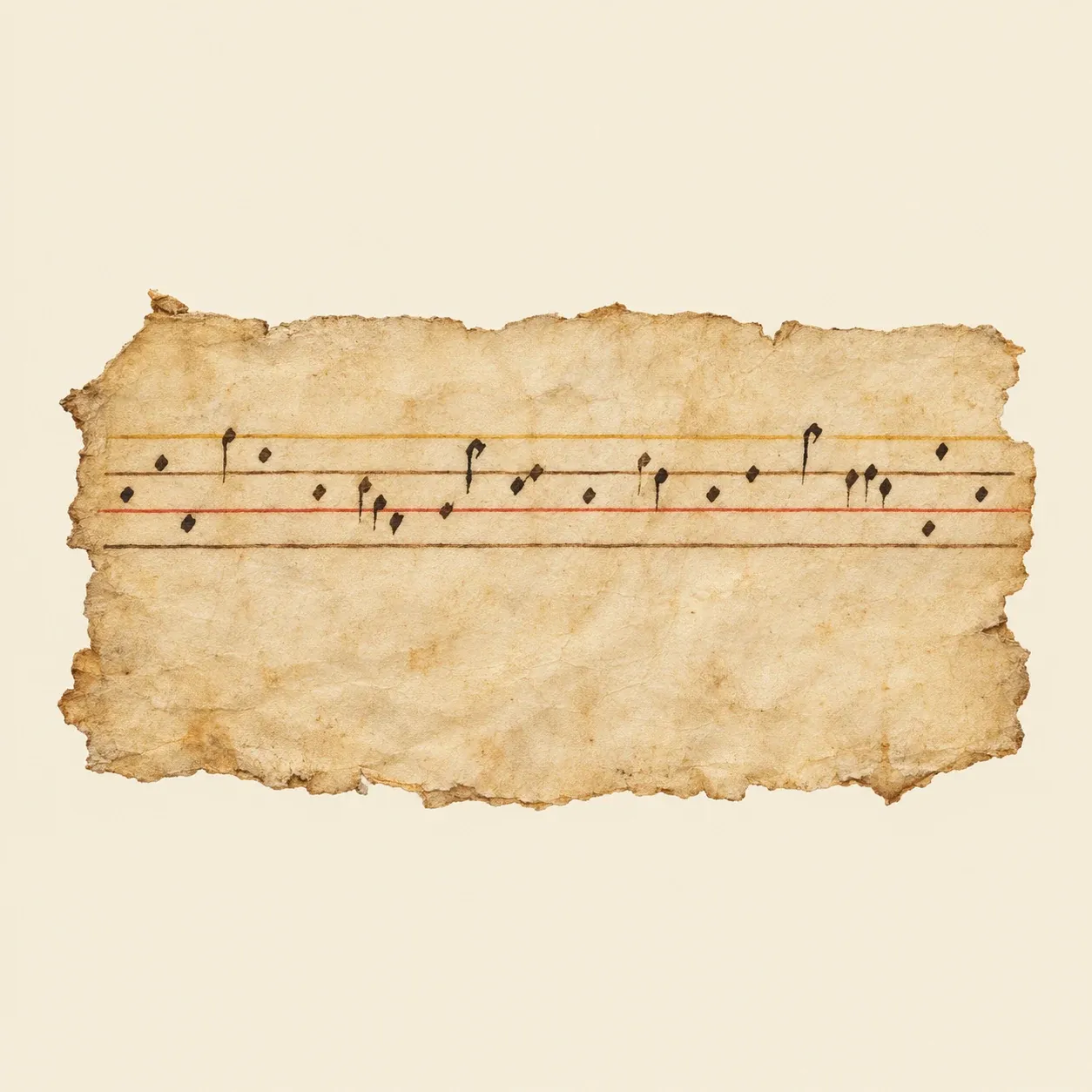 Neumes on four lines: the coloured lines mark the notes F and C, each of which lies a semitone above the note below it.
Guido of Arezzo, a Benedictine monk of Pomposa who later taught at the cathedral school of Arezzo, brought lines into ordinary chant books. In the prologue to his antiphoner, written between about 1020 and 1030, he set neumes on lines and in the spaces between them, with the lines a third apart, a letter at the start of a line to name its pitch, a red line for F and a yellow line for C. Letters and coloured lines had appeared before, in the Enchiriadis treatises among others, but he combined them for everyday use. He presented the antiphoner, now lost, to Pope John XIX in 1028. Guido did not fix the number of lines, and copies of his works have staves of three, four or five. A manuscript copied in Rome in 1071, now in the Bodmer Foundation near Geneva, still shows its red F lines. By the thirteenth century chant books had settled on four lines, which editions of chant still use today.
The staff fixed pitch but left rhythm to custom. Earlier polyphony indicated a few rhythmic patterns by the way notes were grouped together. In the second half of the thirteenth century, theorists gave each note shape its own length: Lambertus in a treatise of about 1270, and Franco of Cologne in his Ars cantus mensurabilis, dated about 1260 in the New Catholic Encyclopedia and about 1280 by the University of Basel. Franco’s system was copied in Italy, France and England, and parts of it lasted until the sixteenth century. Polyphonic music settled on five lines by the fourteenth century, while keyboard music in some countries used six or seven lines until the middle of the seventeenth.
The printing press spread the staff further. In Europe, the oldest surviving book of music printed from movable type is the Constance Gradual, printed in southern Germany around 1473, which the British Library holds. In Venice, Ottaviano Petrucci published the Harmonice Musices Odhecaton in 1501, the first book of polyphony printed from movable type. Each sheet went through his press several times: first for the staff lines, then for the notes, then for the words. In Paris in the late 1520s, Pierre Attaingnant used type in which each note carried its own short piece of staff, so a page could be printed in one pass.