Fishing reel
Storing and winding line on a spool
Contents
- 1Spool holding the line
- 2Crank handle on the spool axle
- 3Axle turning in the side plate
- 4Ratchet wheel and spring pawl
- 5Foot clamped under the rod
A fishing reel is a spool fixed to the rod that holds far more line than the rod is long. The angler can let a strong fish run, wind the line back when it tires and cast the bait well out. The clearest early description comes from Chinese poems of about 870, which tell of a single wheel with a horn handle that chirped as the line ran out.
What it is
Without a reel, the line is tied to the tip of the rod and its length is fixed. There is no spare line to give, so a fish that pulls harder than the line can bear breaks it, and the bait can be swung out only as far as the rod and that fixed length of line allow. A reel is a spool fixed near the butt that holds a reserve of line many times longer. The line runs from it through rings along the rod to the tip. The angler can let a strong fish take line, wind it back as the fish tires, and throw the bait far out while line pours off the spool. The rod, the line and the hook themselves are described under fishing rod and hook.
There are three main kinds. A single-action reel turns its spool once for each turn of the handle. A multiplying reel uses gears to turn the spool several times for each turn. A fixed-spool reel does not turn its spool when casting at all: the line slides off over its end. Most reels also have some kind of brake, from a simple click to an adjustable drag.
How it works
On a single-action reel the handle is fixed to the axle of the spool, so one turn of the handle winds on one turn of line. How much line that is depends on the diameter of the line already wound: a full spool takes in more at each turn than a nearly empty one. The axle turns in holes in the side plates, a plain bearing kept smooth with oil.
A toothed ratchet wheel turns with the spool, and a pawl mounted on the frame, pressed by a spring, rides over its teeth. This click makes a noise as the spool turns and adds a little resistance. It stops the spool spinning on when a fish stops pulling and tells the angler that a fish has taken the bait. On the early brass reels the click could not be switched off, so the angler had to pull line off by hand before casting.
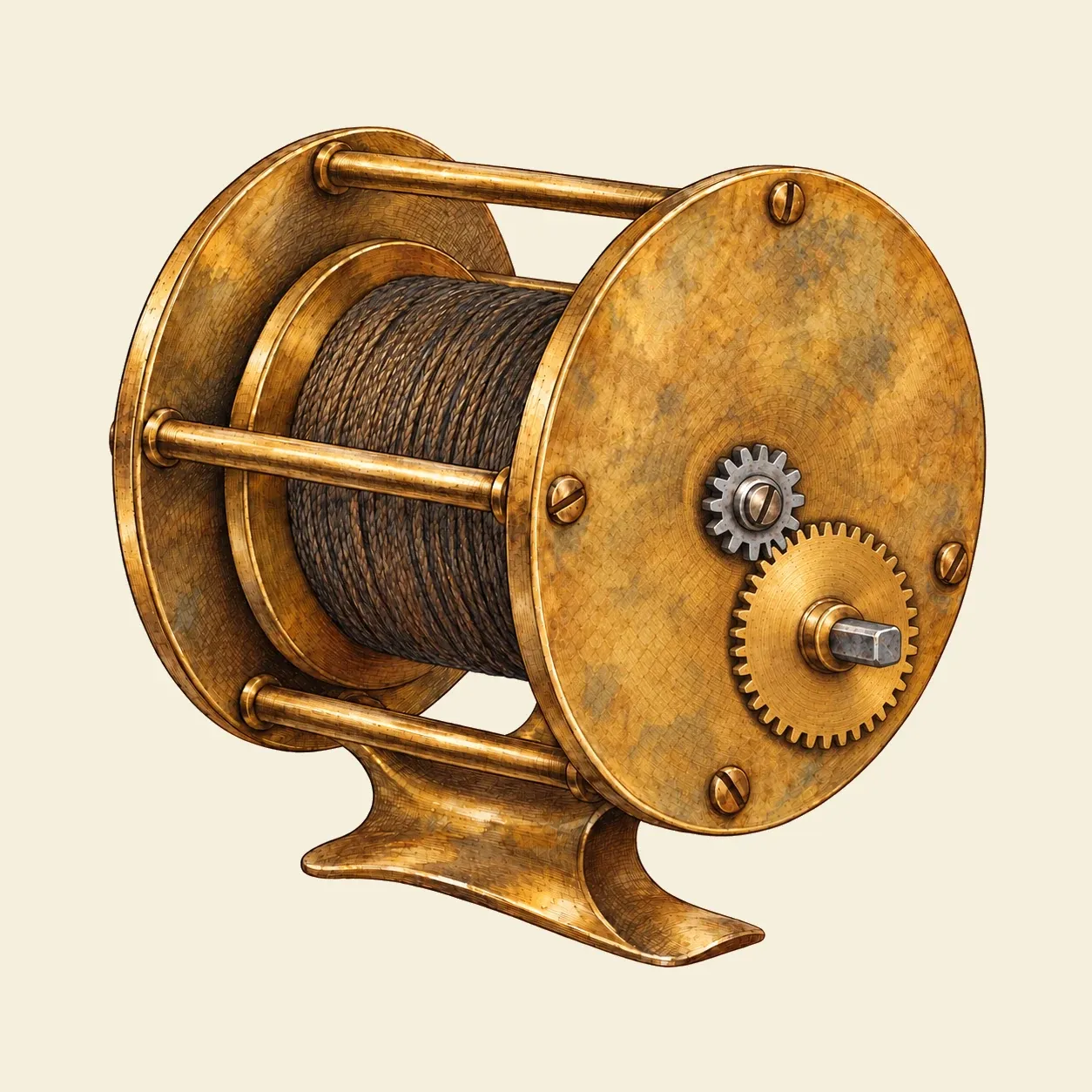 On a multiplying reel a large wheel on the handle drives a small pinion on the spool.
A multiplying reel places a large toothed wheel on the handle shaft and a small pinion on the spool axle, so the spool turns faster than the hand (gear). On the Kentucky reels of the 19th century one turn of the handle turned the spool about four times. The line comes in quickly, and a cast bait can draw line straight off the revolving spool. When the bait slows down, the spool keeps turning and throws off loose loops that tangle. Anglers check it with a thumb on the spool, and later reels added brakes against this overrun.
The spool of a fixed-spool reel faces the rod tip and stays still during the cast. The line slips over its front rim the way yarn slips off the end of a mill bobbin, so only as much line leaves as the bait pulls, and the spool cannot overrun. Very light baits can be cast a long way. Turning the handle drives a wire arm, the bail, round the spool to lay the line back on.
A brake lets a big fish take line before the line breaks. The first stops on brass reels locked the spool completely, so a heavy fish could still snap the line. A friction brake, or drag, slips at a force the angler sets and lets line out against a steady pull.
How to do it
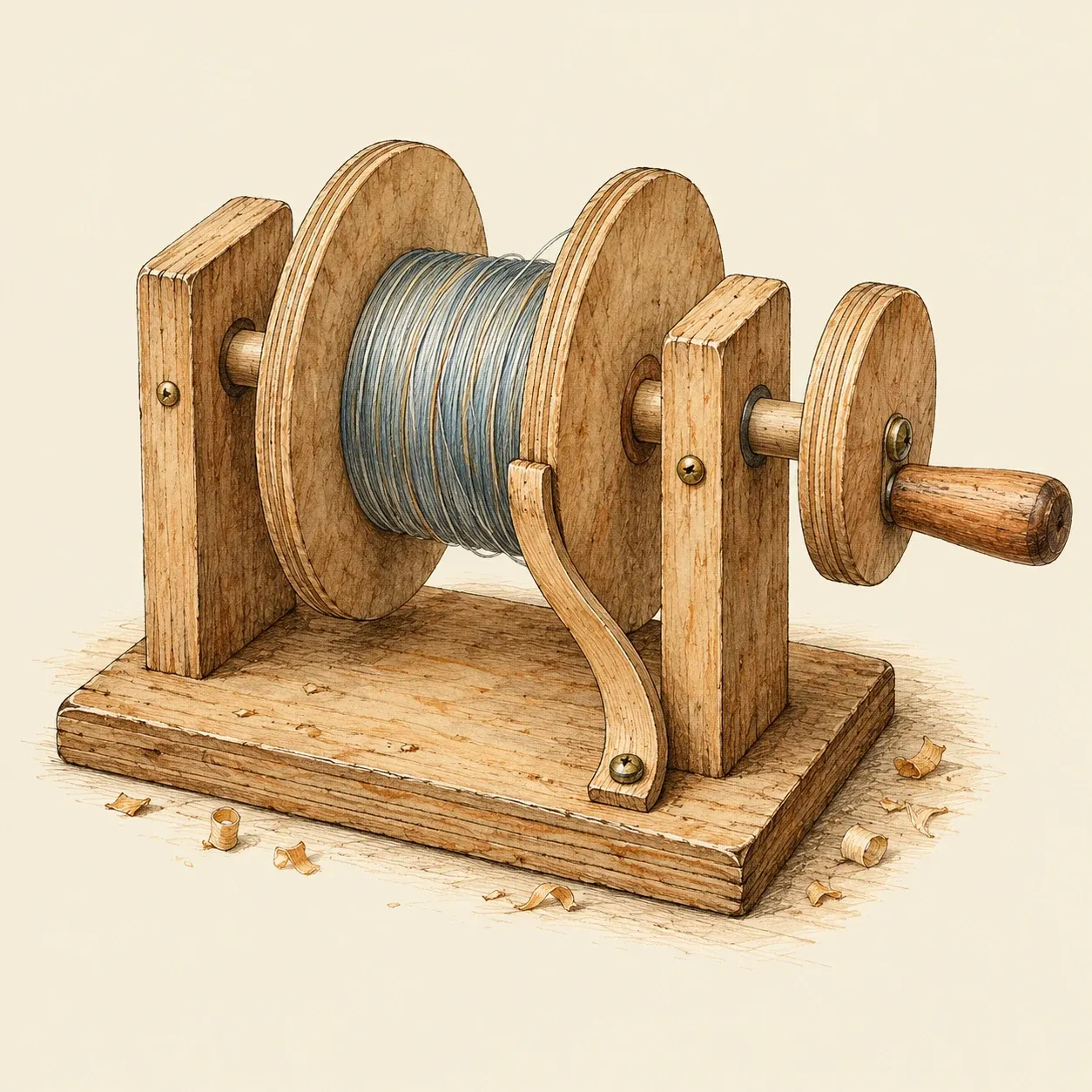 Spool and handle turn together on one dowel; a springy strip rubbing on a disc acts as the brake.
For the spool, glue two discs of plywood about 6 cm across and 5 mm thick to the ends of a 3 cm length of dowel 2.5 cm thick. Once the glue is dry, drill a 6 mm hole through the centre of the whole spool. For the frame, glue and pin two side pieces of hardwood 8 cm high to the ends of a base 5 cm long, so that the spool fits between them with a little play. Drill a 7 mm hole through both sides at the same height, set the spool between them and push a 6 mm hardwood dowel through side, spool and side, leaving about 2 cm sticking out beyond one side. Glue the dowel into the spool only, so that spool and dowel turn together while the dowel turns freely in the sides. Rub soap or candle wax on the dowel where it passes through the sides.
For the handle, glue a third plywood disc onto the end of the dowel that sticks out, outside the frame. Drill a hole near the rim of this outer disc and glue in a 4 cm piece of 8 mm dowel with a rounded end. For a friction brake, fix a thin, springy strip of wood to the base so that its end rubs on the rim of one of the spool discs. Bending it harder against the disc gives more resistance.
Lay the base against the rod 20 to 30 cm above the butt, with the handle on the side of your winding hand, and lash it on firmly with strong cord. Screw small eyes along the rod for the line, the last at the tip. Tie the line to the hub of the spool and wind it on evenly. Pull the line from the tip: the spool should give it with a light, steady resistance and take it back when you turn the handle.
Clamp the wood when sawing and drilling, wear safety glasses and keep your fingers away from the bit. When a fish or a snag pulls line off, the handle spins: keep your knuckles clear and slow the spool with your palm. A line under load can cut skin, so never wrap it round your fingers. The rules for any fishing still apply: a licence where one is needed, a safe distance from steep or slippery banks, and hooks kept covered when not in use.
History and evolution
The word diaoche, “fishing wheel”, already appears in the Liexian zhuan, a collection of lives of Daoist immortals that existed under the Later Han and was quoted by authors of the Jin period (265–420). In one story the friends of the fisherman Lingyang Ziming ask whether his diaoche is still there, without saying what it was.
A silver-gilt plate in the J. Paul Getty Museum shows a seated fisherman whose rod carries a round object near the butt, with loops of line hanging below the rod. The museum dates it to Late Antiquity, but its provenance has never been established: Frederick Buller (1997) reads the object as a reel, Anthony Cutler (1990) doubted a Late Antique date because of that reel, and a technical study by David Scott the same year found the silver and its corrosion consistent with antiquity.
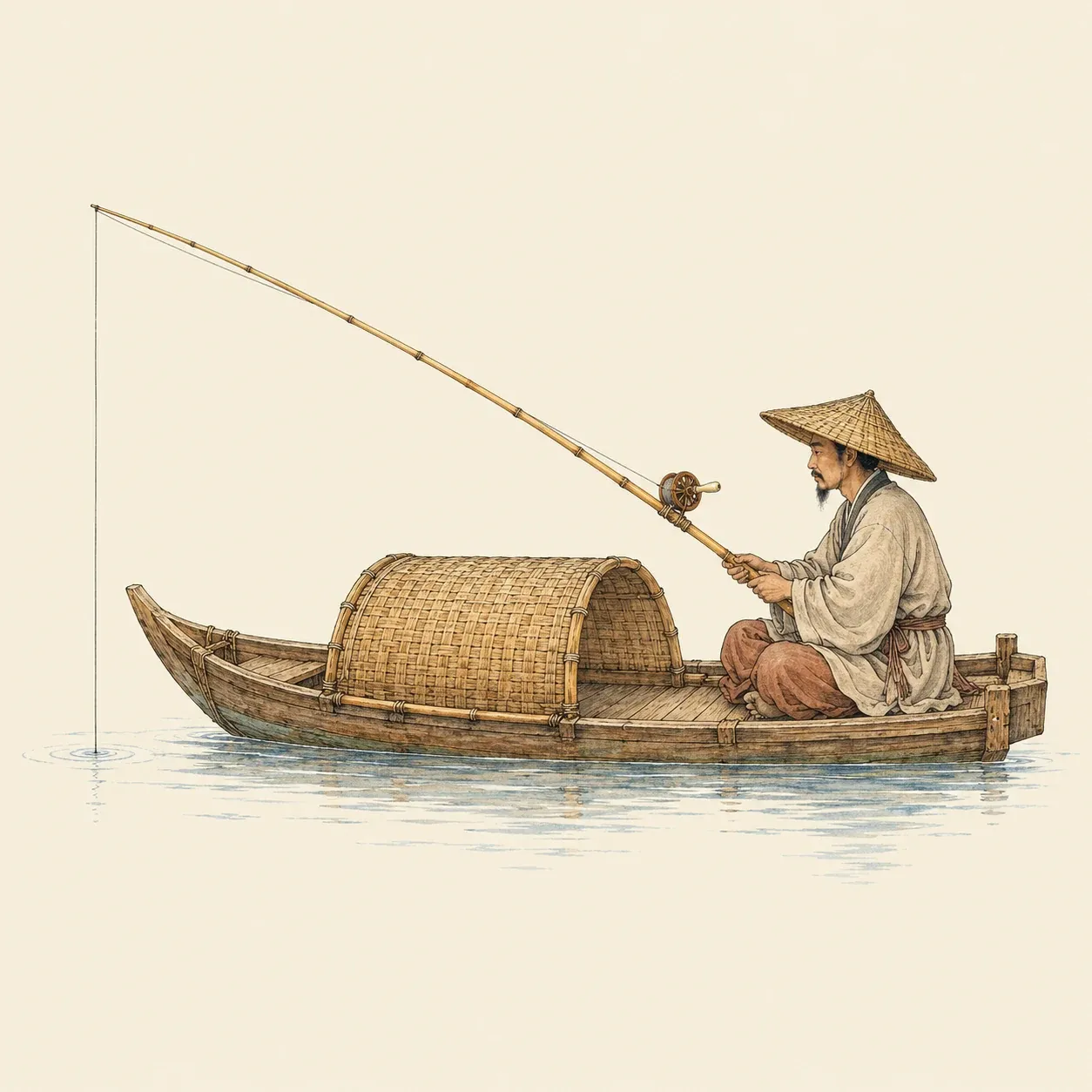 The Tang poets describe a single wheel on the rod, carried in a small fishing boat.
The first clear description comes from two Tang poets, Lu Guimeng, who died around 881, and his friend Pi Rixiu, who served in Suzhou after passing the state examination in 867. Lu wrote a set of poems on fishing gear, one of them on the diaoche, and another on a reel he had brought back from Tongjiang. In his replies Pi describes the reel of a small boat hung under its low awning, and Lu’s reel as a single wheel with a horn handle, smooth and light, that chirped like a bush cricket when the line was cast.
In England, Thomas Barker described a reel in 1651. A pike angler he admired used a hazel rod twelve feet long with a wire ring at the tip, and two feet from the butt a hole held a “winde” that turned a barrel to take in or let out the line. The second printing of Barker’s book, in 1657, adds a printed drawing of a reel, which the American Museum of Fly Fishing describes as the first known Western representation of one. Izaak Walton wrote that some salmon anglers fitted a wheel about the middle of the rod or near the hand, with the line running through a wire ring at the tip.
British reels of the late 18th century were made of brass and often had a permanent click. The London tackle maker Onesimus Ustonson advertised brass multiplying reels, and the American Museum of Fly Fishing holds one of his of about 1780. From the 1830s, free-running wooden reels from Nottingham let anglers cast directly off the spool.
In Kentucky, the watchmaker George Snyder of Paris built a multiplying reel for casting baits around 1815, probably after a British model. Fewer than a dozen of his reels are known. Watchmakers and silversmiths of the region, among them the Meek brothers and Benjamin Milam of Frankfort, then made such reels by hand in brass and German silver for almost a century, and they became the model for later baitcasting reels.
Alfred Holden Illingworth, an English mill owner, patented his first fixed-spool reel in 1905. The line came off the end of the stationary spool like yarn off a bobbin and was wound back by an arm that turned around it. His Number One was the first fixed-spool reel made in quantity, and his second model, patented in 1910, set the basic form that such reels still follow.