Military flail
A striking head on a flexible joint
Contents
- 1Long handle of a war flail
- 2Joint of linked leather loops
- 3Striking arm studded with iron nails
- 4Short handle of a horseman's flail, with a wrist loop
- 5Weight on its strap
A military flail joins a striking head to its handle by a flexible link, so that the head swings out ahead of the hand. Two kinds are well attested: the long war flail held in both hands, which grew out of the threshing flail, and the short horseman's flail with a weight on a strap or chain. The oldest heads of horseman's flails found in central and eastern Europe, mostly of bone, come from Avar cemeteries of the 7th and 8th centuries.
What it is
A military flail is a weapon whose head is not fixed rigidly to the handle. One or more striking heads hang from it by rings, a chain, a cord or a leather strap. The weapon takes its name and its principle from the farm flail used to beat grain out of the ears on the threshing floor (see harvest and threshing).
Two kinds are well attested. The war flail of the late Middle Ages is a threshing flail made for fighting: a long handle held in both hands, joined to a shorter, heavy striking arm that was often studded with nails. The horseman’s flail, common in the steppes and in eastern Europe, has a short handle and a weight of bone, antler or metal on a strap or chain. A third kind, the one-handed ball and chain familiar from films and games, is much less certain, and historians disagree about how often, or even whether, it was used.
How it works
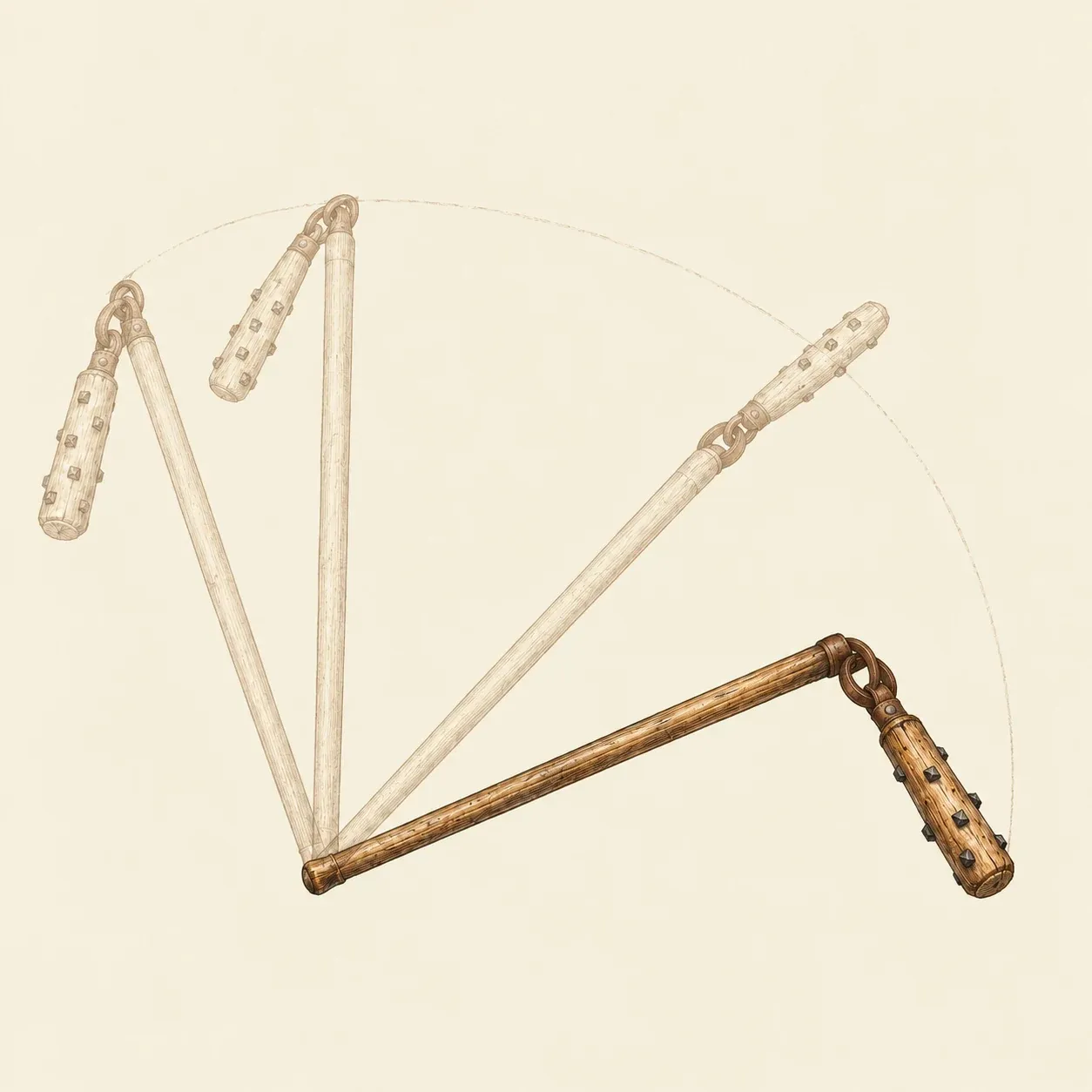 During the swing the striking arm lags behind the handle, then overtakes it.
The flexible joint changes the way the blow is delivered. When the handle is swung, the striking arm at first lags behind, then whips round and overtakes it, so that the head travels faster than the end of a rigid club of the same length. Paul Sturtevant, who doubts the ball and chain, accepts that the swing gives the head a higher speed than the head of a comparable mace. The same freedom is the flail’s weakness. The head is hard to control, it can rebound off whatever it strikes towards the user, and in a crowd it is as dangerous to neighbours as to opponents.
On the long war flail the striking arm hangs from the end of the handle by a flexible joint, as on the farm flail, where it is often made of two linked loops of leather. Alistair Holdsworth notes that the wooden arm was made more dangerous with iron or copper nails, which concentrate the force of the blow. The fighter swings the long handle with both hands, much as a thresher does, and the heavy arm comes down at the end of the swing. On the horseman’s flail the head hangs from the end of a short handle, 40 to 50 cm long in eastern Europe according to Holdsworth, and the strap could also be looped round the hand alone. Maksym Osypenko of the National Museum of History of Ukraine describes it there as an auxiliary weapon.
How to do it
A soft model of the joint shows how a flexible link lets the striking arm overtake the handle. It needs two lengths of foam pipe insulation, one about three times as long as the other, a metre of soft cord, cloth tape and a pencil to push the cord through the foam.
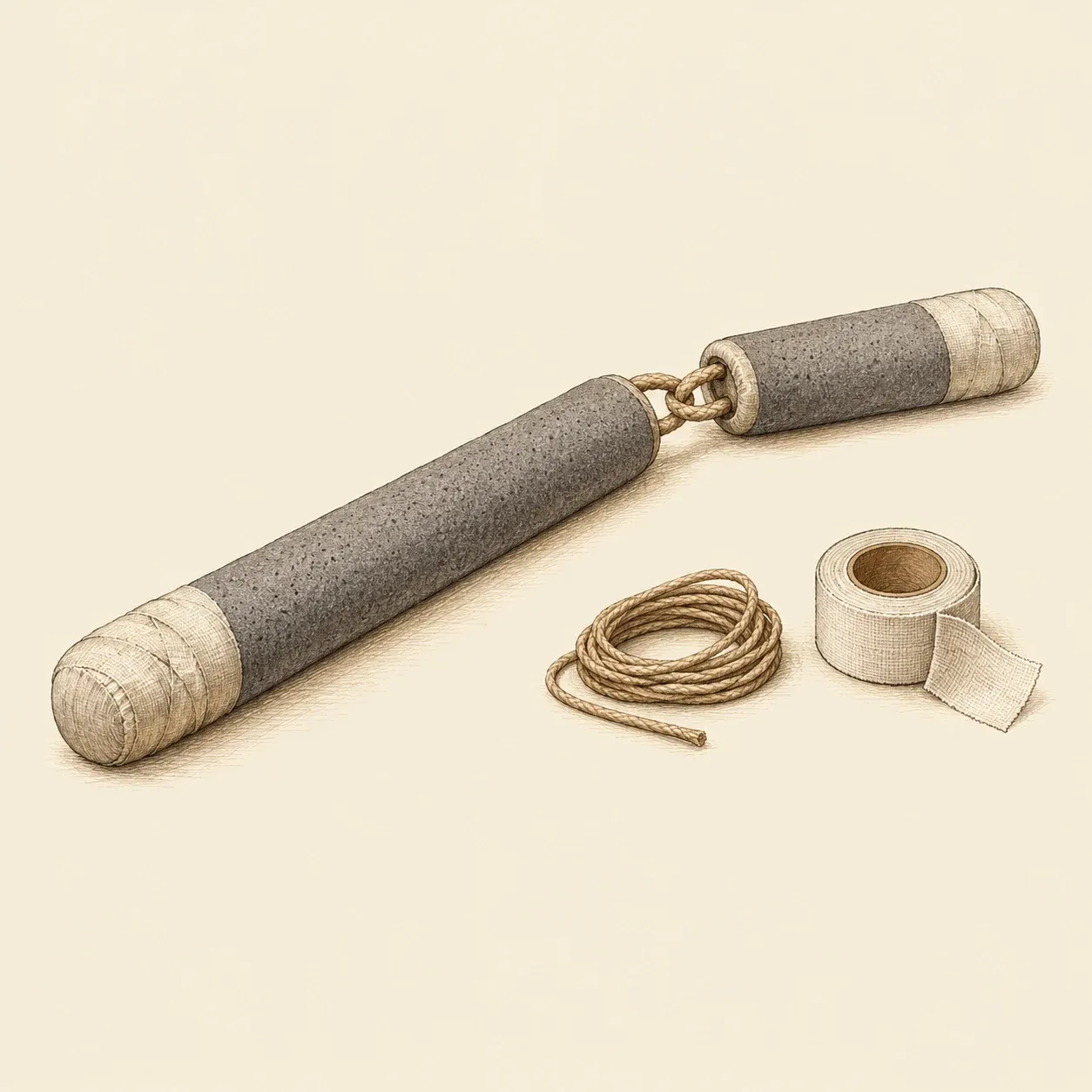 Two loops of cord, one through each tube, make the same joint as the leather loops of a farm flail.
Close both ends of each tube with tape so that they are rounded. With the pencil, push a length of cord through the foam a few centimetres from one end of the long tube and tie it into a loop. Pass a second length of cord through the loop, then through one end of the short tube, and tie it. The two loops are now linked, like the two leather loops of a threshing flail. Hold the long tube in both hands and swing it slowly, low and in front of you: the short tube lags behind, then swings past the end of the long one.
Safety. Keep the model soft: never replace the cord with a chain or the foam with wood, and never add a weight.
History and evolution
The flail began as a farm tool, and its shape as a weapon stayed close to that origin. Alistair Holdsworth reads horsemen on coins of Thessaly of about 400–370 BC as carrying war flails, although coins of the same period also show the flail as a tool.
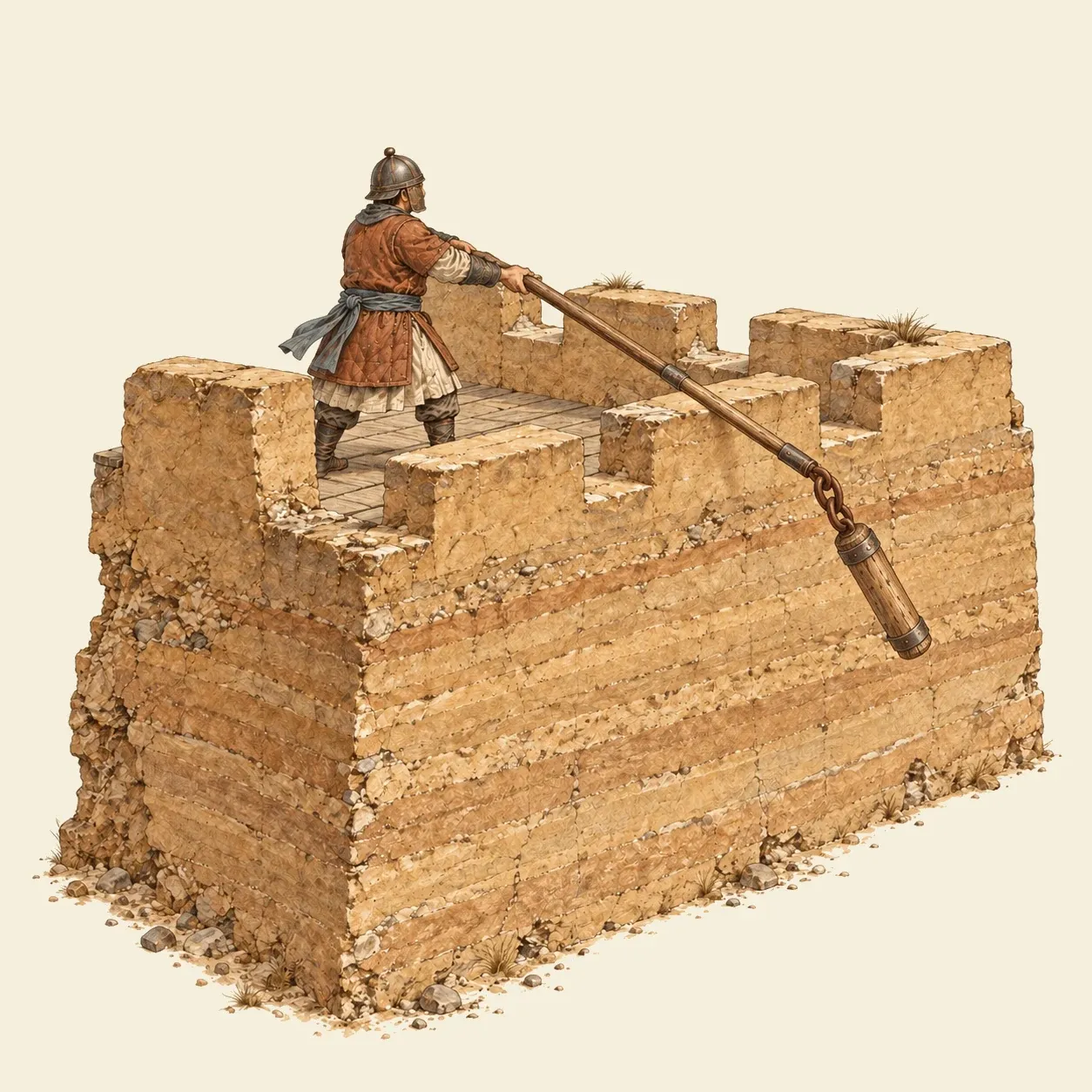 A defender strikes over the parapet with a jointed staff, as the Taibai yinjing describes.
The oldest firmly dated description is Chinese. The Taibai yinjing, a military treatise that Li Quan presented to the emperor in 759, lists among the equipment for defending a city a jointed staff shaped like the flail for threshing grain, used to strike enemies climbing onto the parapet. The Tongdian of Du You, completed in 801, repeats the sentence and lists flails among the supplies to be stored on the walls.
On the Asian steppes, flails with a weight on a strap, called kistens in the Slavic languages, were a secondary weapon of horsemen between the 5th and the 10th century according to Holdsworth, and the peoples of eastern Europe took them up. Their heads were at first of bone, horn, antler or stone. In central and eastern Europe, Piotr Kotowicz places the oldest ones among the Avars of the 7th and 8th centuries: mostly round or pear-shaped heads of bone, found mainly in cemeteries. Éva Garam, who studied these Avar bone balls, takes many of them for the ends of whip handles, and writes that those tied by an iron eye and a strap to the head of a handle could serve as flails. Holdsworth counts hundreds of heads found from the 10th to the 13th century, from Russia and Ukraine to the Balkans, Finland and Poland. Osypenko dates the first metal war-flails in Kievan Rus’ to the end of the 11th century, with most finds from the 12th and the first half of the 13th; the 48 in his museum’s collection are round, pear-shaped, biconical, cubic or star-shaped.
In western Europe, flails appear in images from the late 11th century, often in the hands of demons or of the mob arresting Christ, and the threshing flail was used by peasants as a makeshift weapon. Weapons plainly derived from the threshing flail are drawn from around 1400, and German fight books such as Hans Talhoffer’s of 1459 show how to handle them. The war flail had its great moment in the Hussite wars of Bohemia (1419–1434). The Hussites fought from behind circles of wagons, and flails were among the weapons of the wagon crews. The Hussite Museum in Tábor presents the nail-studded flail, a tool every peasant already knew how to handle, as their characteristic weapon. The one-handed ball and chain is another matter: Paul Sturtevant argues that it was mostly an artistic idea, and the Metropolitan Museum catalogues one of its examples as probably made in the 19th century in the style of the 16th. Kelly DeVries and Robert Douglas Smith, whom he quotes, judge that a weapon of this kind was probably used but was not common.