Dugout canoe
A boat hollowed from a single trunk
Contents
- 1Solid end left at the bow
- 2Side wall
- 3Interior hollowed with an adze
- 4Cross rib left in the solid wood
- 5Flattened bottom
- 6Paddle
A dugout canoe is a boat cut from one tree trunk. The builder shapes the outside, hollows the inside and leaves a floor and two walls thick enough to hold together. The oldest known, found in a peat bog at Pesse in the Netherlands, is a small pine boat made around 8000 BCE.
What it is
A dugout canoe, or logboat, is a hull made from a single piece of wood. A straight trunk is felled, cleared of its bark and shaped at both ends, then hollowed from above until only a floor and two side walls remain. The ends are often left solid for some length. Some builders also left a few cross ribs standing in the solid wood to stiffen the hull.
Dugouts were made in Europe, Africa, Asia, Australia and the Pacific, from whatever large trees grew nearby: pine, lime, alder and oak in Europe, pine in eastern China, probably a mahogany in Nigeria, aspen in Finland and Estonia. Most were paddled on rivers, lakes and sheltered coasts, for fishing and everyday transport.
How it works
A dugout floats because the hull pushes aside a volume of water weighing as much as the boat and its load. Hollowing the trunk removes most of its weight while keeping its outer volume, so the empty shell rides high and can carry people and their gear.
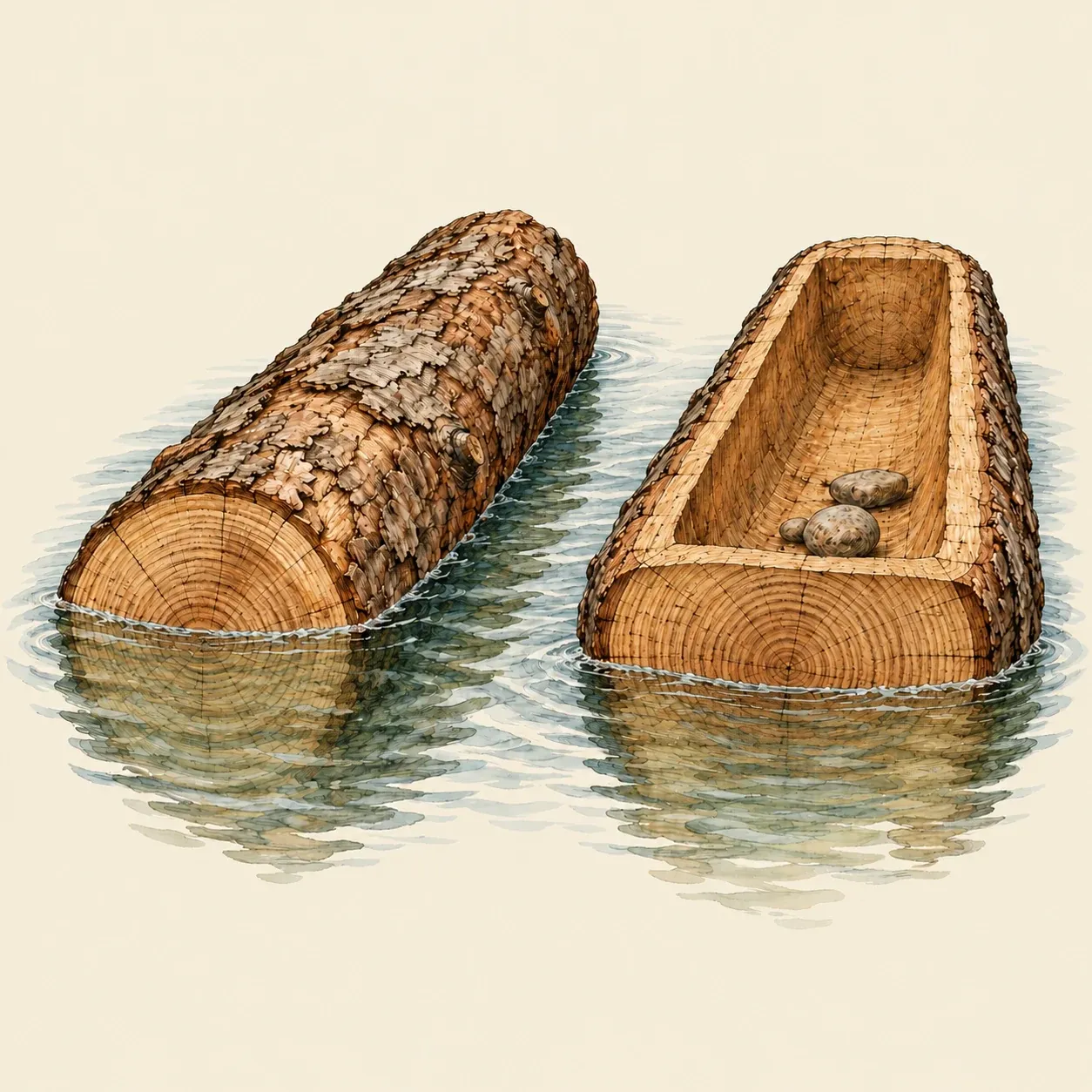 A round log has nothing to bring it back upright; a hollowed hull with a flat floor and weight kept low settles level.
Floating is the easy part; staying upright is harder. A solid round log of even density has no preferred position: turned a little, it simply stays turned. Hollowing the upper half lowers the centre of weight, and flattening the bottom and keeping the hull wide make it push back when it tips, because the side that dips into the water gains buoyancy. People in a dugout sit or kneel on the floor to keep their weight low. The trunk sets the limits. The beam can never be wider than the tree, the length cannot exceed its straight part, and a narrow hull stays tender, so a sudden move can roll it over.
Thick walls make a heavy, sturdy boat; thin walls make a lighter one that splits more easily. Wood also shrinks as it dries and can crack.
How to do it
A full-size dugout needs a large tree and a great deal of work: the replica of the Pesse canoe kept about ten people busy for five days. A model of the same shape, carved from a short log, shows how the hull is laid out and why it floats upright.
Take a fresh log of a soft wood such as lime, poplar or willow, 30 to 40 cm long and 10 to 15 cm thick, and split or saw it in half along its length. Saw a second, shorter section from the same log and keep it whole and round for the test. Clamp the half log flat side up to a bench. Mark the outline of the opening on the flat face, leaving about 4 cm uncut at each end. Shape the two ends to a blunt point with a saw and a rasp, and shave the underside a little flat so that it can stand on a table.
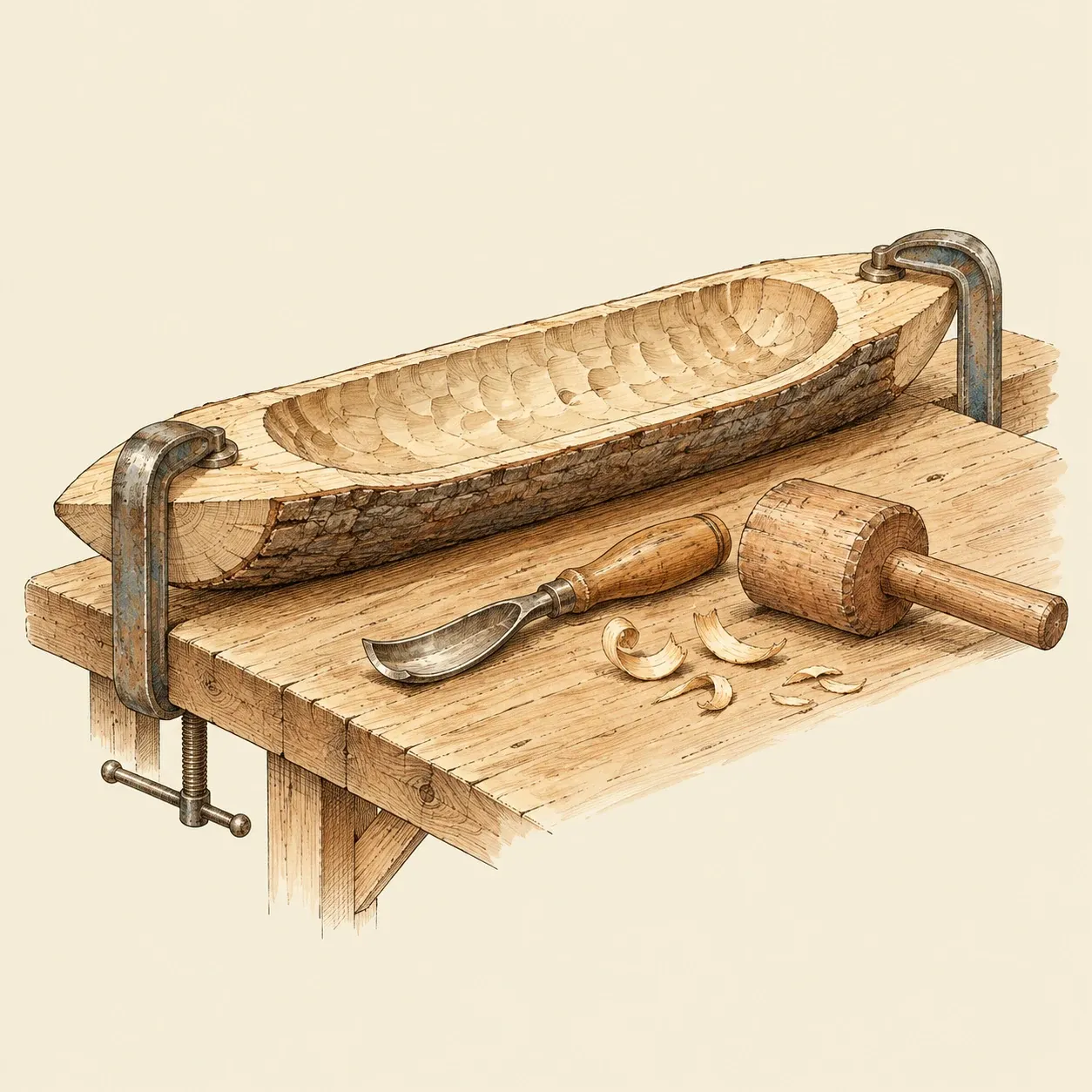 The hull is hollowed from the middle towards the ends, in thin chips.
Hollow the inside with a wide gouge and a mallet, working from the middle towards the ends and taking off thin chips. Leave a floor and walls about 1 cm thick, and if you wish, leave a cross rib standing in the middle. Check the thickness often by pinching the wall between finger and thumb. Smooth the inside with a curved knife or sandpaper.
Test it in a basin of water. First float the whole round section, which has not been split, and turn it by hand: it rolls and stays where it is put. Then float the hollowed hull, which sits upright and higher. Place a few pebbles on its floor and it settles lower but stays level. Balance the same pebbles on a stick laid across the top and it leans and rolls far more easily. Finally lash two thin sticks across the hull with string and tie a small branch to their ends as an outrigger: the boat now resists rolling on that side.
Safety: gouges and knives slip and cut deep. Always clamp the work instead of holding it, push the blade away from your body and keep your other hand behind the cutting edge; a cut-resistant glove on that hand helps. Children should carve only with an adult beside them. Do the water tests in a basin or tub, never in open water. A real dugout can roll over easily: anyone who paddles one should wear a life jacket and stay on calm water close to shore.
History and evolution
People reached Australia and New Guinea at least 50,000 years ago through several sea crossings, one of them close to 100 km, but none of their craft survive. In northern Europe paddles appear well before the first logboats: Jan Lanting notes a birch paddle from Star Carr in Britain, a site about 9,500 radiocarbon years old, and concludes that skin or bark boats came first.
The oldest boat known is a dugout found in 1955 by workers building a motorway through a peat bog near Pesse, in the Netherlands. It is about 3 m long and 44 cm wide, hollowed from a Scots pine. The Groningen radiocarbon laboratory dated it twice; the more precise result, 8825 ± 100 years before present, puts it around 8000 BCE. Some archaeologists doubted it was a boat because of its small size and thick walls, and suggested a trough. A replica built at the Drents Museum was paddled successfully in 2001. Pine dugouts about a thousand years younger were found at Noyen-sur-Seine and Nandy, in northern France; according to Lanting, before about 8000 BP pine was the only tree in northwestern Europe long and thick enough for the purpose, and later builders preferred lime and alder, then oak.
Dugouts appear early on other continents. At Kuahuqiao, in Zhejiang, archaeologists found a pine canoe of about 6000 BCE, 5.6 m long as preserved, with three paddles and stone adzes nearby. In Nigeria a herder digging a well near Dufuna in 1987 struck a dugout that Peter Breunig’s team dated to about 6000 BCE, the oldest boat known in Africa. In Lake Bracciano in Italy, the submerged village of La Marmotta has yielded five dugouts made between about 5600 and 5100 BCE. The largest, of oak, is 10.43 m long and has four cross ribs left in the solid wood.
How the hollowing was done is debated. Some recent boatbuilders burned the inside of the log and cut away the charred wood with an adze. Charlie Christensen found no clear sign of it on the Stone Age dugouts of Denmark, but the Kuahuqiao canoe and two of the La Marmotta boats have burnt patches inside. At La Marmotta, tool marks show that the hulls were carved with polished stone adzes and axes.
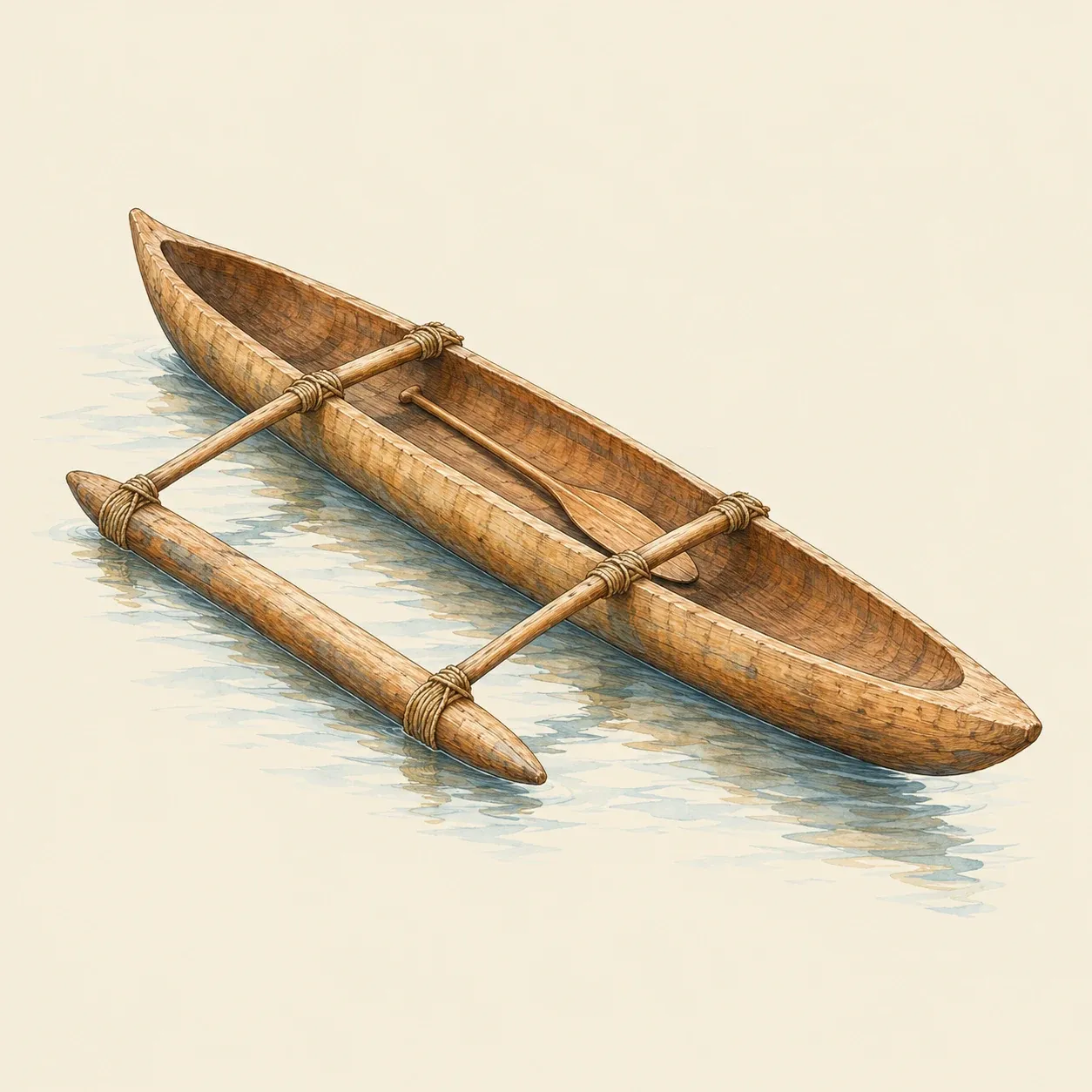 An outrigger float, held out on booms, keeps a narrow hull from rolling.
Builders found several ways round the narrow beam of a trunk. In island Southeast Asia, northern Australia and the Pacific, a dugout was often joined by cross booms to a solid log float. In Finland, a fire lit beside an aspen dugout heated it until the walls could be spread apart and propped, which made the boat wider than the tree. Boards added along the top of a dugout raised its sides, and Adrian Horridge traces the planked boats of the Austronesian peoples to a dugout base with planks sewn on. Mats found beside the Kuahuqiao canoe may come from a roof or from a sail, according to its excavators. In Ireland dugouts were still in use in the late 17th century, and in the Soomaa region of Estonia expanded dugouts served for daily transport and fishing until the mid-19th century.