Current-powered cable boat
A boat that winds itself upstream with the river's own force
Contents
- 1Hull
- 2Paddle wheels
- 3Winding shaft
- 4Rope to the upstream anchor
- 5Trailing float
A current-powered cable boat uses the river itself to travel upstream. Paddle wheels hung over its sides are turned by the current, and their shaft winds in a rope anchored upstream, so the boat hauls itself against the flow. The Sienese engineer Mariano di Jacopo, called Taccola, sketched such boats in manuscripts of the 1430s and 1440s, and French authors of the 1820s published theories of the aquamoteur. A related craft, the reaction ferry, crosses a river on a cable using the current alone.
What it is
A boat going up a river must overcome the current, by rowing, sailing, or being towed from the bank by men or horses. A current-powered cable boat takes its power from the current it is fighting. Over each side of the hull hangs a paddle wheel, like the wheel of a floating mill, and both wheels are fixed to one shaft across the boat. A long rope is anchored upstream, for instance to another rope stretched across the river, and is wound several times round the shaft.
The current turns the wheels, the shaft winds in the rope, and the boat pulls itself towards the anchor. The free end of the rope leaves the shaft on the downstream side and trails behind the boat, where a small float keeps it taut.
How it works
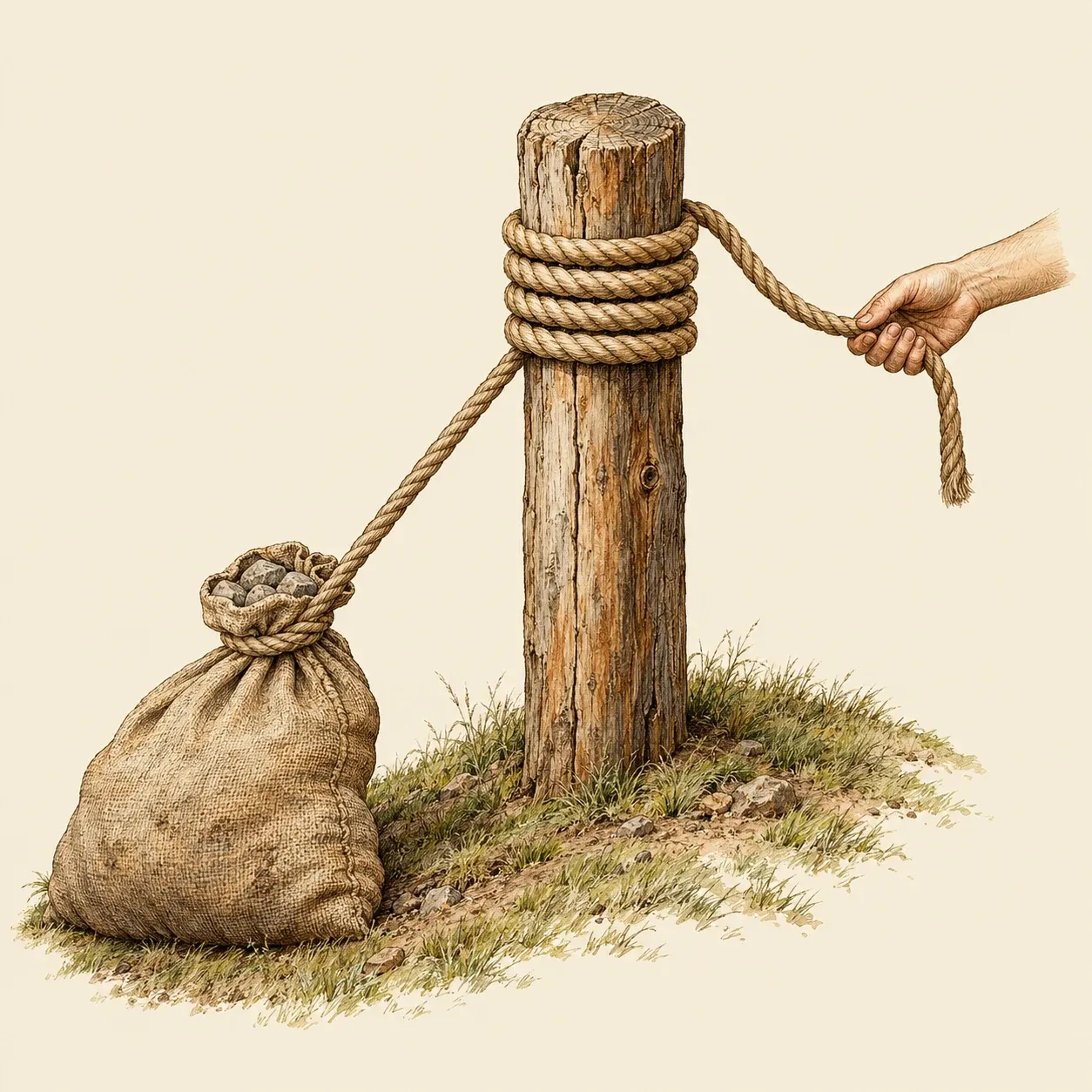 A rope wound several times round a post holds a heavy load while a light pull is kept on its free end.
The lower blades of each wheel dip into the river, and the current pushes them downstream, as it pushes the blades of an undershot water wheel. The wheels turn the shaft, and the rope from the anchor, which comes onto the underside of the shaft, is wound in. A rope wound several turns round a shaft does not slip when its free end is held with a small pull, which is why the free end trails to a float that the current drags downstream. In Taccola’s version without a float, the boatman pulled on the free end.
The current pushes on the hull as well as on the wheels, and it tries to carry the boat downstream. The boat moves upstream because the wheels are much larger than the shaft. Like a long lever, a wheel of large radius turning a shaft of small radius multiplies the force of the water on its blades, so that the pull on the rope can exceed the drag of the current on the hull. The boat gains force at the cost of speed: for every turn of the wheels it gains only the length of rope that one turn of the shaft takes in, and it creeps upstream far more slowly than the water flows.
How to do it
A model in a rain gutter shows a boat climbing against a flow of water with the flow’s own power. You need a length of plastic rain gutter about 1.5 m long with end caps, a garden hose, a block of polystyrene about 10 cm by 6 cm by 3 cm, a wooden skewer, two plastic bottle caps, stiff plastic cut from a bottle, strong thread, a drawing pin, a small cork, glue, scissors, a craft knife, and an adult to help.
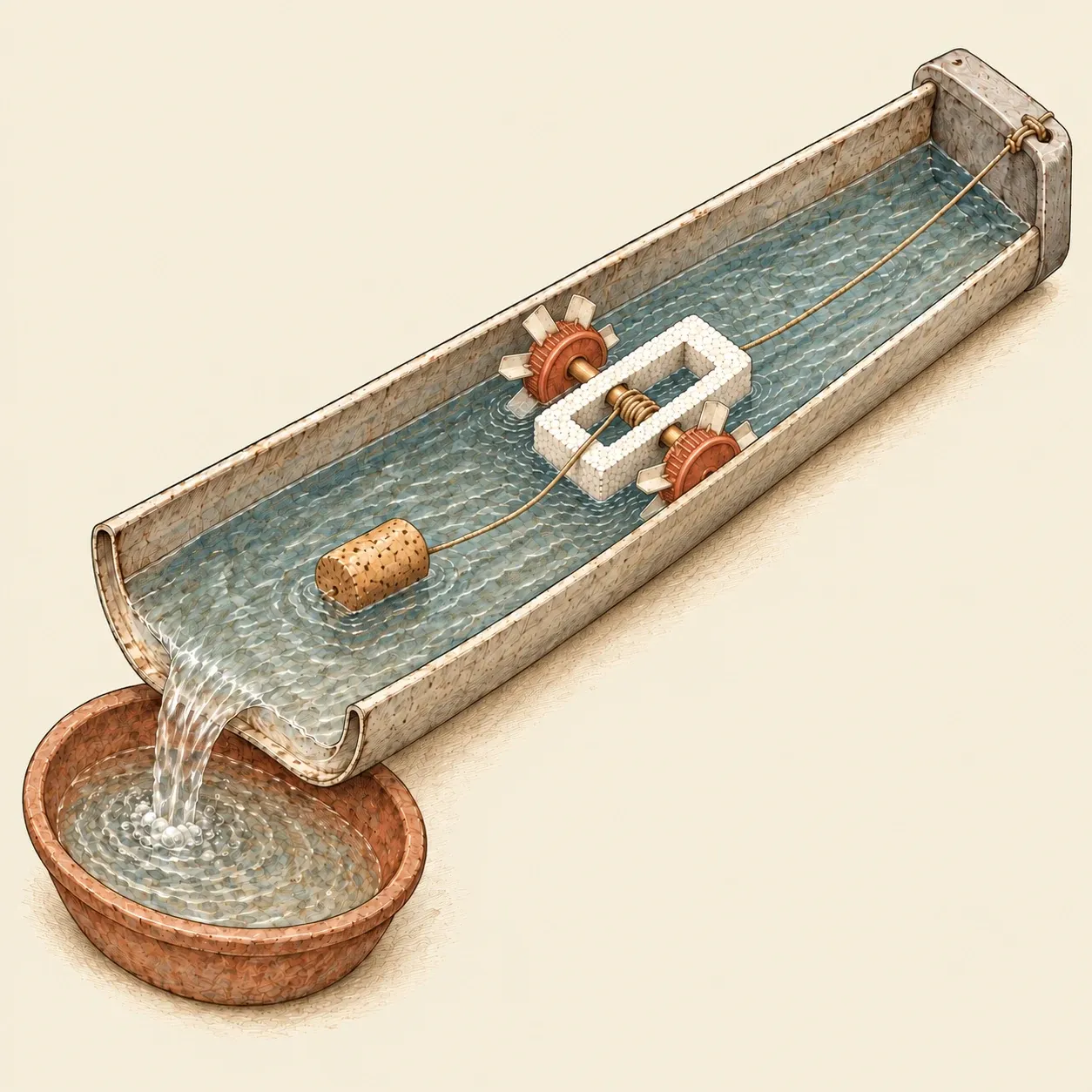 The flowing water turns the wheels, and the skewer winds the thread in, pulling the boat upstream.
Make two paddle wheels by gluing six small plastic blades, about 2 cm by 2 cm, round the edge of each bottle cap. Near the front of the block, cut a slot right through it from top to bottom, about 3 cm across and 1.5 cm long, so that 1.5 cm of foam is left on each side. Push the skewer across the block through both sides so that it spans the slot and turns freely, and fix a wheel on each end so that the lower blades dip into the water when the block floats. Lay the gutter outdoors on the ground with a very slight slope, remove the lower end cap, and let the hose run gently into the upper end. Fix the thread to the upper end cap with the drawing pin, lead it under the front of the boat and up into the slot, and wind it four times round the bare skewer there, so that the thread from upstream comes onto the underside. Let the free end drop back out of the slot and tie the cork to it so that it trails downstream. Set the boat in the water: the current turns the wheels and the boat inches upstream. If it slides back, turn the hose up a little or make the blades larger.
History and evolution
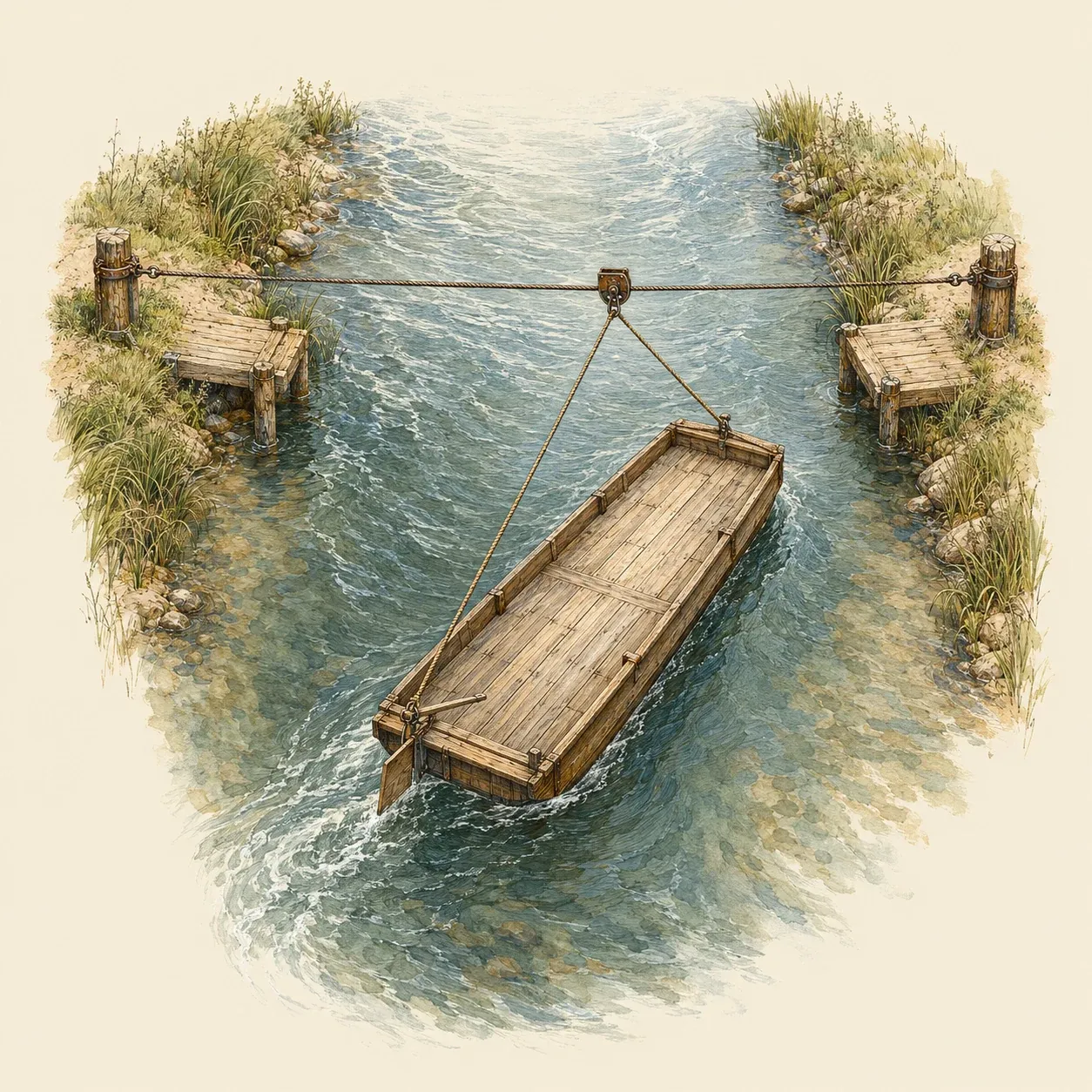 A reaction ferry crosses on a cable, its hull set at an angle so that the current pushes it towards the far bank.
The Sienese engineer Mariano di Jacopo, known as Taccola, drew boats that wind themselves upstream with the current. In one drawing a rope stretched across the river upstream holds a second rope that is led to the boat and wound round the shaft of its paddle wheels; in another, a float tied to the rope behind the boat keeps it taut. Franz Maria Feldhaus and Massimo Corradi both date these drawings to the 1430s and 1440s. Feldhaus also saw the same idea in a drawing of a boat with side wheels in Konrad Kyeser’s Bellifortis of about 1405, while Corradi describes Kyeser’s wheels as worked by men through a crankshaft.
The idea was taken up again in France as the aquamoteur, a boat driven up rivers by the current alone, and French authors of the 1820s published theories and studies of such boats.
A related craft uses the current to cross a river. Around 1511–1513 Leonardo da Vinci drew a ferry carrying oxen across the Adda at Vaprio, near Milan. Such reaction ferries hang from a cable stretched across the river. The ferryman sets the hull at an angle to the current with the rudder; the water presses on the angled hull and rudder, the cable takes the part of that push that runs downstream, and the rest moves the ferry across. Turned the other way, the same current takes it back. A ferry of this kind still crosses the Adda between Imbersago and Villa d’Adda without an engine.