Fishing nets and traps
Knotted mesh and inward funnels
Contents
- 1Knotted net meshes
- 2Edge rope and wooden floats
- 3Weights along the lower edge
- 4Inward funnel of the basket trap
- 5Chamber and emptying closure
A net intercepts fish in a sheet of mesh; a basket trap leads them through an inward funnel into a chamber. Knotted cord and assembled rods make two kinds of passive fishing gear, each requiring its own construction and regular inspection. The oldest dated net, from Antrea in Karelia, was lost around 8300 BCE.
What it is
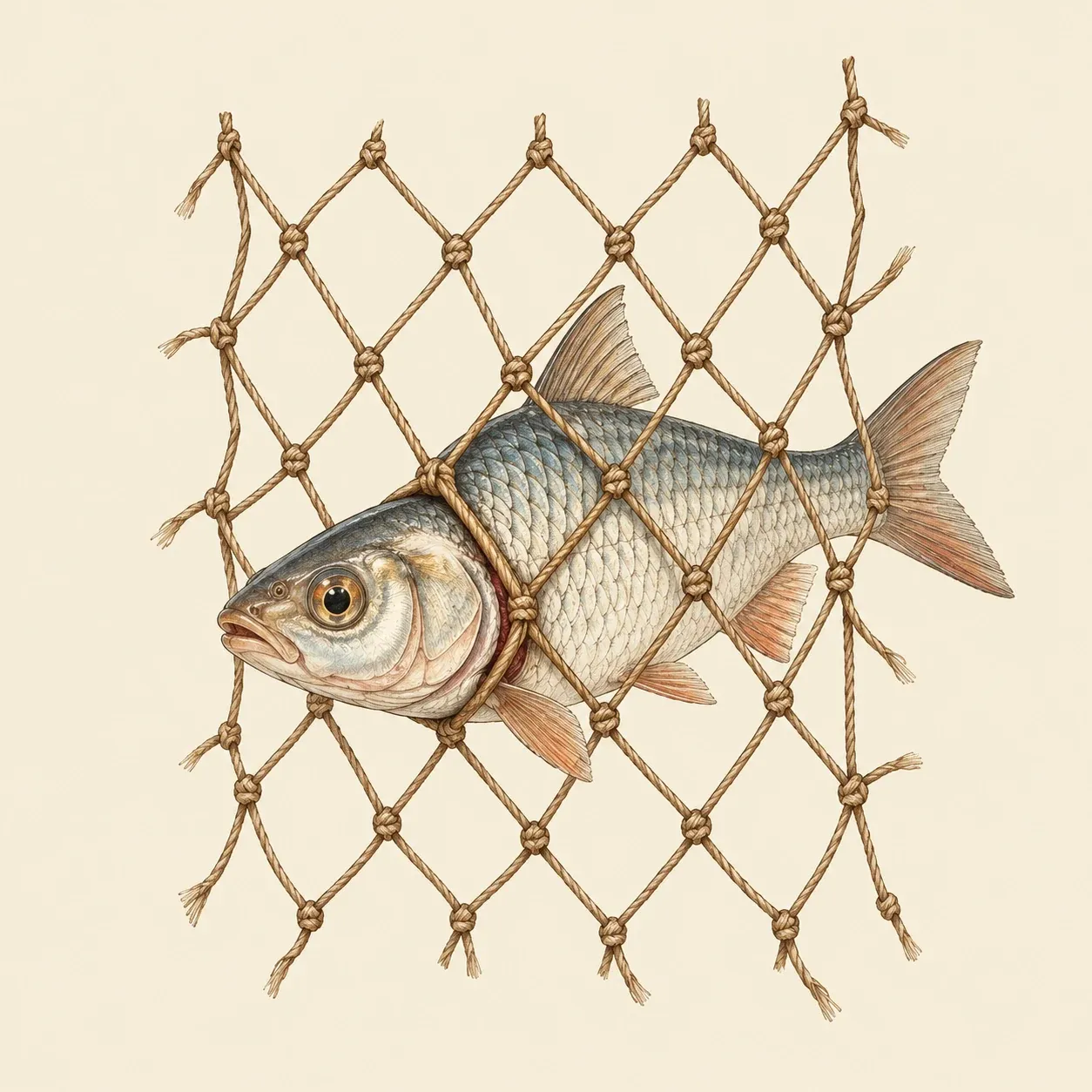 A mesh too narrow for the body holds the fish behind its gills.
Set nets and basket traps catch fish that encounter gear already in place. A net is a flexible sheet of mesh. A basket trap encloses a space and offers a narrowing entrance into it. Both belong to passive fishing, although nets can also be used actively. A mesh that lets one fish through may catch another behind its gills; mesh size alone cannot guarantee that only the intended species is caught.
Cordage supplies the strands and lashings, while basketry supplies the method for enclosing a chamber with rods. Knotted netting needs no weaving loom. Small models can teach the joints on a tabletop without catching living animals.
How it works
A knot holds each junction and passes tension into neighbouring meshes. A smooth gauge, used in the same orientation throughout, controls loop length as the rows are made. Once it is removed, the sheet remains flexible: pulling lengthwise narrows the diamond openings across the panel. A stronger edge rope spreads the load along the border. Wooden floats support the upper edge and weights pull the lower edge down. Together they help spread the net in water. A current can still flatten or carry it away.
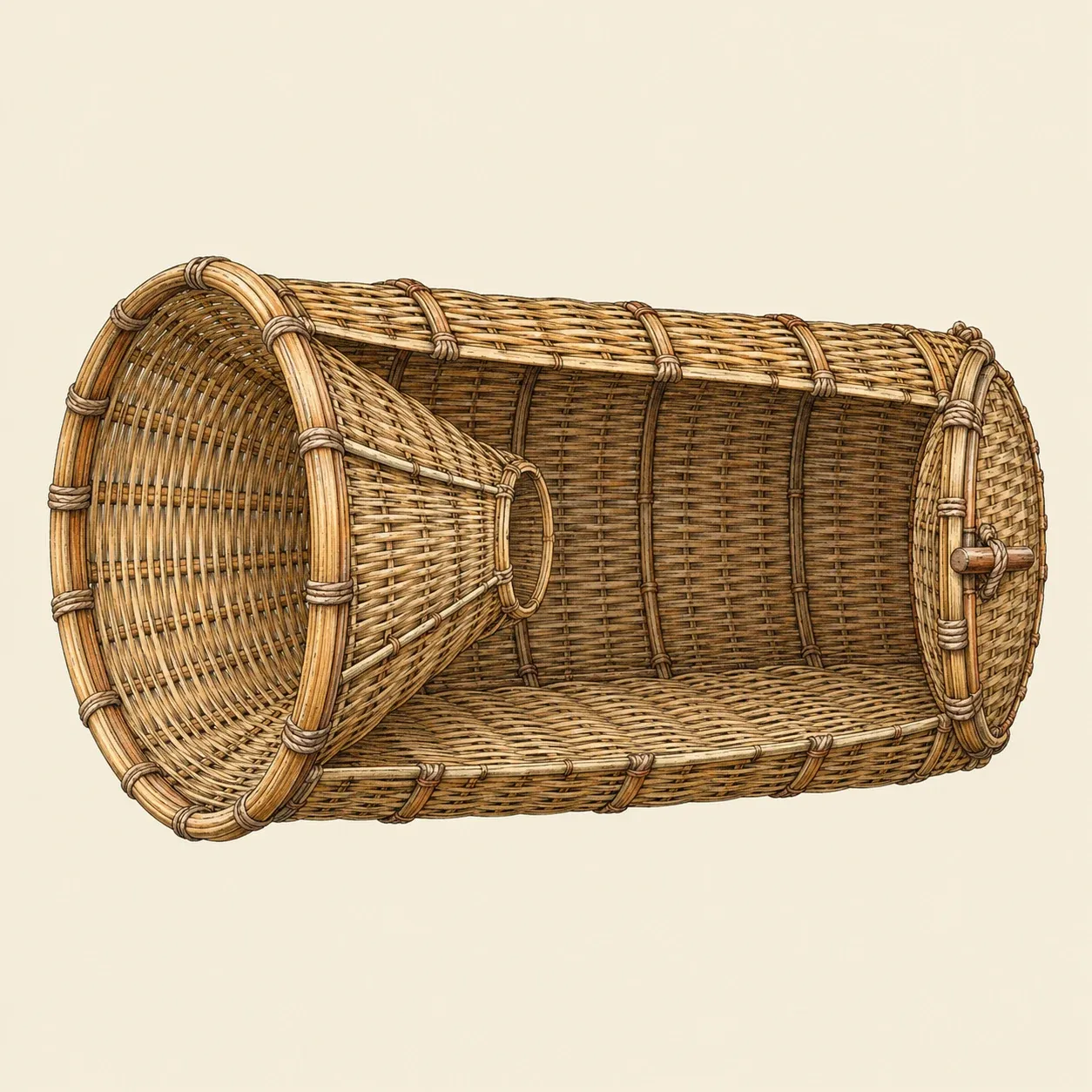 The funnel ends inside the chamber; a separate closure gives access to the catch.
Water passes between the rods of a basket trap. Its broad entrance narrows to an opening projecting into the chamber. Fish may follow that route inward, then have difficulty finding the small opening away from the outer wall. Some animals still swim back out through the narrow end of the funnel, so the trap must be emptied regularly. A separate rear closure lets the chamber be emptied without dismantling the entrance. Gaps between the rods also affect what is retained. Lost gear can continue catching animals long after the person who set it has left, a problem known as ghost fishing.
How to do it
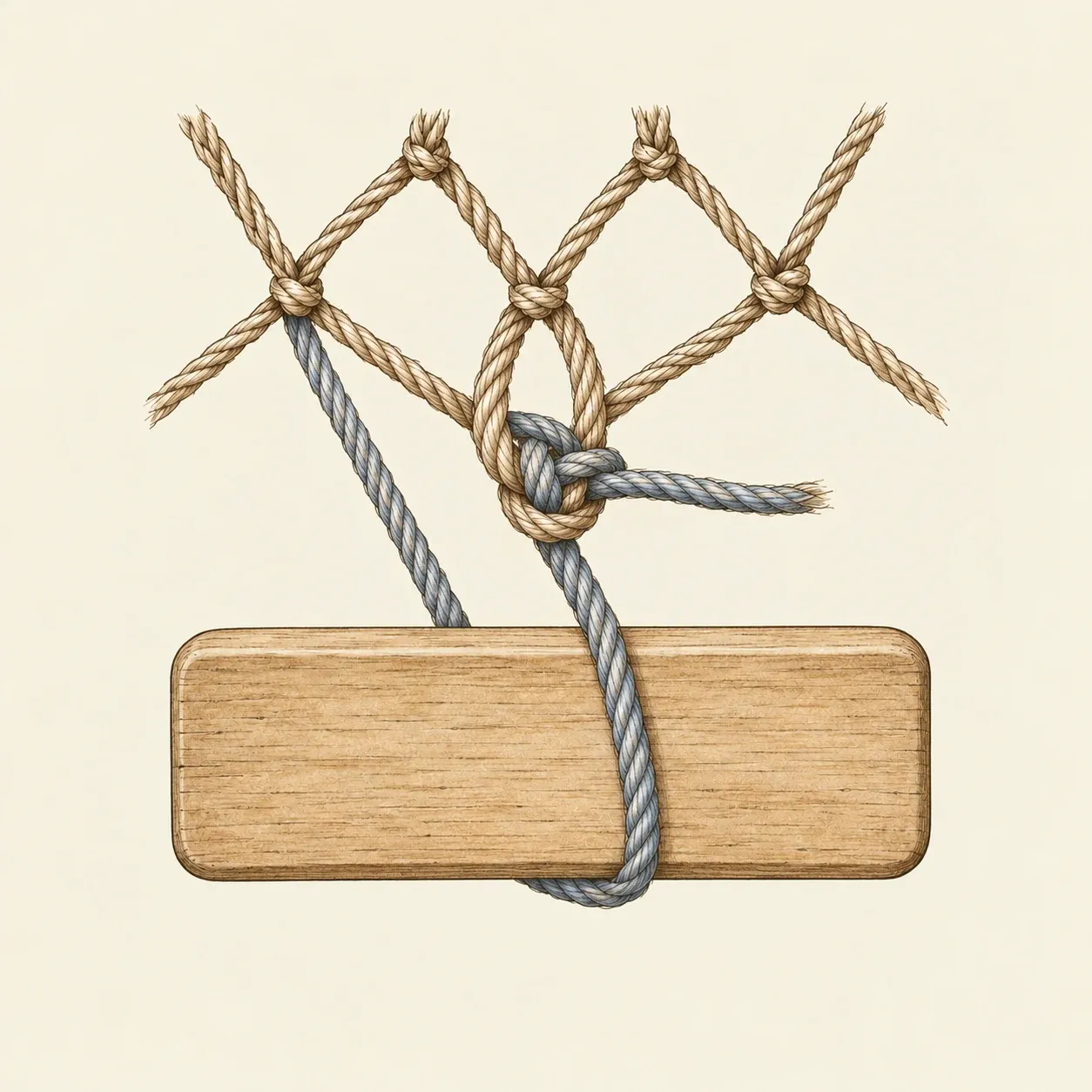 The gauge keeps the loops consistent while each knot is tightened.
For a net sample, stretch an edge rope between two fixed points on a table. Use even cord and a flat wooden gauge with rounded edges. Attach a row of starting loops to the rope, sizing every loop over the same gauge. For the next row, take the working cord around the gauge and through the preceding loop. Make a sheet bend: pass through that loop, go around both its strands and tuck the working end beneath its own crossing before tightening. Keep the opening spread until the knot seats so its size does not change.
Repeat across the row, withdraw the gauge and turn the work for the next row. Several rows will show how the diamonds move. Pull each junction separately and remake any slipping knot. Lash the lower border to another edge rope. Tie dry wooden floats along the top and small pebbles along the bottom, held in closed lashings.
For a small basket trap, bend flexible rods into hoops, lash their ends and connect them with lengthwise uprights. Interlace thinner rods around the uprights as in basket making. Make an open-ended cone separately. Fasten its broad end to the front hoop, leaving its narrow end open inside the chamber. Close the back with a removable panel, hinged by lashings on one side and secured with an undoable tie. Smooth projecting ends. Test the entrance and emptying closure with inert objects on land.
Before any real use, check local permits, legal gear, seasons, species and size limits. Plan frequent checks and prompt release of unintended catches under the applicable rules. Never leave gear abandoned. Do not enter deep water or a dangerous current to install or retrieve a model.
History and evolution
The oldest dated net comes from Antrea, on the Karelian Isthmus, a former Finnish parish now in Russia. In 1913 and 1914, drainage work at Korpilahti brought up the remains of a net made of willow bast, with floats of pine bark and stone sinkers, along with stone and bone tools. The gear lay in the clay of an ancient lake channel, probably lost when a boat capsized. A 2008 study dates the loss to about 8400 to 8300 BCE; other estimates go back to 8600 BCE.
Off the southern coast of Sweden, divers from Södertörn University reported finger-thick hazel rods in 2012, lying 5 to 12 m deep in a drowned river valley. They were read as the remains of seven stationary basket traps, or of fences that led fish into baskets. Only one basket was radiocarbon dated, to about 9,000 years ago.
Different uses produced different net arrangements. Set gill nets stay in place and drift nets move with the current, both fishing passively; seines and trawls are moved around or through the fish and count as active gear. Smithsonian examples also show fixed nets leading into enclosures. Factory-made netting has not removed the work of fitting floats and weights or mending torn meshes. Synthetic strands last longer, and lost gear made from them keeps fishing for longer too.