Basketry
An esparto basket in two-strand twining
Contents
- 1Base with crossed uprights
- 2Uprights raised to form the wall
- 3Pair of active twining strands
- 4Staggered leaf splice
- 5Folded rim with secured ends
Two working strands cross around a basket's uprights to hold its shape. Preserved esparto baskets from Cueva de los Murciélagos show hunter-gatherers using this technique in southern Spain.
What it is
A basket turns flexible plants into a container. Its base supports the contents, the walls keep them together, and a finished rim stops the last rows from unravelling. A small esparto basket can be twined from leaves alone: bundles of long leaves form the uprights, and a long leaf folded in two gives the pair of working strands. It needs no mould, glue or firing, and the maker does not have to start with a finished rope.
Basketry includes several different structures. In twining, two active strands enclose successive uprights. Plaiting interlaces elements without this wrapping pair. Coiled basketry joins successive turns of a bundle with stitches. Each construction leaves different traces and calls for different hand movements. A light basket of this kind is meant for dry objects.
How it works
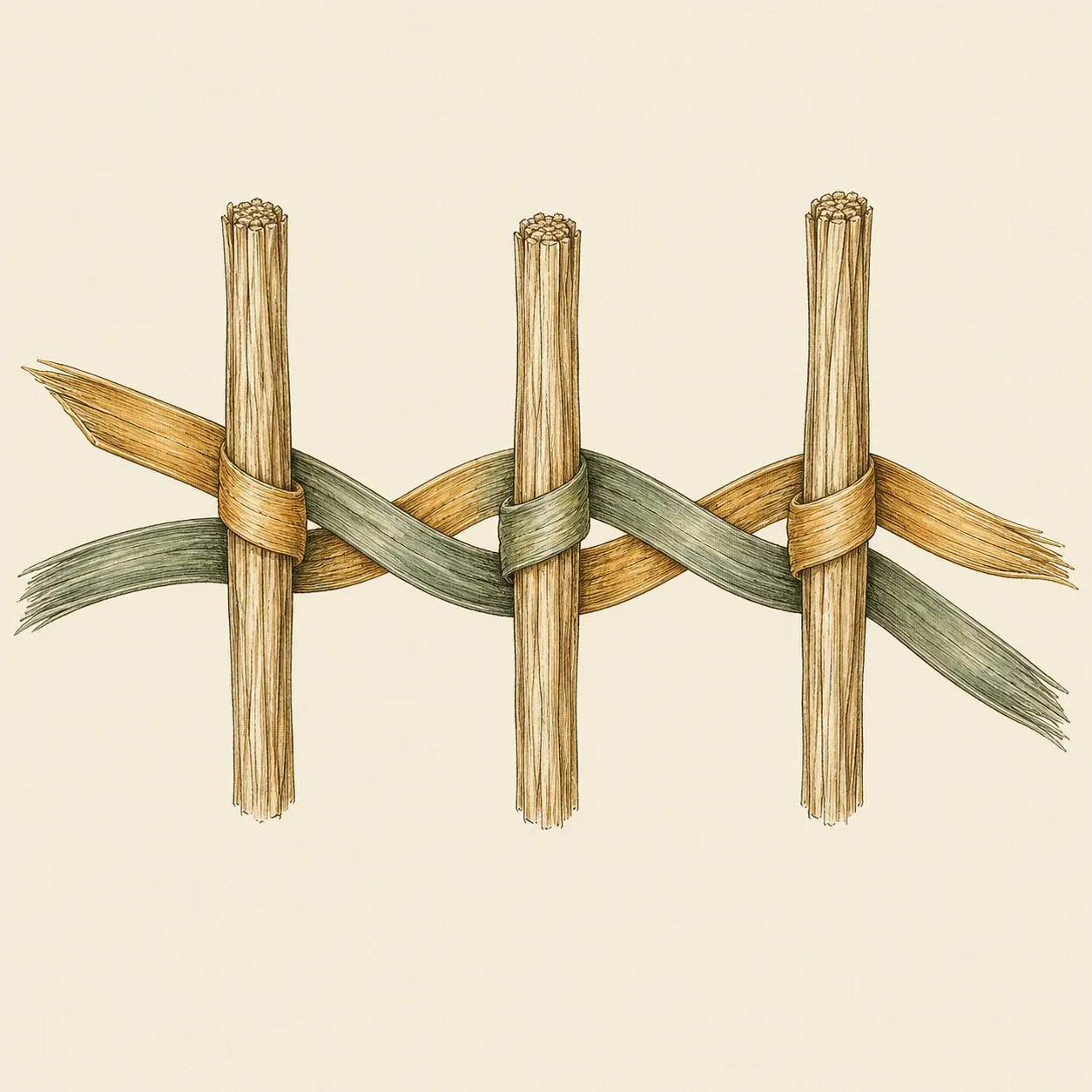 The strands exchange places between neighbouring uprights.
The uprights, each a small bundle of leaves, form the passive framework. One working strand travels in front of an upright while its partner goes behind it. Between that upright and the next, the strands cross and exchange positions. Repeating the movement traps each upright between them. Pushing rows closer together closes the gaps in the wall. Friction at the crossings and tension in the strands resist slipping, though pulling too hard can buckle the base or split a leaf. Even work is more useful than brute force. Following each strand with a finger helps reveal a missed crossing before another row covers it.
The positions of the uprights set the shape. Spread them out in one plane and the base grows wider. Bend them upwards gradually and subsequent rows form a wall. Joining both working strands at the same point would produce a thick, uneven patch, so their splices are staggered. Tucking the ends under several passages holds them in place. Folding and securing the uprights completes the rim.
How to do it
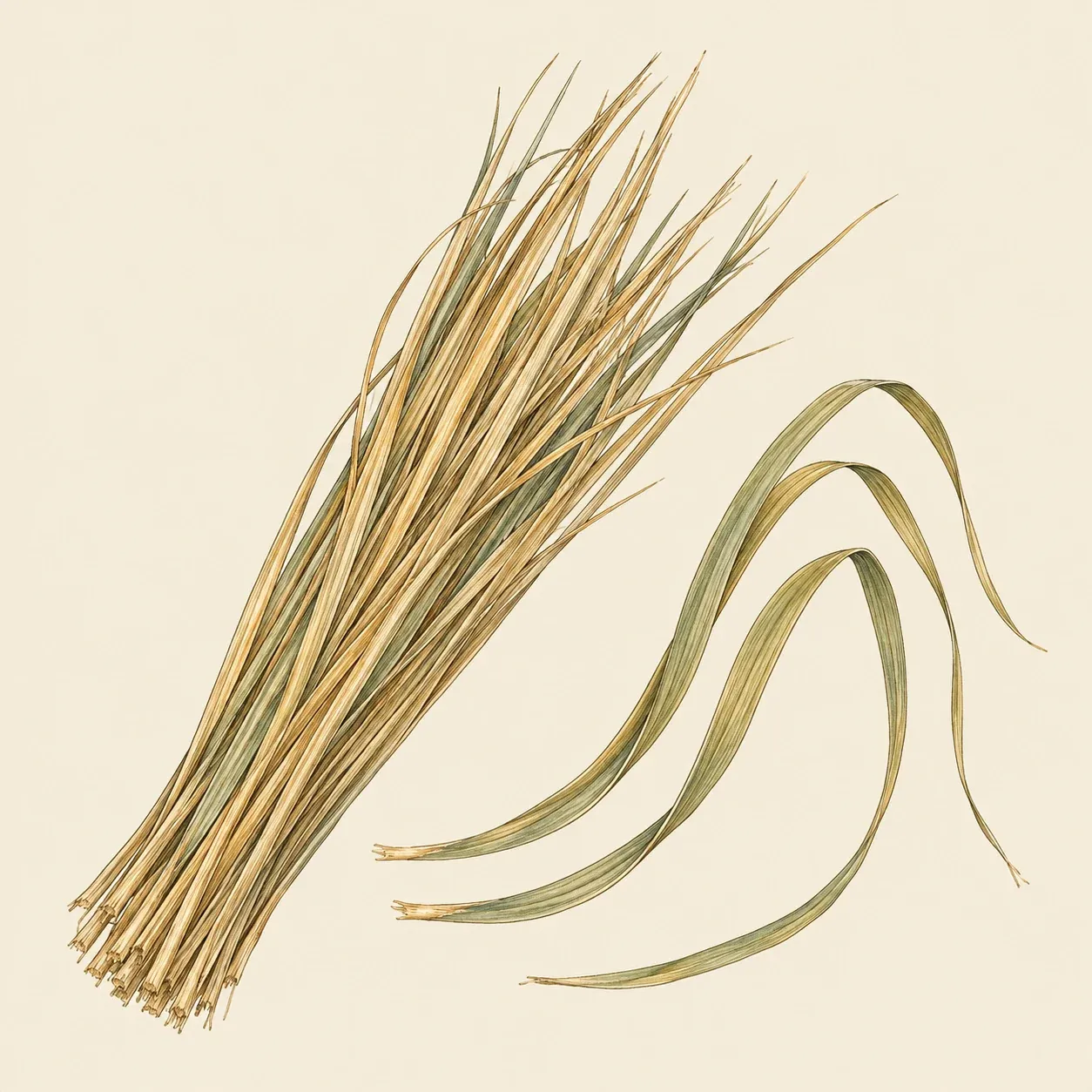 Water softens the intact leaves without crushing them.
Use long, sound leaves from a reliably identified plant, collected with permission or bought for basketry. Avoid irritating plants and material from polluted ground. Wear gloves if the edges cut, and direct any cutting tool away from the hand holding the leaves. The Murciélagos study describes a traditional esparto preparation: drying for 20 to 30 days, then immersion for about 24 hours to soften raw leaves. Test a leaf by bending it gently; it should flex without splitting. Keep the working supply pliable without allowing stored leaves to grow mould.
For a first exercise, cross small groups of long leaves at their centres. Their free ends will become the uprights. Fold a long working leaf around one group to make a pair of active strands, then twine around the groups. Gradually split the groups into smaller bundles of a few leaves, each bundle becoming one upright, and keep crossing the pair between every two uprights in the same direction. Keep the small base flat and ease each row against the previous one.
Raise the uprights a little at a time to make a low wall. Before a working strand runs out, overlap a fresh leaf and trap the overlap under several passages. Replace the other strand elsewhere. Bend the uprights into the rim and tuck their ends into the final rows without tearing them. Air-dry the basket in a ventilated place and discard mouldy fibres. Try a few light objects while it rests on the ground before carrying it. Do not use it for heavy loads or to hold food, and do not fit handles intended to lift a person.
History and evolution
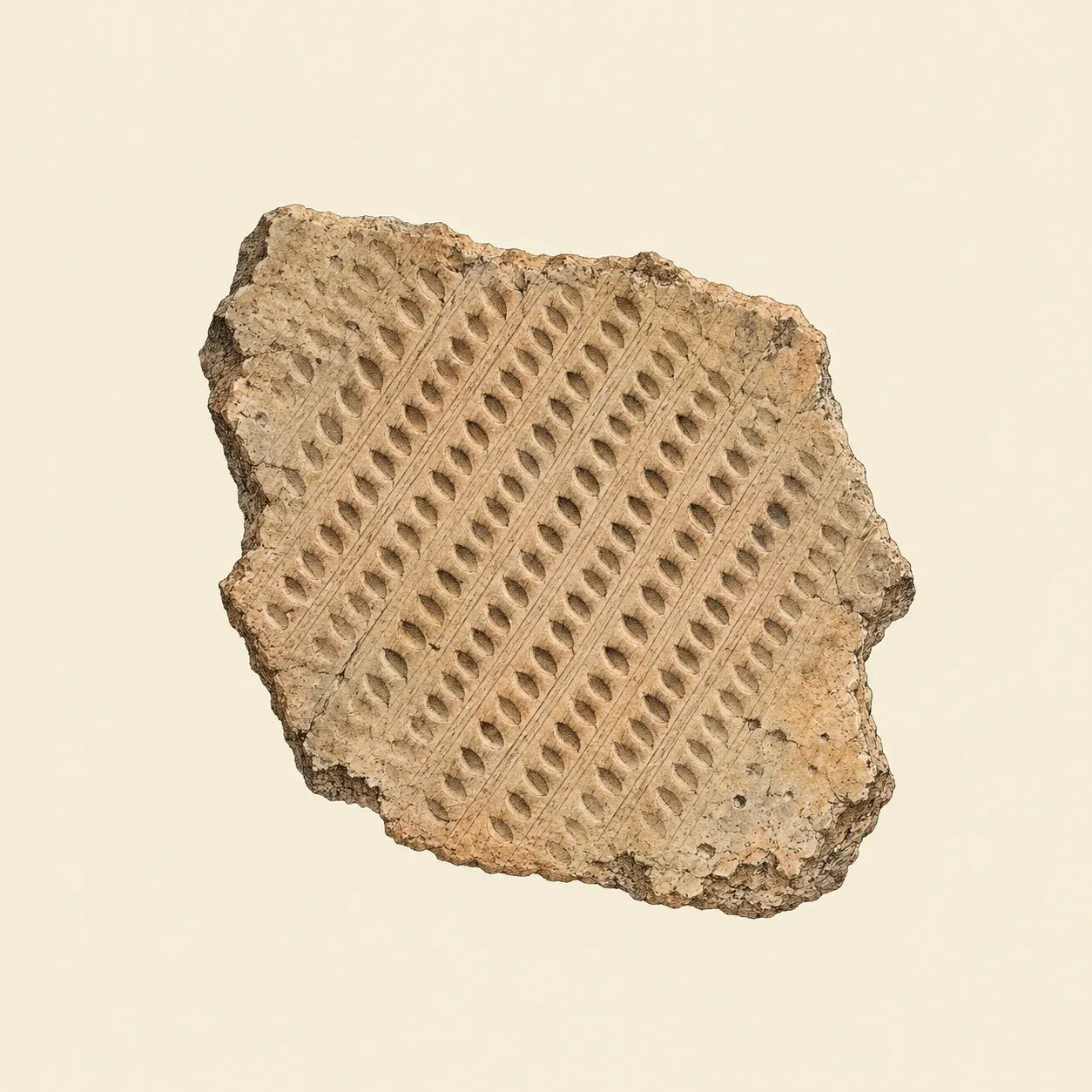 Fired clay can keep the imprint of interlaced fibres that have since rotted away.
Plant fibres were interlaced long before the oldest surviving baskets. At Pavlov I, in Moravia (Czech Republic), fragments of fired clay about 26,000 years old carry the imprints of finely interlaced fibres, with at least two kinds of weave. James Adovasio, Olga Soffer and Bohuslav Klíma described them in 1996. The imprints may come from baskets, bags or mats; the fibres themselves have rotted away.
Baskets rarely survive. In the dry Cueva de los Murciélagos, near Albuñol in southern Spain, three almost complete baskets of uncrushed esparto, made by simple twining, have been radiocarbon dated to about 9,500 years ago, around 7500 BCE. A team from the Universidad de Alcalá and the Universitat Autònoma de Barcelona published them in 2023 as the oldest basketry made by hunter-gatherers in southern Europe.
The study covered 76 organic objects from the cave, dated from about 9,500 to 6,200 years ago. In the Neolithic part, raw esparto is still used, crushed esparto also appears and so do other methods, such as stitched coiling, along with sandals. Nineteenth-century miners disturbed the finds, so their original links with the burials are only partly known.