Koji fermentation
Growing a mould on cooked grain so that its enzymes ferment food
Contents
- 1Shallow wooden tray
- 2Layer of steamed rice grains
- 3White felt of mould threads over the grains
- 4Threads growing into a grain (magnified)
- 5Spore-bearing head of Aspergillus oryzae
Koji is steamed rice, barley, wheat or soybeans on which a mould, most often Aspergillus oryzae, has been grown until it is full of enzymes. Mixed with more grain, beans, salt or water, those enzymes turn starch into sugars and proteins into smaller pieces, the first step of sake, miso and soy sauce. Moulds grown on rice were already used to ferment a drink at Shangshan, in southern China, some 10,000 to 9,000 years ago.
What it is
Koji is grain or beans that a mould has colonised. In Japan the word means both the mould and the cooked rice, barley, wheat or soybeans it grows on. The mould is most often Aspergillus oryzae. It is grown on purpose in thin layers kept warm and very damp, and harvested before it turns green with spores. What the maker wants from it is its enzymes, the proteins that a mould releases to digest its food.
Koji is the starter of many East Asian foods and drinks. Rice koji mixed with steamed rice, water and yeast becomes sake. Soybeans mashed with koji and salt and left to mature become miso. Soybeans and wheat grown over with koji, then soaked in brine, give soy sauce. In China, ferments of the same family are called qu. They are often pressed into bricks of crushed grain and carry several moulds, yeasts and bacteria at once; some rely on a red mould, Monascus, the mould of red koji.
Traditional koji is made in a warm room lined with wood. Steamed rice is cooled, sprinkled with a powder of dried spores and spread in shallow wooden trays stacked on shelves. Workers turn and loosen it by hand while it grows.
How it works
Steaming prepares the grain. Raw starch is packed in hard granules that enzymes attack only slowly; heat and water swell and soften them, so the starch becomes easy to digest. The rice is then cooled before the spores are added, because heat would kill them.
The spores sprout fine threads, called hyphae, that run over the surface of each grain and push into it, and the grains are soon covered with a white felt. The growing mould breathes and gives off heat, so the layer warms up by itself; turning it by hand lets the heat out and brings in air. As the grains dry a little, the mould slows down and stops. By then the threads have released large amounts of amylases, which cut starch into sugars, and proteases, which cut proteins into peptides and amino acids.
Makers choose their strain for the job. A sake koji needs a mould that makes plenty of amylase, since the sugar it frees is what the yeast turns into alcohol. A soy sauce koji needs more protease than amylase, because the flavour comes from broken-down soy protein; some soy sauce is made with a close relative, Aspergillus sojae. Left to grow on, the mould raises upright stalks ending in round heads covered with chains of yellow-green spores. Those spores are dried and sold to start the next batch.
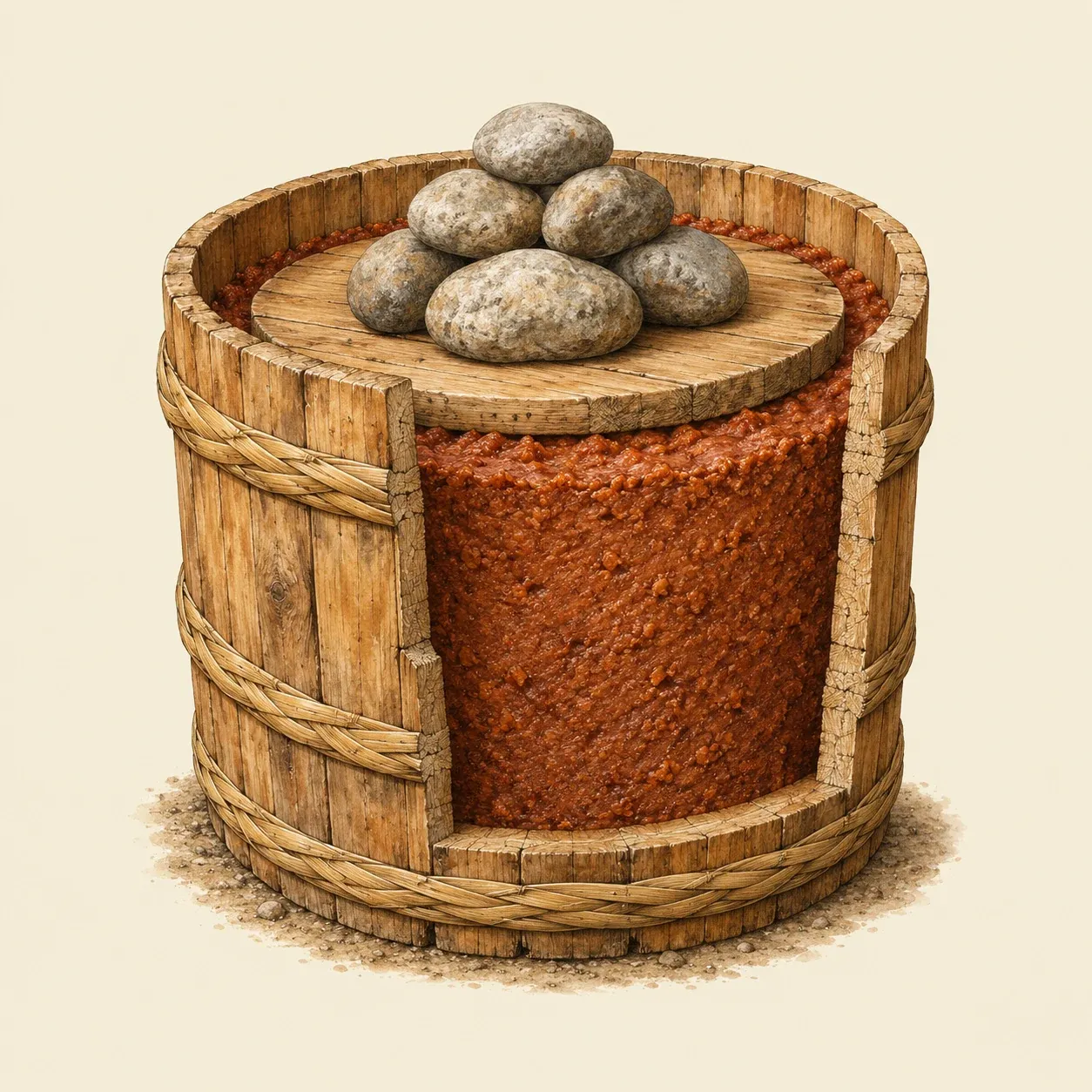 Miso matures under a lid weighed down with stones.
The work of the koji goes on after it has been mixed in. In miso, its enzymes keep digesting the soybeans while the paste matures, and microbes that tolerate salt join in: a yeast, Zygosaccharomyces rouxii, and a lactic acid bacterium, Tetragenococcus halophilus. The salt holds back most other microbes, and the paste darkens and gains flavour with time. Rice miso can be ready fairly soon, while soybean miso matures for months, and longer still without heat treatment.
Aspergillus oryzae is a domesticated mould. Its genes are almost identical to those of Aspergillus flavus, a common mould of crops that can make aflatoxin, a strong poison. Japanese studies of starter strains in the 1970s found that none of them produced aflatoxin, and genome work has since shown that the genes needed for it are partly deleted or silent in koji strains.
How to do it
Growing koji is not a home project: a warm, damp tray of cooked rice welcomes wild moulds just as well, some of them poisonous, and a beginner cannot tell them apart. Dry rice koji, sold in some food shops, shows its main enzyme at work without growing anything.
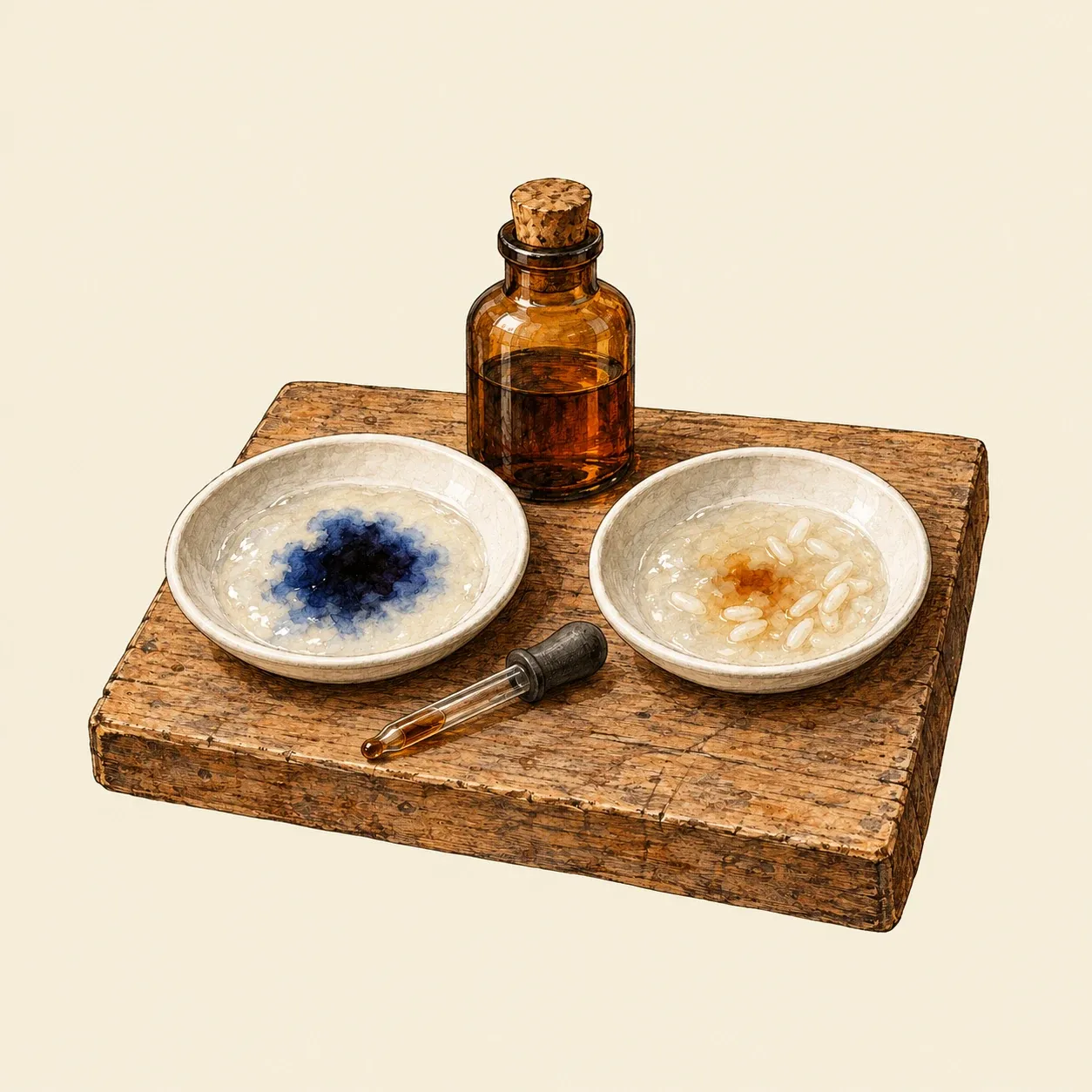 Iodine turns blue-black where starch remains and stays brown where koji has broken it down.
Stir a spoonful of cornflour or potato starch into a little cold water. Ask an adult to pour hot water from the kettle over it while you stir, until it turns into a thin, clear paste, and let it cool until it is barely warm. Put a spoonful of paste in each of two saucers. In the second, mix in a pinch of koji grains crushed with a few drops of lukewarm water. Cover both saucers and wait.
Then add a drop of iodine solution to each. Iodine is yellow-brown on its own and turns blue-black when it meets starch. The plain saucer turns dark at once. In the saucer with koji, where the amylase has been cutting the starch into sugars, the colour stays lighter, and after a longer wait it stays brown. To check that an enzyme is at work, an adult can first boil a pinch of koji in a little water: heat destroys the enzyme, and that saucer turns blue-black like the plain one.
History and evolution
The oldest traces of moulds grown on grain to ferment it come from the lower Yangtze region of China. At Shangshan, in Zhejiang, pots from the earliest phase of the site, some 10,000 to 9,000 years old, hold residues of rice together with remains of yeasts and of the red mould Monascus. The researchers read them as traces of a qu starter, moulds grown on rice to brew a drink. At Qiaotou, a site about 9,000 years old in the same province, pots for drinking held moulds whose shape matches Aspergillus and Rhizopus, identified by their form rather than by species. Machida and his colleagues, writing on the genetics and history of koji, place the origin of this kind of fermentation in China 3,000 to 2,000 years ago, much later than these residues.
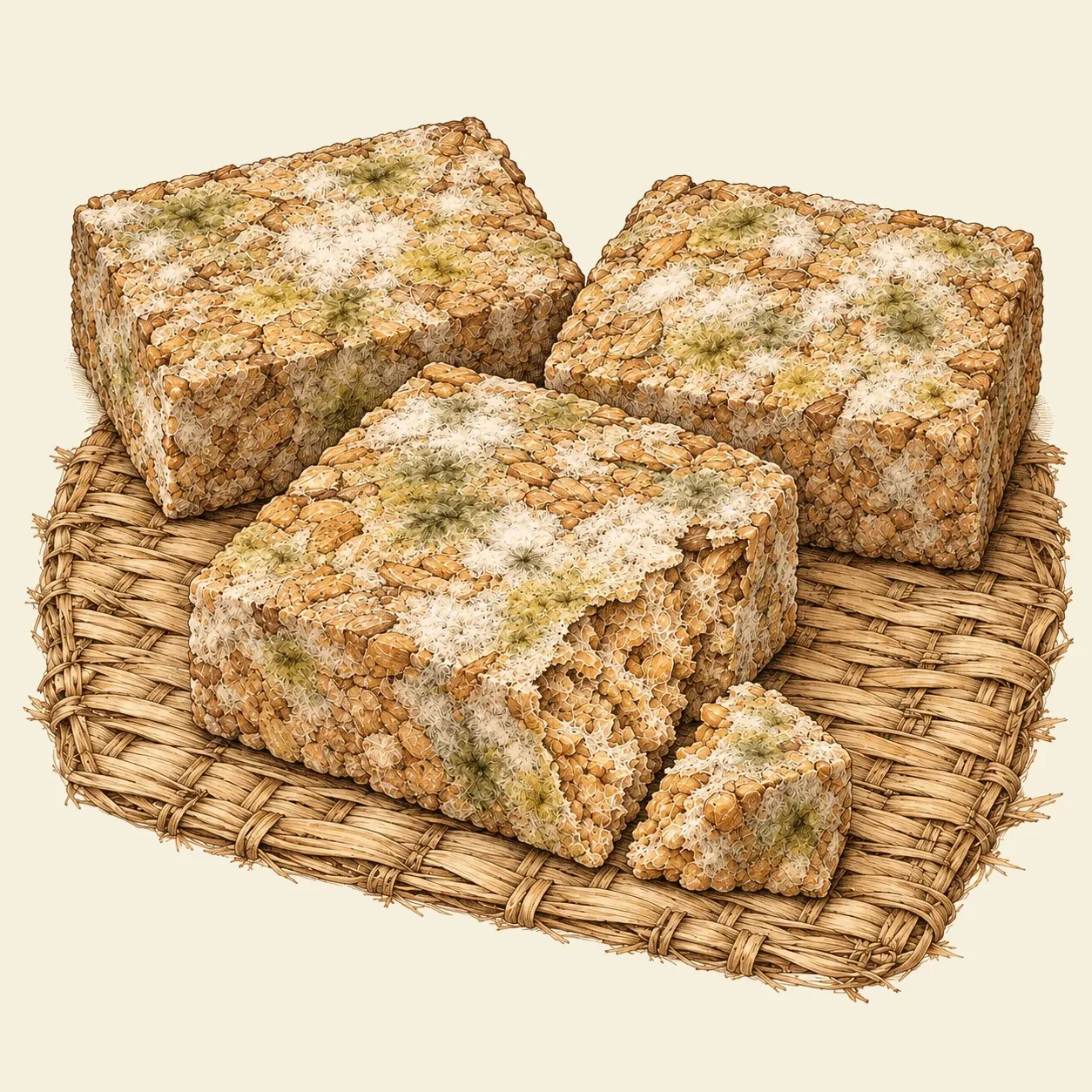 Chinese ferments are often pressed into bricks of crushed grain in which several moulds grow.
Chinese scholars of the 2nd century CE already wrote of pastes of soybeans, meat or fish made with grain ferments. A farming manual of the 6th century, the Qimin yaoshu, gives a soybean paste made with ferments of powdered and whole wheat, salt and brine. These pastes, jiang in Chinese, became hishio in Japan, and in the 8th century a palace office attached to the imperial kitchen made hishio from soybeans.
In Japan the starter became a trade. In the Muromachi period, from the 14th to the 16th century, sellers of koji spores were organised in a guild, the Koji-za. Spore makers grew their cultures with the white ash of burnt hardwood leaves, which held back unwanted microbes. In the 1870s Hermann Ahlburg, a German teaching in Tokyo, isolated the mould from koji and named it Eurotium oryzae; Ferdinand Cohn later renamed it Aspergillus oryzae.
The mould then entered industry. In 1894 Jokichi Takamine patented a way of growing it in thin layers on damp wheat bran and extracting its starch-digesting enzyme, sold as Taka-diastase, a remedy for poor digestion. Its genome was sequenced in 2005. Comparisons with Aspergillus flavus point to a mould domesticated by long selection in the hands of starter makers, which has lost the ability to make aflatoxin and makes enzymes in great quantity.