Caxixi
A woven rattle with a gourd base
Contents
- 1Woven handle
- 2Basketwork wall of spokes and weavers
- 3Base cut from a gourd
- 4Dry seeds
- 5Lacing that holds the base
The caxixi is a small closed basket rattle from Brazil, woven of straw, vine or cane into a bell shape, with a flat round base cut from a gourd and a handful of dry seeds inside. Shaken, the seeds strike the hard base and the woven wall. Berimbau players hold it in the hand that strikes the bow, so that it sounds with every stroke. The oldest known description of a bow player with a basket rattle is by James Wetherell, British vice-consul in Bahia, published in 1860; Peter Fryer dates the passage to 1856.
What it is
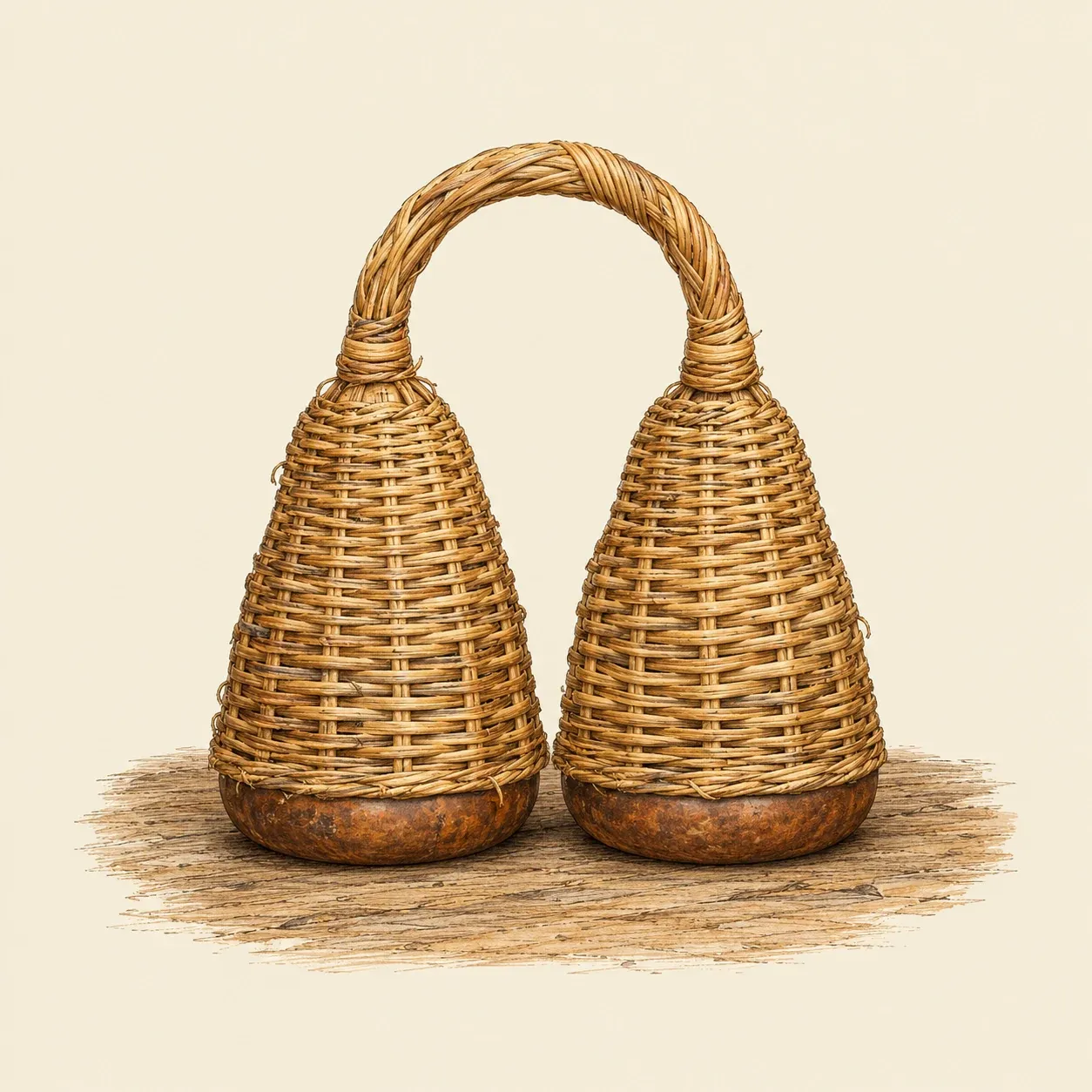 A double caxixi: two rattles sharing one handle.
The caxixi is a closed rattle made of basketwork. Its body is shaped like a small bell or a beehive, narrow at the top and wide at the bottom. Split vine, straw, rush, cane or strips of bamboo bark are woven over a set of spokes that spread from the top downwards. The wide end is closed by a flat disc cut from the shell of a dried gourd, sometimes from a coconut shell. A loop of the same woven material forms a handle at the top. Dry seeds are sealed inside before the body is closed; makers in Brazil use the hard, round seeds of Job’s tears among others.
Most caxixis are small enough to hang from two fingers. One in the Ethnological Museum in Berlin is 19 cm high and weighs 10 g. Some are made in pairs, two rattles joined by a single handle, like one woven of coconut leaf in Rio de Janeiro and acquired in 2013 by the Museum of Anthropology in Vancouver. In Brazil the caxixi is best known as the companion of the berimbau in capoeira. It is also played in candomblé ceremonies, in samba and in coco, and percussionists in many countries use it on its own.
How it works
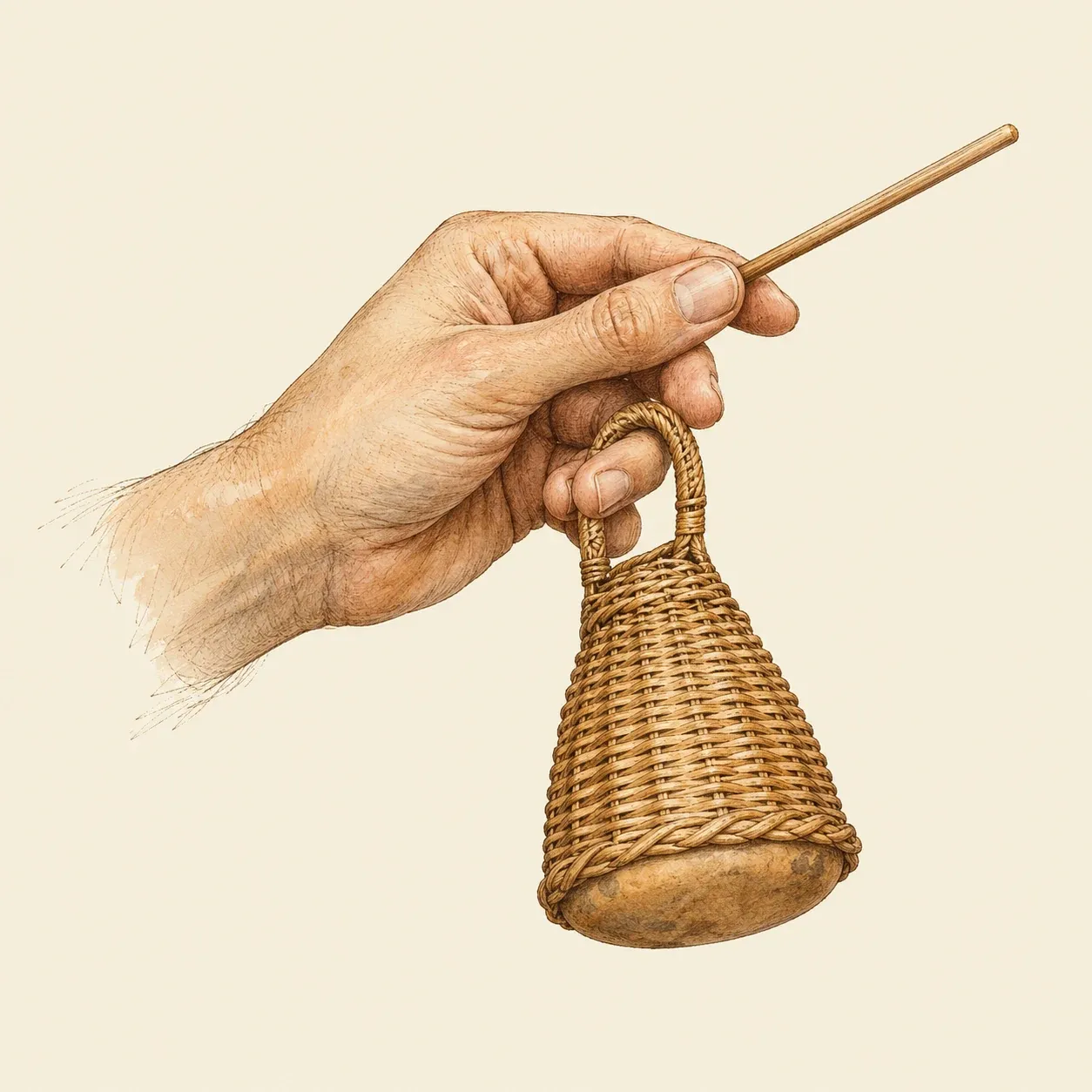 With the berimbau, the caxixi hangs from the fingers of the hand that holds the stick.
The caxixi has no part that is tuned. It belongs to the vessel rattles, a group of idiophones in which loose particles strike the inside of a closed container. Each time the hand changes direction, the seeds carry on moving and hit the container. Against the hard gourd base they give a sharp click, against the woven wall a drier rustle, and the sound has no definite pitch. Played alone, the caxixi is shaken mostly up and down, so that the seeds are thrown against the base and the top in turn.
A berimbau player slips the handle over the middle fingers of the right hand, the hand that holds the stick. Every stroke on the wire then shakes the rattle, and its click falls with the stroke and stresses it. Between strokes the player can shake the caxixi alone, filling the gaps in the rhythm or ending a phrase. Many capoeira rhythms include passages played on the caxixi alone. The ethnomusicologist Kazadi wa Mukuna described its part as doubling the basic pattern of the stick and adding small ornaments between the strokes.
How to do it
A simple caxixi can be woven with basketry cane or rattan, sold for chair seating, and a small dried gourd. Soak a dozen spokes about 40 cm long, one more spoke about 20 cm long and a long, thinner weaver in water until they bend without cracking. Bind the twelve long spokes together at their middle, bend them over so that both halves point down, giving 24 ends, and wrap the bend tightly with weaver to form the handle loop. Push the short spoke into the wrapping beside them, so that 25 spokes hang down.
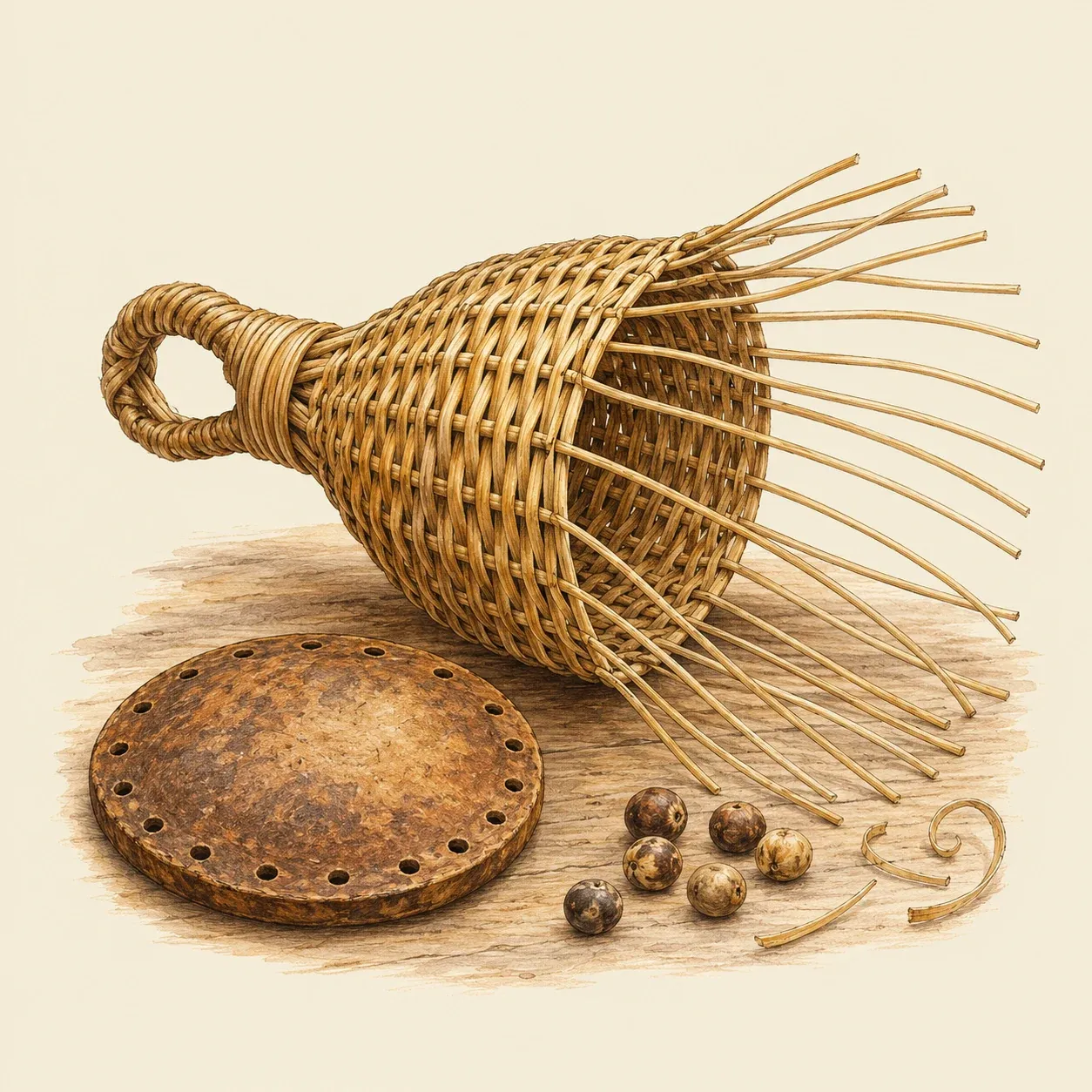 The weaving starts at the handle and widens downwards; the gourd disc closes the bottom.
Just below the handle, start weaving the weaver over and under the spokes in a spiral, pressing each round down against the last. Because the number of spokes is odd, each round passes on the other side of every spoke from the round before, and the weave locks. As you go down, spread the spokes a little at each round so that the body widens into a bell about 12 to 15 cm high. Keep the weave close: seeds must not escape through it. Leave the last few centimetres of spokes free.
Cut a disc slightly wider than the open end from the wall of a dried gourd, smooth its edge and drill small holes all round it, a few millimetres from the edge. Pour a small handful of dry seeds into the basket, hold the disc against the opening and shake: with too many seeds the sound is dull, with too few it is faint. When it sounds right, fit the disc into the open end, pass the free ends of the spokes through the holes or tie them to the disc with thin cord through the holes, and finish with two or three tight rounds of weaving over the rim. Trim the ends and let the rattle dry.
Safety. Cut away from your body and hold the gourd in a clamp or a vice when drilling it. Wear a dust mask while sanding the gourd. Loose seeds and small rattles are a choking hazard: keep them away from young children, and check that the base stays firmly closed.
History and evolution
Where the caxixi comes from is not known. Waldeloir Rego, who studied capoeira in Salvador, wrote in 1968 that nothing concrete was known about the origin of the instrument or of its name. The Congolese ethnomusicologist Kazadi wa Mukuna, in his study of the Bantu contribution to Brazilian music (1979), linked it to the dikasá, a basket rattle of the Kasai region used in initiation ceremonies by the Luba and the Kuba. The musician and researcher Bira Reis has suggested that the name imitates the rattle’s sound. Roger Vetter, for the Grinnell College collection, notes that basket rattles were probably used by some Indigenous peoples of Brazil before the caxixi entered capoeira.
How it came to be paired with the berimbau is also unclear. According to Mukuna, among the Luba the musical bow and the basket rattle belonged to different ceremonies and were not played together, and researchers think the pairing happened in Brazil. The oldest known description is by James Wetherell, British vice-consul in Bahia, whose notes were published in 1860 after his death: the player strikes the wire with a small stick held between finger and thumb, and from his other fingers hangs a basket-work rattle holding small stones. Peter Fryer, in his history of African music in Brazil, dates this passage to 1856. Kay Shaffer, who surveyed travellers’ accounts in the 1970s, found none that described the two together, and the folklorist Edison Carneiro thought the caxixi joined the berimbau, along with the coin used to stop the wire, in twentieth-century Bahia.
In the 1960s Rego saw it used in Bahia only in capoeira and disputed the claim of the folklorist Luís da Câmara Cascudo that it was played in candomblé. Later researchers record it in candomblé, in coco and in samba. Outside Brazil it has become a common rattle in hand-drum and world-music groups.