Tea processing
Turning fresh leaves into green, black or white tea
Contents
- 1Fresh shoot: a bud and two leaves
- 2Bamboo withering tray
- 3Iron pan set in a stove, for fixing green tea
- 4Bamboo rolling mat
- 5Rolled leaves oxidising in a shallow basket
- 6Drying basket over a charcoal fire
Tea processing turns the young shoots of the tea plant into dry leaves that keep. Its central skill is the control of oxidation: green tea is heated soon after picking, while black tea is rolled and left to darken before it is dried. The oldest tea that survives as dried leaf consists of bundles of tea buds from the tomb of the Chinese emperor Jing, who died in 141 BCE.
What it is
Green, black, white and oolong teas all come from the leaves of one shrub, Camellia sinensis. The type of tea depends on how the leaf is processed. Pickers take the tip of each young shoot, usually a bud and the two leaves below it, and the work that follows turns this soft, wet leaf into a dry one that keeps when it is packed airtight.
Along the way the maker decides how far the leaf’s own enzymes may change it. White tea is withered and dried with as little handling as possible. Green tea is heated soon after picking, which stops those enzymes, then rolled and dried. Black tea is withered, rolled and left to oxidise until it turns coppery, and only then dried. Oolong stops halfway, with part of the leaf browned. Done by hand, the work needs little more than shallow trays and baskets, a pan or a steamer, and a gentle fire for drying.
How it works
In a living leaf, the polyphenols called catechins and the enzyme that oxidises them, polyphenol oxidase, are kept in separate parts of the cell. Withering comes first: the shoots are spread in a thin layer and lose water until about 70% of their weight is moisture. The leaf becomes limp enough to roll without breaking into pieces, and its cell membranes let substances through more easily.
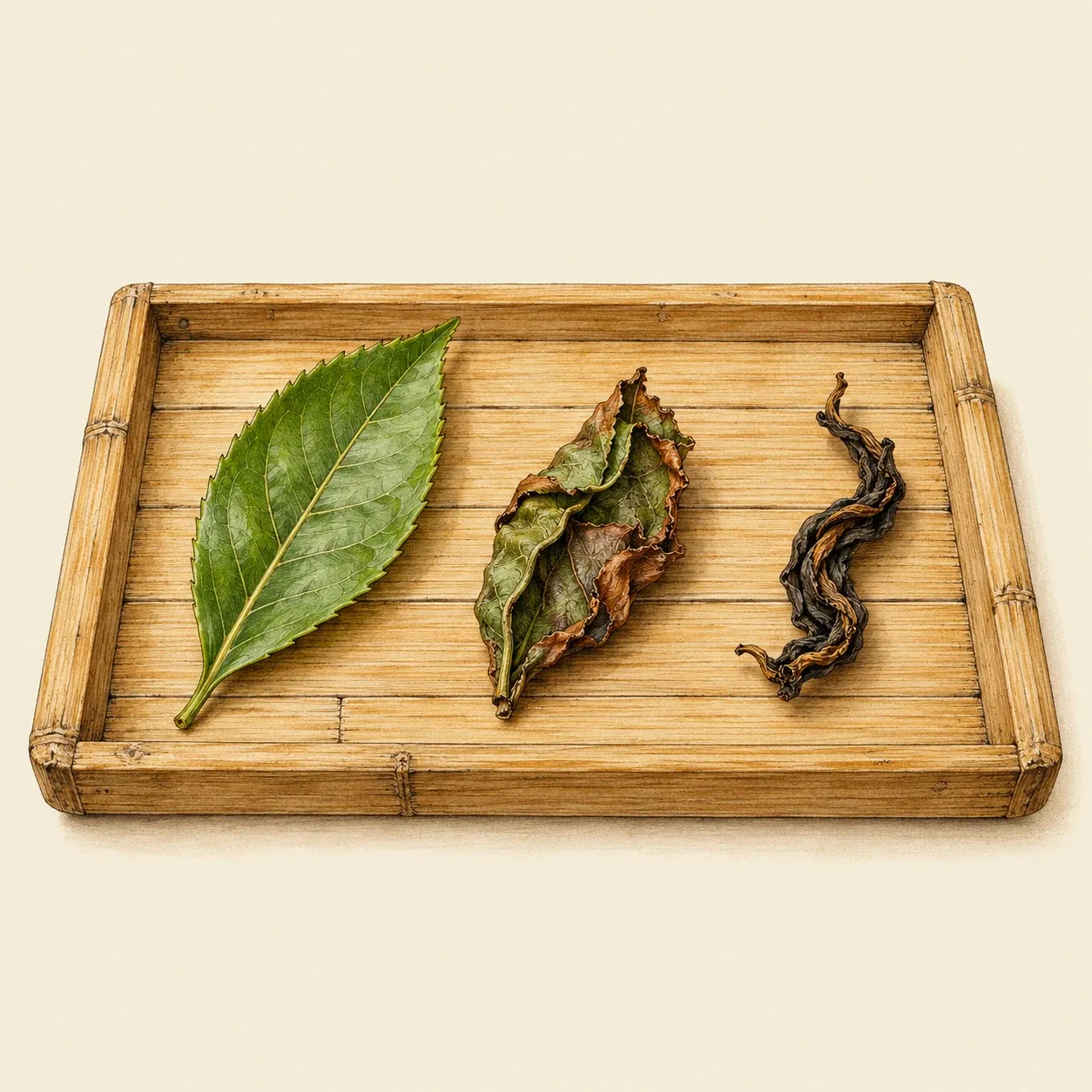 From fresh leaf to black tea: rolling bruises the leaf, and the bruised parts darken first.
Rolling twists and bruises the leaf, breaks its cells and brings the enzyme and the catechins together in the juice. Exposed to the air, the enzyme turns the catechins into larger molecules, the theaflavins and thearubigins, which give black tea its colour and much of its taste. In black tea factories this oxidation, which the trade calls fermentation although no microbes are involved, runs fastest at about 28 °C and is usually kept between 24 and 28 °C.
Heat stops the change. How quickly the enzyme is inactivated depends on both the temperature and the time the leaf spends at it, so green tea is fixed with heat far above the warmth of oxidation. In one study of green tea made in India, the leaves were steamed at about 105 °C for 6 to 8 minutes or fired in a pan at about 250 °C for 8 to 10 minutes. Done right after picking, before any browning, this leaves a colour and polyphenols close to those of the fresh leaf. Steaming is preferred in Japan and India and pan-firing in China and Korea. For black tea, the heat comes only at the end, in the drier, once oxidation has gone far enough. Drying then takes the leaf down to about 5% moisture, and the dry leaf keeps when it is stored airtight.
How to do it
You need a tea plant, Camellia sinensis. On a dry, sunny day pick 250 to 500 g of young shoots, each with a bud and two leaves.
Black tea. The shoots must wilt first. Leave them overnight, about 16 hours, in a thin layer on a cloth or a screen in a room at 20 to 25 °C, until they are limp and soft.
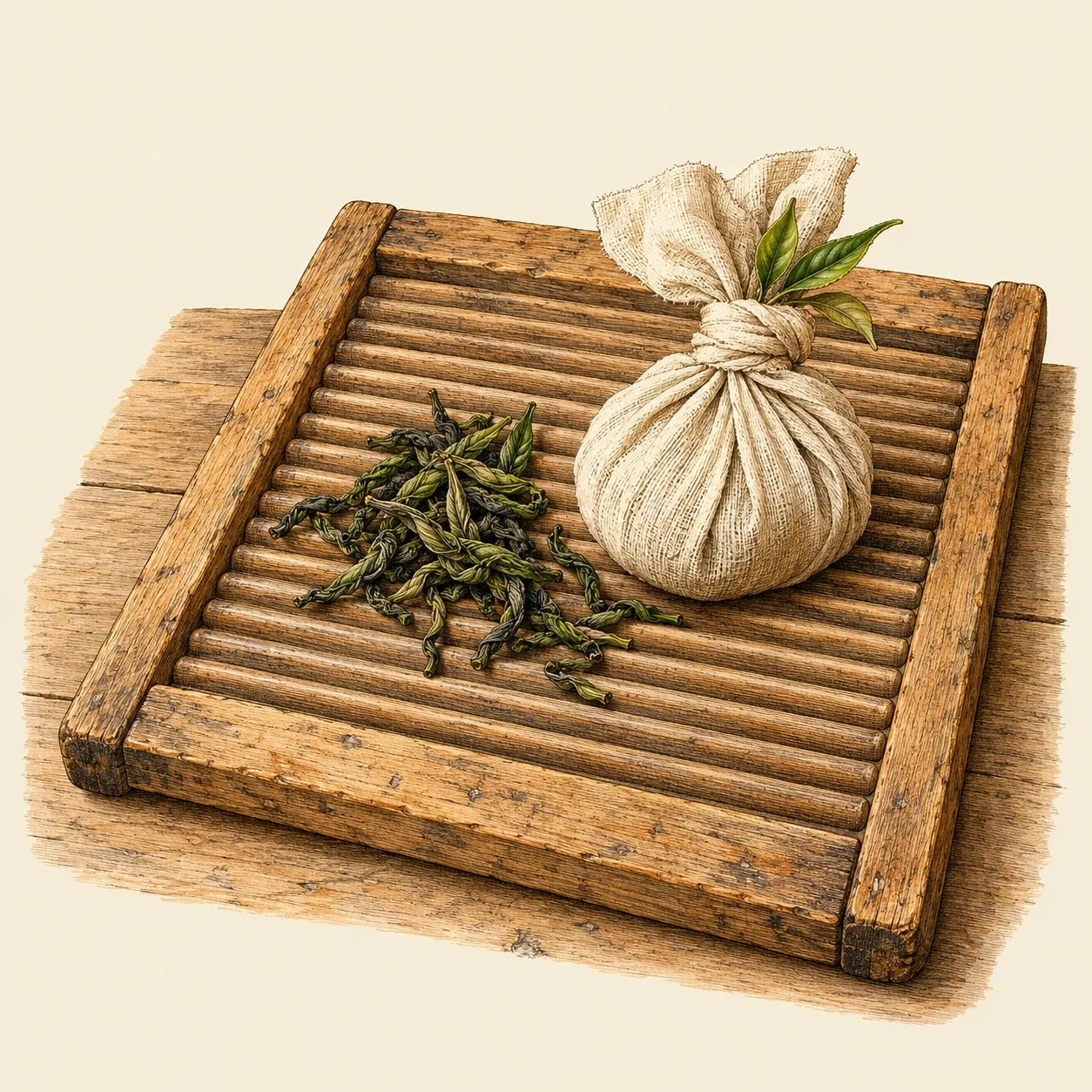 Rolling the withered shoots wrapped in a cloth breaks the leaf cells and starts the oxidation.
Rolling takes the longest. Press and twist the leaves, a handful at a time or wrapped in a cotton cloth, in several rounds of a few minutes, shaking them loose between rounds; after forty minutes or so they are dark, twisted and wet with their own juice. Heap them a few centimetres deep on a tray, lay a thin cloth over them and keep them somewhere warm and humid, at 25 to 30 °C. After about three hours the green has turned to copper and the smell has changed with it. The oven then ends the oxidation: about five minutes at 95 °C, followed by roughly an hour at 60 °C, until the leaves crumble.
Green tea. Heat the shoots soon after picking. Toss them in a dry wok over low heat, or steam them for about two minutes, until they go limp like cooked spinach. Spread them on a cloth to cool for a few minutes, then roll them gently in the cloth for one or two minutes, until a little juice appears. Pan-fry them again for a minute or two, tossing all the time, then roll again. Repeat until the leaves feel slightly crisp and finish drying them over very gentle heat.
White tea. Lay the shoots out indoors or in the sun and let them dry without touching them.
Safety. Make sure the plant is Camellia sinensis and that it has not been treated with garden products that are not approved for food crops. Throw away any batch that smells musty or shows mould.
History and evolution
The oldest tea that survives as dried leaf comes from the mausoleum of Emperor Jing of the Western Han, who died in 141 BCE, near Xi’an. In 2016 Lu Houyuan’s team showed that bundles of plant matter buried there were made almost entirely of tea buds. The same study found tea at Gurgyam in western Tibet, about 1,800 years old, and dates the first clear written mention of tea as a drink to 59 BCE. An older trace of a tea drink comes from a bowl in an early Warring States tomb at Zoucheng, in Shandong, about 2,400 years old, which held tea leaves left after boiling or brewing.
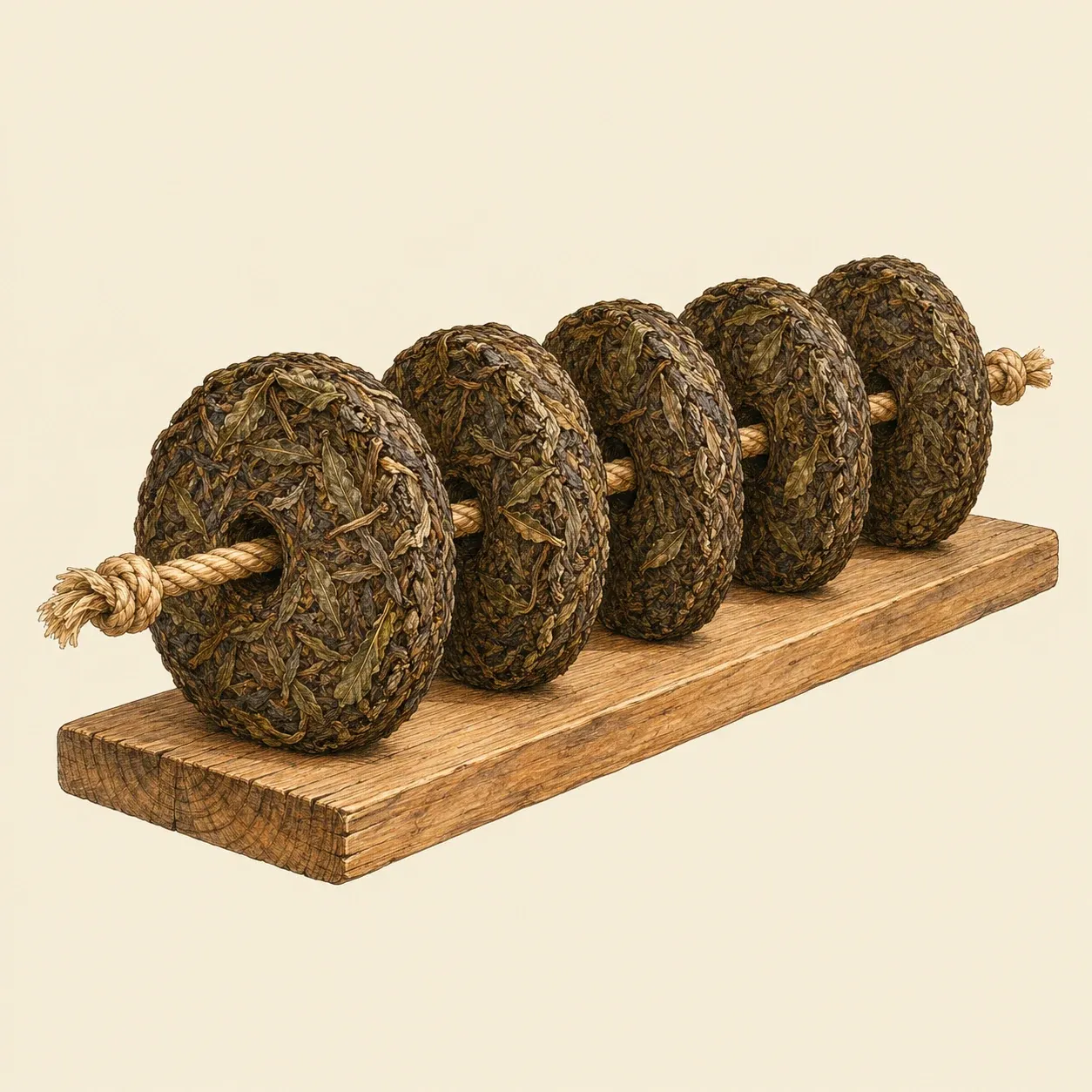 In Lu Yu’s time, tea pressed into cakes was dried and threaded on cords.
In the eighth century, under the Tang dynasty, Lu Yu wrote the Classic of Tea. In his time tea leaves were steamed, pounded in a mortar, pressed into cakes, dried and threaded on strings of reed or bamboo. To make the drink, a piece of cake was broken off, ground to powder and boiled. In 1391 the Hongwu emperor, founder of the Ming dynasty, ordered that tribute tea be sent to the court as loose leaves instead of cakes, and steeping whole leaves in water became the usual way to prepare it.
In 1823 Robert Bruce, on a trading journey, saw tea growing wild in the hills near Rangpur, in Assam. Eight chests of Assam tea were shipped to London in 1838 and sold at auction on 10 January 1839, all to one buyer, a Captain Pidding. In the 1930s plantations that already rolled their leaf in machines began to add the McKercher CTC machine. It passed the rolled leaf between two grooved steel rollers turning at different speeds, which tore it into small pieces, broke nearly all its cells and gave a quick, even oxidation.