Toothbrush
Scrubbing the teeth with fibres, from chewed twigs to bristles
Contents
- 1Bone handle
- 2Tuft of bristles
- 3Hole drilled from the front
- 4Wire pulling the tufts into the holes
- 5Slit along the back, filled with wax
A toothbrush scrubs the film of bacteria off the teeth with the tips of many fibres. The oldest clear description is of the chew stick, a twig whose chewed end frays into a brush, in Buddhist texts in Pali that were written down in Sri Lanka in the first century BCE. Bone handles drilled for tufts of bristle have been found in Tang-dynasty pits in China, from 618 to 907 CE, and nylon replaced animal bristle from 1938.
What it is
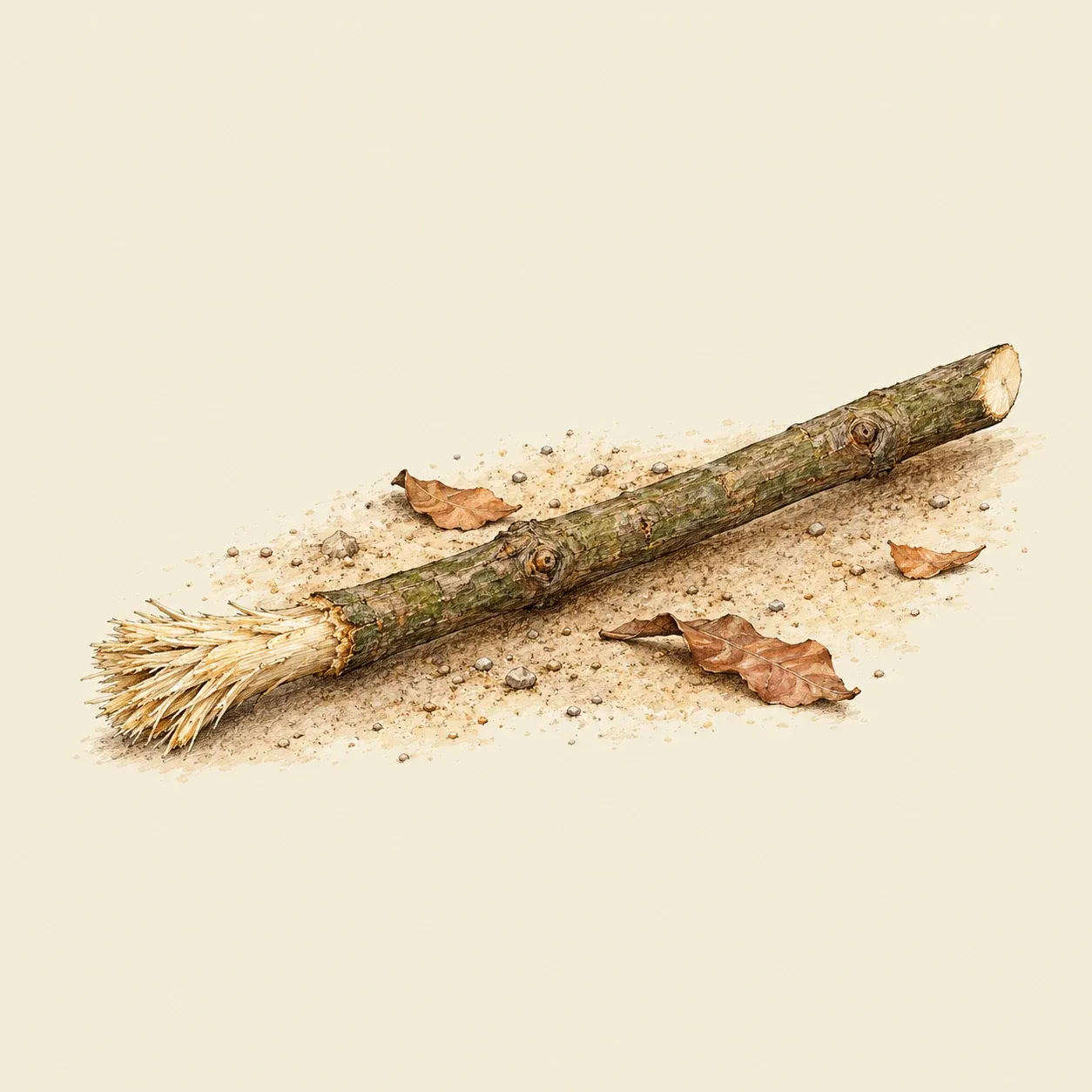 A chew stick: the chewed end splits into fibres that work like bristles.
A toothbrush is a handful of fibres used to rub the teeth clean. The oldest kind is the chew stick: a twig about the size of a pencil, whose end is chewed until it splits into a tuft of soft fibres that are then rubbed over the teeth. When the tuft wears out, the user cuts it off and chews a new one. The bristle brush does the same job with tufts of hair set in rows in a handle of bone, wood or, today, plastic. In an electric toothbrush a motor moves the head of bristles.
Chew sticks are still used across much of Africa and Asia. The best known is the miswak, cut from the arak tree, Salvadora persica, in the Middle East. In West Africa people use twigs of lime and orange trees, and in India twigs of the neem tree.
How it works
Teeth are covered all the time by plaque, a sticky film of bacteria that keeps forming again. Left in place, it causes tooth decay and gum disease. It clings to the teeth and has to be rubbed off. The tips of the bristles, or the fibres of a chew stick, slide over the surfaces of the teeth and into the groove along the edge of the gum, and scrape the film away.
The NHS and the American Dental Association give the same advice: brush twice a day for about two minutes, with a soft brush and a fluoride toothpaste, which helps to prevent decay. The NHS advises spitting out the toothpaste afterwards without rinsing, so that the fluoride stays on the teeth. A brush cleans less well once its bristles are splayed, and the ADA recommends a new one every three to four months. Manual and electric brushes work equally well when every surface is reached. A chew stick adds the juice of the wood it is cut from: arak contains silica, which polishes, and compounds that act against bacteria.
How to do it
This exercise makes a small brush in the old way, with tufts of bristle pulled into holes by a wire. Use it to scrub fingernails, tools or shoes, never teeth: a brush for the mouth must be made from materials and in conditions intended for it.
Take a block of hardwood about 15 cm long, 3 cm wide and 1.5 cm thick. On the front, mark two rows of six holes, about 8 mm apart. Clamp the block and drill each hole right through with a 5 mm bit. Turn the block over and, with a fine saw, cut a groove about 2 mm deep along each row on the back, so that it runs across the holes.
You need bristles bought for brush-making or taken from a cheap, stiff paintbrush, and brass wire 0.5 mm thick. Cut a piece of wire about 40 cm long. From the back, push a loop of wire through the first hole until it comes out at the front. Lay a tuft of bristles about as thick as a pencil through the loop, centred on it. Pull the wire back from behind: the loop drags the tuft into the hole, folding it in half, until the fold sits firmly in the hole and the two halves stand up side by side. Lay the wire in the groove, push a new loop through the next hole and repeat to the end of the row. Twist the two ends of the wire together and press them into the groove. Do the second row the same way.
Fill the grooves with wood glue or melted candle wax so that the wire is covered. When it has set, trim all the bristles to the same height with sharp scissors.
History and evolution
The oldest clear description of a tooth-cleaning tool is in the early Buddhist texts written in Pali. They were handed down by heart for centuries after the Buddha’s time and written down in Sri Lanka in the first century BCE. One short discourse lists five drawbacks of not using a chew stick and five benefits of using one, among them fresher breath and a cleaner sense of taste. The monastic rules tell how monks who did not clean their teeth were told to use tooth sticks. When some monks used long ones to hit novices, sticks longer than eight finger-breadths were forbidden, and when a short one stuck in a monk’s throat, sticks shorter than four finger-breadths were forbidden too.
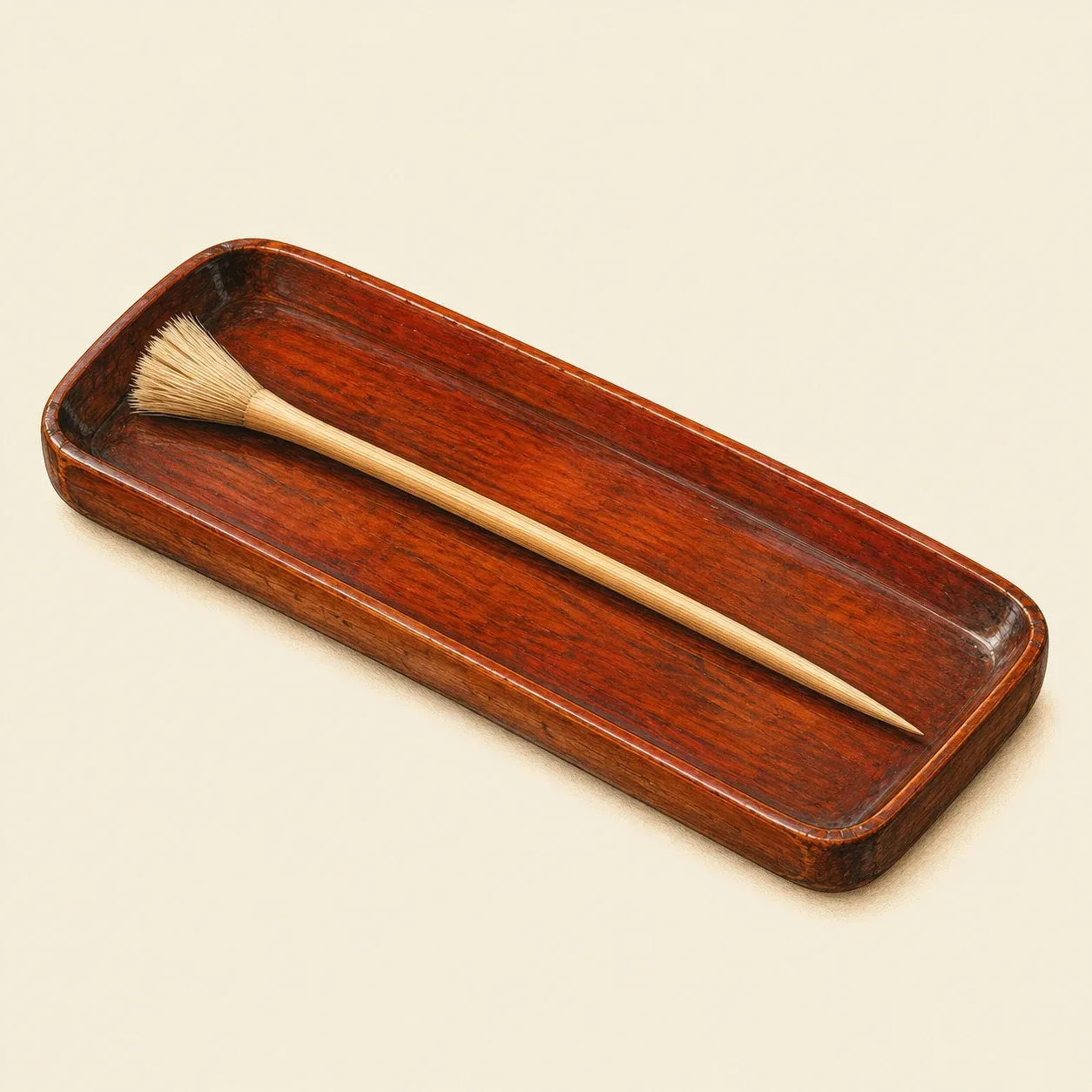 A Japanese fusayōji: the end of a willow twig crushed and combed into a tuft.
Other traditions kept chew sticks too. Arabs used them before Islam, and the Prophet Muhammad recommended the miswak, which made it part of Muslim practice. In Japan, aristocrats, priests and warriors of the Heian period cleaned their teeth with twigs as Buddhism spread. In the Edo period the fusayōji, a twig of willow or spicebush crushed with a wooden mallet and combed into a tuft at one end, reached ordinary people, sold with tooth powder in shops such as one in the grounds of the Sensō-ji temple in Edo.
Brushes with tufts of bristle set in a handle appeared first in China. Bone handles with holes drilled in the head for the tufts have been dug up from ash pits of the Tang dynasty (618 to 907 CE) in Chengdu, in Sichuan. The American Dental Association cites a Chinese encyclopedia that dates the invention to 1498, a much later date. Bristle brushes were used in central Europe by the middle of the seventeenth century, and in the eighteenth century France and England were the main makers. Around 1780 William Addis, in England, began making toothbrushes in large numbers, and his firm stayed in business into the twentieth century. The handles were carved from the thigh bones of cattle, and the bristles came from boars.
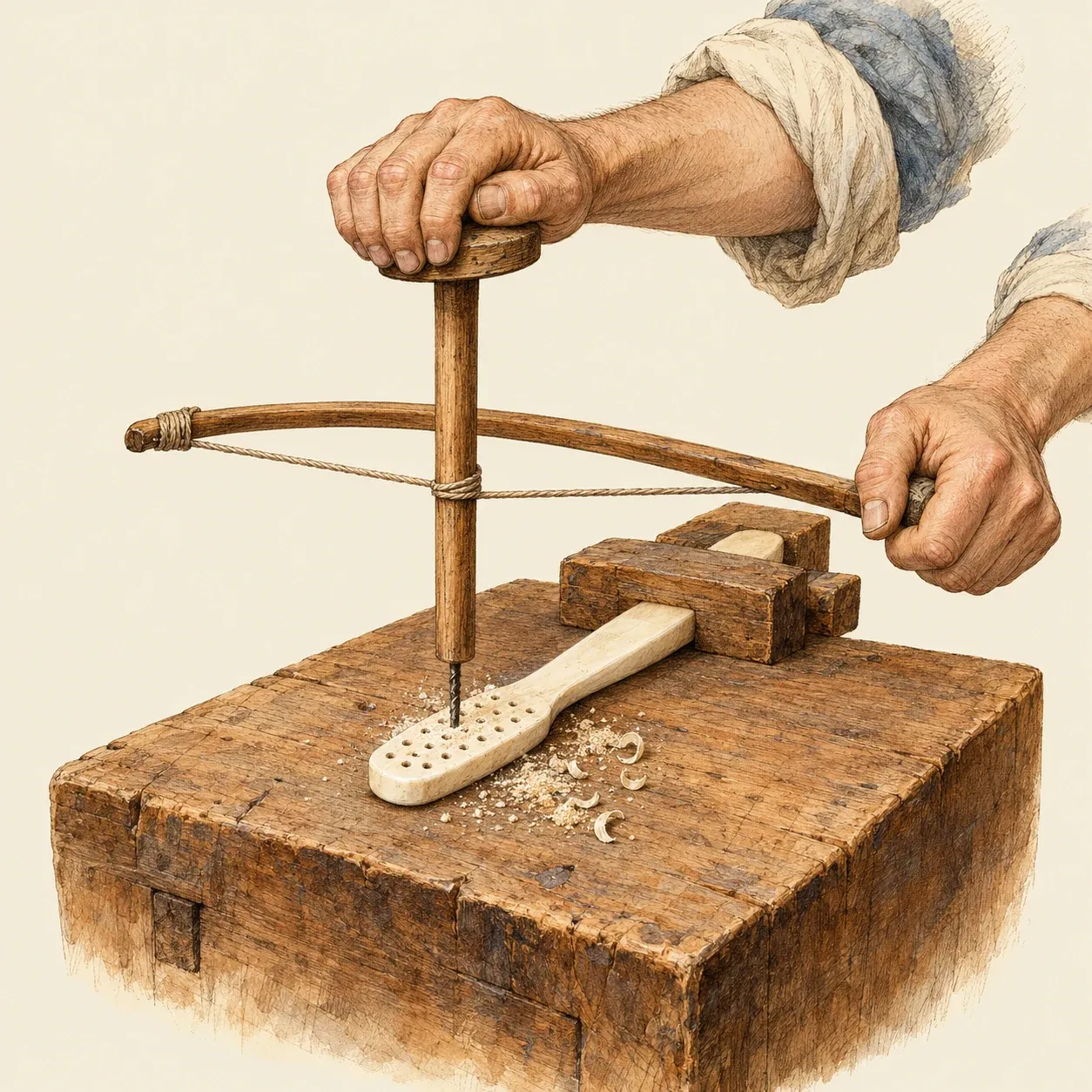 Until the 1870s the holes for the tufts were drilled with a bow drill, one at a time.
Until about 1874 the holes in the handle were drilled with a bow drill, so holes and rows are unevenly spaced, a feature archaeologists use to date old brushes. The tufts were then pulled in with wire from slits cut along the back, which were filled with wax or cement, or threaded through a tunnel bored from the end of the handle. Celluloid handles appeared by 1893. In 1937 the chemical firm Du Pont developed nylon bristles, after the war between China and Japan had cut off the supply of natural bristles, and the first nylon toothbrush went on sale in the United States in 1938. Addis launched nylon brushes in Britain in 1940. The Swiss dentist Philippe-Guy Woog designed the Broxodent, an electric toothbrush powered from the mains, in 1954, and the first electric toothbrush sold commercially in the United States came out in 1960.