Oyster farming
Catching young oysters and raising them
Contents
- 1Curved roof tile coated with lime
- 2Spat fixed to the tile
- 3Wooden frame of the collector on its stakes
- 4Mesh bag of oysters
- 5Iron trestle
Oyster farming raises oysters from their drifting larvae. The farmer sets out hard surfaces on which the young settle, then grows them on the shore bed, in mesh bags on low trestles or hanging in deeper water until they reach market size. The oldest written record is of the oyster beds that Sergius Orata made near Baiae, in Campania, before 91 BCE.
What it is
Oyster farming is the raising of oysters in the sea or in coastal lagoons. Instead of dredging wild beds, the farmer gathers the young oysters, called spat, and grows them where they can be tended, protected and harvested. Europe farms two main species: its native flat oyster and the Pacific cupped oyster, which came from Japan and is now farmed in many parts of the world.
The work falls into stages. Spat is caught in summer on collectors set out in the water, or bought from a hatchery. After some months the young oysters are detached and grown on: sown on the shore bed, packed in mesh bags on low trestles between the tide marks, or hung in deeper water from ropes, longlines or rafts. Before sale, many are finished for a while in ponds or clean water. In France the farms stand on public foreshore that the state leases to farmers, under a system set up by a law of 1852.
How it works
An oyster feeds on the microscopic algae of the plankton, which it filters from the water passing over its gills. It grows fast only where the water is rich in this food and constantly renewed by tides and currents.
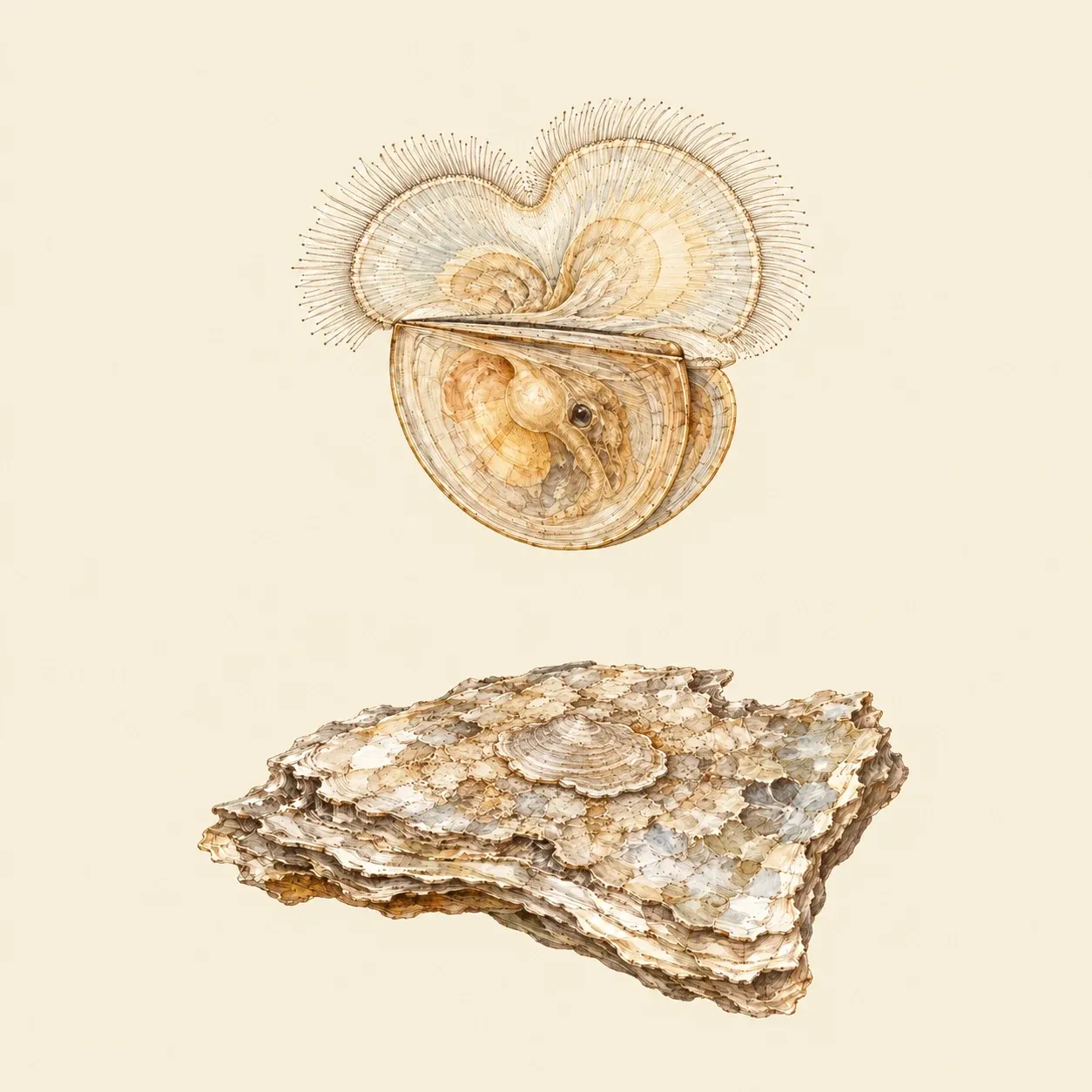 A swimming larva and, below it, a young oyster that has already settled for good.
Oysters spawn in summer, when the water warms. The Pacific oyster sheds its eggs into the sea, and a female 8 to 15 cm long can release 50 to 200 million at a time. The flat oyster keeps its eggs inside its shell and lets the larvae go after 8 to 10 days. The larvae then drift with the currents, for two to three weeks in the Pacific oyster and 8 to 10 days in the flat oyster. When they are ready to settle, they crawl over a hard, clean surface on a small foot, then glue themselves to it for good with a cement. A collector is any surface put into the water at that moment: twigs, ropes, shells, slates or tiles. At Arcachon, growers waited for counts of larvae in the water before setting out their tiles.
Spat holds very tight. On a bare tile it can be taken off only by breaking the tile or the young shell. A thin coat of lime and fine sand solves this: after six to ten months the coat is scraped away with the young oysters still whole, and the tiles are limed again each spring.
The young oysters are then grown in mesh bags fixed to trestles of wood or iron, low on the shore. There they stay raised above the bed and are left in the air at every low tide. As they grow, the farmer moves them to bags of larger mesh at a lower density. A Pacific oyster takes 18 to 30 months to reach a market weight of 70 to 100 g. Oysters grown hanging in deep water are often kept for up to three or four months on the shore before harvest, because oysters used to being left dry by the tide keep better once out of the water.
Oysters filter whatever the water carries, including bacteria from sewage and the toxins of some algae. In the European Union, harvesting areas are classed from the count of E. coli in samples of shellfish flesh. Oysters from class A areas may be sold directly; those from class B areas must first be purified in clean seawater or relaid in cleaner water; those from class C areas must be relaid for a long period or heat-treated in an approved processing plant, and the worst areas are closed. Harvest is also stopped while toxic algae are present.
How to do it
A farm needs a lease on the foreshore and several years of work. A small collector shows how spat is caught, but it may go into the sea only where the law allows it, with the agreement of an oyster farmer on their lease or of the authority in charge of the shore. Otherwise, make it as a dry model.
You need two or three curved clay roof tiles, hydrated lime, fine sand, water, a bucket, cord and a few strips of wood. Scrub the tiles clean. Outdoors, stir lime and fine sand into water to make a thin slurry, dip each tile in it and let it drain, then leave the tiles to dry in the sun. Stack them crosswise, hollow side down, in a small frame of wooden strips, and tie the frame with cord so the tiles cannot slip.
If a farmer agrees to take part, they set the collector out at the moment larvae are reported in the local water, usually in early summer, and at the level on the shore where they catch spat. After a few weeks, look at the tiles with a magnifying glass: spat shows as tiny pale shells fixed flat on the white lime. The collector and the spat stay with the farmer.
Safety: lime is caustic and burns the eyes and skin. Wear gloves and goggles, mix it outdoors and rinse at once with plenty of water if it splashes you. On the shore, check the tide times, never go out alone onto mudflats, keep away from soft mud and come back well before the tide turns. Oyster shells cut, so wear gloves to handle them. Never eat oysters from a collector or picked from the shore: harvesting and eating shellfish follow the health classification of the area and the local law.
History and evolution
Aristotle reports that people from Chios carried live oysters from Pyrrha, on Lesbos, and placed them in narrow straits, where they grew larger but did not multiply. In the Russian Far East, Rakov and Brodianski argue that Neolithic people of the Boisman culture, around Peter the Great Bay, farmed oysters on artificial reefs of stones, sticks and shells, and an oyster valve from one such reef near the Boisman 2 site has been dated to about 4150 BCE. Their case rests on huge middens made almost only of large oysters, with very few young shells, and on old oyster beds far north of the natural range; in a 2024 review, Ashleigh Rogers notes that the lack of young shells may also reflect what foragers chose to collect. The oldest written record of oyster beds kept as a business concerns Sergius Orata, in Campania. Pliny the Elder writes that Orata was the first to make oyster beds, near Baiae, in the time of the orator Lucius Crassus and before the Marsic War, which broke out in 91 BCE, and that he did it for profit. Valerius Maximus adds that Orata built large structures on the shore of the Lucrine lake to have shellfish fresh, and was sued over the public waters; Crassus, pleading against him, joked that if Orata were kept from the lake he would find oysters on his roof tiles.
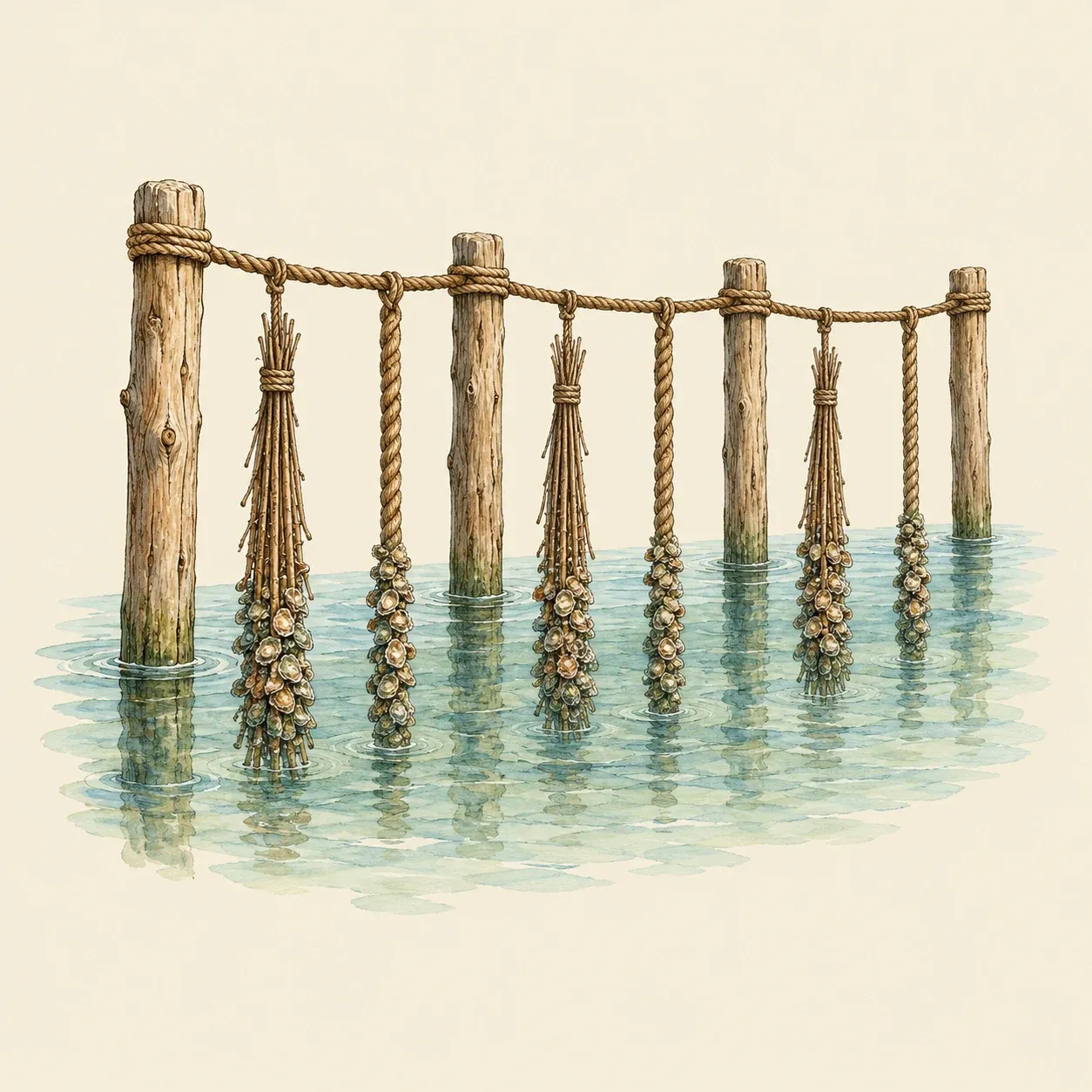 Posts and ropes hold the collectors in the water where the larvae settle.
Annalisa Marzano identifies two Roman ways of catching oyster larvae, with posts and ropes and with tiles, both used with few changes until recent times. Installations for catching and raising spat still worked in the 19th century in Lake Fusaro, a salt lagoon near Naples. In France, by then, dredging had exhausted most natural beds. The naturalist Coste presented a memoir on the artificial oyster beds of Fusaro to the Académie des sciences in 1853, and between 1853 and 1859 he and De Bon began collecting wild spat along the French coast.
At Arcachon, growers first used bundles of twigs as collectors, following Coste’s trials in the bay of Saint-Brieuc. Coste visited in 1859, and in 1860 three model farms were laid out under his direction. He suggested the curved roof tiles of the region as collectors. They caught spat well but held it too fast, and several people tried coatings, among them Dr Kemmerer of the Île de Ré. The FAO and Dominique Buestel’s team date the lime-coated tile to 1865, while Rémy Ladouce credits Michelet, a man of Arcachon, with the lime and sand mixture in 1866. Michelet patented his system in 1867, but Kemmerer had already proposed a lime coating, and a court annulled the patent in 1875. Coated tiles stacked in wooden cages on stakes became the usual collector in France.
The Portuguese cupped oyster, imported to Arcachon from about 1860, spread along the Atlantic coast and replaced the flat oyster in the main farming areas after the mortalities of 1920. From 1966 a gill disease spread, and between 1970 and 1973 it wiped out the species in France. Farmers then brought in the Pacific oyster: several hundred tonnes of breeding oysters from Canada in 1971–1973 and spat from Japan. The flat oyster was hit again by two parasites in the 1970s and 1980s, and its production has stayed low.
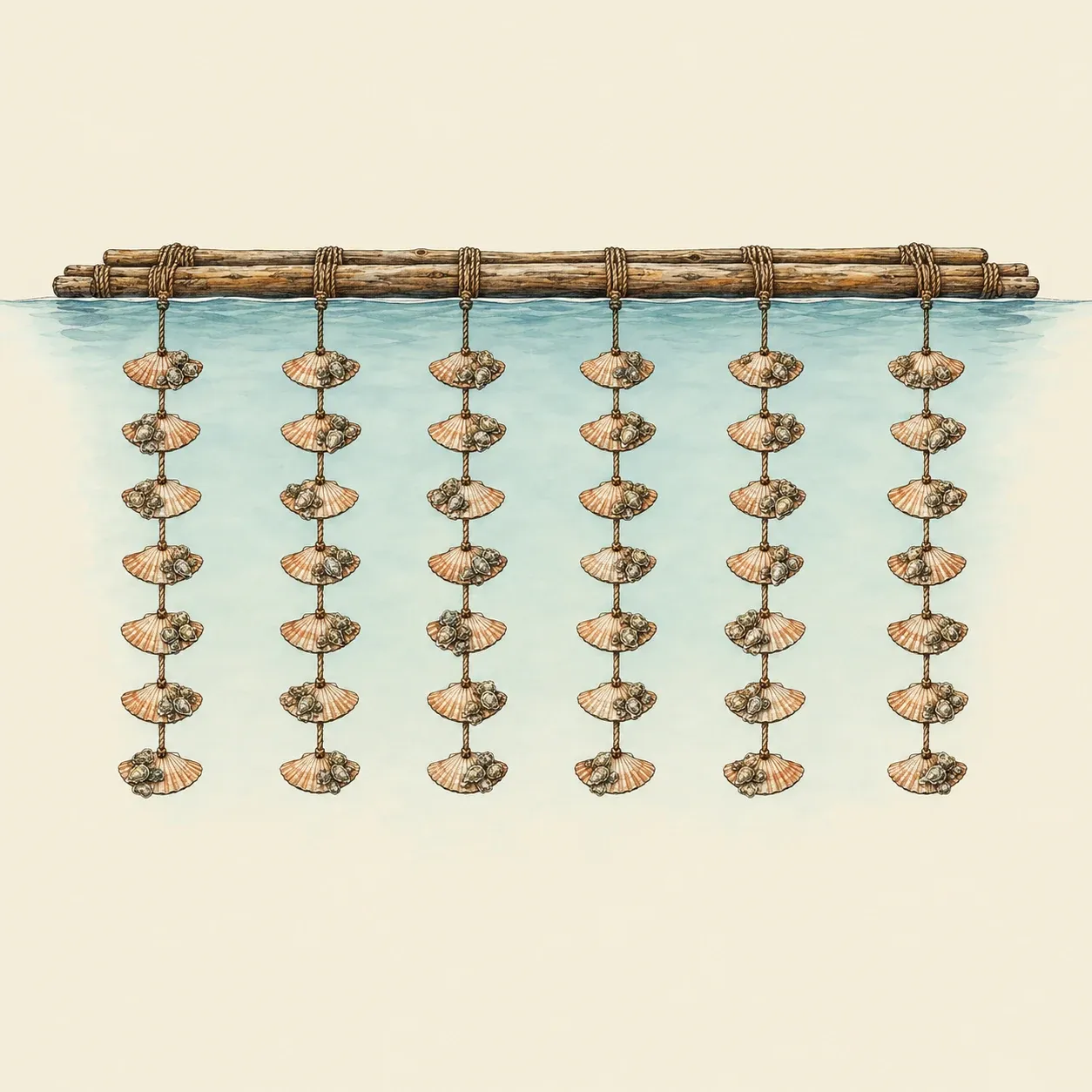 In Japan, much of the crop hangs from rafts on strings of shells.
In Japan, where the Pacific oyster has been farmed for centuries, much of the crop hangs in the sea on strings of shells or in baskets, from longlines or rafts. In France, plastic mesh bags on trestles produced about 60% of the oysters in 2009. In the 2000s, according to Buestel’s team, hatcheries supplied about 30% of French spat, mostly triploid oysters, which carry three sets of chromosomes, grow faster and are nearly sterile; they are obtained by crossing tetraploid oysters with ordinary ones. In 2005, 80% of the 800 million hatchery spat sold in France were triploid.