Pearl culture
Making molluscs grow pearls
Contents
- 1Valve of the oyster shell
- 2Gonad, where the nucleus is placed
- 3Pearl sac grown from the mantle graft
- 4Shell bead nucleus
- 5Layers of nacre
Pearl culture makes a living mollusc coat an object with nacre, the material of its own shell. In the usual modern method a small piece of mantle from another oyster is placed with a shell bead in the oyster's gonad, and its cells grow into a sac that lays nacre on the bead. The oldest written method comes from Song China, about 1080; Linnaeus grew round pearls in freshwater mussels in the 1750s, and the modern industry of round sea pearls took shape in Japan early in the 20th century.
What it is
A pearl is a ball of nacre, the lustrous layered material that lines the inside of many mollusc shells. A natural pearl forms when some cells of the mantle, the soft tissue that builds the shell, end up inside the body of the animal, close into a pouch and go on secreting nacre there. Such pearls are rare. Pearl culture starts the same process on purpose, in oysters or mussels raised for it.
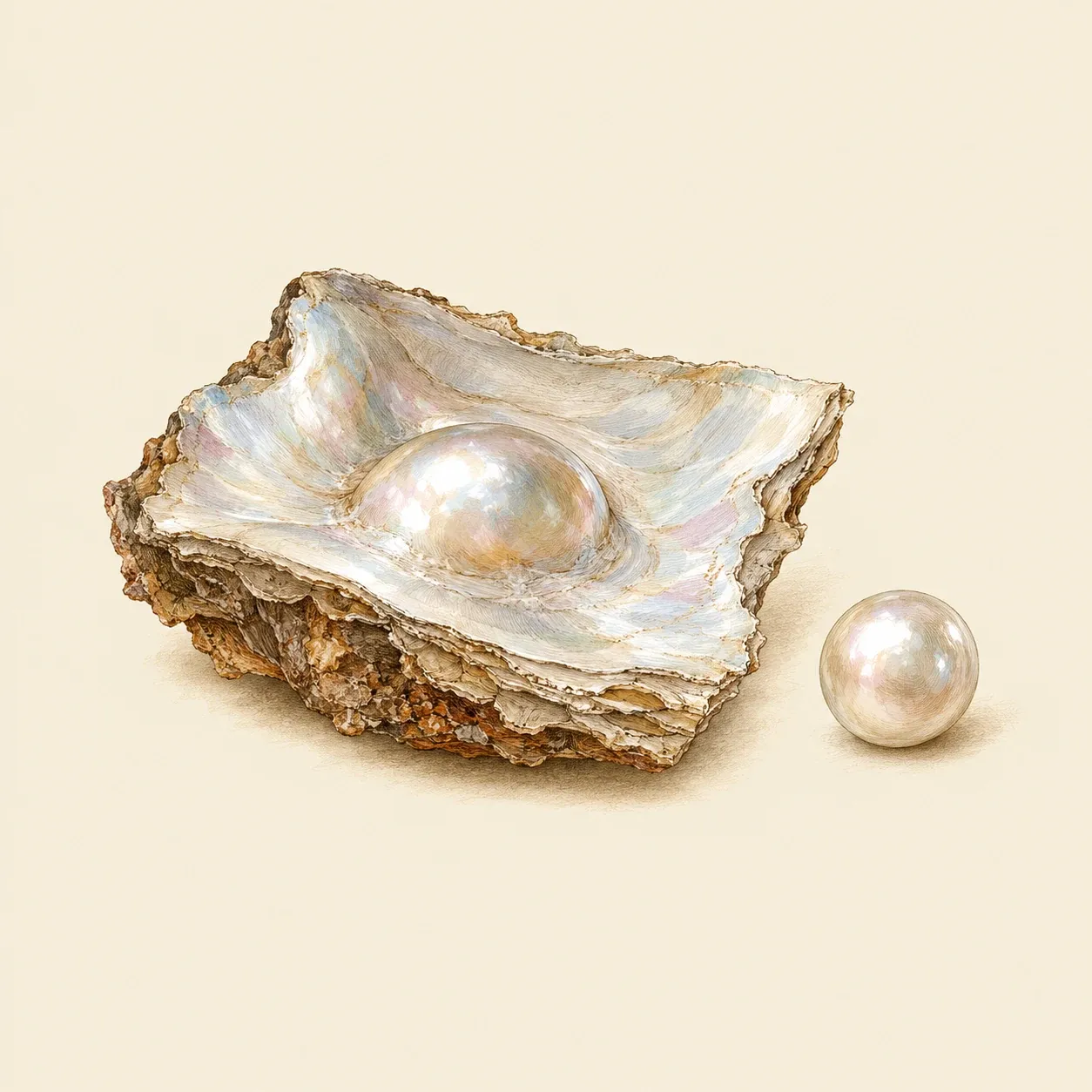 A blister pearl is cut out with a piece of the shell; a free pearl, grown in the soft tissues, can be round.
Cultured pearls are of two kinds. A blister pearl grows against the inside of the shell, over an object slipped between the shell and the mantle, and is cut out with part of the shell. A free pearl grows within the soft tissues and can be round. Most sea pearls now come from pearl oysters: the small Akoya oyster of Japan and China, and the large silver-lipped and black-lipped oysters, farmed in countries such as Australia, Indonesia, the Philippines, Myanmar and French Polynesia. Freshwater pearls are grown in mussels, in China above all. The oysters themselves are raised much as in oyster farming, from young caught in the sea or bred in hatcheries.
How it works
Nacre is laid down by the outer layer of cells of the mantle, its epithelium, as thin sheets of calcium carbonate held together by an organic matrix. In 1856 the German zoologist Theodor von Hessling found that a pearl grows inside a closed pouch of these cells, the pearl sac, which forms when something from outside pushes epithelium into the body of the animal. Japanese researchers drew the practical lesson: the pearl sac is what makes the pearl, and the nucleus inside it only gives the pearl its starting size and shape.
In the usual method for sea pearls, a technician opens a young oyster slightly, makes a small cut at the base of its foot and slides a round bead into the gonad, the reproductive organ. The bead is cut from the thick shell of freshwater mussels, mostly from the Tennessee and Mississippi rivers. Against it goes a square of mantle about 2 by 3 mm, cut from a donor oyster that is sacrificed for the purpose. Oysters close to spawning are not used, because their eggs or sperm flow out during the operation and hide the place of the cut. The inner layers of the graft die, while its outer epithelium spreads around the bead to form the pearl sac, which then coats the bead with nacre.
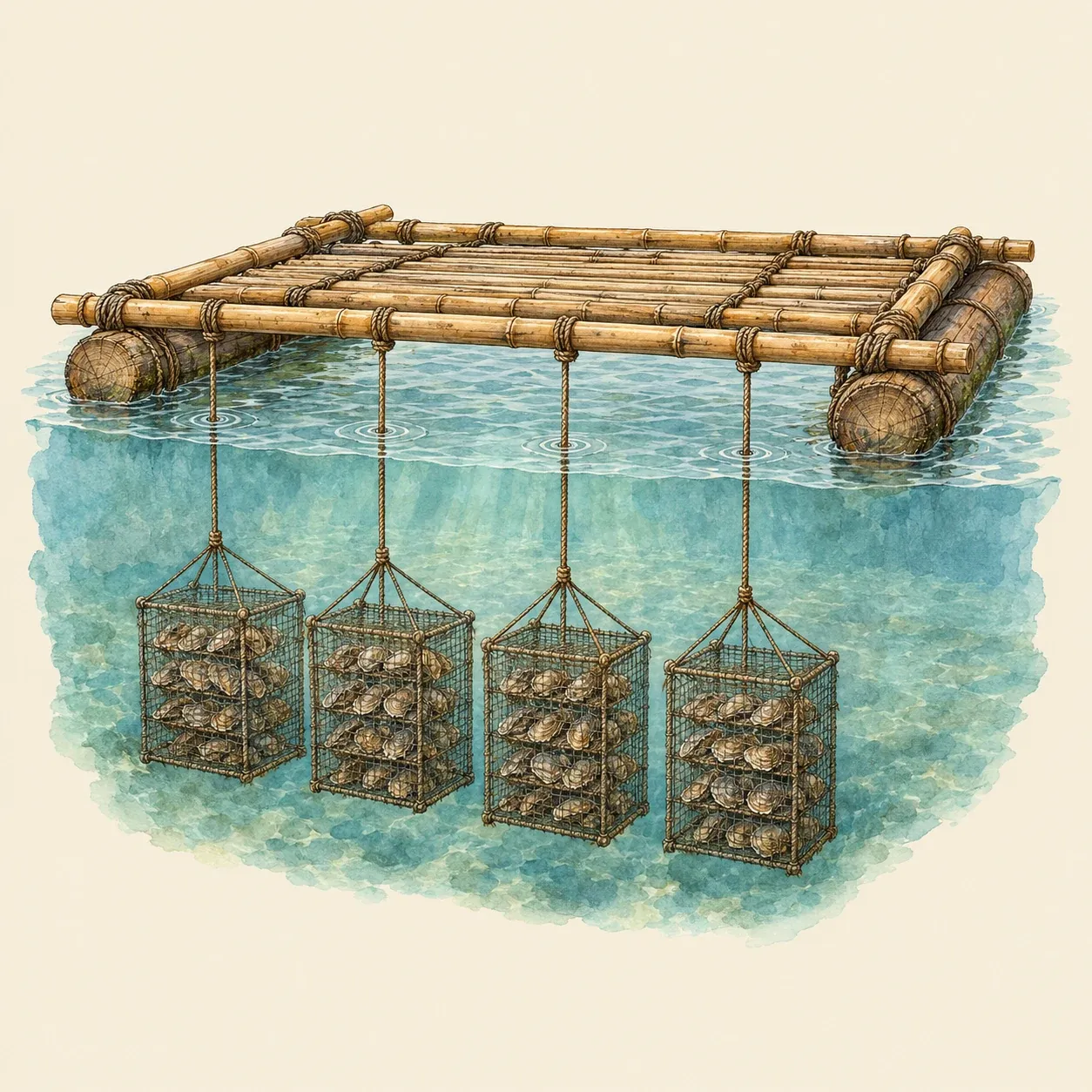 After the operation, the oysters hang in net cages from rafts in sheltered bays.
In the practice the FAO describes for Vietnam, the operated oysters go back into the sea in net cages of fifty to seventy, hung from floating rafts at depths of 3 to 5 m in sheltered bays, and are cleaned regularly of the weed and animals that settle on them. According to GIA, Akoya pearls usually grow for 10 to 14 months, less than the large pearls of the South Seas and Tahiti. These farms harvest in the cold season: cool water slows the deposit of nacre and gives a better outer layer. The pearl is taken out by opening the shell and cutting into the gonad. An FAO training manual puts the losses after the operation at fewer than one oyster in ten with good management.
Freshwater pearls are usually grown without a bead. In 1946 the Japanese farmer Seiichiro Uda began making pearls by inserting only pieces of mantle into the mantle of a mussel. Chinese farms took up this tissue-only method on a large scale with the mussel Hyriopsis cumingii. Since the 2010s they have also sold more and more bead-cultured freshwater pearls, among them the large round pearls traded as Edison.
How to do it
Pearl farms work under licence, in clean, sheltered water, over several years. Young oysters are caught on collectors or bred in a hatchery and grown in cages; for Vietnam the FAO gives 25 g or more as the best weight for the operation. They are prepared so that they are not about to spawn when trained technicians insert the bead and the graft. After a period of recovery the oysters go back to the rafts until the harvest.
Nacre itself is easy to look at. Keep the empty shells of a meal of mussels, or pick up empty shells on a beach where collecting them is allowed. Scrub them, let them dry and look at the inside of the shells in bright light, tilting them slowly. Then look at a broken edge with a magnifying glass: the shell is built of thin layers, laid down one after another as the animal grew, and a pearl grows in the same way around its nucleus.
The law. Never take, disturb or open freshwater pearl mussels. In Europe they are a protected species, they can live for more than a hundred years, and pearl fishing has emptied many rivers of them; in Scotland it is an offence even to possess pearls taken since 1998. Do not cut into or open any living mollusc to look for pearls or to insert anything.
History and evolution
The oldest known written method comes from Song China. In his miscellany Wenchang zalu, Pang Yuanying, active around 1078 to 1082, records a method told by Xie, a vice-minister of rites: choose a bright, round imitation pearl, keep a large mussel in clean water, drop the pearl into its shell when it opens, change the water often and set the mussel out under the moon at night; after two autumns a real pearl will have formed. Kiyohito Nagai gives 1082 for the first publication of the method.
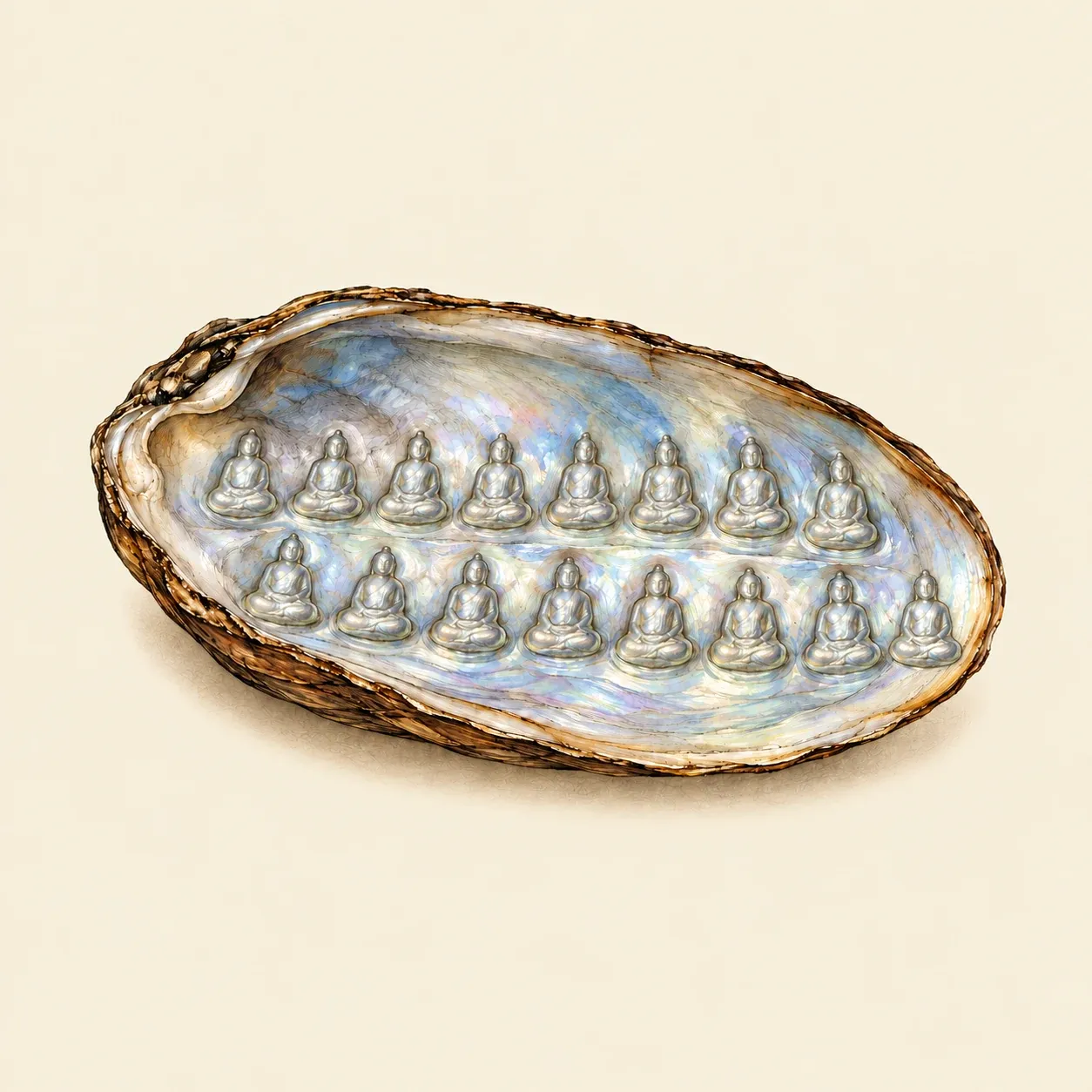 Thin lead figures of the Buddha, slipped under the mantle of freshwater mussels, came out coated with nacre and fixed to the shell.
In 1853 Dr D. T. Macgowan sent the Society of Arts in London a description of an industry in two villages near Deqing, in northern Zhejiang. In May or June the villagers brought large freshwater mussels from Lake Tai, opened them gently with a bamboo spatula and slipped objects between the mantle and the shell in two rows: beads of nacre, pellets of mud and especially thin lead images of the seated Buddha. The mussels spent the summer in canals and ponds and were opened in November, when the objects had become pearly bumps attached to the shell. Workers cut them out, removed the lead or mud, filled the cavity with resin and closed it with a piece of shell, and the pieces were sold as ornaments and amulets. George Kunz reported in 1908 that a temple there honoured the founder of the craft, Yu Shun Yang, said to have lived in the late 13th century; the FAO’s heritage listing for Deqing now names Ye Jinyang, of the Southern Song, as the inventor of this cultivation.
In Europe, Carl Linnaeus announced in 1748 that he could make a mussel grow a pearl. He offered his method to the Swedish state in 1761 and sold it in 1762 to the Gothenburg merchant Peter Bagge, who was never able to make use of it. The Linnean Society of London keeps round pearls he grew in the 1750s in the freshwater mussel Unio pictorum. From Linnaeus’s papers, the zoologist William Herdman concluded that he bored a small hole in the shell of a freshwater mussel and pushed in a pellet of limestone on the end of a silver wire, kept away from the shell so that the pearl would not grow onto it. In the 1890s William Saville-Kent made blister pearls in the Torres Strait between Australia and New Guinea. In 1978 C. Denis George argued that Saville-Kent had also worked out the method for round pearls before the Japanese, but Nagai notes that no technical record of it survives.
In Japan, Kokichi Mikimoto, advised by the zoologist Kakichi Mitsukuri, obtained his first blister pearls from Akoya oysters in Ago Bay in 1893 and began selling ornaments made with them in 1899. Three patents for round pearls were sought in 1907. Tatsuhei Mise patented a needle for inserting a nucleus with a piece of mantle into the tissue of an oyster, Tokichi Nishikawa, a zoologist and Mikimoto’s son-in-law, applied for patents on making a pearl sac with a piece of mantle alone or with a nucleus, and Mikimoto applied for his own method. In 1918 Mikimoto’s farm harvested many good round pearls made by wrapping shell beads entirely in mantle tissue, and it began selling them in London in 1919. European dealers called them fakes; in a court case in Paris in the 1920s, scientists testified that cultured and natural pearls have the same structure, and the court agreed. Nishikawa’s piece method, a bead with a small square of mantle, became the basis of round pearl culture everywhere. Japan’s first official figures, for 1926, counted 33 pearl farmers, and there were 258 by 1937. Nagai reads the totals given with them, 669,000 in 1926 and more than ten million in 1937, as numbers of oysters, while the Pearl Standard gives them as pearls produced.