Zinc Smelting
A metal that leaves the fire as a vapour and has to be caught as it cools
Contents
- 1Firing chamber
- 2Cooler lower chamber
- 3Inverted clay retort
- 4Perforated plate carrying the retorts
- 5Condenser under the neck of a retort
Zinc is hard to smelt because it turns to vapour at the heat needed to free it from its ore, then burns back to oxide in the air. Zinc metal was first produced by distillation in closed clay vessels. Zawar in Rajasthan was distilling zinc on an industrial scale by the early Middle Ages, China followed under the Ming, and Europe in the eighteenth century.
What it is
Zinc is a bluish-grey metal that is almost always found combined with other elements in its ores; native zinc, the free metal, is a very rare mineral. Its ores were long known in Europe under the single name calamine, which covered two zinc minerals, smithsonite and hemimorphite, found in the weathered upper part of ore bodies. Deeper down the usual ore is sphalerite, a zinc sulphide, often mixed with lead ores. Smelting means separating the zinc from the oxygen or sulphur it is bound to, as with copper or lead, but zinc behaves differently in the fire.
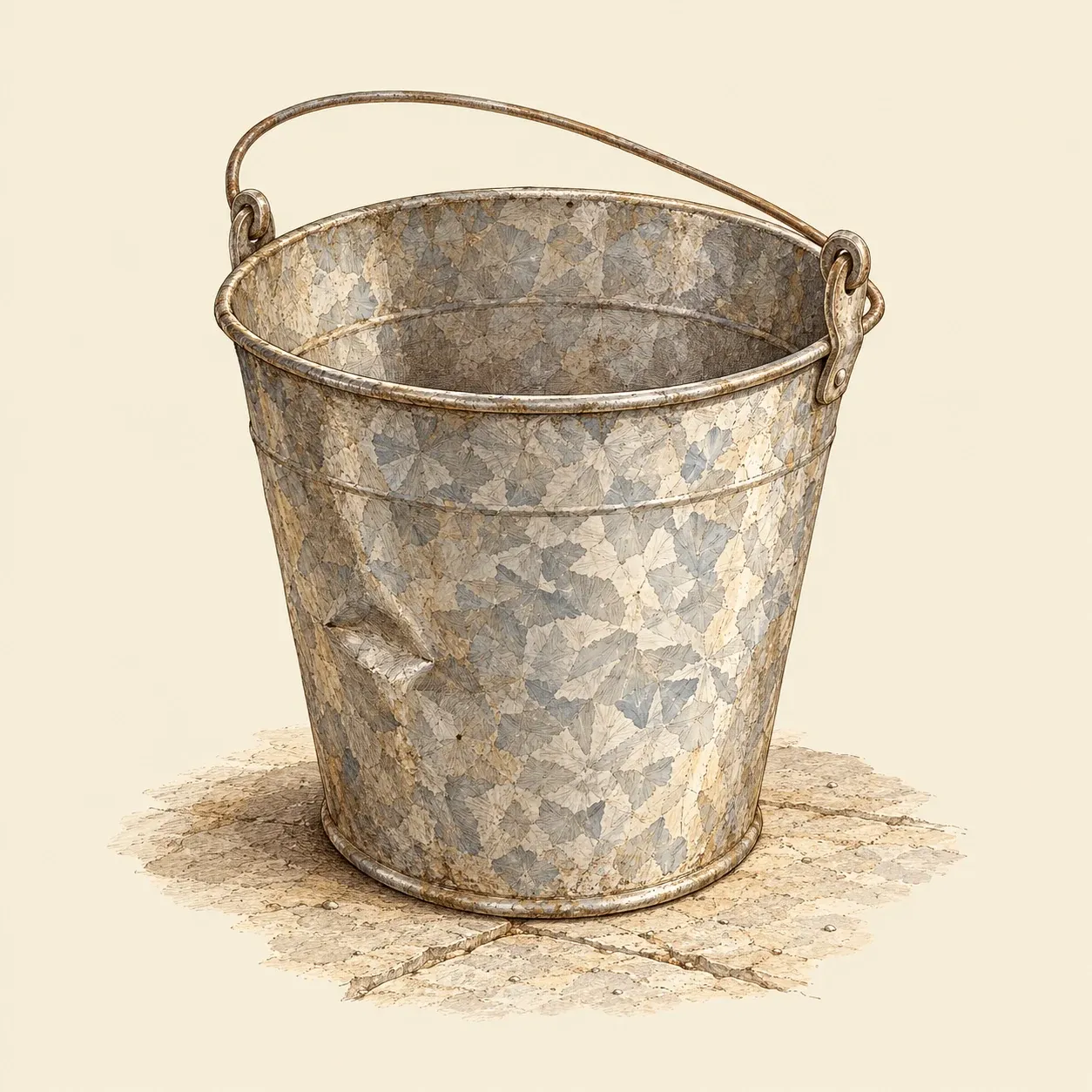 A galvanised bucket: the crystal pattern on its surface is the zinc coating that keeps the steel from rusting.
Today the main use of zinc is galvanising, a thin coating that protects steel from rust. It also goes into die-cast parts, into brass, its alloy with copper, and into chemicals. Brass was made for many centuries before anyone could produce zinc metal, because the zinc of the ore could go straight into the copper without ever appearing on its own. Zinc metal was a later achievement, and it took a different kind of furnace.
The work is dangerous. The fumes of zinc oxide given off by hot zinc cause metal fume fever, with chills, fever, cough and tightness in the chest. Zinc ores often carry cadmium and lead, and roasting sulphide ores releases sulphur dioxide. Zinc smelting has always been an industrial process, with no small version that can be run safely.
How it works
Zinc has a low boiling point. The heat needed to strip the oxygen from its ore is already above that point, so the zinc is set free as a vapour. In an open furnace this vapour rises with the hot gases, meets the air and burns back to zinc oxide, a white powder, and almost nothing is recovered. Zinc metal can therefore only be won in closed vessels, where the vapour meets no air and turns back into metal in a cooler part.
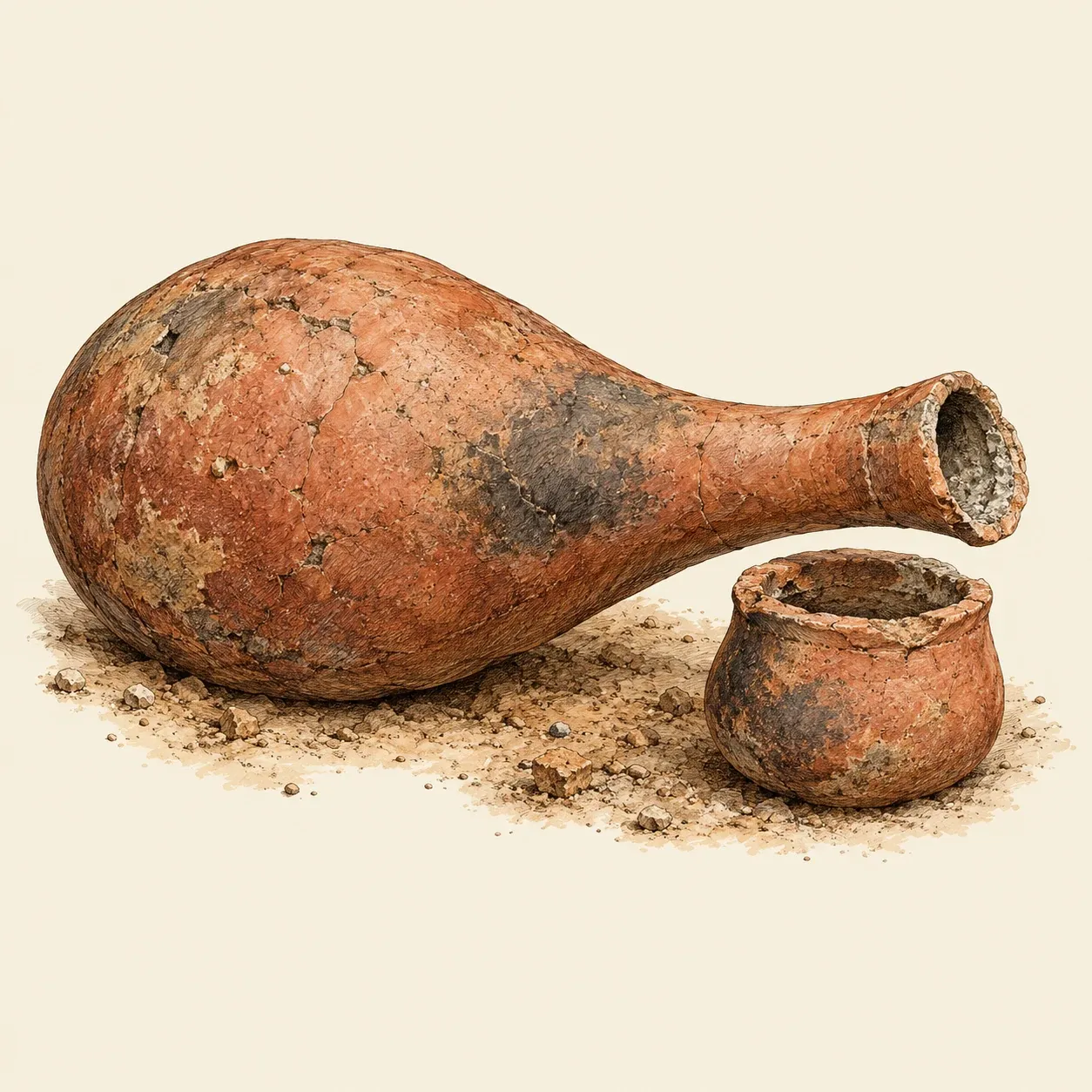 A retort and its condenser of the Zawar type, as excavated.
At Zawar, in the Aravalli Hills of Rajasthan, the furnaces held rows of elongated clay retorts set upside down, their necks passing through a perforated floor into a cooler chamber below, with a clay condenser under each neck. Chinese smelters later used upright retorts with a cooler condensing zone at the top.
Distillation in closed vessels remained the way of making zinc for centuries, in India, in China and then in Europe. In the twentieth century most smelters turned to electrolysis, in which an electric current deposits zinc as metal from a solution prepared from the ore. The zinc never has to pass through the vapour stage, and this route now produces most of the world’s zinc, while the gases and residues of the process still have to be captured and treated.
History and evolution
Brass is older than zinc metal: the way of making it in sealed crucibles, without isolating the zinc, was developed in the Near East in the first millennium BCE. The earliest known large-scale production of zinc metal comes from India. Kharakwal and Gurjar argue that pure zinc was already being made in the second half of the first millennium BCE, with commercial production beginning in the early Middle Ages. Craddock and his colleagues place the start of industrial distillation at Zawar about a thousand years ago, and the Historical Metallurgy Society the twelfth century. Zawar’s mines and furnaces then worked for centuries, and excavations there have uncovered the furnaces and their retorts.
China took up zinc smelting by the middle of the Ming dynasty, in the fifteenth and sixteenth centuries, using its own method of upright retorts. Excavated works along the Upper and Middle Yangtze date from that period, and a Ming treatise on crafts, the Tiangong Kaiwu, describes and illustrates the smelting of zinc. Chinese zinc went mostly into brass, including the brass of the copper-alloy coins of the empire.
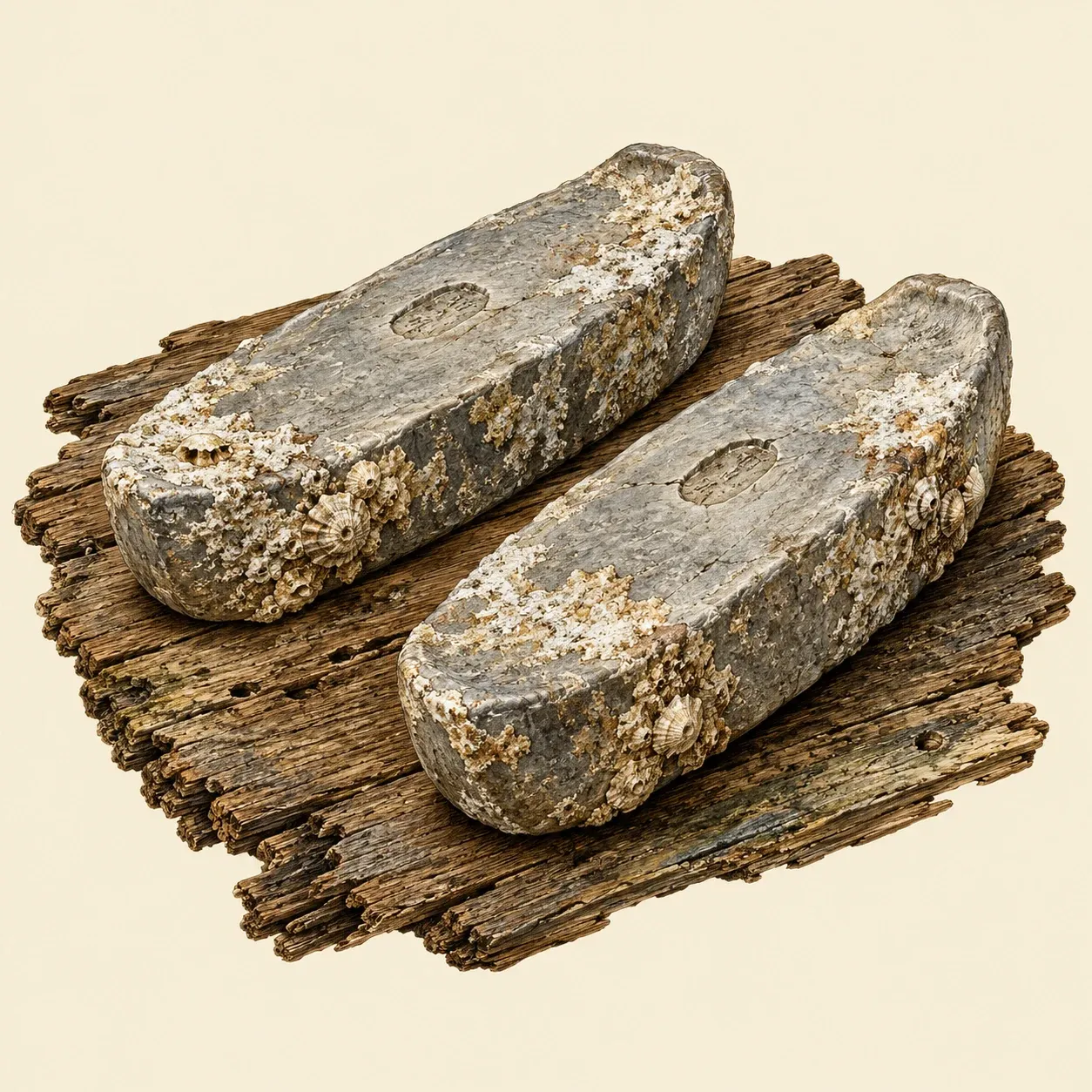 Chinese zinc ingots recovered from a wreck: Asian zinc travelled to India and Europe by sea.
From the sixteenth century, small amounts of Asian zinc reached Europe. Chinese zinc, shipped by the Dutch and English East India Companies, then dominated the world market until the nineteenth century. In 1738 William Champion of Bristol patented a way of producing zinc from calamine on a large scale, by distillation in closed retorts. He later moved to Warmley, east of Bristol, where he built a works that smelted copper and zinc and made brass and finished goods on a single site.
During the First World War the Anaconda Copper Mining Company began refining zinc by electrolysis in Montana, about 1915–1916, using the electricity of the region’s hydroelectric dams to treat complex ores that were hard to smelt, and soon moved its main zinc plant to Great Falls. Electrolysis spread to most smelters during the twentieth century, and so did the use of zinc for galvanising steel, for die-cast parts and for the electrodes of many batteries.