Mining and Quarrying
Reaching minerals underground and keeping the workings safe
Contents
- 1Windlass over the main shaft
- 2Timber lining of the shaft
- 3Ore vein
- 4Timber set: two posts and a cap
- 5Air shaft
- 6Drainage adit
Mining takes useful minerals out of the ground, from open pits and quarries or through shafts and tunnels. A working mine must hold up the rock around it, get rid of the water that seeps in and bring fresh air to the miners. At Lion Cavern in Eswatini, people were already cutting haematite out of a cliff about 46,000 years ago.
What it is
Mining is the work of taking minerals from the ground: stone for tools and building, ores of metals, coal, salt and pigments. When a deposit lies near the surface it is dug from an open pit, or cut in blocks from the face of a quarry. When it runs deep, miners follow it underground, through shafts sunk from the surface and through tunnels driven into the side of a hill.
Underground workings have their own words. A shaft is vertical. An adit is a nearly level tunnel that enters from a hillside. Galleries, or drifts, follow the vein of ore, and the space left where the ore has been taken out is a stope. Every mine faces the same three problems: the weight of the rock above the workings, the water that seeps into any hole dug below the water table, and the air, which goes stale and can carry gases that poison or explode.
Old and abandoned mines stay dangerous long after the miners have left. The US Mine Safety and Health Administration warns that their shafts can be hidden under rotten boards or plants, that their timbers decay and their roofs can fall at any time, and that they may hold deadly gases and deep, cold water. They should never be entered.
How it works
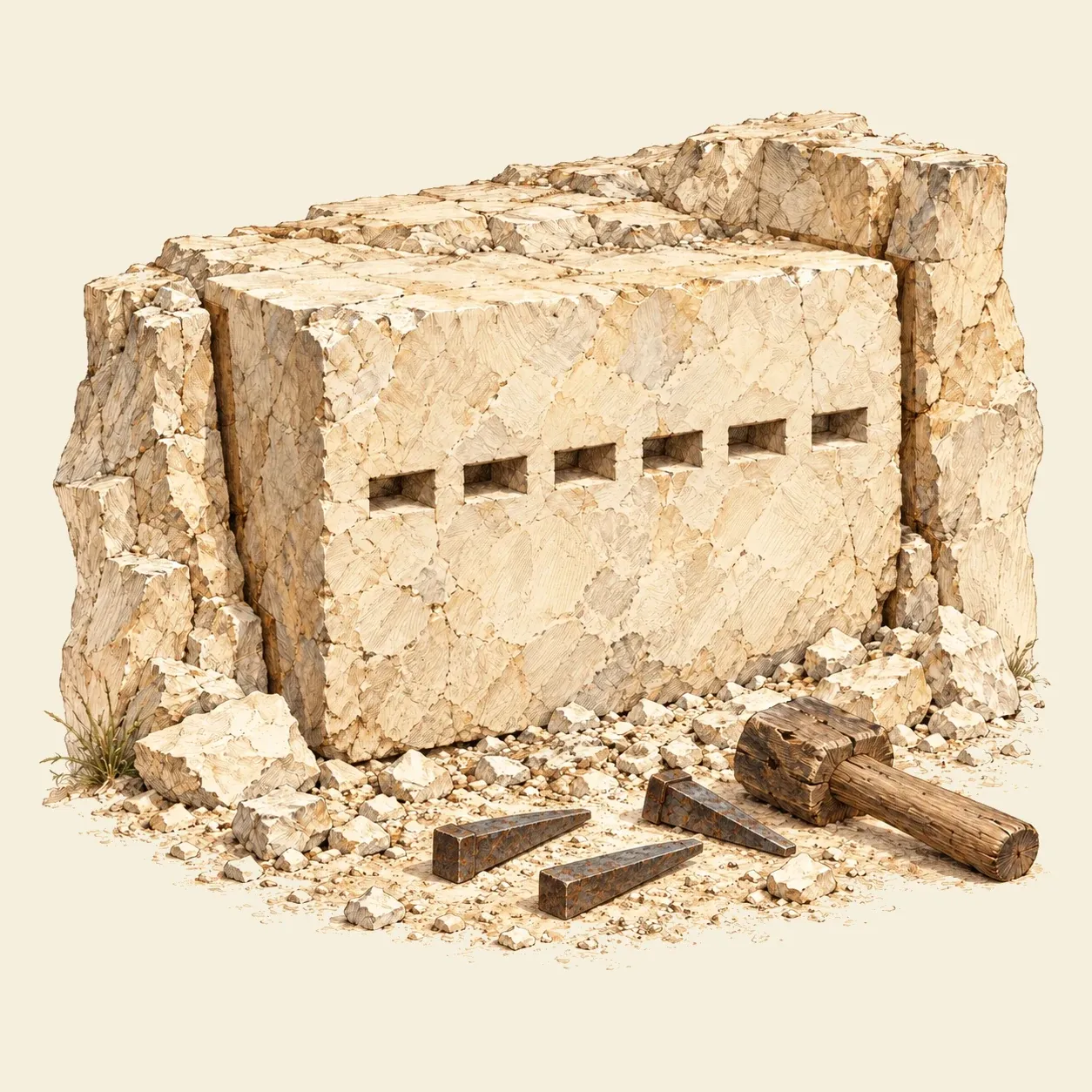 A row of wedge slots in a quarry face, with the quarryman’s iron wedges and mallet.
The rock is broken at the working face. For most of history miners did it by hand, with picks and hammers of stone, antler, bronze or iron. In quarries, stone was split from the face with wedges. Gunpowder came into mines in the seventeenth century and was followed by stronger explosives, which are the tools of trained shotfirers.
Hard, sound rock can stand on its own over a narrow gallery, and miners left pillars of ore or rock in place to carry the roof of wider workings. Weaker or broken ground needs support. In a gallery, the classic support is a timber set: two posts standing on the floor carry a cap across the roof, and poles or boards packed behind them hold back loose stone. In a shaft, square frames of timber laid one above another line the walls.
Water runs downhill, and miners used that wherever the ground allowed. They drove an adit from low on the hillside up to the bottom of the workings, with a floor sloping gently outwards, and the water drained out on its own. Water below the level of the adit had to be lifted. Agricola’s book on mining, printed in 1556, shows pumps worked by men, by horses and by water wheels. The first steam engine that Thomas Newcomen built, in 1712, pumped water out of a coal mine.
Air moves through a mine on its own when two openings stand at different heights and the air inside is warmer or colder than the air outside. Air of a different temperature has a different density, so the two columns of air between the openings do not weigh the same, and that difference in pressure drives the air through the workings. Fresh air then goes down one way, sweeps the galleries and comes up the other, which is why workings were joined to a second shaft. Where that draught was too weak, Agricola shows bellows and fans worked by men, by horses or by the wind, pushing air down through wooden pipes or drawing the stale air out.
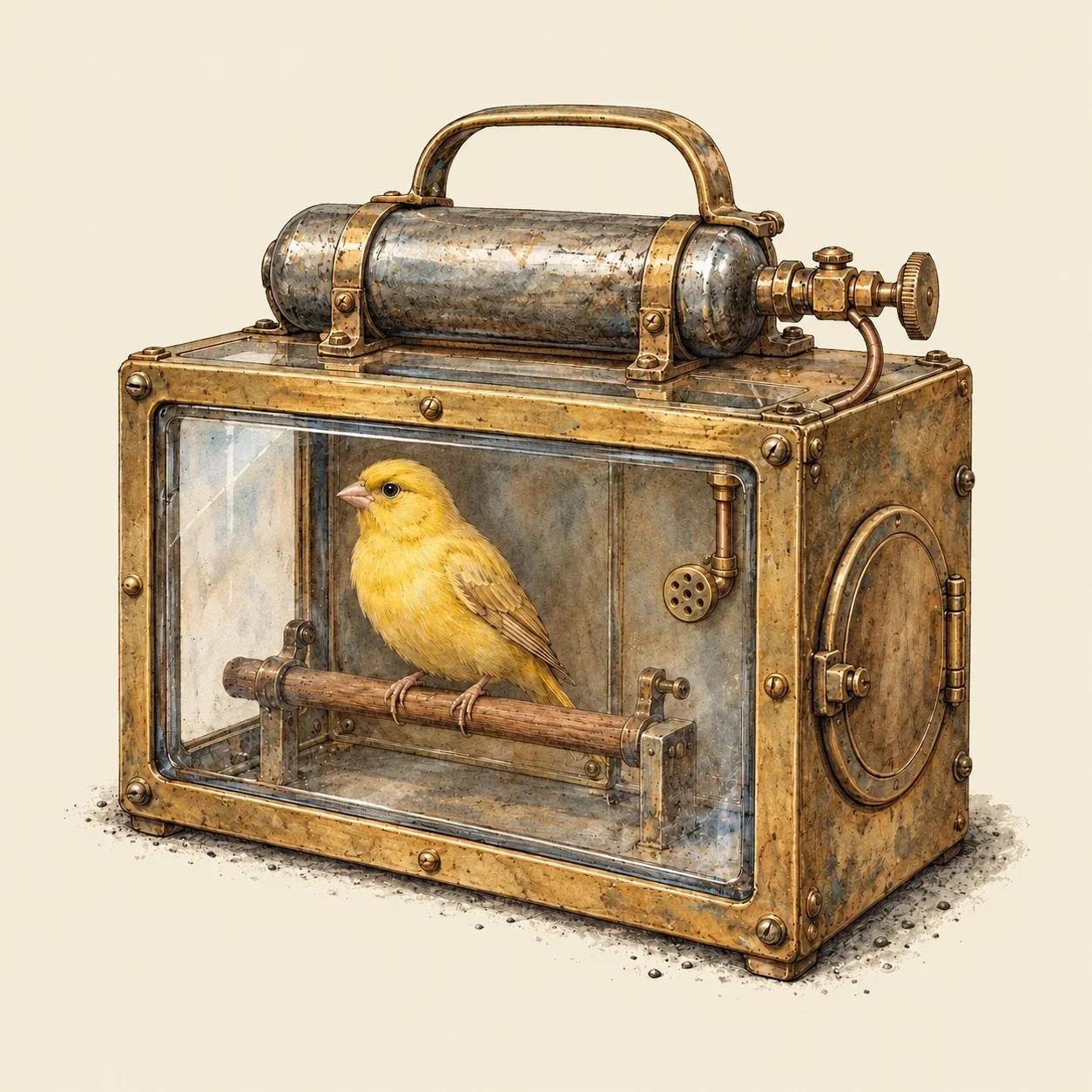 A cage for reviving a canary: once the bird had shown signs of gas, the door was closed and oxygen let in from the cylinder on top.
Miners called the bad airs of the pit damps. Firedamp, mostly methane given off by coal, explodes when mixed with air and lit; the safety lamp let a miner carry a flame through it. Blackdamp is air that has lost much of its oxygen. After an explosion or a fire, afterdamp is charged with carbon monoxide, a gas with no colour, smell or taste. John Scott Haldane, called in after the explosion at Tylorstown Colliery in Wales in 1896, proposed small animals as detectors, because the gas affects them before it affects people. Canaries were chosen, and rescue teams carried them underground in small cages. When the bird swayed on its perch or fell, the men knew to get out. Some cages could be closed and filled with oxygen from a small cylinder to revive the bird.
History and evolution
People dug for stone long before anyone smelted metal. At Taramsa 1, near Qena in Upper Egypt, people of the Middle Stone Age dug pits and worked faces into a bed of gravel to reach the cobbles of chert they shaped into stone tools. Wind-blown sand filled the abandoned workings, and luminescence dating of that sand places the work in the Middle Stone Age. In 2026 a team led by Manuel Will reported another place of extraction at Jojosi, in eastern South Africa, where people came back for hornfels over a long period and left almost nothing but knapping waste.
At Lion Cavern, on Bomvu Ridge at Ngwenya in Eswatini, miners cut into a cliff of haematite to get the red and glittering pigment it contains. Raymond Dart and Peter Beaumont reported in 1967 that this mining went back to the Middle Stone Age, and a radiocarbon date obtained in 1971 on charcoal from the bottom of the sequence gave about 43,000 radiocarbon years, which calibrates to about 46,000 years. New excavations led by Gregor Bader then dated the mining by luminescence: the results, published by Brandi MacDonald and her colleagues in 2024, place it at least 48,000 years ago.
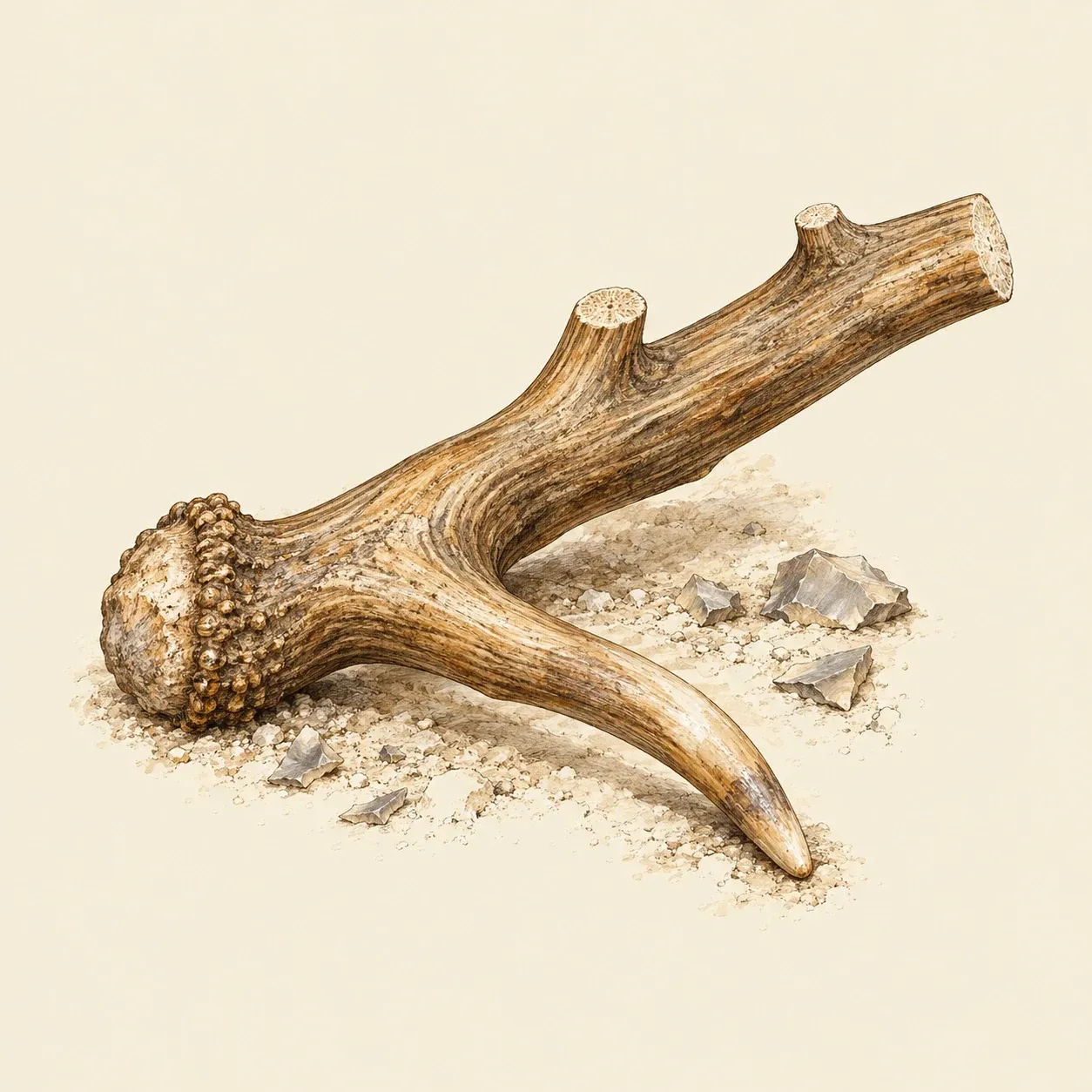 A pick made from a red deer antler. Neolithic miners pried flint out of the chalk with tools like this one.
In Neolithic Europe, miners went underground for good flint. At Grime’s Graves in Norfolk, more than four hundred shafts and pits were dug into the chalk to reach a seam of dark flint, and galleries were cut outwards from the bottom of the deepest shafts. New radiocarbon dates published by Frances Healy and her colleagues in 2018 show that the deep galleried shafts were worked from about 2600 BCE until about 2400 BCE. The miners pried out the flint with picks made from red deer antlers, which they left behind in large numbers.
Georg Agricola’s De re metallica, published in 1556, a few months after his death, described the mines of central Europe in words and woodcuts: shafts, galleries, timbering, hoists, pumps and the machines that aired the workings. In February 1627, at Schemnitz, now Banská Štiavnica in Slovakia, rock in a mine was broken with gunpowder for the first time on record. Newcomen’s engine of 1712 made it possible to pump out mines too deep for adits and water wheels.
As coal mines went deeper in the nineteenth century, gas became the great danger. Safety lamps from 1815 reduced the risk of firedamp explosions, and from the late 1890s canaries warned of carbon monoxide. British collieries kept them until the 1980s, when electronic gas detectors took their place.