Safety lamp
A flame caged in wire gauze for gassy mines
Contents
- 1Brass oil vessel
- 2Wick and flame
- 3Wire gauze cylinder
- 4Double gauze at the top
- 5Guard wires and carrying ring
A safety lamp is an oil lamp whose flame is enclosed so that it cannot set fire to the firedamp of a coal mine. In the best-known form, Humphry Davy's, a cylinder of fine iron gauze lets air in and keeps the flame inside. The first safety lamp was described by William Clanny in 1813, and Davy and George Stephenson each produced their own in 1815.
What it is
Coal seams give off firedamp, a gas made mostly of methane. Mixed with air in proportions between about 5 and 15%, it explodes at the touch of a flame, and miners worked by the light of candles and open lamps. A safety lamp lets a miner carry a flame into that air without lighting it. The flame burns in a closed cage that lets fresh air in and burnt gases out but stops the flame itself from getting through.
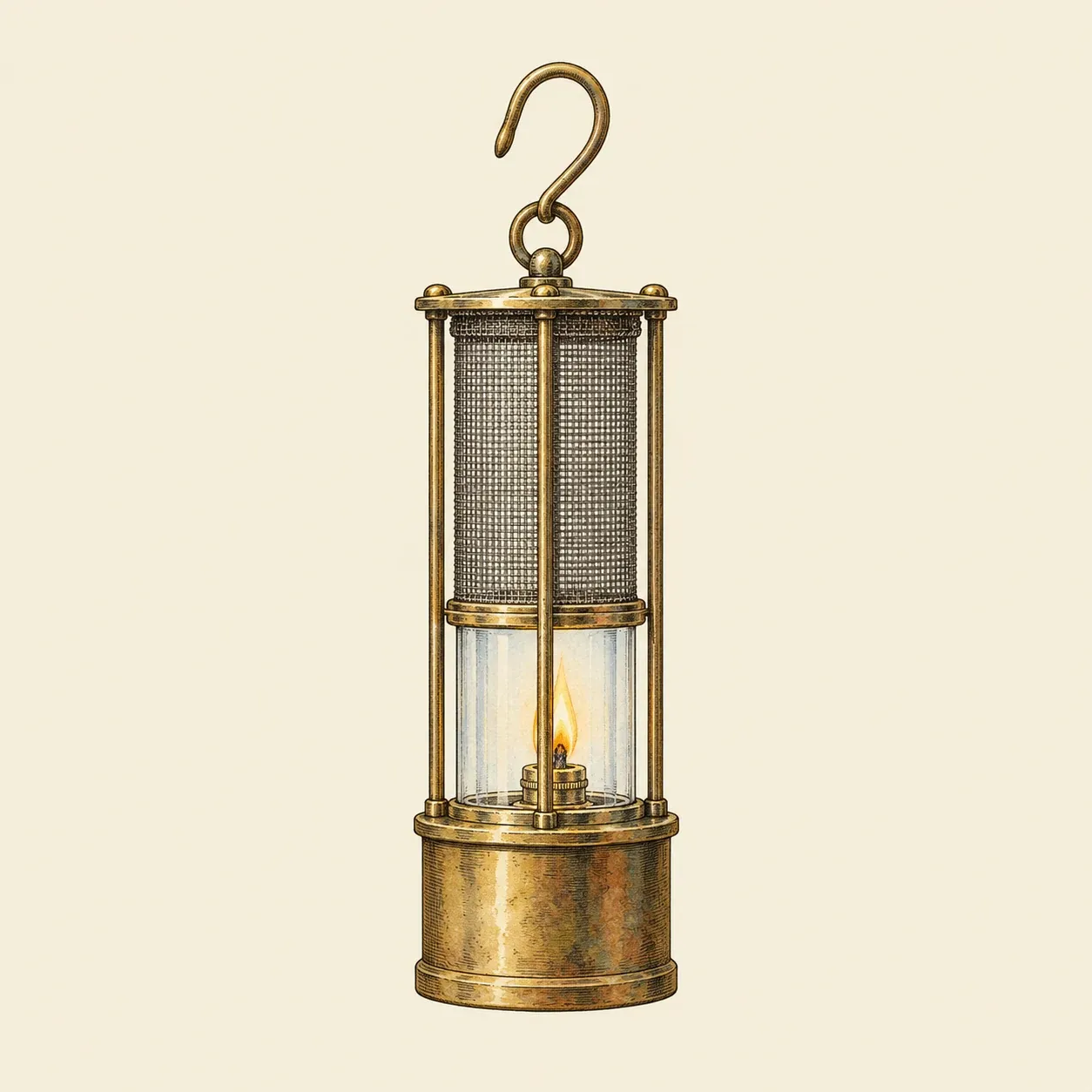 Later lamps put a thick glass cylinder round the flame and kept the gauze above it.
The lamp Humphry Davy designed at the end of 1815 is the simplest form. A small oil lamp with a brass vessel carries a cylinder of fine iron gauze, closed at the top by a second layer of gauze. Three upright wires protect the cylinder and meet above it at a plate with a ring for carrying or hanging the lamp. The gauze is the whole enclosure: there is no glass, and the miner sees the flame through the mesh. Later lamps put a thick glass cylinder round the flame and kept the gauze above it, which gave much more light.
The lamp was also the miner’s gas detector. The way its flame changed told him whether firedamp was present and roughly how much.
How it works
A flame is a layer of gas hot enough to keep itself burning. When it reaches the gauze, the iron wires draw heat out of it faster than the burning gas can make it, and the gas that passes through the holes comes out too cool to burn on the other side. Davy began with narrow metal tubes: an explosion does not travel down a tube that is thin and long enough. A sheet of gauze works like a great number of very short tubes side by side. In his paper of January 1816 he reported that the gauzes he tried, from 625 to 6,400 holes per square inch, were safe. A handbook of 1842 warned that no opening should be wider than one twenty-fourth of an inch, about 1 mm, and the gauze that became standard had 28 iron wires to the inch, or 784 holes per square inch.
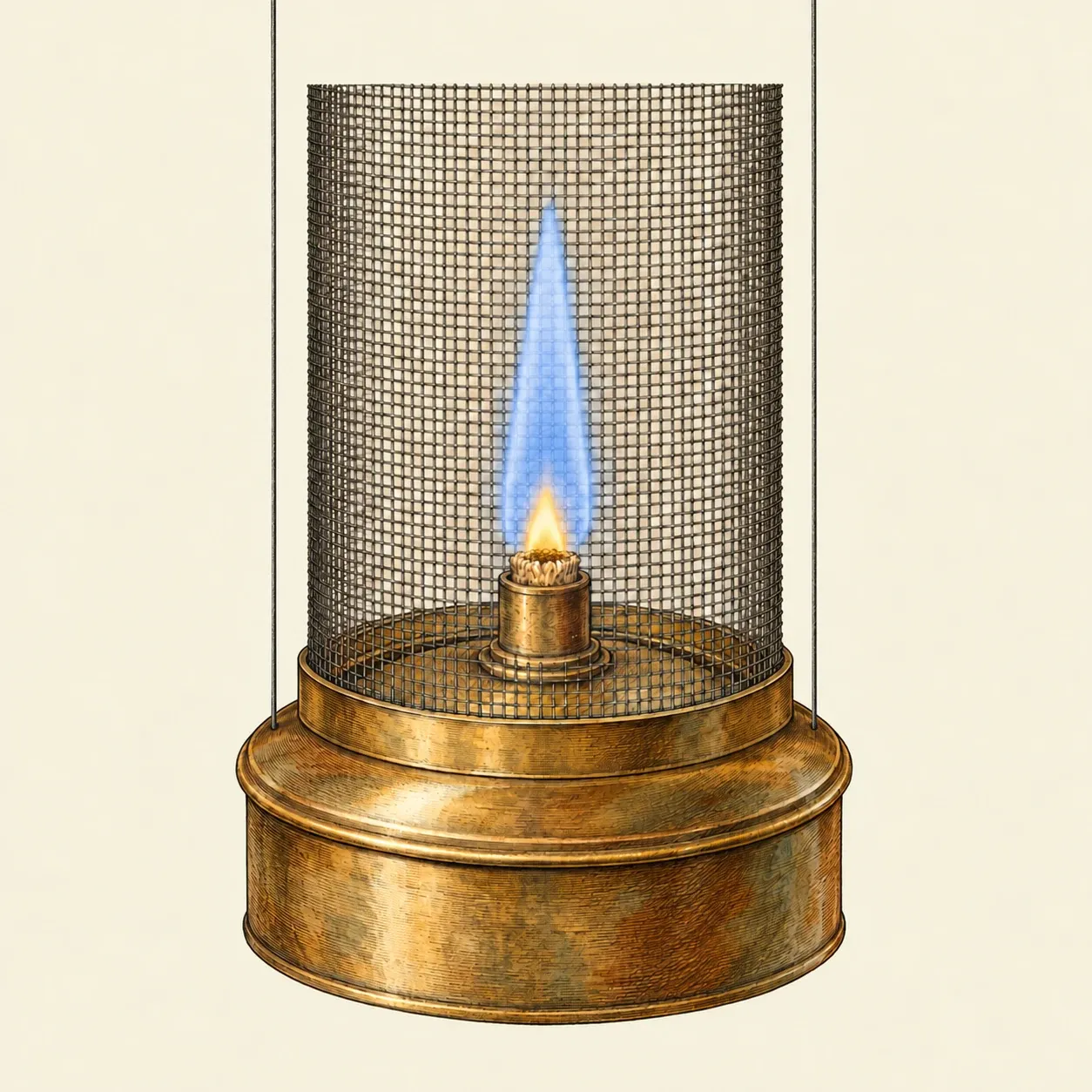 When firedamp is present, a pale blue cap rises above the flame; the more gas, the taller the cap.
The lamp breathes in whatever air surrounds it. When that air holds firedamp, some of the gas burns inside the cage. With a little gas, a pale blue cap appears above the yellow flame, and it grows taller as the proportion rises. Some lamps had marks on their glass so that the height of the cap could be read. In an explosive mixture the whole cylinder fills with flame and the gauze can glow red, yet the burning stays inside. This is the signal to withdraw at once: left in the gas, the wires keep heating and can eventually melt.
The protection had limits that were known from the start. A strong current of air could blow the flame through the mesh. In tests by a British Royal Commission between 1879 and 1886, a Davy lamp from Blantyre Colliery passed its flame to the explosive mixture around it when that mixture was moving. A hole larger than the mesh, made by a blow or by rust, removed all protection, and so did opening the lamp underground, which miners were told never to do. The light was weak. The lamp also let collieries work deeper and gassier seams, and explosions went on.
How to do it
A real safety lamp must be made and certified for its work, and a home-made lamp must never be taken near any gas, fuel vapour or dust. What can be shown safely at a table is the principle: a flame does not pass through fine metal gauze.
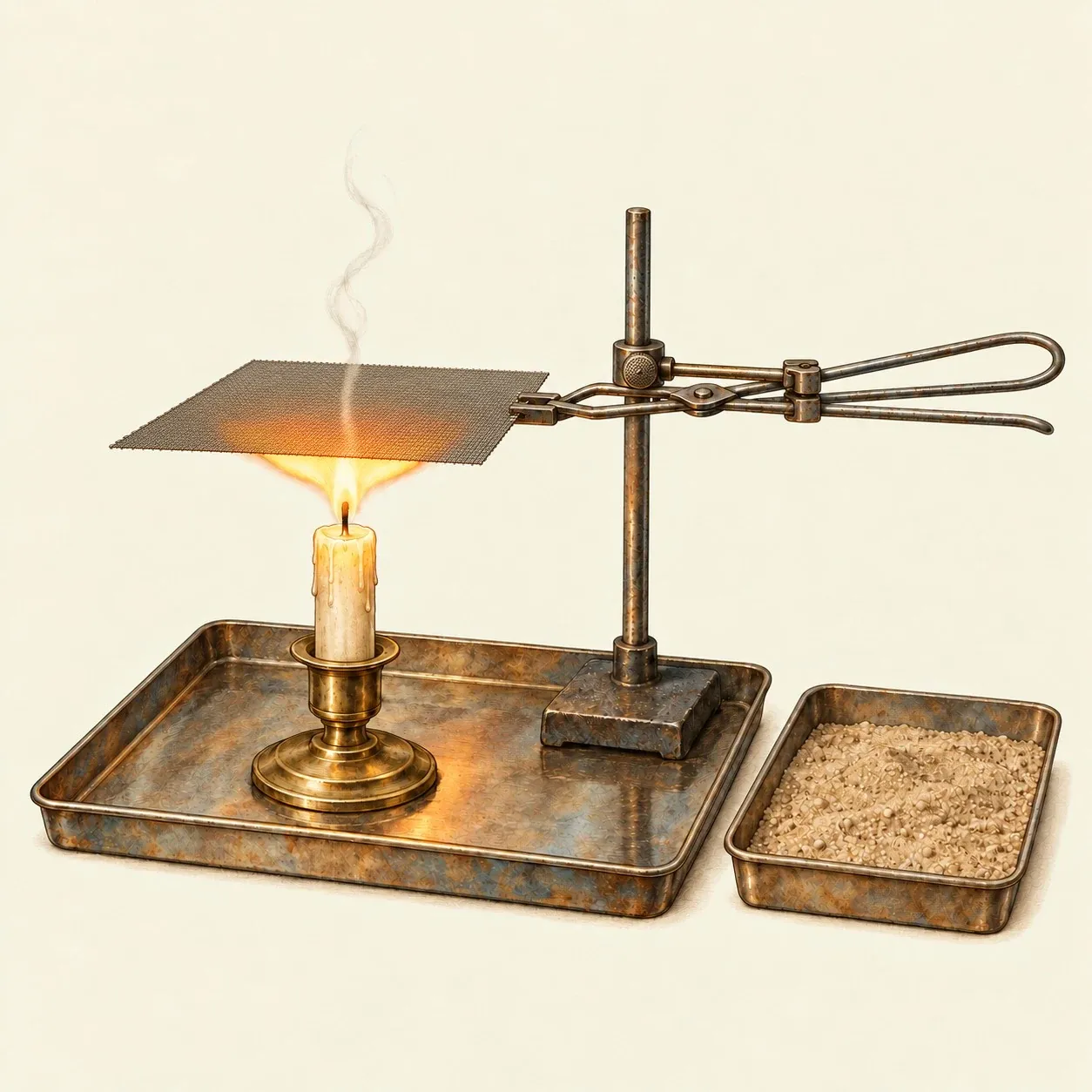 The flame spreads under the gauze but does not pass through it.
You need a candle in a stable holder, a metal tray, a square of fine metal gauze about 15 cm across (the steel or copper gauze sold for laboratories, or a piece cut from a fine metal sieve with the plastic rim removed), long metal tongs or a laboratory clamp, and a bucket of sand or water. Light the candle and let the flame settle. Hold the gauze flat with the tongs and lower it slowly onto the flame until it cuts the flame about halfway up. The lower part of the flame spreads out beneath the mesh, and above it you see only a little smoke and no flame. Lift the gauze and the whole flame returns. A cold gauze works best; after some seconds in the flame it grows hot, soot builds up on the wires, and it should be put down on the tray to cool before it is used again.
The flame is open and the gauze becomes hot enough to burn skin. Work on a heat-proof surface away from curtains, paper and anything that can catch fire, tie back long hair and loose sleeves, keep sand or water within reach, and let children do this only with an adult. Never hold the gauze in your fingers, never use a gas burner, lighter fluid, alcohol or any other fuel for this test, and never use it to check for gas. Let everything cool before you put it away.
History and evolution
On 25 May 1812 an explosion at Felling Colliery, near Gateshead, killed 92 men and boys. The next year a Society for Preventing Accidents in Coal Mines was formed at Sunderland, and its members looked to science for a safe light.
The first answer came from a Sunderland physician, William Reid Clanny. In a paper read to the Royal Society on 20 May 1813 he described a candle burning behind thick glass in a closed box. A pair of bellows pushed fresh air into it through water below the flame, and the burnt air escaped through water above it, so that any explosion inside could not reach the mine. The lamp worked but needed constant pumping, and Clanny went on to simpler designs.
In 1815 two men worked on the problem at the same time. George Stephenson, the enginewright of Killingworth Colliery who later built locomotives, tested a lamp in the mine on 21 October 1815 and improved versions on 4 and 30 November; in its developed form, the flame burned in a glass chimney under a metal cover pierced with small holes. Humphry Davy started work in London on 9 October 1815, with Michael Faraday as his assistant. On 9 November his first paper, on lamps whose air passed through narrow tubes, was read to the Royal Society. He then replaced the tubes by wire gauze. Five of his gauze lamps were tried at Hebburn Colliery on 9 January 1816, and his account of the gauze lamp was read two days later.
Each side claimed priority. Davy’s supporters held that the lamp came from his experiments and that Stephenson had borrowed the idea. In 1817 a committee in Newcastle concluded that Stephenson had worked independently, and coal owners raised £1,000 for him. Both lamps stayed in use, the Davy across most of Britain and Stephenson’s “Geordie” lamp in the north-east, where many miners preferred its brighter light.
Later lamps combined glass and gauze. In 1839 Clanny put a glass cylinder round the flame with the gauze above it, and in 1840 the Belgian engineer Mathieu Mueseler added an inner chimney that improved the draught and kept the glass clear of soot. After the air-current tests of the Royal Commission, lamps with a metal bonnet around the gauze were preferred. Electric lamps brought the next change. In the United States, the Bureau of Mines approved in 1915 a cap lamp developed with Thomas Edison, with a light bulb on the helmet and a rechargeable battery on the belt. Electric cap lamps gave far better light, but they could not show gas, so flame safety lamps were kept as gas detectors long after they ceased to be used for light.