Textile recycling
Tearing worn cloth back into fibre
Contents
- 1Feed table with rags
- 2Fluted feed rollers
- 3Swift set with teeth
- 4Casing over the swift
- 5Opened fibre leaving the machine
- 6Drive pulley and belt
Textile recycling recovers the fibres of worn clothes and cloth. Rags are sorted by fibre and colour and torn apart by a toothed drum into loose fibre, which is spun again with some new fibre or made into felt, padding and insulation. Re-spun rag wool, called shoddy, was first made at Batley in Yorkshire in about 1813.
What it is
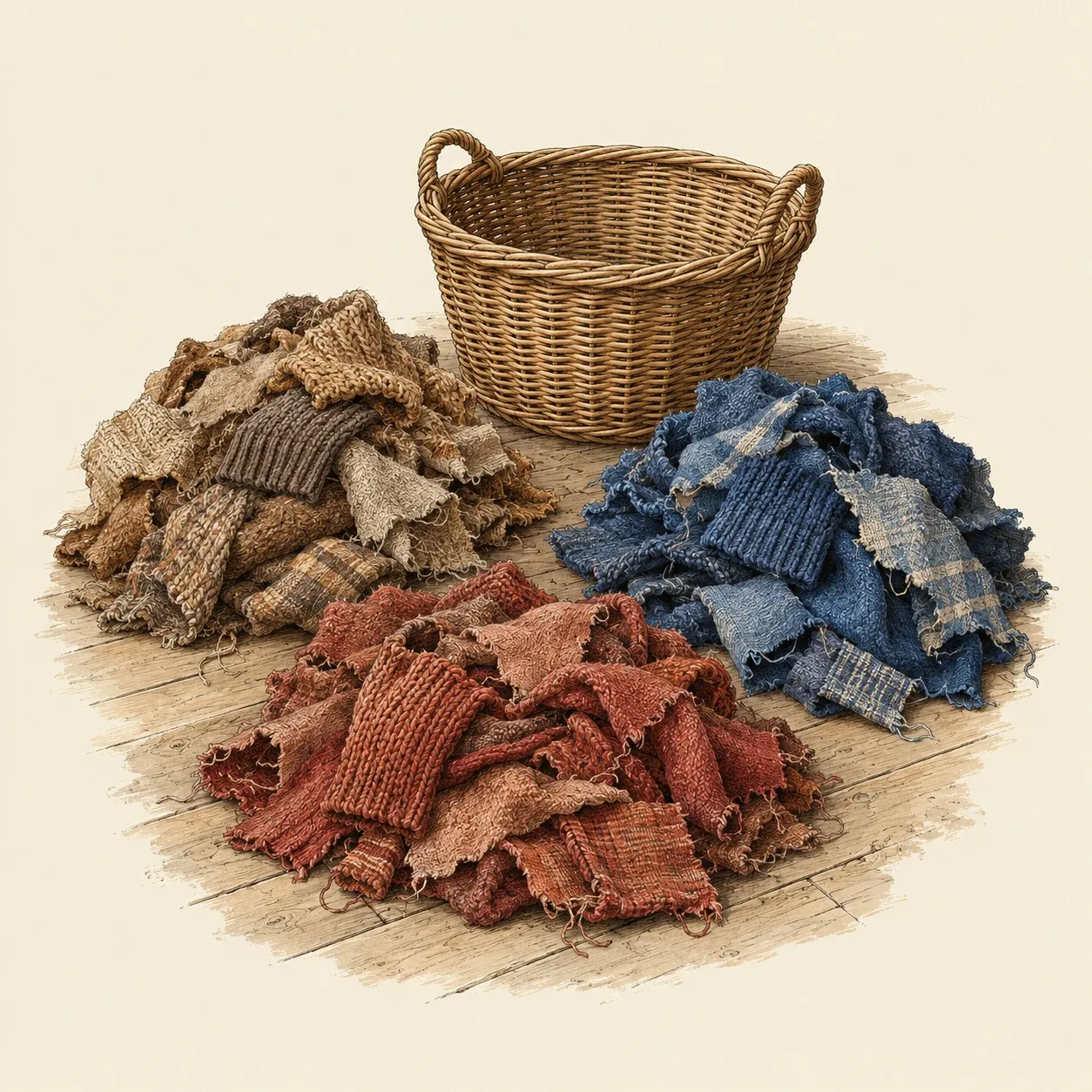 Rags are sorted by colour and fibre before they are torn.
Textile recycling turns worn clothing, household linen and cutting waste back into fibre that can be used again. Reuse passes a garment on to be worn as it is; recycling takes the cloth itself apart. Most of it is done mechanically. Rags are sorted, cut and torn until the yarns come undone and the fabric becomes a loose mass of fibre, which is spun into new yarn or laid into felts, pads and insulation.
Sorting decides what each rag can become. Woollen rags are graded by colour as well as by fibre, and in Prato, in Tuscany, sorters called cenciaioli still do this by hand. The kind of cloth matters too. In the Yorkshire mills, soft rags such as knitted stockings and flannels gave shoddy, while hard woven cloth, torn on more finely set machines, gave mungo, a shorter fibre.
How it works
The rags are first cleared of anything that is not fabric, such as buttons, zips, labels and hard seams, and cut into pieces. Refashion, the French organisation for textile waste, notes that metallised or plastic threads, elastane and open fabrics such as lace and tulle get in the way of the machines, and that blends are hard to handle.
In the classic rag machine of the Yorkshire mills, the rags lie on a feed table and are drawn in slowly between a pair of fluted rollers that grip them. Just beyond the rollers turns the swift, a large cylinder covered with short steel teeth, running far faster than the rollers. Its teeth rise past the rollers, catch the cloth as it leaves their grip and tear it apart, and the opened fibre is carried round and thrown out of the casing. Samuel Jubb, a Victorian historian of the trade, describes swifts set with coarse teeth for soft rags and finer ones for cloth. Tearing, now often called garnetting, is still the main step of mechanical recycling.
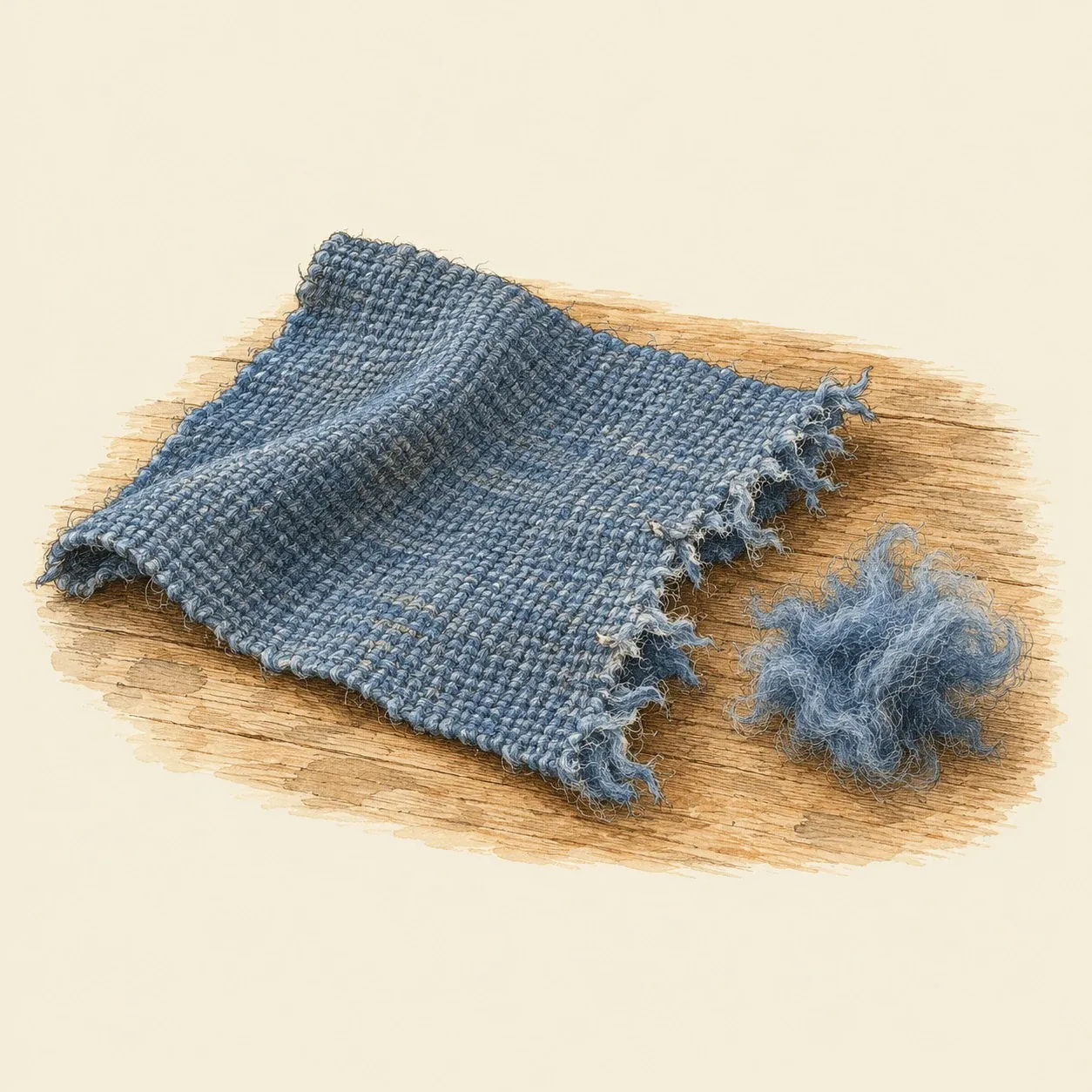 Tearing opens the cloth into fibre, but breaks many fibres and leaves them shorter than new wool.
Tearing breaks many fibres, so recycled fibre is shorter and more uneven than new fibre. To make yarn it is usually blended with new carrier fibre, which gives strength and a good appearance. Unravelling knitted fabric is gentler and keeps the fibres longer. In Prato the rags are washed and dried, torn, then carbonised to destroy vegetable matter such as plant burrs and cotton fibres, before carded spinning and weaving. Fibre too short to spin goes into nonwovens, webs of fibre bonded or needled into felt, padding and insulation, which Refashion describes as the largest outlet by volume. Wiping cloths and stuffing take more.
How to do it
A worn woollen jumper shows the principle on a small scale. Choose one of pure wool, wash it, and cut it apart along the seams; cut away ribbing, labels and any stitching in synthetic thread. A loosely knitted piece can be unravelled: find the end of the yarn at a cut edge, pull it out row by row and wind it into a skein. The yarn comes out crinkled and can be knitted again.
For loose fibre, cut the knitting into small pieces and pull each one apart with your fingers until the loops open into tufts. Hand carders, two wooden paddles covered with fine wire teeth, then do the work of the swift. Spread the tufts on one carder and draw the other across it several times until the fibre lies in a soft, even layer. Card some new wool in with it so that the short recovered fibres have longer ones to hold on to. The carded fibre can be spun on a drop spindle, or felted into a small mat by rubbing it in hot, soapy water.
Carder teeth are sharp and can scratch or pierce the skin, so keep your fingers off them and draw the carders away from your body. Pulling and carding raise fibre dust: work by an open window or outdoors. Felting needs hot water, so test it with your hand before putting the work in, and keep young children away from the kettle.
History and evolution
Linen and cotton rags had long been ground for paper, but tearing woollen rags into fibre to spin it again began in the West Riding of Yorkshire. Jubb dates the first use of shoddy to 1813, and John Malin, the historian of the West Riding recovered wool industry, also places its start in about 1813, drawing on Jubb and on evidence that Yorkshire manufacturers gave to Parliament.
Jubb favours Benjamin Law of Batley as the first maker of shoddy, but notes that several men began running rag machines at almost the same time, among them at Howley Mill near Batley. Some early machines had been built to grind hard worsted waste rather than rags, and there was no patent, so one machine was copied from another. Water wheels drove them; attempts to turn them by hand failed because of the force they needed, and a horse gin did better. Mungo, the shorter fibre torn from hard woven cloth, followed some years later.
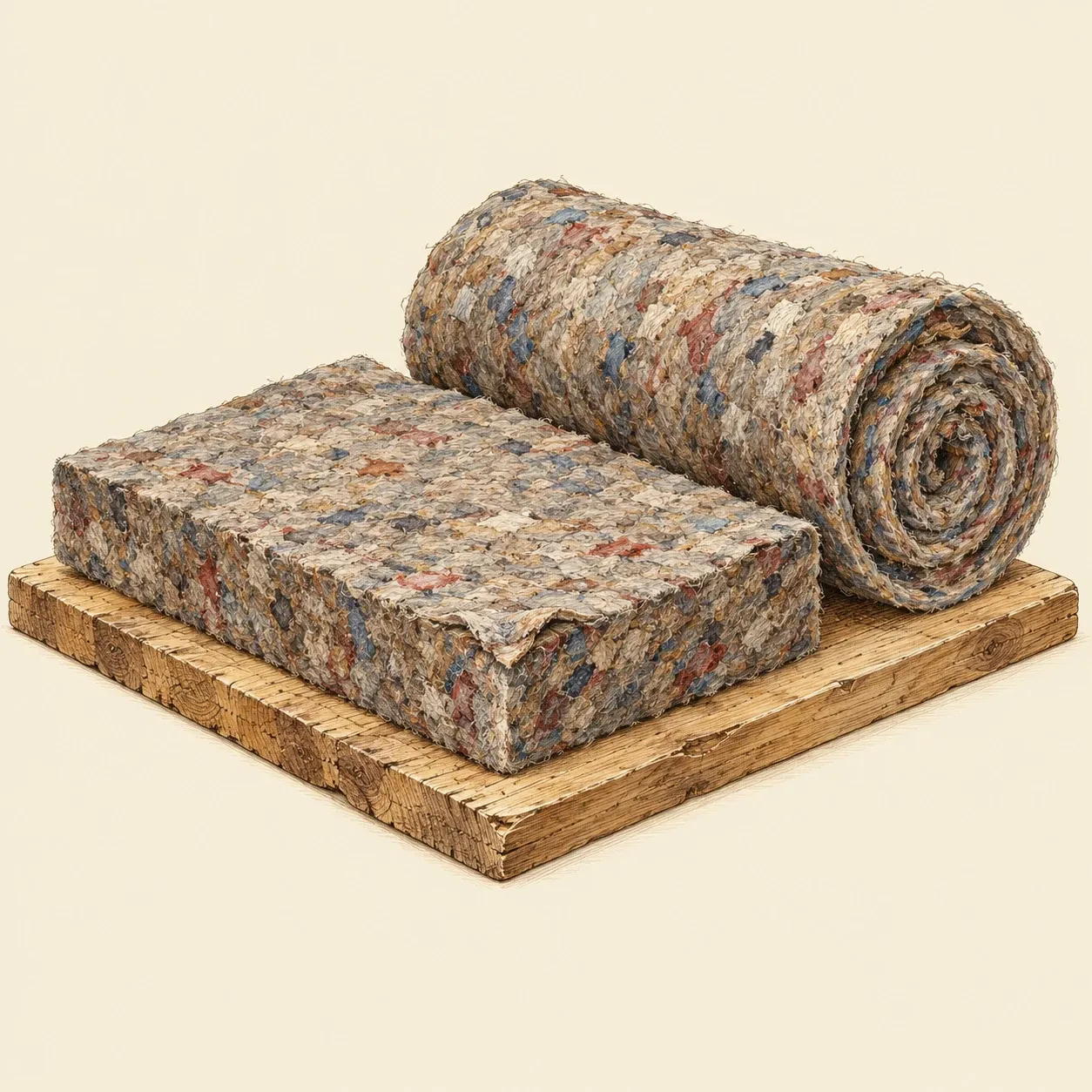 Insulation made from recycled textile fibre, one of the main outlets for fibre too short to spin.
The trade spread through the woollen district around Batley and Ossett in the nineteenth century, and Malin follows it into the twentieth century. In Prato, the regeneration of discarded clothing grew into a whole supply chain, and the town became a centre of carded wool fabrics. The Meucci family’s wool-recycling mill at Vernio, in the Bisenzio valley above Prato, worked until 1988 and now houses a museum of textile machinery.
Most worn textiles are still not recycled. The European Environment Agency finds that most textile waste in the EU goes into mixed household waste rather than separate collection, and the European Commission’s Joint Research Centre estimates that more used textiles are burnt or landfilled each year than are reused and recycled together. EU law has required member states to collect textiles separately since 1 January 2025, and the agency warns that without more sorting and recycling capacity much of what is collected could still be burnt, landfilled or exported.