Candle
A wick that feeds on its own solid fuel
Contents
- 1Bronze pricket holding the candle
- 2Solid body of beeswax
- 3Wick of twisted plant fibres
- 4Cup of melted wax
- 5Dark zone of wax vapour
- 6Bright zone where soot particles glow
A candle is a wick set in a fuel that stays solid at room temperature, such as tallow or beeswax. The flame melts a small pool at the top, the wick draws the liquid up, and its vapour burns. Etruscan bronze stands with prongs for candles, from about the middle of the sixth century BCE, are the oldest firm evidence.
What it is
A candle is a lamp whose fuel is solid. A wick runs through the middle of a stick of tallow, beeswax or another fat or wax that stays hard at room temperature. Once it is lit, the flame melts only a little fuel at the top, so the candle needs no bowl to hold it. It can stand on a spike or in a socket and be carried while it burns, which a fat lamp with an open pool of oil does badly.
Candles are made by dipping a wick again and again into melted fuel, or by pouring the fuel into a mould around a stretched wick. Tallow, rendered from the fat of cattle or sheep, was cheap and common; beeswax smelled better and made less mess, but cost more. From the eighteenth century, candles were also made from spermaceti, a wax from the head of the sperm whale, then from stearin made from fats, and from paraffin wax distilled from coal and oil shale.
How it works
In his Christmas lectures of 1860, Michael Faraday took the candle apart step by step. The heat of the flame melts the top of the candle into a shallow pool. Air drawn upwards by the hot flame flows past the sides and cools the outer edge, so a rim of solid fuel remains and holds the pool like a cup. If a draught blows from one side, the cup becomes lopsided and the liquid runs down the candle, which is called guttering. The liquid climbs the wick by capillary action, the force that draws water up a strip of cloth, and turns to vapour near the flame.
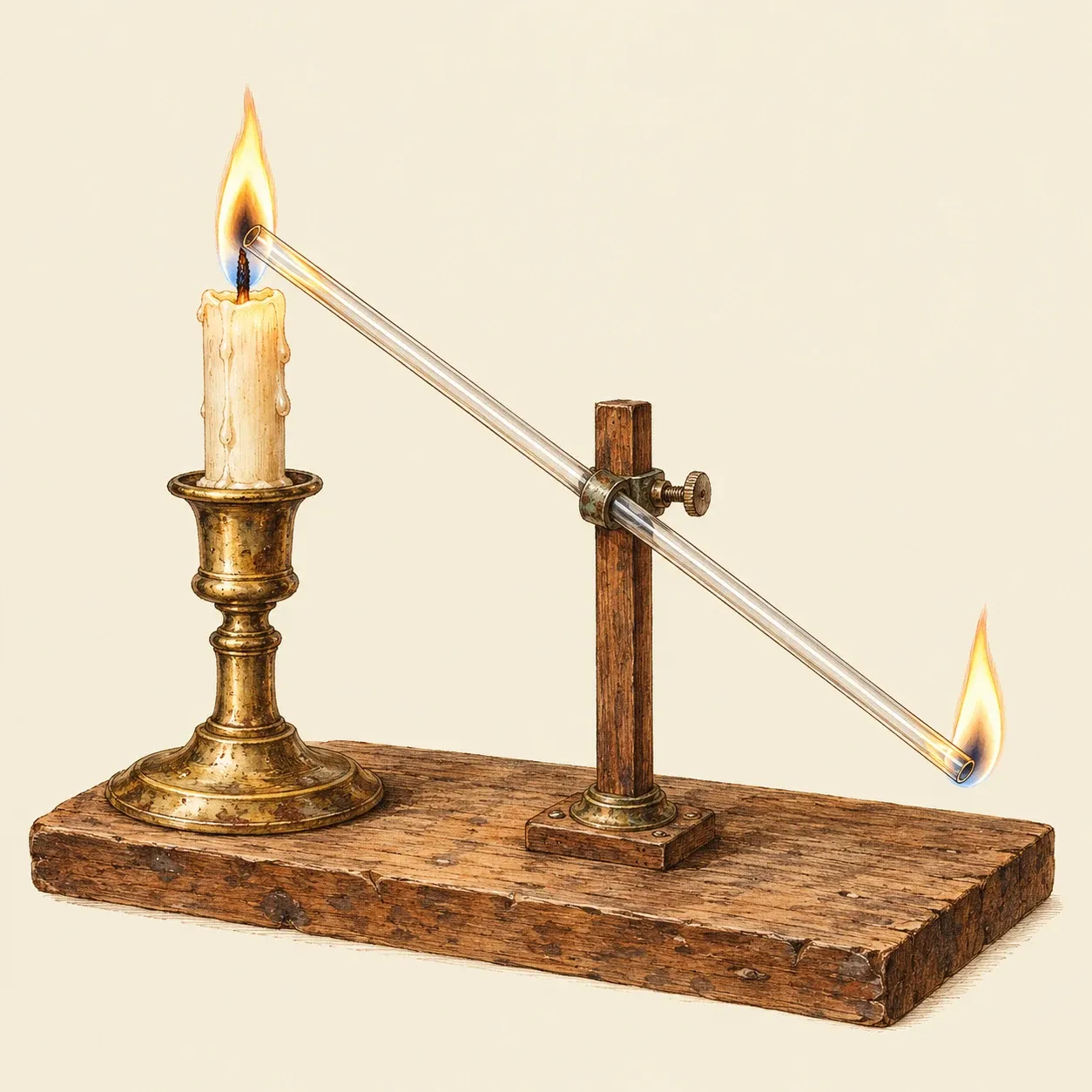 Faraday drew vapour from the dark zone through a glass tube and lit it at the far end.
The flame has a structure. Around the wick lies a dark zone filled with unburnt vapour: Faraday drew some off through a glass tube and lit it at the far end. The vapour burns where it meets the air, at the edge of the flame. The yellow light comes from tiny solid particles of soot that glow in the heat and then burn away at the top of the flame. When the flame is disturbed, they escape as smoke.
The wick must burn away as fast as the candle shortens. In old candles with twisted wicks, the charred end stood up in the flame, grew longer and made the candle smoke, so it was cut off regularly with snuffers, scissors with a small box to catch the burnt wick. A plaited wick curls over as it burns into the hottest part of the flame and wears away on its own. Candle makers also soaked cotton wicks in boric acid, which melts the ash into glass so that the wick burns away completely. Beeswax melts at about 62 to 65 °C, and a wick has to suit both the fuel and the width of the candle.
How to do it
Hand-dipping makes a pair of thin tapers at once. You need beeswax, cotton candle wick of a size meant for thin tapers, a tall clean tin can, a saucepan, a short wooden rod, scissors and a sheet of cardboard. Cut a length of wick a little more than twice the depth of the can and hang it over the middle of the rod, so the two ends hang apart.
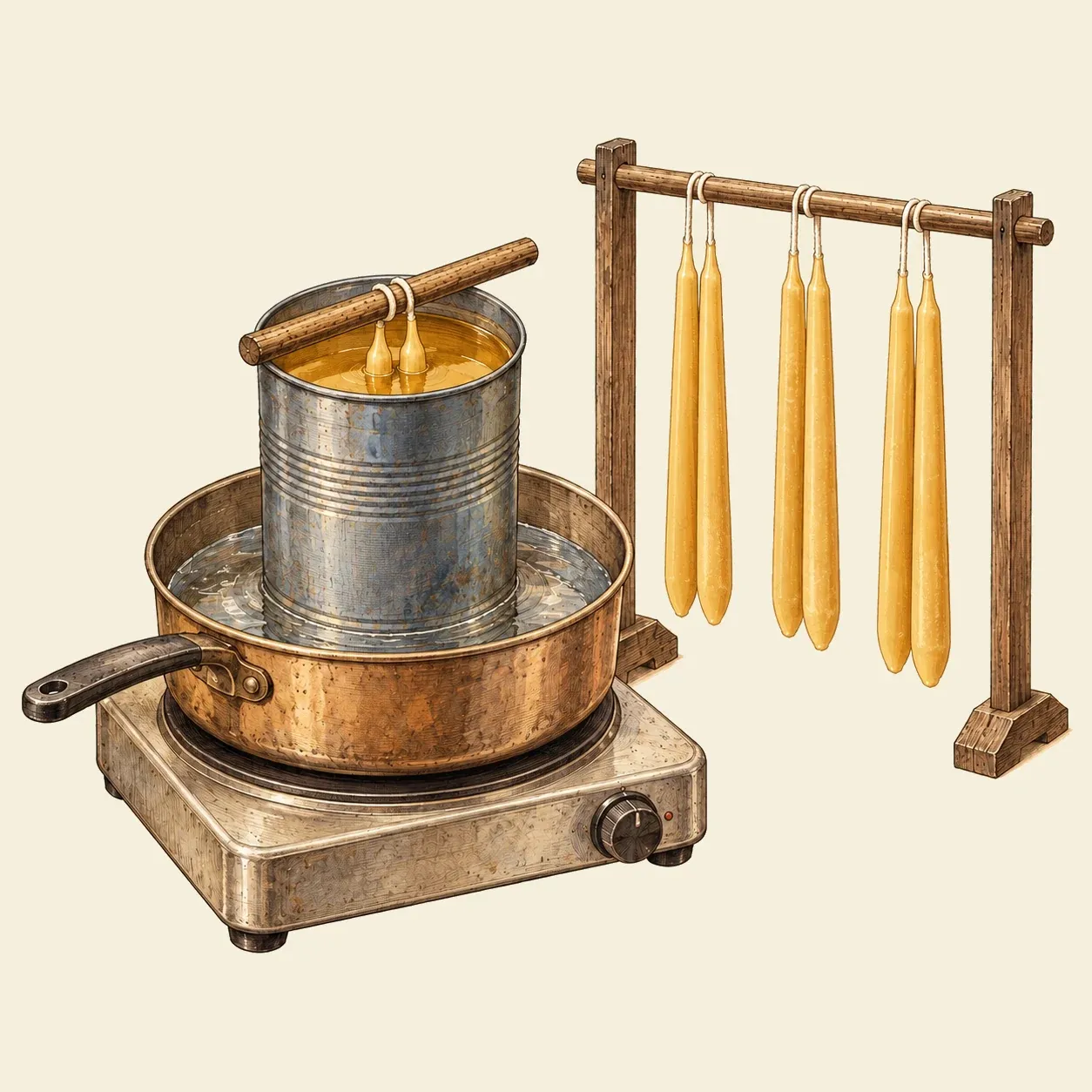 The tapers grow a thin layer at each dip and cool between dips.
Put the wax in the can, stand the can in the saucepan with water around it, and heat gently until the wax has melted, adding more until the can is nearly full. Lower the wicks into the wax in one smooth movement, lift them out at once and pull them straight. Let each layer cool and set before the next dip, and keep the wicks off the bottom of the can. If the wax barely builds up, it is too hot; if it goes on in lumps, it is too cool. Repeat until the candles are as thick as you want, then cut the wick between them, trim the base flat with a warm knife and trim the wick short. Leave them to harden for a day before lighting.
Safety. Melt wax only in a container standing in water, never in a pan directly on a flame or hot plate, and never leave it while it heats. If wax catches fire, turn off the heat and, only if you can do so safely, cover the container with a close-fitting metal lid; never use water or anything wet on burning wax. Burn the candle in a sturdy holder that cannot catch fire, at least 30 cm from anything that can burn, and never leave it alight in an empty room or while you sleep.
History and evolution
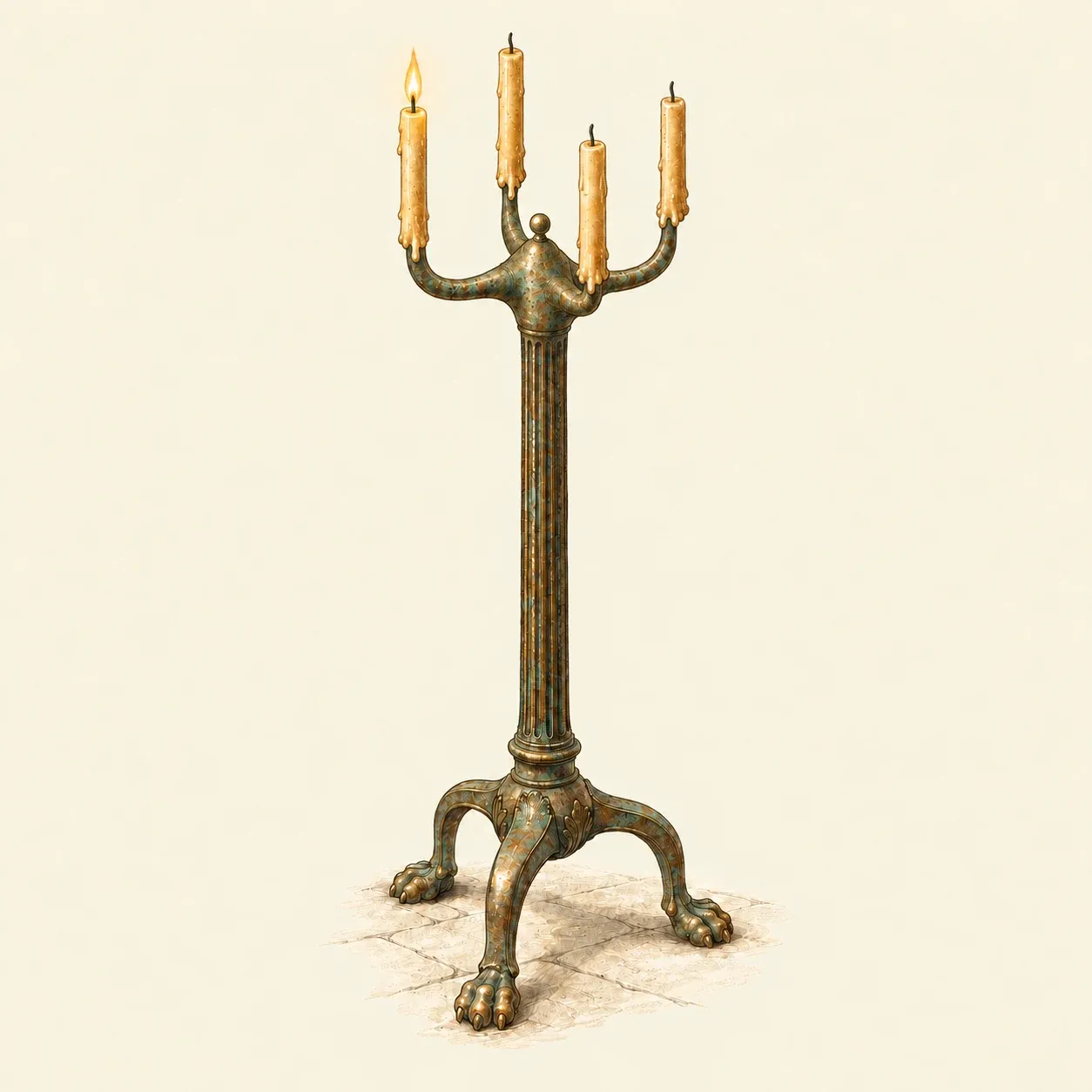 Etruscan candelabra carried candles on the prongs of their crown.
The oldest firm evidence of candles comes from Etruria, in central Italy. Its bronze candelabra are tall stands ending in a crown of upturned prongs on which candles were impaled. Laura Ambrosini, an Etruscologist at Italy’s National Research Council, places the first candelabra made to carry candles in the middle of the sixth century BCE, and the Metropolitan Museum in New York dates one of its Etruscan bronze candelabra to about 550 BCE. Another at the Met, probably made at Vulci about 500 to 475 BCE, has four prongs for candles at the top of its fluted shaft, and National Museums Liverpool describe candelabra for real candles as a characteristic Etruscan invention. In the first century BCE, the Roman scholar Varro explained that the candelabrum took its name from the candela, the candle, because burning cords were fixed on it, and he believed the oil lamp came later. Roman candles were of wax or tallow, and according to Pliny their wick was the pith of a rush.
The cheapest light of this kind was the rushlight. In 1775 the naturalist Gilbert White described how labouring families in Hampshire peeled common rushes, leaving one strip of rind to hold the pith, then bleached and dried them and dipped them in kitchen fat. A rush about 72 cm long burned for almost an hour, while a halfpenny candle in a draughty room lasted only about two hours. Snuffers are recorded from the fifteenth century, and spermaceti candles, which gave a bright, steady light, came into use in the mid-eighteenth century.
Chemistry changed candles in the 1820s. In 1823 Michel-Eugène Chevreul showed that fats are compounds of glycerol and fatty acids, and with Joseph-Louis Gay-Lussac he patented the use of stearic acid in candles: in 1824 according to L’Actualité chimique, in 1825 according to the American Oil Chemists’ Society. Louis Adolphe de Milly and Motard made the process industrial by splitting tallow with lime and pressing out the liquid part, and used wicks treated with boric acid that no longer needed snuffing. The Victoria and Albert Museum dates the self-trimming plaited wick to 1825, the Kings Landing museum to 1824.
In 1834 Joseph Morgan, a pewterer and candle-mould maker in Manchester, patented a candle-making machine. James Young’s patent of 1850 for oil distilled from coal led to paraffin wax, and by the 1860s paraffin was the most common candle material. Kerosene lamps followed in the 1850s and the electric light bulb in 1879, although in most homes electric light replaced candles and oil lamps only well into the twentieth century.