Crossbow
A bow held drawn by a trigger lock
Contents
- 1Prod, the bow of the crossbow
- 2Bowstring
- 3Stirrup
- 4Tiller, the wooden stock
- 5Nut, holding the string
- 6Trigger
A crossbow is a short, stiff bow fixed across a wooden stock. Its string is drawn back once and held by a catch, so the shooter can take aim without effort and loose the shot with a trigger. Bronze trigger mechanisms from tombs at Qufu, in eastern China, date from the 6th century BC, and in medieval Europe the crossbow served in sieges, at sea and in the hunt.
What it is
A crossbow is a bow mounted crosswise at the front of a wooden stock. The bow is called the prod or lath, and the stock the tiller. When the crossbow is spanned, its string is pulled back along the top of the tiller and caught by a lock. The shooter lays a short, heavy arrow called a bolt or quarrel in a groove in front of the string, raises the tiller against the cheek or the shoulder, aims and squeezes the trigger.
On a European crossbow of the 15th century, the prod is often a composite bow of wood, horn and tendon glued together, of the kind contemporary documents called a horn bow. An iron stirrup at the front lets the shooter hold the weapon down with one foot while spanning it. The lock is a nut, a small turning cylinder of antler set in the top of the tiller, and a long iron trigger lies under the stock.
How it works
A crossbow stores energy as a hand bow does: drawing the string bends the limbs of the prod, and the bent limbs throw the bolt when they straighten (see bow and arrow). The difference is the lock. An archer has to hold the full weight of the draw while aiming, so a hand bow can be no stiffer than the archer’s arms. A crossbow string, once caught, stays drawn with no effort from the shooter. The prod can therefore be much stiffer than any bow drawn by hand.
The European nut does this with very few parts. The nut turns freely in a seat cut into the tiller. A notch with two horns on its upper side catches the string, and a small notch on its underside receives the upper end of the trigger, a lever pivoting on a pin through the tiller. While the trigger’s end sits in that notch, the nut cannot turn and the string stays caught. Squeezing the long tail of the trigger against the stock pulls its end out of the notch; the pull of the string then turns the nut forward, the horns tip down and the string flies free, pushing the bolt.
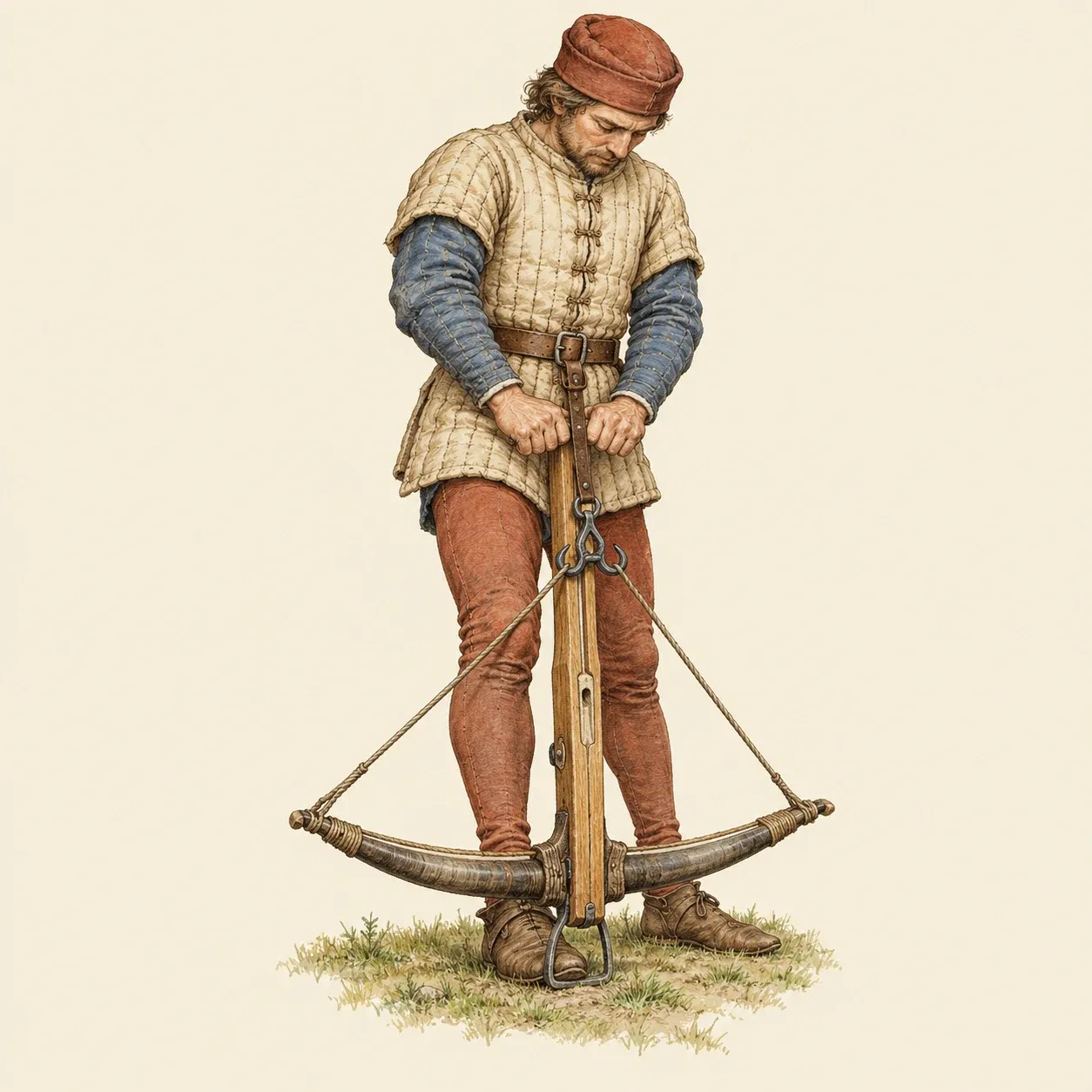 With a hook on his belt and a foot in the stirrup, the crossbowman spans the bow by straightening his body.
The stiffer the prod, the harder it is to span. The earliest crossbows were spanned by hand. Dick Salzer, writing for the American Society of Arms Collectors, gives an approximate maximum draw for each method: about 100 pounds (45 kg) by hand, 175 pounds (79 kg) with a spanning belt and 275 pounds (125 kg) with a belt fitted with a pulley, which doubles the pull. The belt hook let the shooter use the legs and back: he bent down, caught the string with a hook hanging from his belt and stood up with one foot in the stirrup. The goat’s-foot lever, a pair of hinged arms pivoting on pegs on the tiller, multiplied the pull five times and reached about 450 pounds (204 kg). For the steel bows of the late Middle Ages, Salzer gives a ratio of 78 to 1 for the windlass of ropes and pulleys and 164 to 1 for the cranequin, a rack drawn back by a crank and gears.
How to do it
A model of the nut lock shows how the catch works without a bow and without any projectile. It needs a block of softwood about the size of a hand, a short piece of round dowel, a flat stick, two nails, two small screw eyes and a rubber band, with a saw, a drill, a knife and sandpaper.
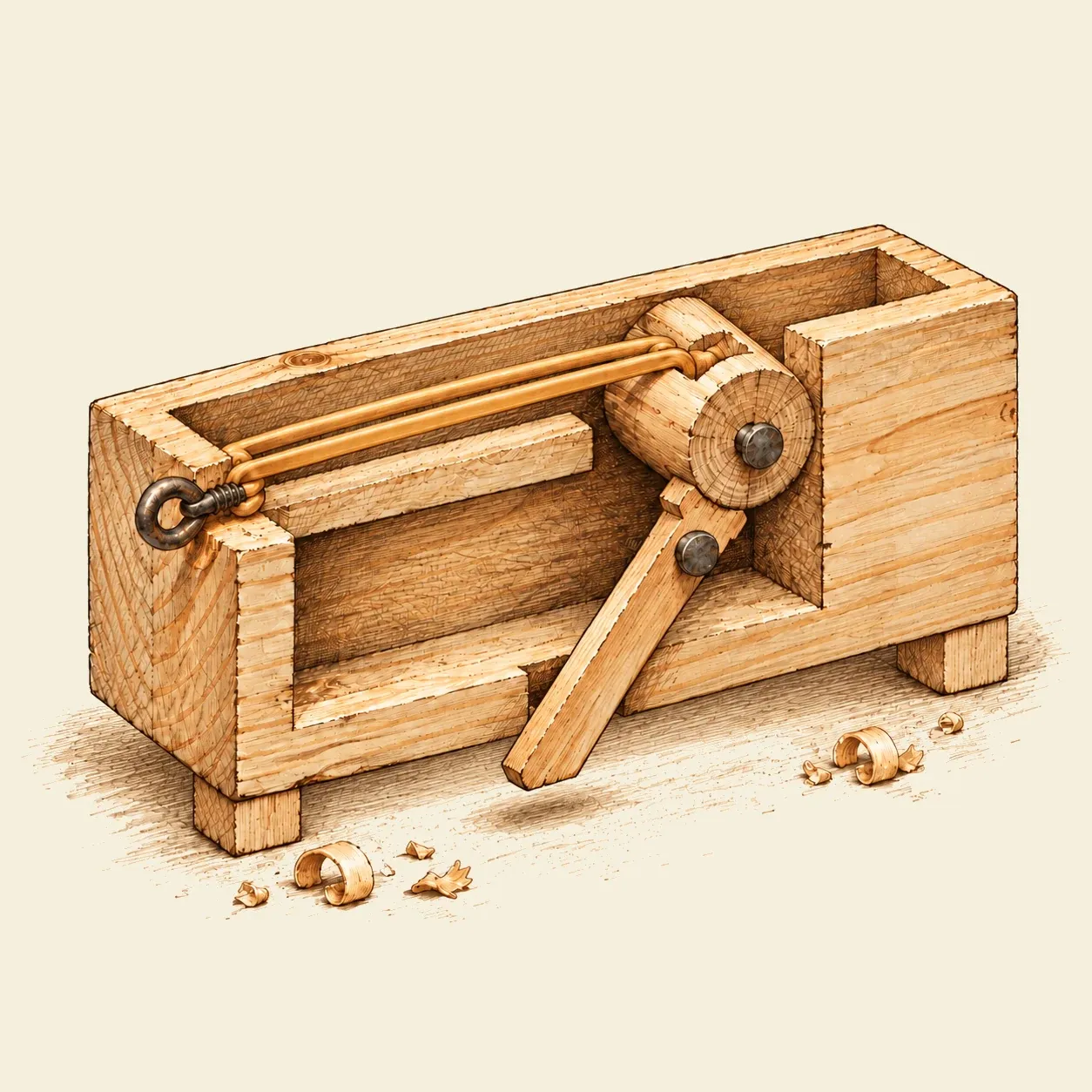 The model has the two parts of a medieval lock: the turning nut and the trigger that keeps it from turning.
Cut a slot down the length of the block for the dowel, and drive one nail across the block through the centre of the dowel so that it can turn on it. File a notch in the top of the dowel deep enough to hold the rubber band, and a small notch on its underside. Below the dowel, fix the flat stick on a second nail across the block, so that its upper end can swing into the small notch and its lower end hangs out under the block. Turn the two screw eyes into the front end of the block and hook the rubber band onto them. Turn the dowel so the notch faces back, stretch the band over it and engage the end of the stick in the lower notch. When you press the stick against the block, its end leaves the notch, the dowel turns forward and the band slips off.
Safety. Do not attach a bow or a stronger spring to the model. Real crossbows are weapons, and many countries regulate who may own and use them.
History and evolution
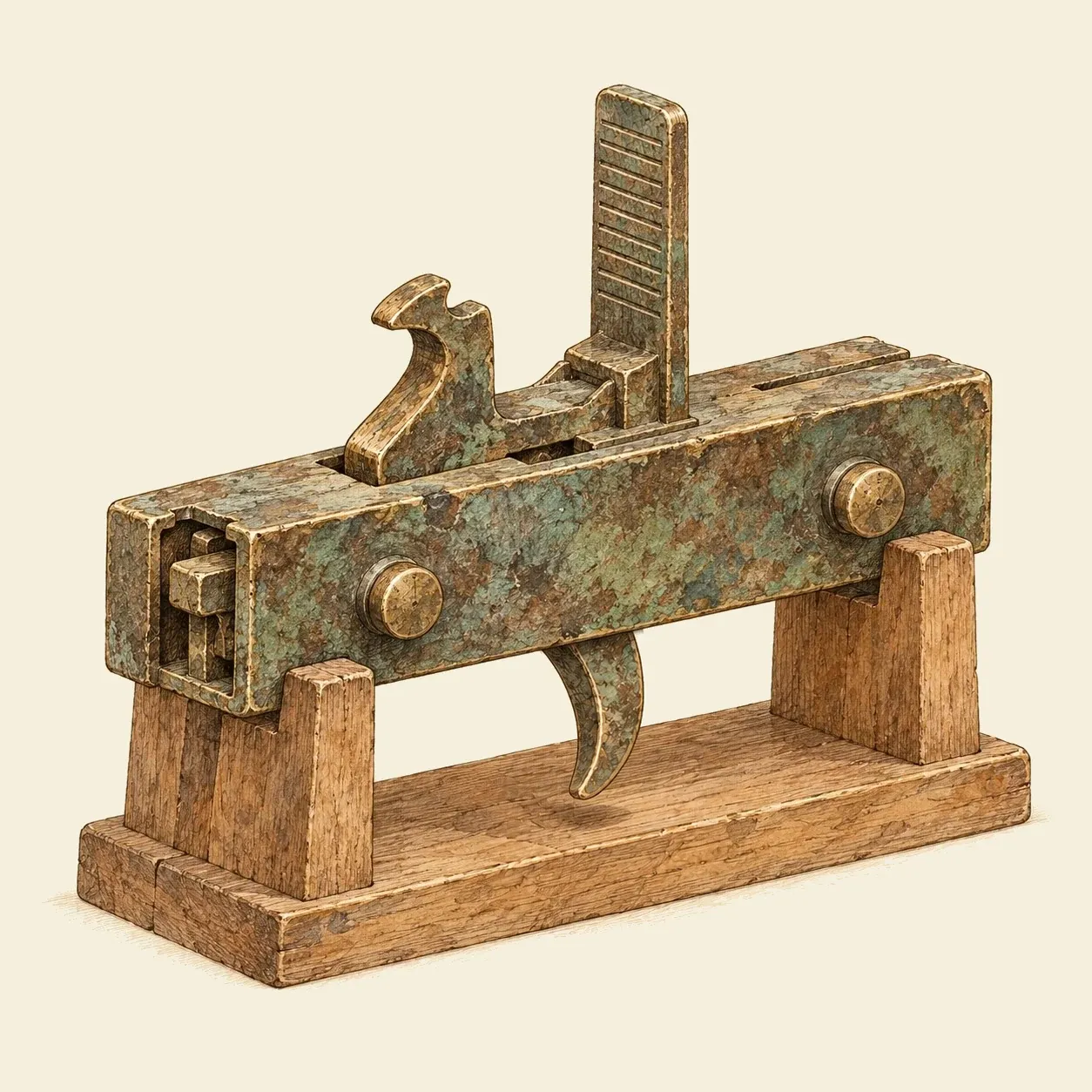 A Chinese bronze lock: the hook holds the string, the upright sight carries range marks, and the blade below is the trigger.
The crossbow first appears in China. Because the bow and stock were made of wood, the parts that survive are the bronze trigger mechanisms. The oldest excavated ones come from tombs at Qufu, in Shandong, the capital of the state of Lu, and date from the 6th century BC. Some Chinese archaeologists have proposed that objects of bone, stone and shell from about 2000 BC were crossbow triggers, an idea that no dated find has yet confirmed. The Art of War, a text of the 5th century BC attributed to Sunzi, mentions the crossbow, and a repeating crossbow that dropped bolts from a magazine was found in a tomb in Hubei of the 4th or 3rd century BC. Under the Han dynasty the hook, the cam and the trigger were commonly enclosed in a bronze box held by two pins, and the upright sight on the hook was marked with lines for judging range.
In the Greek world the gastraphetes, or belly bow, was a composite bow fixed on a stock and spanned by pressing the belly against its rear end. It was known by about 400 BC and led to the larger torsion catapults. In western Europe the crossbow was in use by the 12th century: in 1139 the Second Lateran Council forbade, under pain of anathema, the use of the crossbow and the bow by Christians against other Christians. The ban did not cover wars the Church judged just, and it had little effect on warfare.
Composite horn bows probably reached Europe from the East in the 12th century or earlier and were the main type from the 14th century to the end of the 15th. Steel bows are recorded from the early 14th century but, judging from surviving examples and pictures, were not common before about 1500. Their great stiffness required the windlass and the cranequin. The Metropolitan Museum in New York holds a horn-bowed crossbow made in 1460 for Count Ulrich V of Württemberg, with its tiller inlaid with carved staghorn. Firearms pushed the crossbow off European battlefields during the 16th century, but it remained a hunting weapon and became a sport, with shooting competitions held in many towns of France and Germany.