Torsion Catapult
Artillery powered by twisted sinew rope
Contents
- 1Spring frame
- 2Skein of sinew rope
- 3Bronze washer and iron lever
- 4Arm
- 5Slider with claw trigger
- 6Winch
A torsion catapult throws arrows or stones with the energy of twisted rope. Its arms are thrust through tight skeins of sinew held in a wooden frame, and drawing the string back twists the skeins further. Greek engineers developed it in the 4th century BC; Duncan Campbell reads Athenian arsenal lists as showing torsion machines probably in store by 330/329 BC, and the Romans used its descendants until late antiquity.
What it is
A torsion catapult is a piece of ancient artillery that draws its power from twisted bundles of rope. The earlier Greek bow machines used a bent bow, like a large crossbow. In a torsion machine the bow is replaced by two separate wooden arms. Each arm is pushed through the middle of a vertical skein of rope made from animal sinew, wound many times between the top and bottom beams of a strong wooden frame. A bowstring joins the tips of the two arms.
On a Hellenistic arrow-shooter, the spring frame sits at the front of a long wooden stock. A grooved slider runs along the top of the stock, with a claw at its rear end that grips the bowstring, and a winch at the back of the stock pulls the slider back. The whole machine turns and tilts on a joint at the top of its stand. Larger machines of the same family threw stones, and the Romans later built a one-armed stone-thrower, the onager.
How it works
Drawing the string back turns each arm in its skein, which twists the fibres of the skein further. Like a wrung towel, the twisted rope resists and tries to untwist. When the string is released, the two skeins swing the arms forward and the string throws the missile. The skeins were already very tight before the first shot, because the energy a spring can give depends on how hard it is wound.
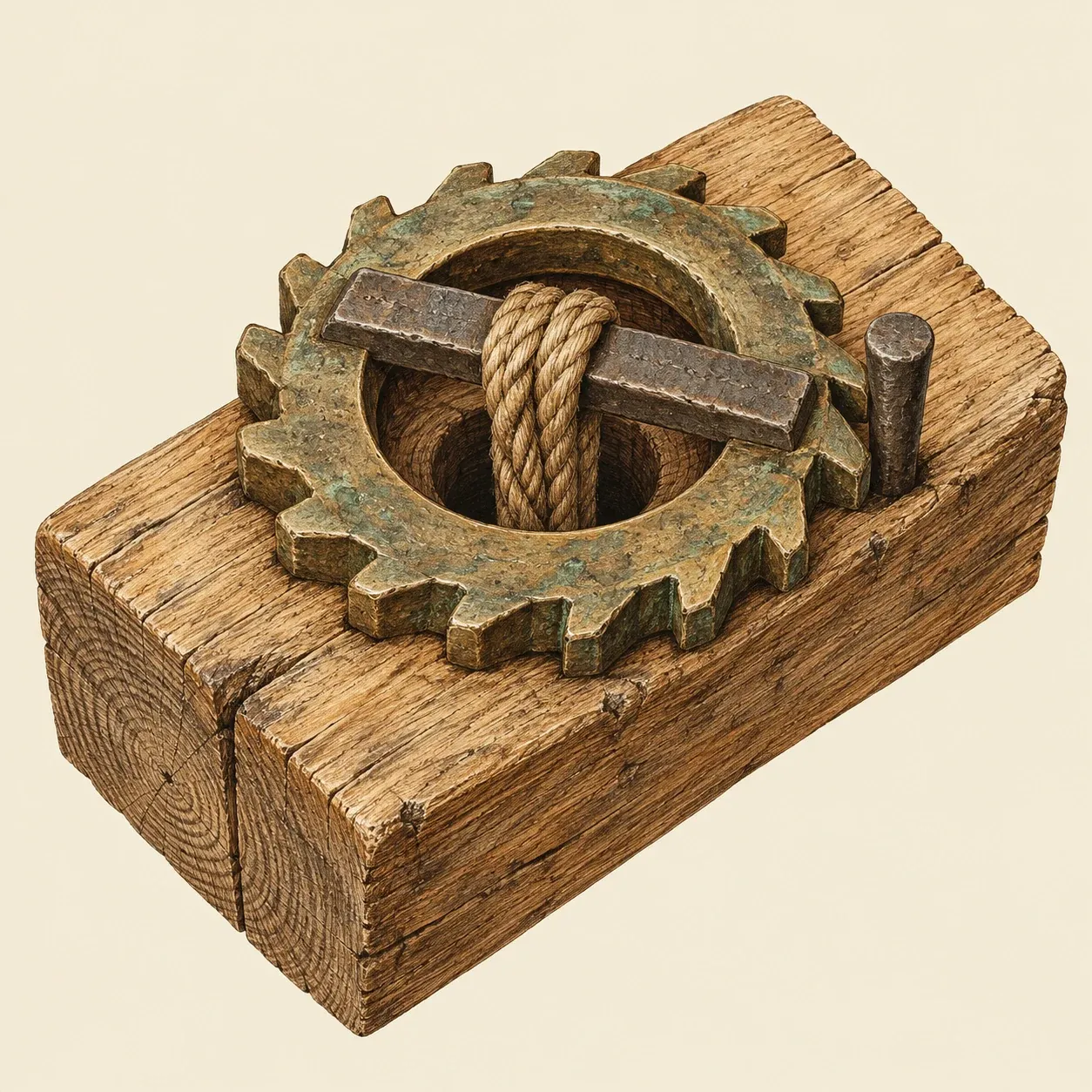 Turning the washer twists the skein a little more; a pin against one of its teeth stops it from turning back.
Each skein was made by feeding the sinew rope down through a bronze washer in the top beam of the frame, through the frame, and up through a second washer in the bottom beam, looping it each time around an iron bar laid across the washer, which modern scholars call the lever. The rope was pulled tight at every pass until no more could be forced through. In use the springs slackened. Instead of rebuilding them, the crew turned a washer to twist the skein tighter and pinned it in its new position. At Ampurias in Spain, each washer sat on a plate pierced with sixteen holes, so that it could be set at steps of 7.5 degrees, and one set of washers from Ephyra in Epirus was cast with fifteen ratchet teeth.
The two springs had to be equally tight, or the arms would not move together and the missile would fly askew. The Roman architect Vitruvius says the crews tightened them with wedges and levers until both gave the same note when struck with the hand, as a musician tunes strings by ear.
To shoot, the crew pushed the slider forward through the frame until its claw closed on the string. The winch drew the slider back, carrying the string with it, and a ratchet held it at full draw while an arrow was laid in the groove. Releasing the claw loosed the shot. The size of every part was worked out from the thickness of the spring, measured by the inner diameter of its washer, so that a design could be built at any scale. Writers on artillery named arrow-shooters after the length of their arrows, a three-span machine shooting arrows about 69 cm long.
How to do it
A small one-armed model shows the torsion spring at work. It needs seven strips of wood, four for a frame about the size of a book, two for posts and one for a crossbar, two short round dowels, a flat stick, a plastic spoon, strong string, a sponge, wood glue, small nails or screws, a drill and a saw. It throws only cotton-wool balls or crumpled paper.
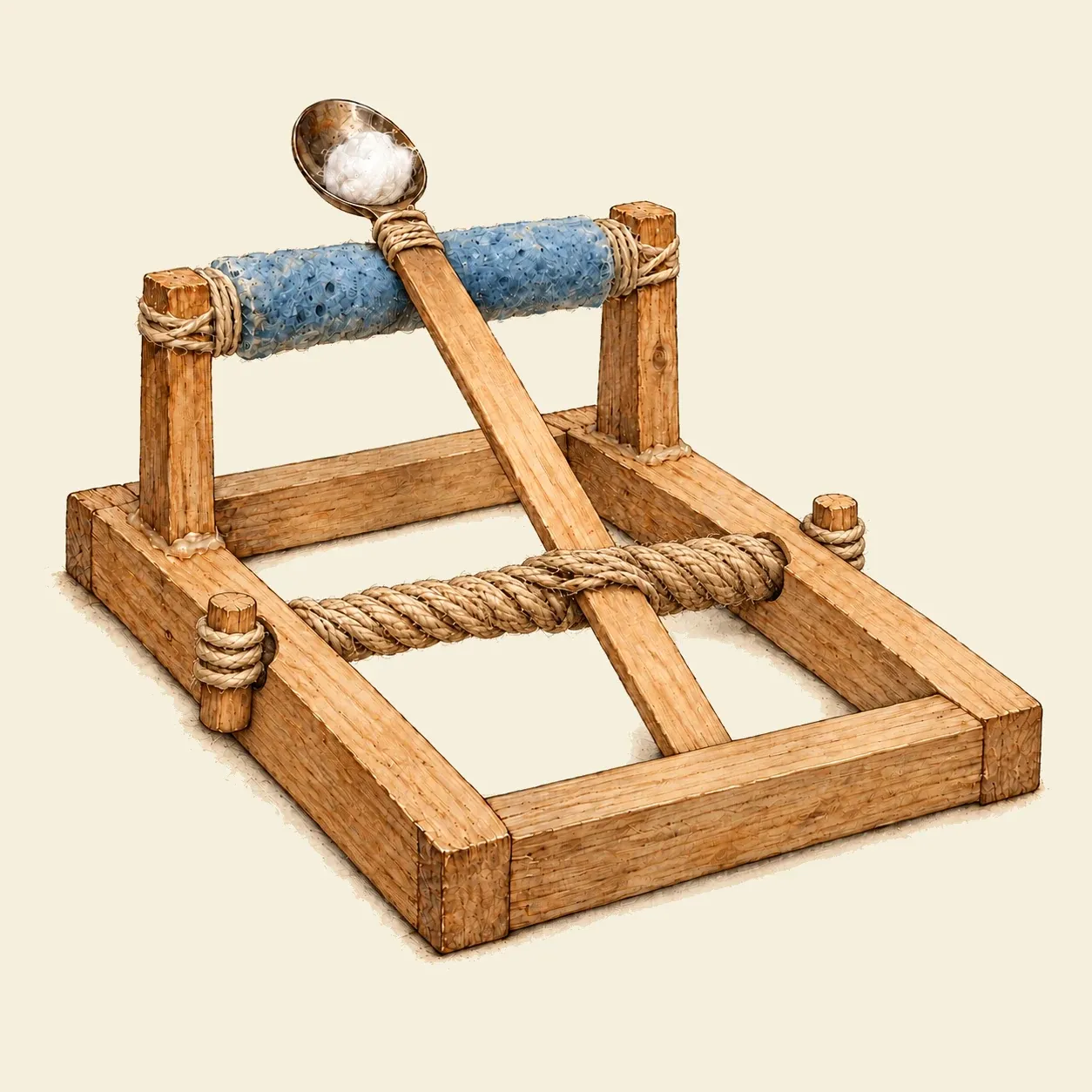 Pulled back down towards the table, the stick twists the skein; released, it swings up and strikes the padded bar.
Join four strips into a rigid rectangle and lay it flat on the table. Drill a hole through the middle of each long side, the two holes facing each other. Pass the string in through one hole, across the frame and out through the other, round a short dowel held against the outside of that side, then back across the frame and round a second dowel against the outside of the first side. Repeat a dozen times, pulling tight at each pass, and tie the ends: the skein now runs horizontally across the middle of the frame. Push the flat stick through the middle of the skein, at right angles to it, and fix the spoon to its free end. Turn each dowel a little clockwise, as seen from outside the frame, to add twist, and stop them from turning back with a nail or tape. Glue a post upright on each long side, a little in front of the skein, and fix the crossbar between their tops; pad it with a piece of sponge where the stick will strike it. Pull the stick back down towards the table, put a cotton ball in the spoon and let go: the skein swings the stick up against the padded bar, and the ball flies on.
Safety. Throw only cotton wool or soft paper, never stones, marbles or anything hard, and never aim at people or animals: stand beside the model, not behind or in front of it. A twisted skein can spin a dowel round suddenly; hold the dowels firmly when adjusting them, and untwist the skein after use.
History and evolution
The Greek bow machines came first. The historian Diodorus, writing in the 1st century BC, says the catapult was invented at Syracuse in 399 BC under the tyrant Dionysius I and first used against Motya in 397 BC. Duncan Campbell and other historians read this as the bow-powered gastraphetes and similar machines, which may already have existed some decades earlier. E. W. Marsden placed the first torsion machines around 350 to 340 BC and supposed that Philip II of Macedon paid for their development, but no direct evidence supports either point.
The written record becomes firmer at Athens. An inventory of the naval arsenal from 330/329 BC lists frames of catapults, which Marsden and Campbell take to be torsion machines and Tracey Rihll reads otherwise. The engineer Werner Soedel and the historian of technology Vernard Foley also place the change to torsion springs about half a century after the first catapults, with the first very powerful machines in the campaigns of Alexander from 334 BC. An inventory that Campbell dates to 306/305 BC, and Yvon Garlan to 307/306 BC, names a three-span catapult with sinew springs. In the 3rd century BC, engineers working for the Ptolemies at Alexandria fixed rules of proportion for arrow-shooters and stone-throwers. The oldest datable metal parts are 21 washers from at least seven machines of different sizes, found in a fortified farmstead near Ephyra in Epirus that the Romans destroyed in 167 BC.
Springs were made of rope twisted from animal sinew. Ancient writers also mention hair, including women’s hair, when sinew ran short. A catapult missile usually weighed between 13 and 18 kg, and the heavy machines most often used threw about 27 kg. Philon of Byzantium judged that even these did little damage to a wall from 160 m away.
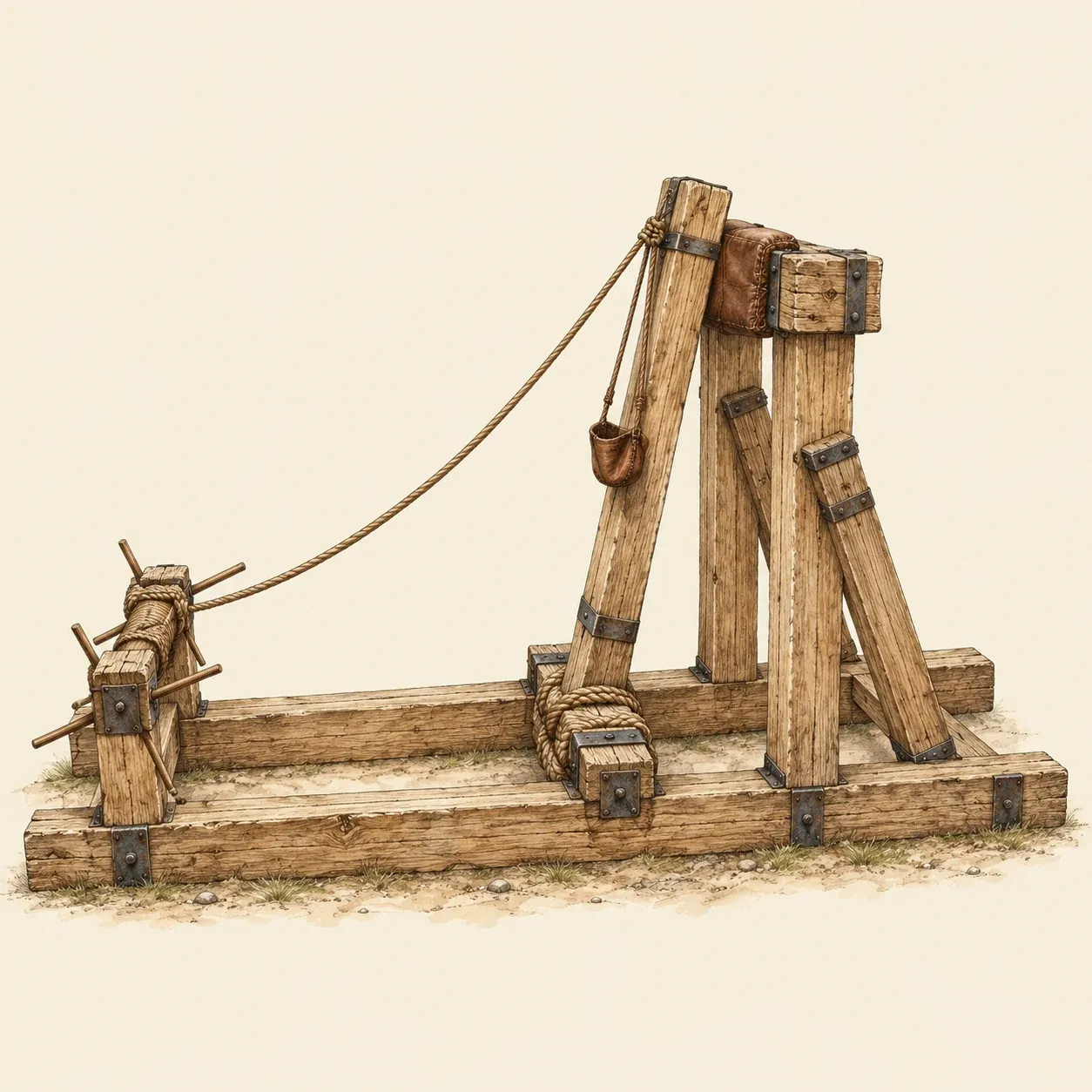 The onager had one arm in a horizontal skein; a cushion stuffed with chaff took the blow when the arm came up.
The Romans took over Greek artillery and called the two-armed machines ballistae or scorpions. Vitruvius described them in the 1st century BC. The one-armed onager appears in the sources from AD 353. Ammianus Marcellinus, who served in the Roman army in the 4th century, describes it as two heavy beams joined by ropes, with a single arm rising from the ropes and ending in a sling, and a haircloth cushion stuffed with chaff to stop the arm. The soldiers named it after the wild ass, which was said to kick stones back at its hunters. From the 6th century the trebuchet, driven by men pulling ropes and later by a counterweight, gradually took the place of torsion artillery.