Trebuchet
A falling weight that hurls stones
Contents
- 1Trestle frame
- 2Axle
- 3Beam, with the long throwing arm
- 4Hinged counterweight box
- 5Sling and pouch
- 6Windlass
A trebuchet is a great see-saw for throwing stones. A heavy box of earth or stones on the short arm of a pivoting beam falls and swings the long arm up, and a sling at its tip hurls the shot. Pulling crews worked the first trebuchets in ancient China; the counterweight machine appears in the late 12th century, first drawn in a manual written for Saladin around 1180 to 1187, and it remained the heaviest artillery until cannon took its place.
What it is
A trebuchet is a beam that turns on a horizontal axle at the top of a timber frame. The axle divides the beam into a short arm and an arm several times longer. The long arm carries a sling at its tip. On the short arm hangs either a set of ropes for a pulling crew or a counterweight, a large box filled with earth or stones. When the short arm comes down, the long arm swings up and the sling throws the stone.
Paul Chevedden, a historian of medieval artillery, distinguishes three forms: the traction trebuchet, worked by men pulling on ropes; a hybrid machine using both men and a weight, which other historians doubt ever existed; and the counterweight trebuchet, driven by gravity alone. On many of the counterweight trebuchets built in Europe in the 13th and 14th centuries, the box hangs from a hinge at the end of the short arm, and a windlass at the back pulls the long arm down to load it.
How it works
To load the machine, the crew turns the windlass, whose rope hauls the long arm down to the ground. This raises the counterweight high above the axle. A hook holds the arm in place. The stone sits in a pouch between the two cords of the sling, laid in a trough of planks under the frame. When the hook is knocked free, the counterweight falls and turns the beam. The long arm drags the sling along the trough, then lifts it into the air, and the sling swings round faster than the arm itself.
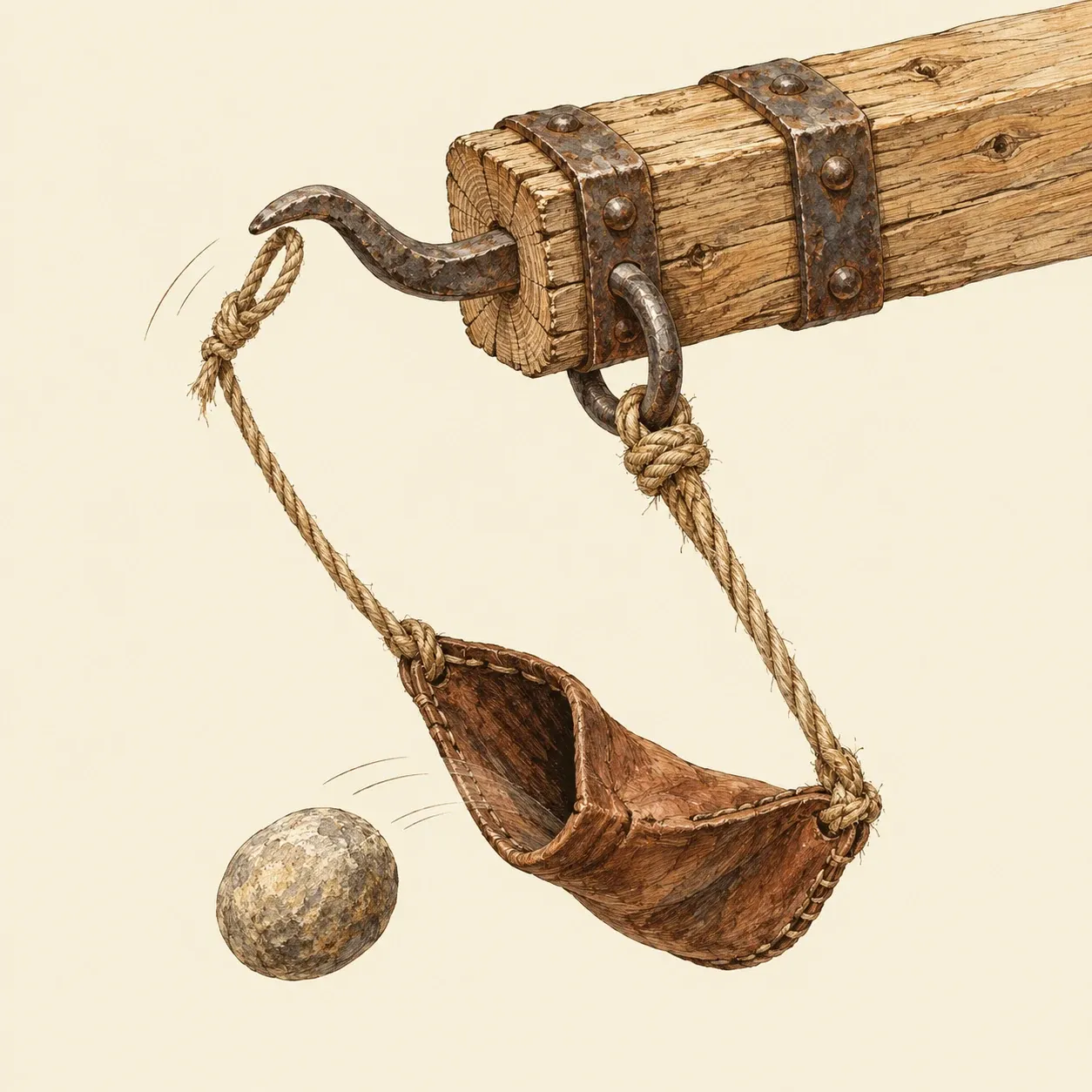 One cord of the sling is tied to the beam; the other is looped over an iron prong and slips off to release the stone.
One cord of the sling is tied to the end of the arm. The other ends in a loop slipped over an iron prong at the tip. While the sling trails behind the arm, the pull on the loop holds it on the prong. As the sling overtakes the arm, the loop slides off, the pouch opens and the stone flies. The angle of the prong and the length of the sling decide when that happens. Engineers adjusted them so that the stone left at about 45 degrees, the angle that gives the longest throw, and so that the sling opened when the beam stood almost upright and the counterweight had nearly finished its fall.
Hanging the box on a hinge added range. At first the box drops almost straight down, and as the hinge straightens it swings and passes more of its energy to the beam. In a computer simulation by Chevedden and three colleagues at Purdue University, a hinged counterweight machine gave about 70% of its energy to the shot. The swinging box also brakes the beam as the stone leaves, so the frame jumps less, and the machine did not need to be re-aimed after every shot. A medium-sized reconstruction built for a museum in Denmark grouped its shots within a square of 6 m at a range of 180 m. Erik Horsdal, a physicist at Aarhus University, treats the beam, the box and the sling as three linked pendulums, and calculates that an ideally proportioned machine could pass over 90% of its energy to the stone.
How to do it
A tabletop model throws a small foam ball and shows every part of the machine. It needs a board for the base, two upright strips of wood, a round dowel for the axle, a flat stick for the beam, a small cup or cloth bag, a handful of metal washers, string, a scrap of cloth, a paper clip, a nail, wood glue and screws, with a drill and a saw.
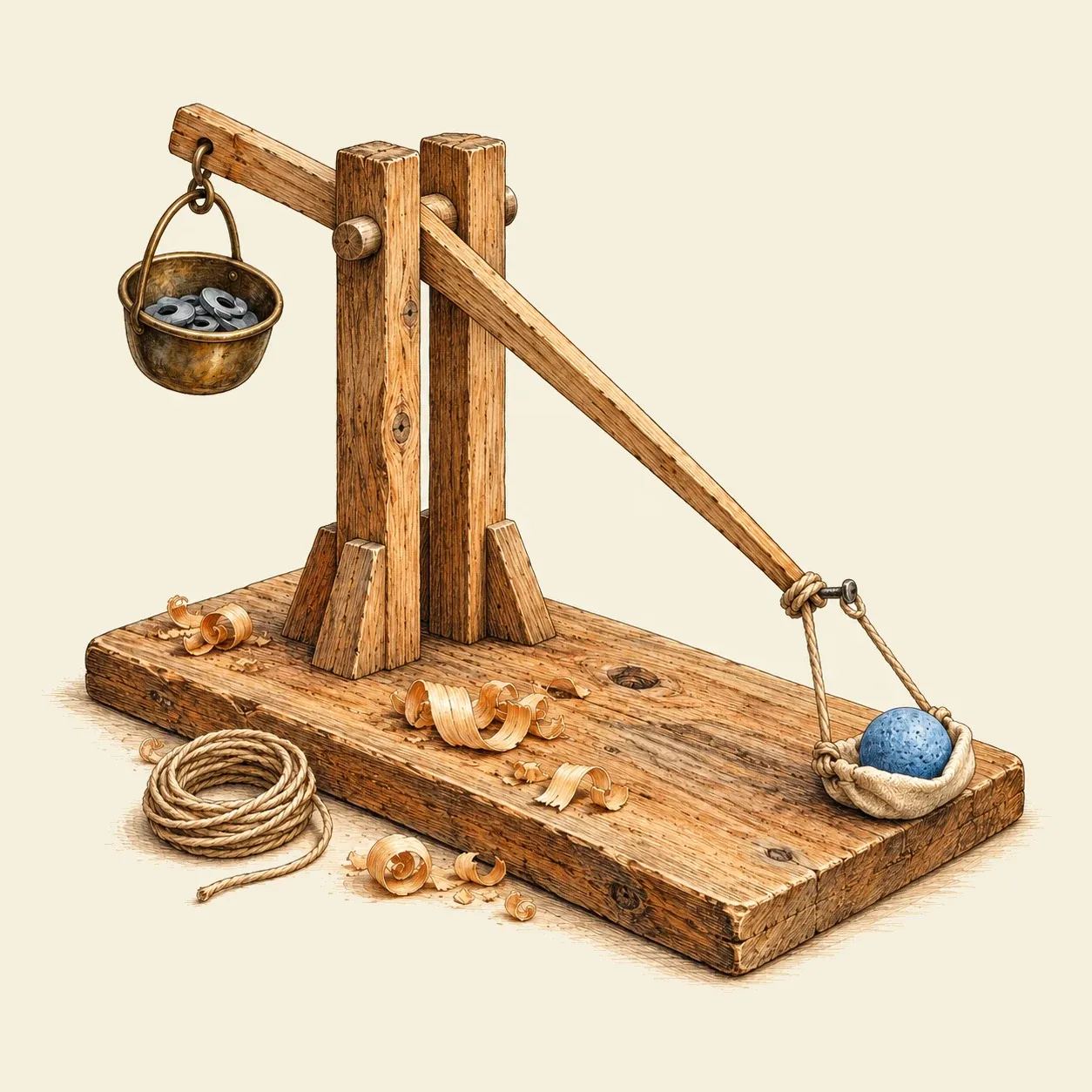 On the model, a cup of washers on a hook plays the part of the hinged counterweight.
Screw the two uprights to the base, facing each other, and drill a hole through the top of each for the axle. Drill a hole through the beam about a quarter of its length from one end and slide it onto the axle between the uprights, so that it turns freely. Hang the cup by a hook from the end of the short arm, so that it swings like the hinged box of a full-size trebuchet, and put the washers in it. Bend the paper clip into a prong and fix it to the tip of the long arm, pointing forward along the arm. Make a sling from two equal lengths of string tied to the corners of a small cloth pouch; tie one string to the tip of the arm and make a loop at the end of the other to hang on the prong. Drive a nail into the base under the long arm as a trigger, tie a string to it, pull the arm down, hook it under the nail, and lay the pouch with the ball on the base behind the uprights. Pull the trigger string from the side. Adjust the angle of the prong until the ball flies forward instead of straight up or into the ground.
Safety. The arm swings fast and the counterweight drops hard. Stand to one side, out of the plane in which the arm and sling turn, and keep heads and hands out of their path. Throw only soft foam balls, never stones or anything hard, and never aim at people or animals.
History and evolution
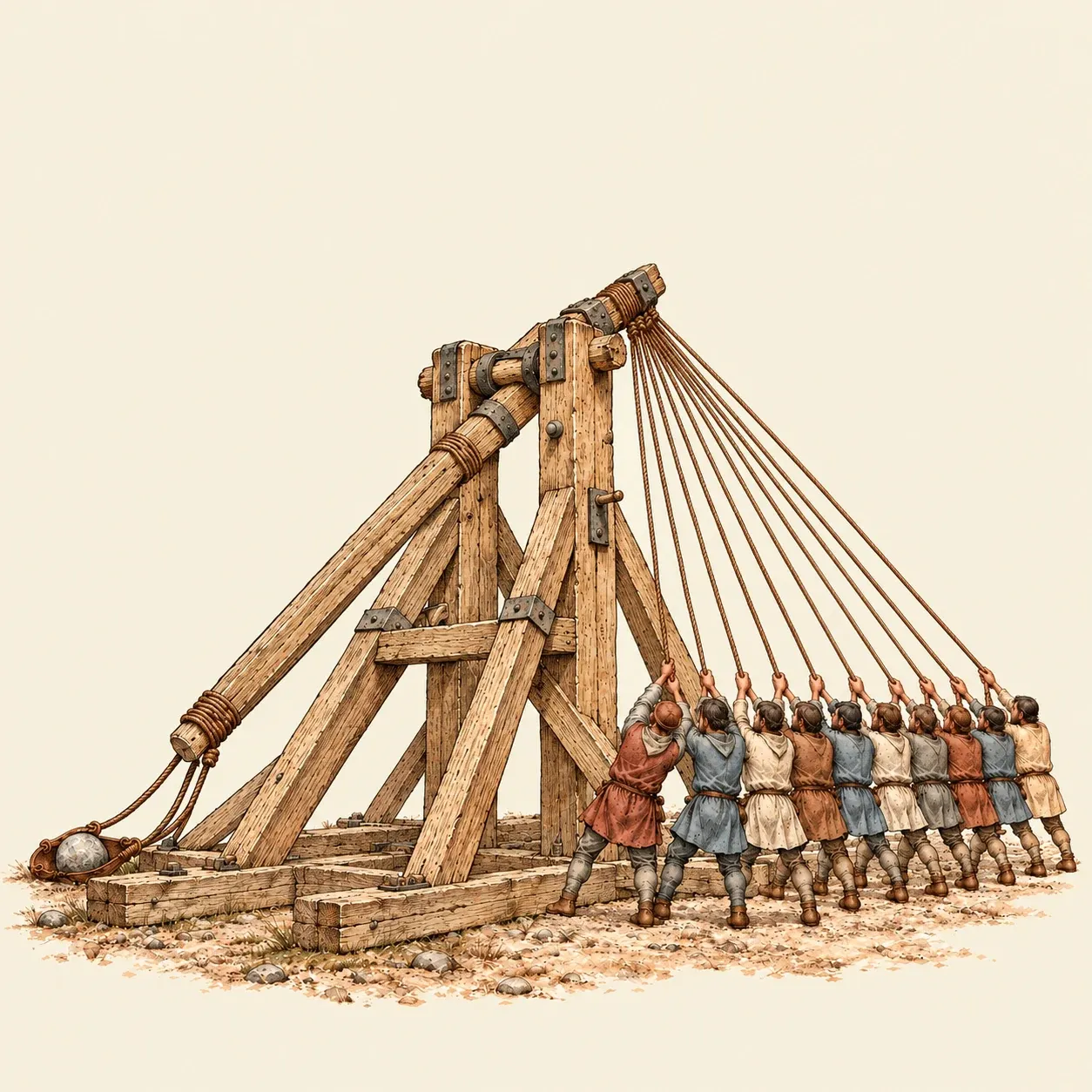 The first trebuchets had no counterweight: a crew pulled ropes hanging from the short arm.
The trebuchet began in China as a traction machine. Chevedden places its invention there before the 4th century BC. The design travelled west and reached the eastern Mediterranean by the late 6th century AD, when Avars and Slavs besieging Thessalonike used it against the city. The largest Chinese traction machines needed a crew of about 250 men to throw a stone of about 60 kg more than 75 m. Chevedden argues that hybrid machines, with a weight added to the pulling crews, appeared in the Islamic world in the 8th century; Michael Fulton, in a study of crusade-era artillery, and his reviewer Peter Purton judge that design mechanically implausible.
The oldest certain drawing and description of a counterweight trebuchet is in a military manual written for Saladin by Murda al-Tarsusi. Fulton dates it to about 1180 and Chevedden to about 1187; it is in any case earlier than Saladin’s death in 1193. Fulton places the arrival of the counterweight machine in the last two decades of the 12th century. Chevedden reads an earlier account by the Byzantine historian Niketas Choniates, of the siege of Zevgminon in 1165, as describing such a machine, and sees the experiments of the emperor Alexios I at the siege of Nicaea in 1097 as an early step. The first European source to mention one records a siege at Castelnuovo Bocca d’Adda, in northern Italy, in 1199. The sketchbook of Villard de Honnecourt, drawn between about 1220 and 1240, shows the base frame of one and describes its counterweight as a chest full of earth.
Counterweight trebuchets could throw stones of up to about 300 kg, and some 14th-century reports give 900 to 1,200 kg. They changed fortification. Around 1200, under al-Adil, the brother of Saladin, the citadels of Cairo and Damascus were given massive towers to carry trebuchets that kept enemy machines out of range. Konrad Kyeser, a German writer who lived from 1366 until some time after 1405, drew one in his military manuscript, the Bellifortis. Cannon replaced the trebuchet slowly over about two centuries. At the siege of Tenochtitlan in 1521, a machine built for Hernán Cortés threw its first stone straight up and the stone fell back and broke it.