Combination lock
Opening by setting discs, not by turning a key
Contents
- 1Dial
- 2Spindle
- 3Wheel pack, one wheel for each number
- 4Drive cam
- 5Lever and its fence
- 6Bolt
A combination lock opens without a key: discs, rings or wheels, each with a notch, must all be turned to one setting before the bolt can move. The oldest known example is a small bronze lock from a box buried in a woman's grave of the Roman imperial period in Athens; the oldest dated one is on a brass casket made in Iran in 1197.
What it is
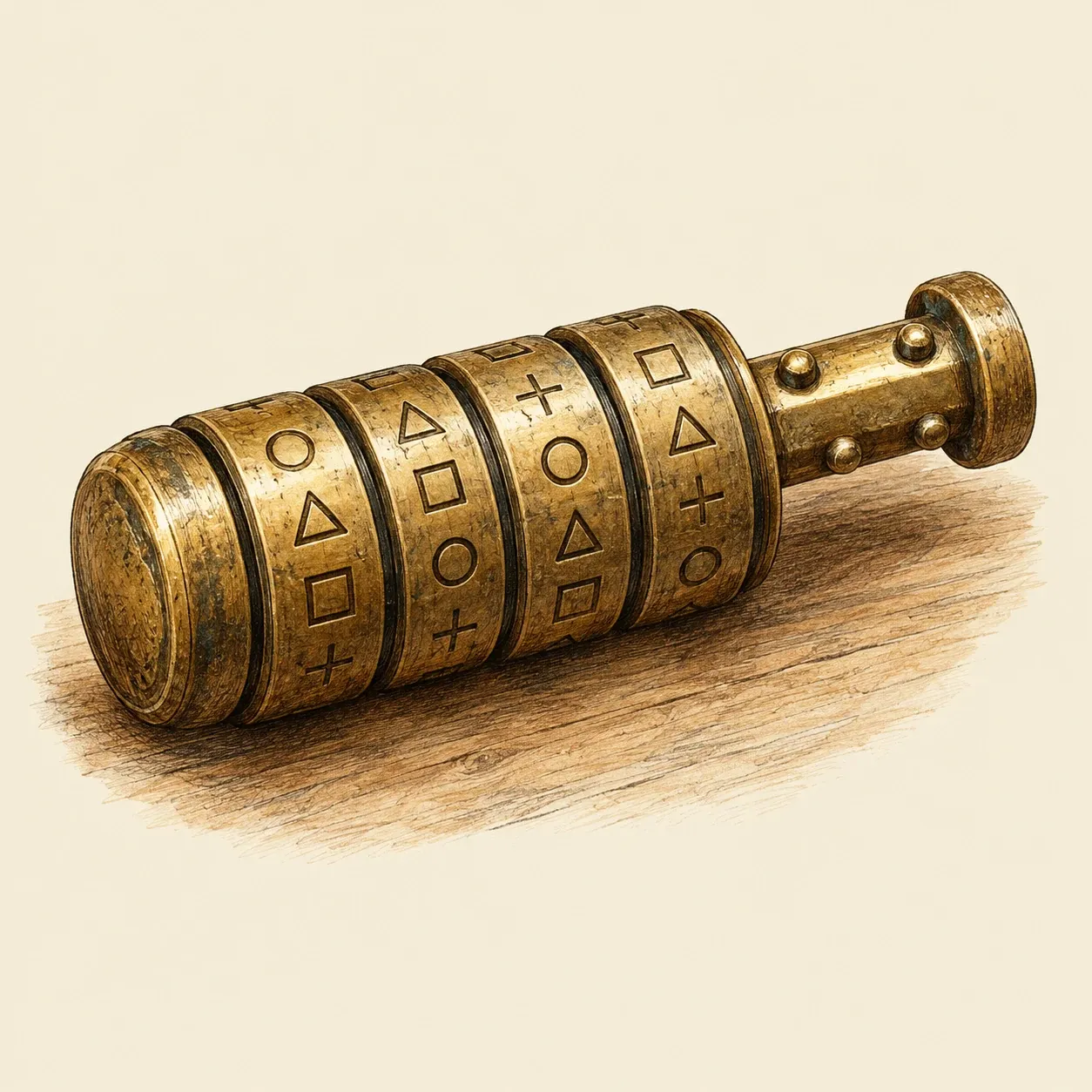 A ring padlock: the bar slides out only when every ring is turned to its place.
A combination lock holds a bolt shut until the user sets a series of parts to the right positions. There is no key to lose or copy: the secret is a sequence of letters or numbers, kept in the head. Changing that sequence changes the lock.
The idea takes several forms. Ring padlocks have a row of rings round a hollow body, and a bar or shackle that pulls free when every ring shows its letter. Medieval caskets from Iran carried rows of small dials on the lid. Safes and strongrooms use a single graduated dial on the door, which sets a stack of wheels hidden in a lock case behind it.
How it works
Every version relies on notches that must line up. In a ring padlock, each ring has a slot cut on its inside, and the bar carries a stud under each ring. While any slot points the wrong way, its stud catches on the ring and the bar stays in. Once the slots form a straight channel, the studs slide along it and the bar comes out.
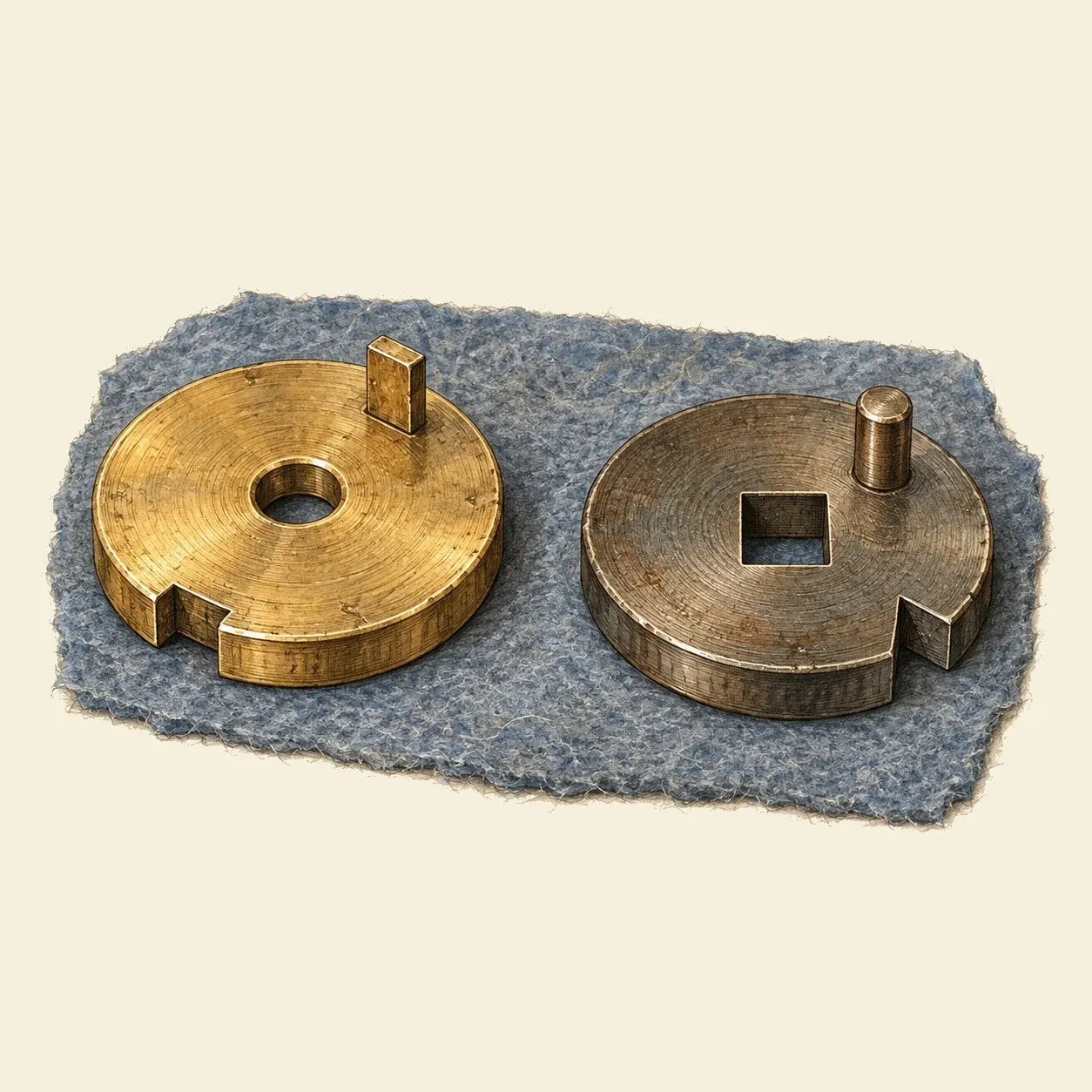 A wheel with its gate and its fly, and the drive cam with its pin, which starts the chain.
A safe lock has one wheel for each number. The wheels turn freely on a fixed post inside the case, each with a notch in its rim, called the gate. The dial turns a spindle that runs through the post and screws into the drive cam, so the cam always moves with the dial. A pin on the cam catches a small tab on the nearest wheel, called the fly. That wheel carries its own pin, which picks up the next wheel, and so on down the pack.
To open a three-wheel lock, the user turns the dial one way until the first number has come round four times. All three wheels then turn together, and the one farthest from the cam stops with its gate where the fence will drop. Turning the other way to the third pass of the second number sets the middle wheel without moving the first. Turning back to the second pass of the third number sets the wheel next to the cam. Washers between the wheels keep one from dragging another by friction.
The lever rests above the pack, with a short bar, the fence, lying across the rims of all three wheels, and a nose touching the rim of the cam. The last turn brings the notch of the cam under the nose. If all three gates are lined up beneath the fence, the fence drops into them, the nose falls into the notch of the cam, and the cam drags lever and bolt back into the case. If a single wheel is off, the fence rests on its rim and the bolt stays out. A mistake means starting the whole sequence again.
How to do it
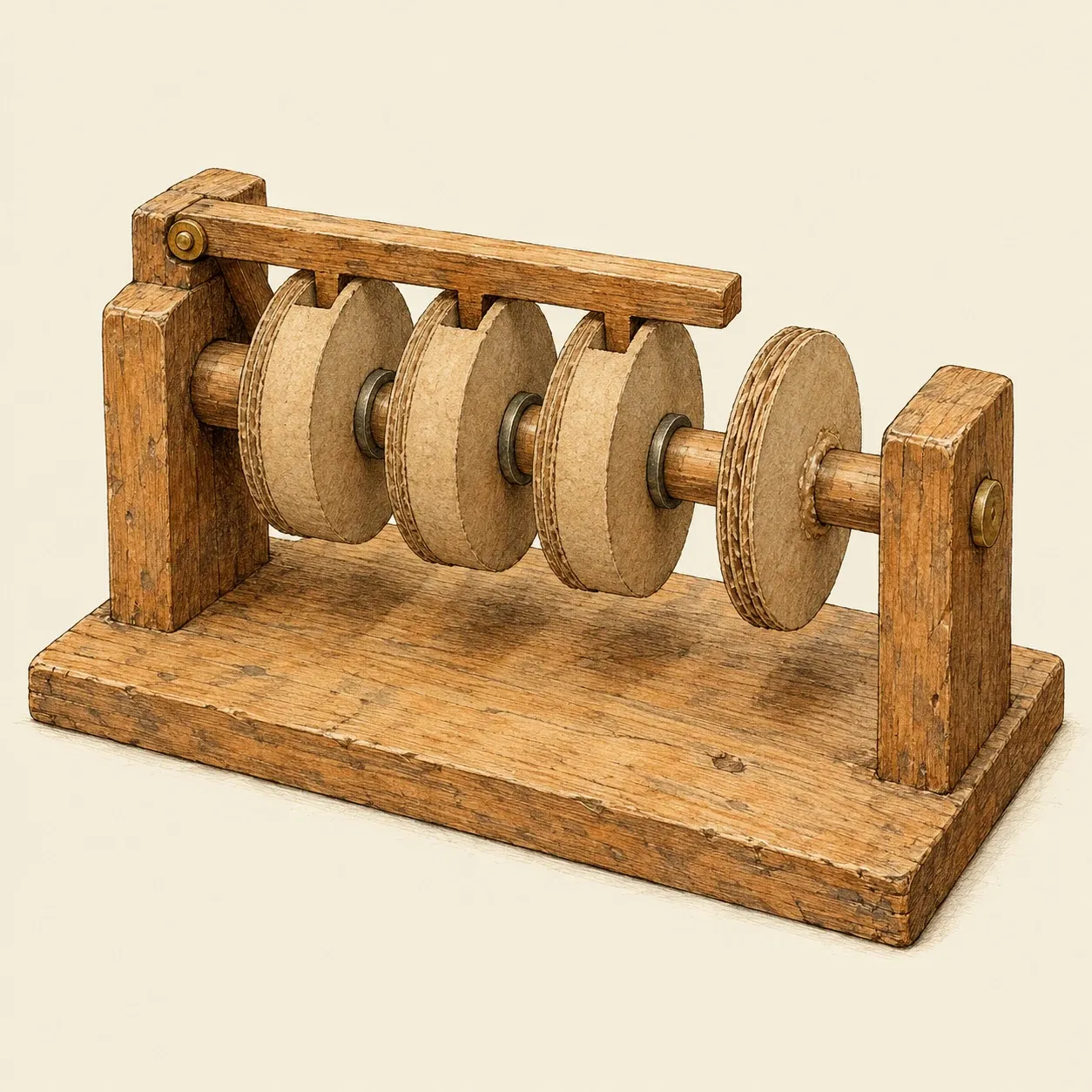 In the card model, the strip falls only when the three notches line up beneath it.
A card model shows the wheel pack and the fence. Cut three discs about 8 cm across from stiff card and cut a square notch, 1 cm wide and deep, in the rim of each. Pierce each disc in the centre so that it turns freely on a wooden dowel. Fix a fourth disc to the dowel with glue as the drive cam, and push the dowel through two wooden uprights so that it turns in them. Put a card washer between each pair of discs.
Glue a short pin, a piece of matchstick, to one face of each disc near the rim, and a second one to the other face of the two middle discs, all at the same distance from the centre and each reaching a little more than halfway across the gap. The pins of neighbouring discs then catch each other, so that turning the dowel picks up the discs one after the other, as the drive pins and flies do in a real lock. Hinge a wooden strip on a block behind the discs, so that it rests by its own weight across the three rims. Glue a card dial marked with a scale to the end of the dowel outside one upright, and draw a pointer on the upright.
Turn the dowel several times one way, then less the other way, as described above, and watch each disc stop in turn. When the three notches are in line, the strip drops into them. The cutting is done with a craft knife: cut on a board, away from the hand holding the card, and keep the blade retracted when it is not in use.
History and evolution
The oldest known combination lock comes from the Kerameikos cemetery in Athens. In 1964, archaeologists excavating a woman’s grave of the Roman imperial period, in front of the Dipylon gate, found a bronze mechanism with her rings, engraved gems and other valuables. A restorer recognised it as the lock of a small box. Wolfram Hoepfner, who published it in 1970, describes a thin bronze plate about 6.6 by 7.0 cm with three knobs riveted to it. There was no keyhole. The middle knob worked the bolt, which could slide back only after each of the two discs had been turned until an arm of the bolt dropped into its notch.
The oldest dated example is a brass casket in the Museum of Fine Arts, Boston, signed by the astrolabe maker Muhammad ibn Hamid al-Asturlabi al-Isfahani and dated 593 of the Hijri calendar, 1197. Its lid carries four dials in a row, set with eight letters in all. Another casket by the same maker, dated 1200, is in the David Collection in Copenhagen. Around 1206 the engineer al-Jazari described a chest closed by four combination locks, one at each corner of the lid, each with three discs, so that twelve letters opened it. He did not claim the idea as his own. Around 1420–1430 the Venetian engineer Giovanni Fontana included combination locks among the machines drawn in his book of devices.
In Europe, the Science Museum in London holds an eighteenth-century brass combination lock and a nineteenth-century letter padlock. In the United States, Linus Yale Jr. brought out the Monitor bank lock around 1862, one of the first bank locks worked by a dial instead of a key. In 1911 the Encyclopaedia Britannica described dial locks with stacked wheels, the dial usually divided into 100, as being in almost universal use on American safes. The same dial, wheel pack and fence are still used on safes and on many padlocks.