Sternpost rudder and hull
Holding a course, keeping the sea out
- 1Rudder stock
- 2Rudder blade
- 3Pintle and gudgeon
- 4Tiller
- 5Keel
- 6Frame
- 7Clinker planking
A sternpost rudder is a flat blade hung on hinges at the back of a ship and turned with a tiller, so that the water flowing past it swings the stern and points the ship. It works with a hull of keel, frames and planks, sealed at every seam, that keeps the sea out and resists the wind's sideways push.
What it is
The rudder is a flat wooden blade at the back of the ship. Here it hangs on the sternpost, the upright timber that closes the hull at the stern, and turns on iron hinges called pintles and gudgeons. A bar fixed in its head, the tiller, gives the helmsman leverage.
The ship drawn is a cog, the cargo carrier of the North Sea and the Baltic from the twelfth to the fifteenth century. Its hull is built on a keel, with frames inside and planks outside, and every seam sealed. The plate simplifies it: many cogs had a flat bottom of flush planks, with clinker planking only on the sides.
How it works
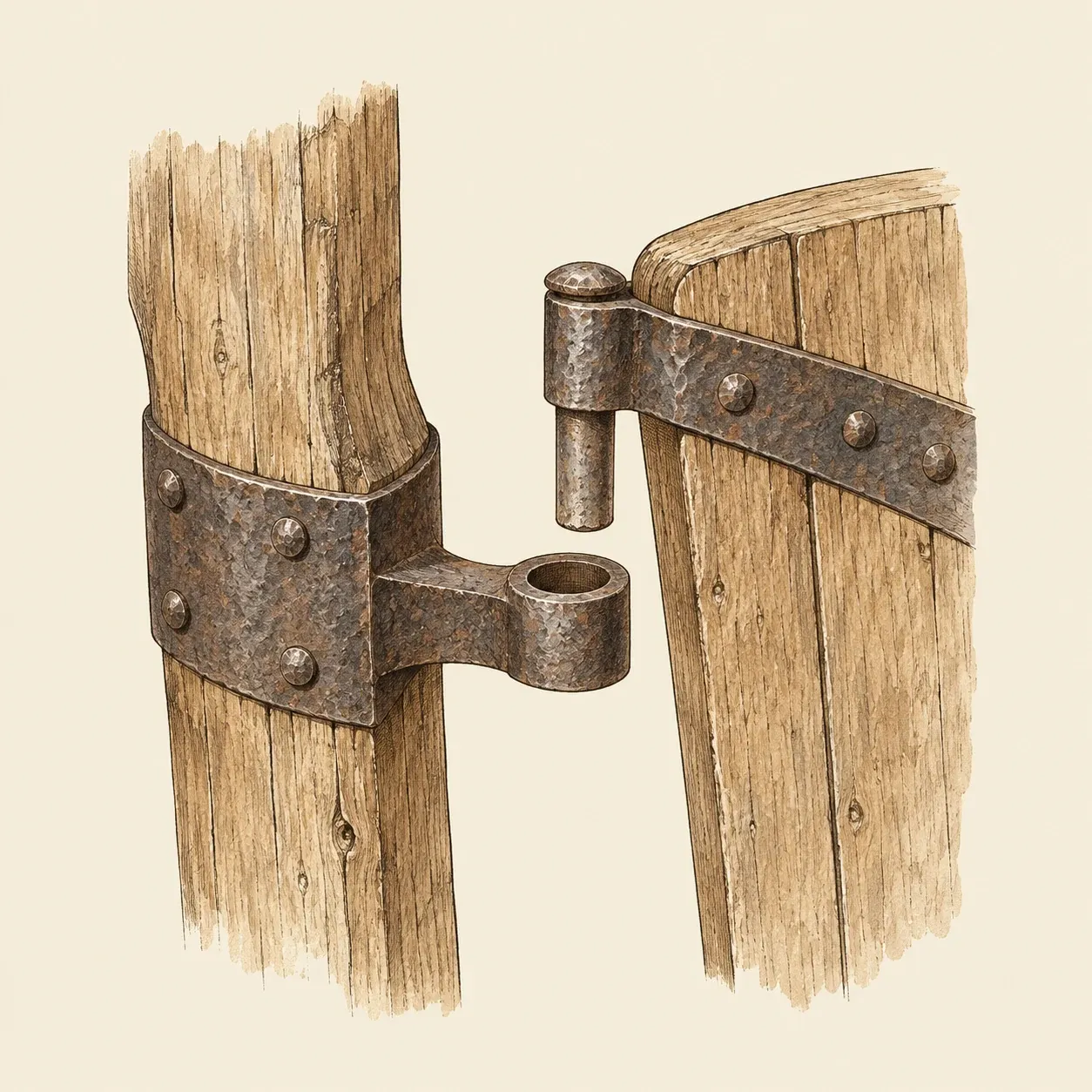 The pin of the pintle drops into the eye of the gudgeon, and the rudder swings like a door.
A rudder only steers while water flows past it. Turned to one side, the blade (2) meets the flow at an angle and bends it. The water pushes back, the stern moves sideways and the bow swings the other way. To turn right, the helmsman pushes the tiller (4) to the left. A blade turned too far no longer bends the flow smoothly and brakes more than it steers.
Straps round the rudder stock (1), its thick front edge, end in downward iron pins, the pintles. Matching straps nailed to the sternpost end in eyes, the gudgeons. The pins drop into the eyes (3), all on one vertical line. On large ships, builders later put part of the blade ahead of the pivot: the water pressing on that part offsets some of the pressure behind, and this balanced rudder is lighter to turn.
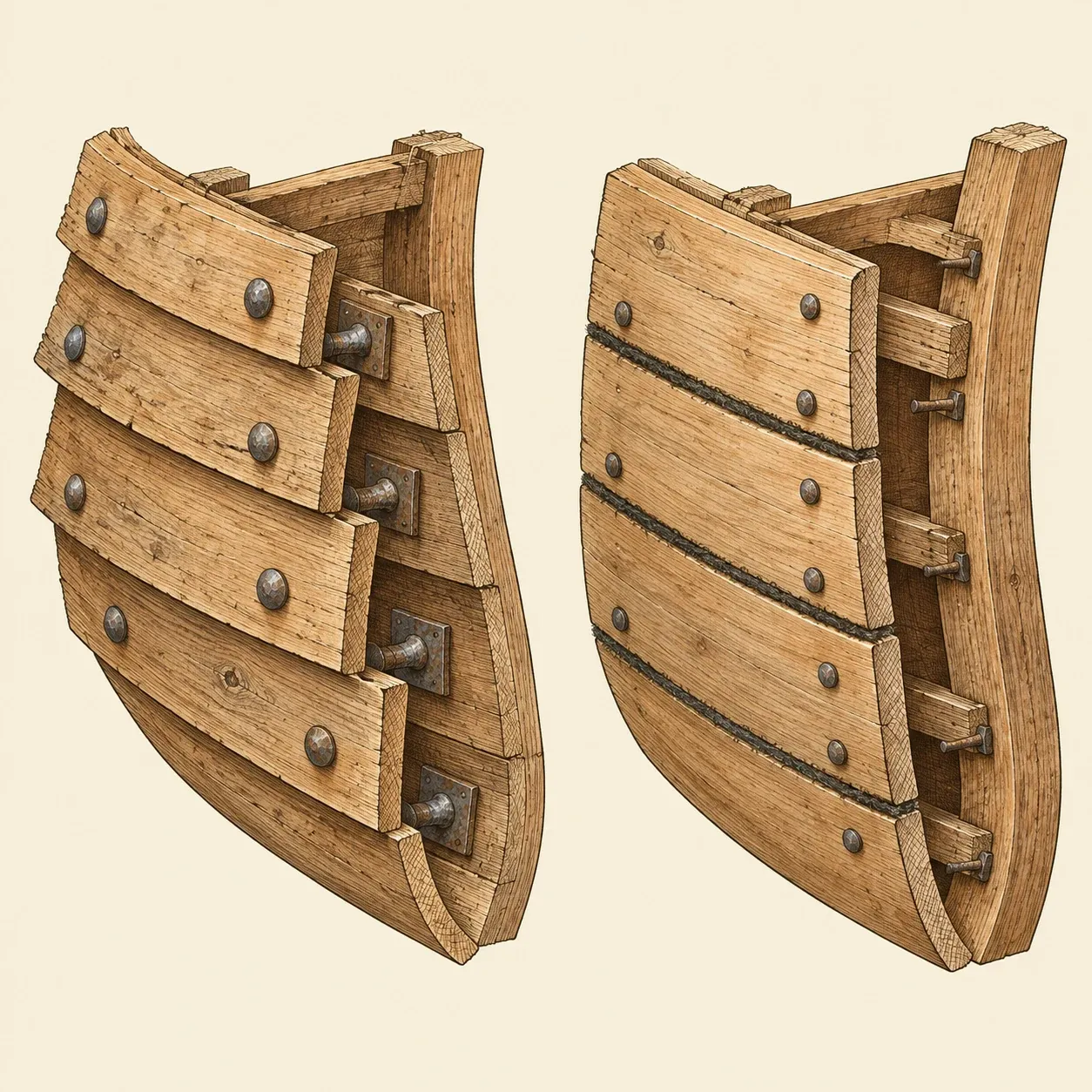 Clinker planks overlap and are riveted through the lap; carvel planks meet edge to edge and depend on their caulking.
The hull starts with the keel (5), a long timber along the bottom, with the stem rising at the front and the sternpost at the back. The frames (6) are the ribs and the planks the skin. In clinker building (7), each plank overlaps the one below and is riveted to it through the overlap; the shell comes first and the frames are fitted inside afterwards. In carvel building, the frames are usually set up first and the planks laid edge to edge on them.
Every seam is caulked. Viking builders used tarred wool; later shipwrights drove oakum, fibre teased out of old tarred rope, into the seams with an iron and mallet, then sealed it with hot pitch.
With the wind on the side, a sail pushes a ship sideways as well as forward. The keel and the flat sides of the hull resist, because they would have to shove a lot of water aside. The ship still slips a little downwind; sailors call this leeway.
How to build
A plank-on-frame model follows the same order of work at small scale. The steps below are for a flat-bottomed skiff with a rudder hung on its transom, the flat board that closes the stern. Use a published plan from a recognised designer, rated for the people and load it states, and do not enlarge it.
Set up the frames. Cut the transom and frames from the plan’s patterns and fix them upside down on a level building base, at the stations given.
Plank the hull. Bend the side planks round the frames from the stem and fasten them with the bronze or galvanised fastenings the plan specifies; plain steel rusts. Lay the bottom planks across and plane the edges fair.
Seal the seams. For a plank bottom, drive cotton or oakum gently into the seams with a caulking iron and cover it with seam compound. Driving too hard splits the plank edges. A plywood skiff is sealed with the glue and coatings the plan names.
Hang the rudder. Fix two gudgeons to the transom and two pintles to the rudder, on one vertical line so the blade swings freely. Add a clip that stops it lifting off its pins, and a tiller that reaches the helmsman’s seat.
Test it afloat. Float the empty boat on a line in calm, shallow water, with a bailer at hand. New planks may weep until they swell; if the leaks do not slow within a day or two, or get worse, take the boat out and recaulk. Load it with weights to the plan’s limit and check again before anyone boards. Try the steering slowly, with an experienced person aboard.
Safety. Wear a lifejacket on and beside the water, and never test a boat alone: someone must watch from the shore. Cold water can make a strong swimmer gasp uncontrollably in the first minutes, so check the water temperature as well as the forecast, stay close to shore in shallow water, and put the trial off if the water is cold. Never load beyond the plan’s limit. Clamp the work before sawing or planing, keep hands behind the cutting edge, and wear eye and ear protection with power tools. Never heat pitch or tar indoors or over an open flame: it catches fire and burns deep. Turn and carry the hull with at least two people.
History and evolution
Ships were first steered with large oars at the stern or on the sides. Viking ships had a single side rudder on the right-hand side, the “steering board” behind the word starboard. Trials with replicas at the Viking Ship Museum in Roskilde show it worked almost as well as a sternpost rudder.
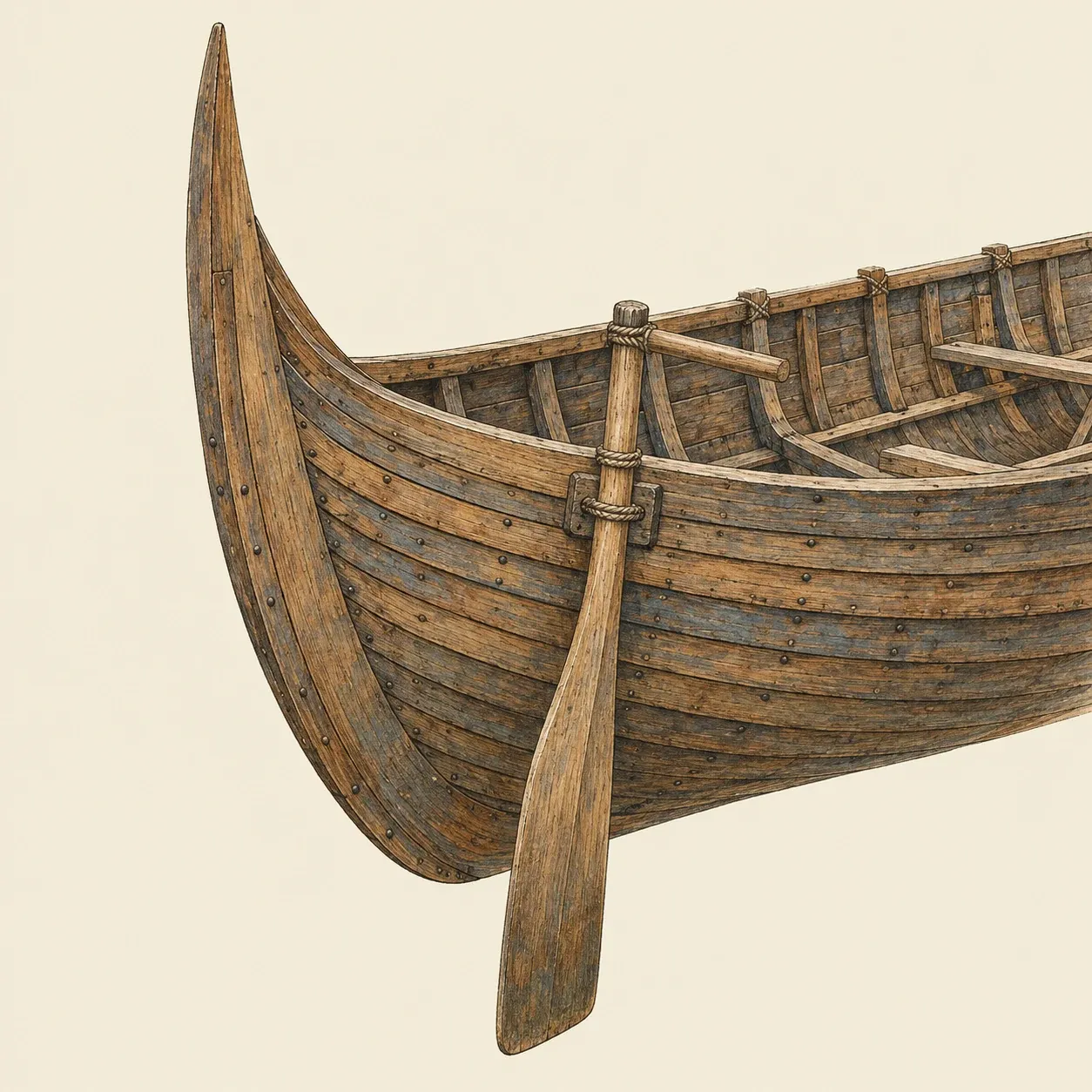 The side rudder turned against a wooden block on the hull, held by a withy rope.
A pottery boat model from a Han tomb in Guangzhou, of the first century CE, has a rudder on the centreline of the stern, the oldest known. In 985 the geographer al-Muqaddasi described Arab helmsmen steering with two ropes, which most historians take to be lines to a stern rudder. Whether the idea travelled west or was found again in Europe is still debated.
In Bremen, a wreck with one plank dated to about 1100 carries an iron gudgeon for a stern rudder. Fonts carved at Zedelgem, about 1150–1160, and Winchester, about 1180, show ships with a rudder on the sternpost; this catalogue takes about 1180. Cogs carried it from the 1240s. The historian Lawrence Mott argues that northern side rudders could not grow with bigger, higher ships; Mediterranean ones lasted into the fourteenth and fifteenth centuries.
On tall ships the tiller lay below decks and was worked by a whipstaff, a vertical lever through the deck above. The wheel, which pulls the tiller by ropes wound on a drum, appeared around 1700. Iron hulls spread in the nineteenth century; the SS Great Britain, launched at Bristol in 1843, joined an iron hull to a screw propeller.