Horn working
Softening horn with heat and pressing it into shape
Contents
- 1Bony horn core
- 2Horn sheath in layers
- 3Solid tip
- 4Lengthwise cut in the sheath
- 5Horn opened out into a flat plate
- 6Thin translucent leaf split from the plate
Horn is the hard sheath of keratin that grows over a bony core on the heads of cattle, sheep and goats. Heated in water or over a fire, it softens enough to be opened out, pressed flat, bent or moulded, and it sets again in its new shape as it cools. Horn workers made combs, spoons, cups, buttons and thin translucent panes from it until plastics replaced it. Among the oldest known horn objects are combs from Predynastic Egypt, about 3900–3500 BCE; in Poland, horn cores with working marks at Kopydłowo date from about 3600–3400 BCE.
What it is
Horn working turns the horns of cattle, sheep and goats into a raw material. A horn has two parts. Inside is the horn core, a spur of porous bone that grows from the skull. Over it lies the sheath, the part that is actually called horn: a hollow cone of keratin, the same family of proteins as hair, nails and hooves, built up in thin layers. Towards the point the sheath becomes a solid tip with no bone inside.
The horner separates the sheath from the core, then uses heat to soften it. A softened sheath can be slit, opened out and pressed into a flat plate. The plate can be cut into combs, split into thin leaves that let light through, or pressed into moulds to make spoons, boxes and cups. Solid tips and pieces of hoof were cut, drilled and polished into buttons and handles. The Museum of Design in Plastics calls horn a natural plastic for this reason: heat and pressure give it a shape that it keeps once cold.
How it works
The sheath is fixed tightly to the core while the animal lives. After slaughter, horners soaked the horns in water for some time, a period that depended on the season. As the tissue between bone and keratin decayed, the sheath loosened and could be pulled off the core. The solid tip was usually sawn off first.
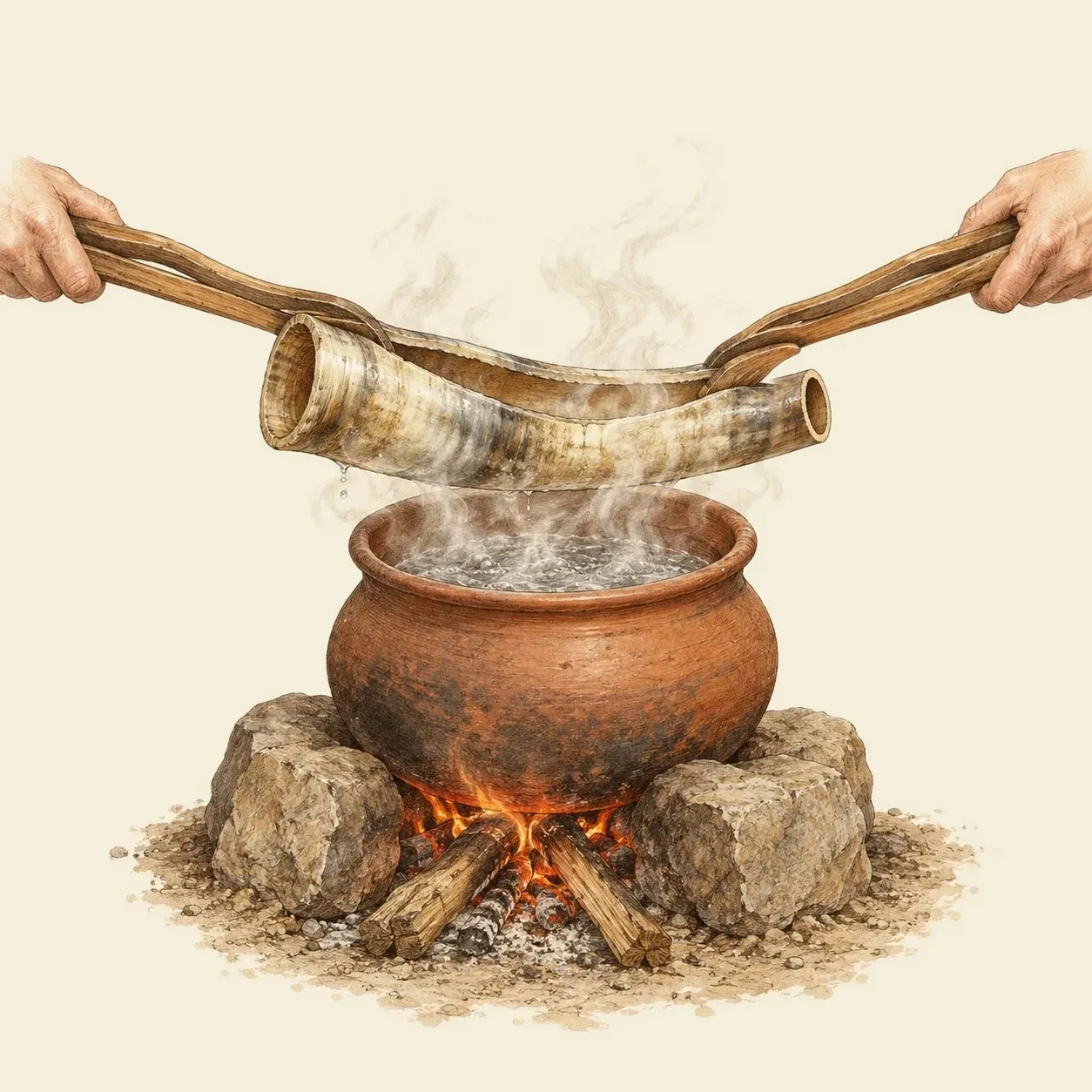 Heat softens the slit sheath enough for it to be opened out.
Keratin softens when it is heated and hardens again when it cools. In hot water or near a flame, the sheath becomes pliable: it can be slit along its length with a knife and its walls prised apart. Pressed between flat plates while still hot and left there until cold, it stays flat. Pausanias, a Greek writer of the second century CE, already noted that fire turns ox horn from round to flat and into other shapes. Heated a second time, a plate can be pressed into a hollow mould, where it takes the shape of a spoon bowl or a box lid and keeps it.
Because the sheath grows in layers, a heated plate can also be split into thinner leaves. Scraped with a flat knife, such a leaf becomes clear enough to let light through. Thin horn leaves served as panes in lanterns and windows. Harsh treatment spoils the material: in modern tests of old recipes, soaking horn in lye made of wood ash softened it but stained it and left it prone to cracking.
How to do it
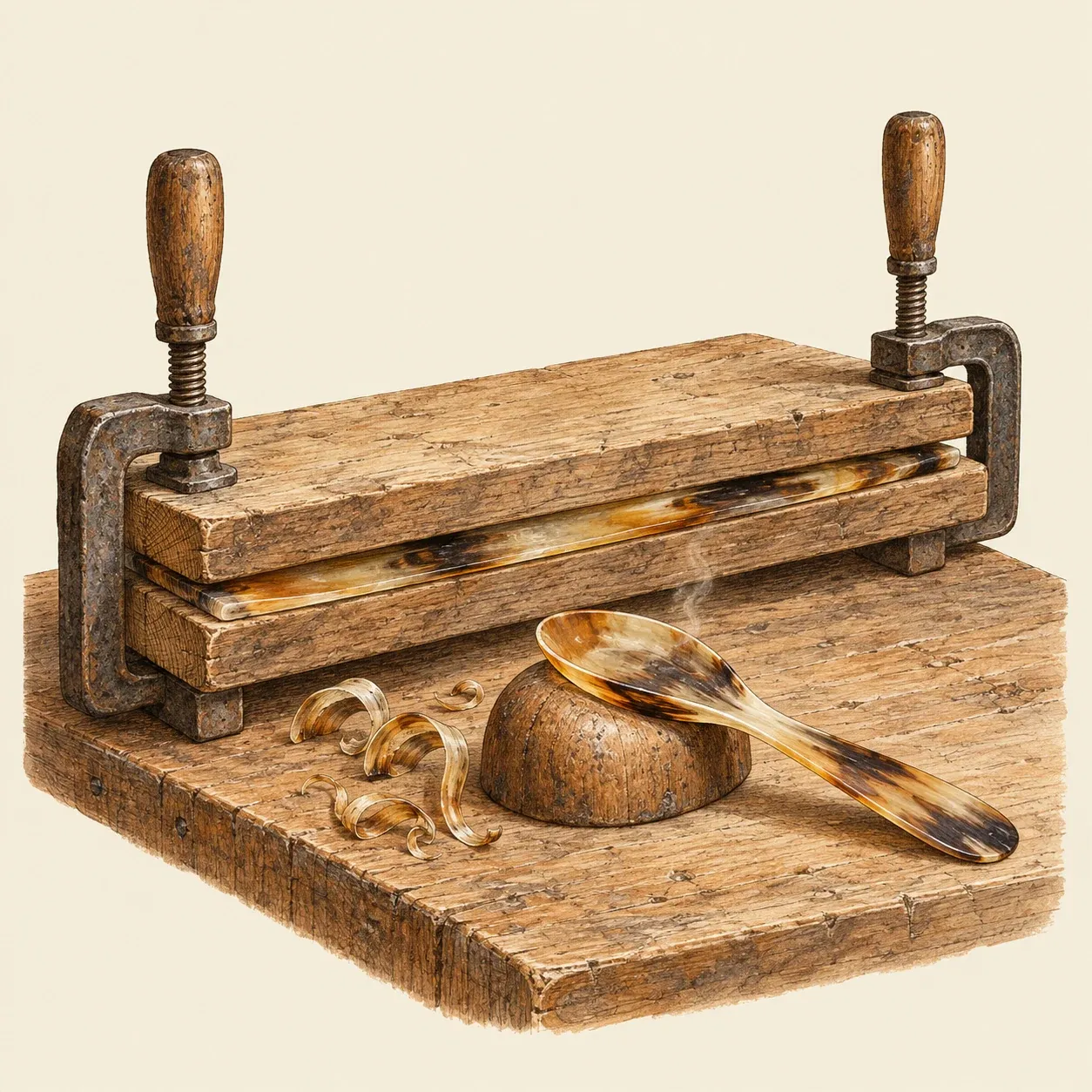 Clamped between boards until cold, the horn keeps the shape it was given while hot.
Start with a cleaned cattle horn sheath from a craft supplier, as the soaking needed to free a fresh horn from its core is long and smells strongly. Saw off the solid tip and keep it for a button or a handle. With a fine saw, cut the hollow part along its length on the inner curve.
Put the sheath in a large pan of water, bring it to the boil and keep it simmering. Testing is the only reliable guide: in a test of a sixteenth-century French recipe by Columbia University’s Making and Knowing project, a piece of horn could be bent only after about two hours of boiling. Lift the sheath out with tongs, open the cut with wooden wedges and work it flat, then put it straight between two flat boards and tighten them in a clamp or vice. Leave it until it is completely cold. If it springs back, boil it again and press it harder.
For a spoon, carve a rounded wooden former. Heat a strip cut from the flat plate, press it over the former with a second board and clamp it until cold. Finish the piece with a scraper, then with wet abrasive paper and a polish.
Safety: boiling water and hot horn scald, so use tongs and heat-resistant gloves and keep children away from the stove. Do not soften horn in hot oil at home, as hot oil can catch fire. Heated horn gives off a strong smell; work in a ventilated room. Clamp the horn when sawing. Sanding raises a fine dust, so sand wet and wear a dust mask.
History and evolution
Horn decays in most soils, so early finds are rare. Some of the oldest known horn objects are combs from Predynastic Egypt: the Metropolitan Museum of Art holds one decorated with a pair of ducks, dated about 3900–3500 BCE, and the British Museum one from El-Mustagida dated about 3500 BCE. In Europe the early evidence is mostly bone. At Kopydłowo 6, in central Poland, excavators found a sunken feature interpreted as a workshop for processing horn, belonging to the Funnel Beaker culture, which occupied the site about 3600–3400 BCE according to radiocarbon dates. At its bottom lay a pile of horn cores of cattle, aurochs and goats bearing clear marks of horn working. Mikołaj Lisowski describes cut and chop marks left by removing the sheaths and counts the find among the earliest evidence of horn working in Poland. A girl buried in 1370 BCE in an oak coffin at Egtved, in Denmark, wore a horn comb hanging from her belt.
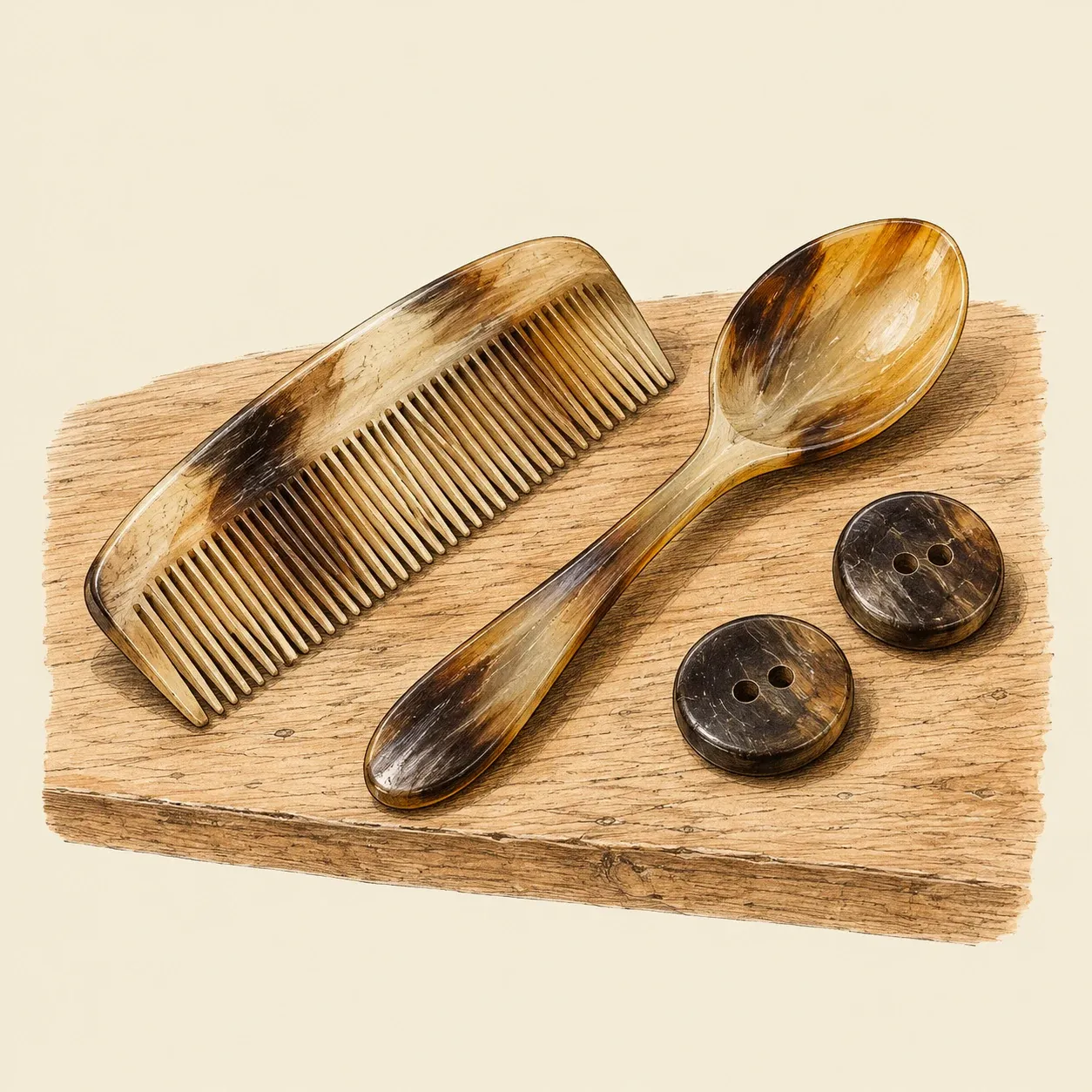 A comb, a moulded spoon and buttons cut from hoof.
In medieval towns horn working became a trade of its own. Paris regulations written between 1260 and 1270 divided the craft by product. In London the horners are first mentioned in 1284; their oldest surviving ordinances date from 1391, and in 1476 they were joined by the makers of leather bottles, both trades being hurt by competition from glass. The company received a royal charter from Charles I in 1638. In 1688 Randle Holme drew the tools of the horners: a press in which hot plates and wedges flattened the slit horns, and a long flat knife for shaving them clear and transparent. Hooves were worked in the same way. In 1840 an English magazine described cow hoof boiled until soft, cut into strips and squares and dyed black to make buttons.
Plastics took over horn’s uses in the twentieth century, and in 1943 the London horners chose to support the plastics industry, whose moulding methods resemble their own. Some kinds of horn kept particular uses: hard black buffalo horn for the nocks of bows, and sheep horn heated and bent into walking-stick handles.