Rammed earth
Earth compacted between formwork panels
Contents
- 1Formwork upright
- 2Side panel of the formwork
- 3Wooden rammer
- 4Loose layer of earth
- 5Compacted earth layers
- 6Stone plinth
Rammed earth forms a wall by compacting damp soil between two formwork panels. The grains pack together under the rammer, and clay binds them as the wall dries. This unfired-earth technique is documented in Neolithic China and has been used for houses, platforms and enclosing walls.
What it is
Rammed earth is soil compacted inside formwork, which is removed when the material can hold its shape. The wall is built in place, layer by layer, rather than assembled from bricks. The earth remains unfired: no kiln turns its clay into ceramic.
The formwork sets the width and shape of the wall. Its two broad side panels contain the earth during ramming; crosspieces and clamps keep them the required distance apart. Once a section is complete, the panels can be taken down and moved to continue the wall. The layers often leave horizontal lines visible on its surface.
How it works
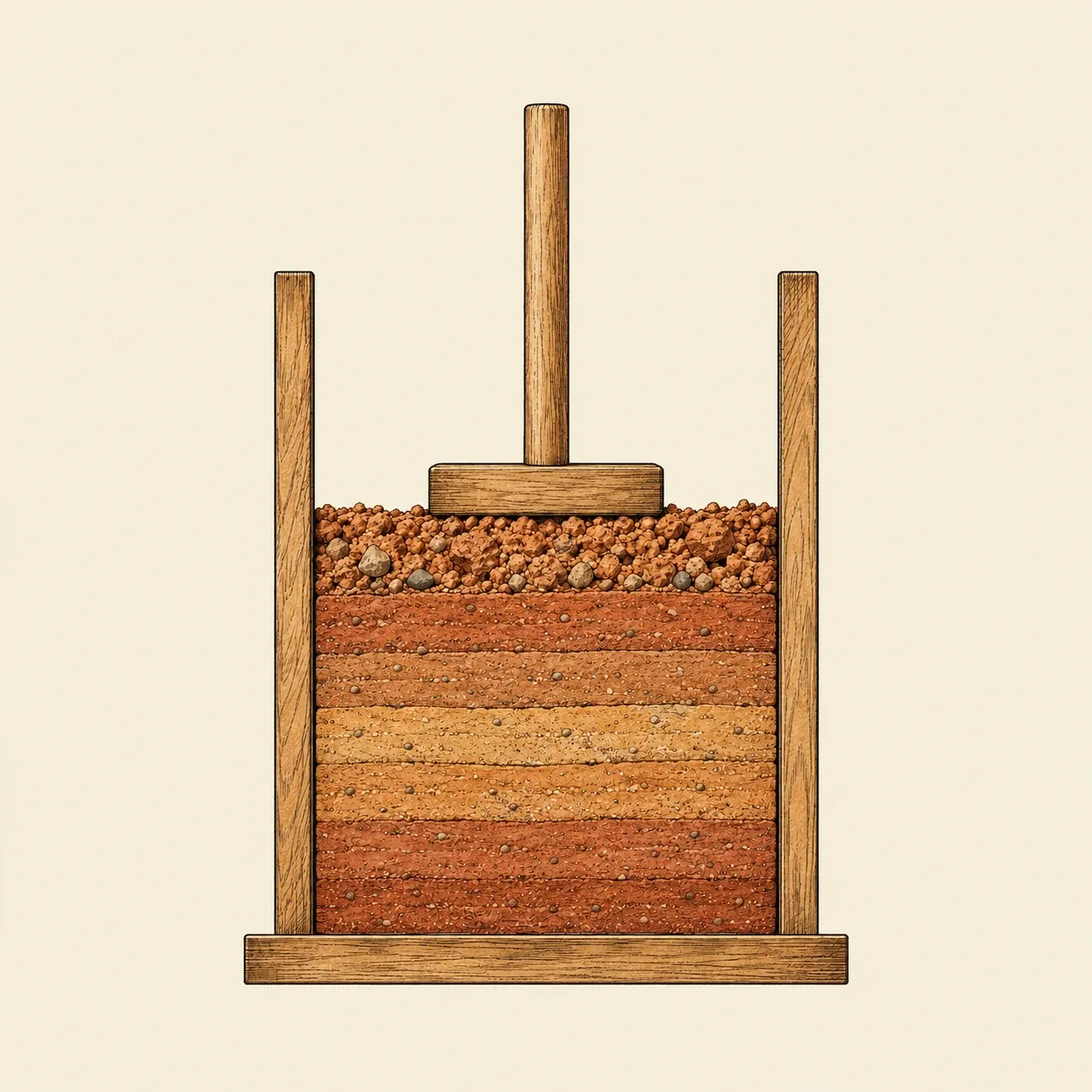 The rammer packs the grains together; the side panels stop the earth spreading sideways.
Soil contains particles of different sizes: stones, sand, silt and clay. Water allows the particles to rearrange during compaction. Blows from the rammer reduce the spaces between them; as the earth dries, clay provides much of the cohesion. Very wet soil behaves differently from soil that is only slightly damp, and the right amount of water depends on its composition.
A layer that is too thick may remain poorly compacted at the bottom. Builders establish layer thickness, moisture and the method of ramming through trials with the soil they intend to use. The formwork must also withstand sideways pressure: panels that spread distort the wall and may overturn during the work.
Rammed earth is stronger in compression than in tension. Loads and openings must therefore be arranged to avoid pulling the material apart or concentrating forces. Persistent water can weaken its cohesion: a plinth, a roof and drainage protect the foot, top and faces of the wall. Its mass absorbs heat and releases it later, but this thermal mass does not make it a good insulator.
How to do it
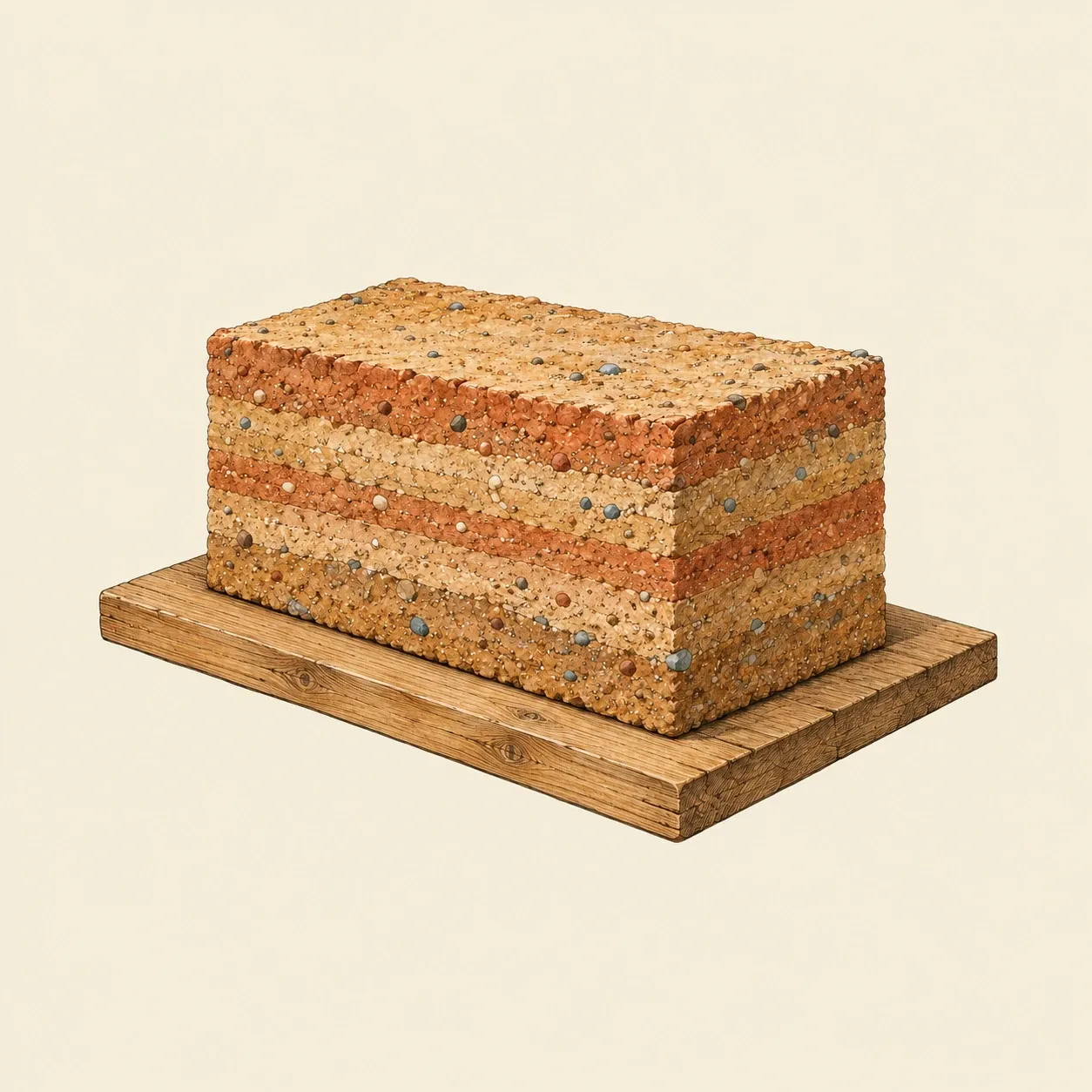 The layers become visible along the edge of the sample after the mould is removed.
Begin with a small sample at ground level, in a firmly held mould that can be dismantled. Use clean mineral soil without roots or organic debris; the topsoil at the surface is poorly suited to building. Remove pieces too large to form regular layers and break up lumps.
Add water gradually and mix to distribute it. Place a thin layer in the mould, then compact it with a small wooden rammer, working across the whole surface, including the edges. Add the next layer and repeat. Trials with different moisture levels and thicknesses allow comparison of strength, cracking and the uniformity of the section after drying.
Open the mould without breaking away the corners and keep the sample out of the rain. For a wall in a building, trials continue at the scale of a test wall and establish the working parameters for construction. The design must also address foundations, openings, connections to floors and protection from water. Timber framing and rammed earth can work together, but their movements and bearing points must be accounted for.
Safety. Keep hands clear of the area being struck and check that the mould cannot come apart under the blows. Do not stand on formwork or build a loadbearing wall from a tabletop trial alone: professionals must check the loads, ground and stability of the whole structure.
History and evolution
In their study of compacted-earth buildings in the Yellow River basin, Liye Xie and colleagues describe a stove at Banpo, a village dated to 4800–3300 BCE. At Xishan, between 3300 and 2800 BCE, the technique was used in enclosing walls and platforms. It later developed in large Chinese structures, notably during the Longshan period.
Earth ramming also appeared in the Iron Age Mediterranean; historical research distinguishes those developments from the ones in Neolithic China. In France, the professional guide to rammed earth records examples from the twelfth century. In the late eighteenth century, François Cointeraux taught and promoted this way of building as part of his projects for rural construction.
Contemporary rammed earth retains the principle of layers compacted within formwork, with larger panels and often mechanical rammers. Some variants add cement to change the earth’s strength and resistance to water. Unstabilised earth requires different provisions for protection and drying; its quality still depends on the material chosen, the compaction and the design of the building.