Potter's Wheel
Shaping clay by rotation
Plate
- 1Wheel head
- 2Clay vessel
- 3Vertical shaft
- 4Collar bearing
- 5Flywheel
- 6Pivot bearing
Anatomy
Loading the figure…
A potter's wheel is a heavy disc that spins on a vertical axis, so that clay set at its centre can be shaped evenly all round by the potter's hands. It began in the Near East as a slow turntable more than six thousand years ago; the fast wheel, which stores enough momentum to throw a pot from a lump of clay, followed.
What it is
A potter’s wheel is a round, flat head mounted on a vertical shaft that turns freely. The potter sets a lump of wet clay at its centre, spins it, and presses the clay with wet hands or a tool. Because every point of the clay passes under the hands in turn, a single steady pressure shapes the whole circumference at once.
There are two kinds. A slow wheel, or tournette, is turned by hand in short pushes. It helps a potter to even out a pot built from coils of clay and to finish its rim. A fast wheel keeps turning on its own because it is heavy, and it is fast enough to throw a pot: to raise it in a few minutes from a solid lump, using only the spin and the potter’s hands.
The two kinds overlap, and archaeologists now distinguish the machine from the forming technique used on it. The plate shows a kick wheel, a fast wheel driven by the foot, of a type used in European workshops before electric motors.
How it works
The kick wheel has one vertical shaft, usually of iron. At the top it carries the wheel head, at waist height for a seated potter. Near the floor it carries the flywheel, a thick, heavy disc of wood, stone or concrete. The shaft runs in two bearings: a collar just below the head that keeps it upright, and a pivot at the bottom, where its pointed or rounded end turns in a cup and carries the weight.
The potter sits on a bench behind the wheel and pushes the flywheel round with one foot. A heavy wheel takes several kicks to get going, but once it spins it stores energy and keeps turning while the hands work. The heavier the flywheel, and the more of its weight lies near the rim, the longer it keeps its speed. Most potters spin the wheel anticlockwise; in Japan the tradition is clockwise.
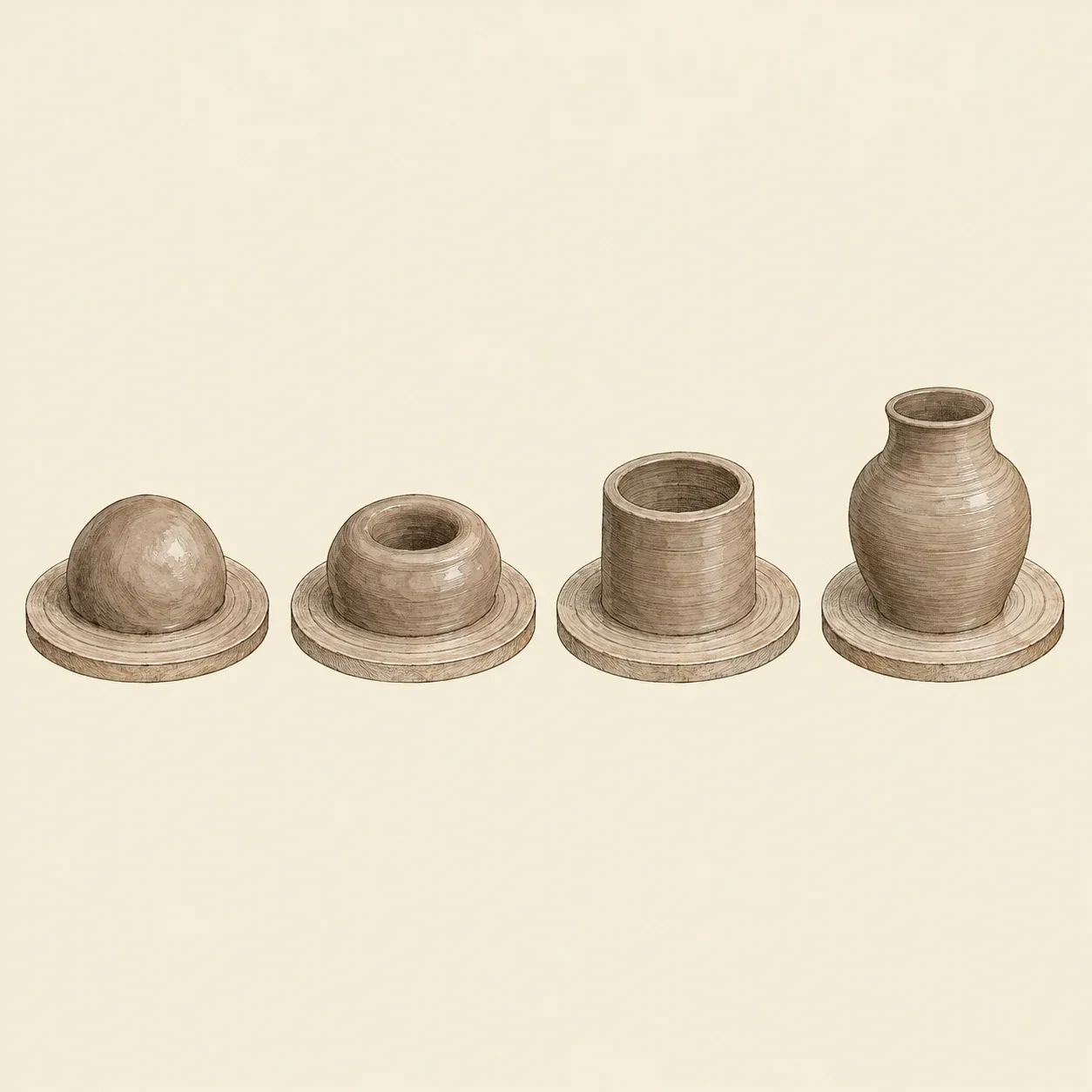 The stages of throwing: centring, opening, raising a cylinder and shaping the pot.
Throwing follows a fixed order. First the clay is centred: pressed with both hands until it runs true and no longer wobbles. The potter then opens it by pushing the thumbs down into the middle, leaving a floor, and draws the clay out into a thick ring. Pulling up with one hand inside and one outside raises the wall, thinner and taller each pass. Finally the shape is swelled or narrowed, the rim is smoothed, and the pot is cut from the head with a wire. Hands and clay are kept wet throughout, and a wooden rib held against the turning wall smooths it and removes the excess water.
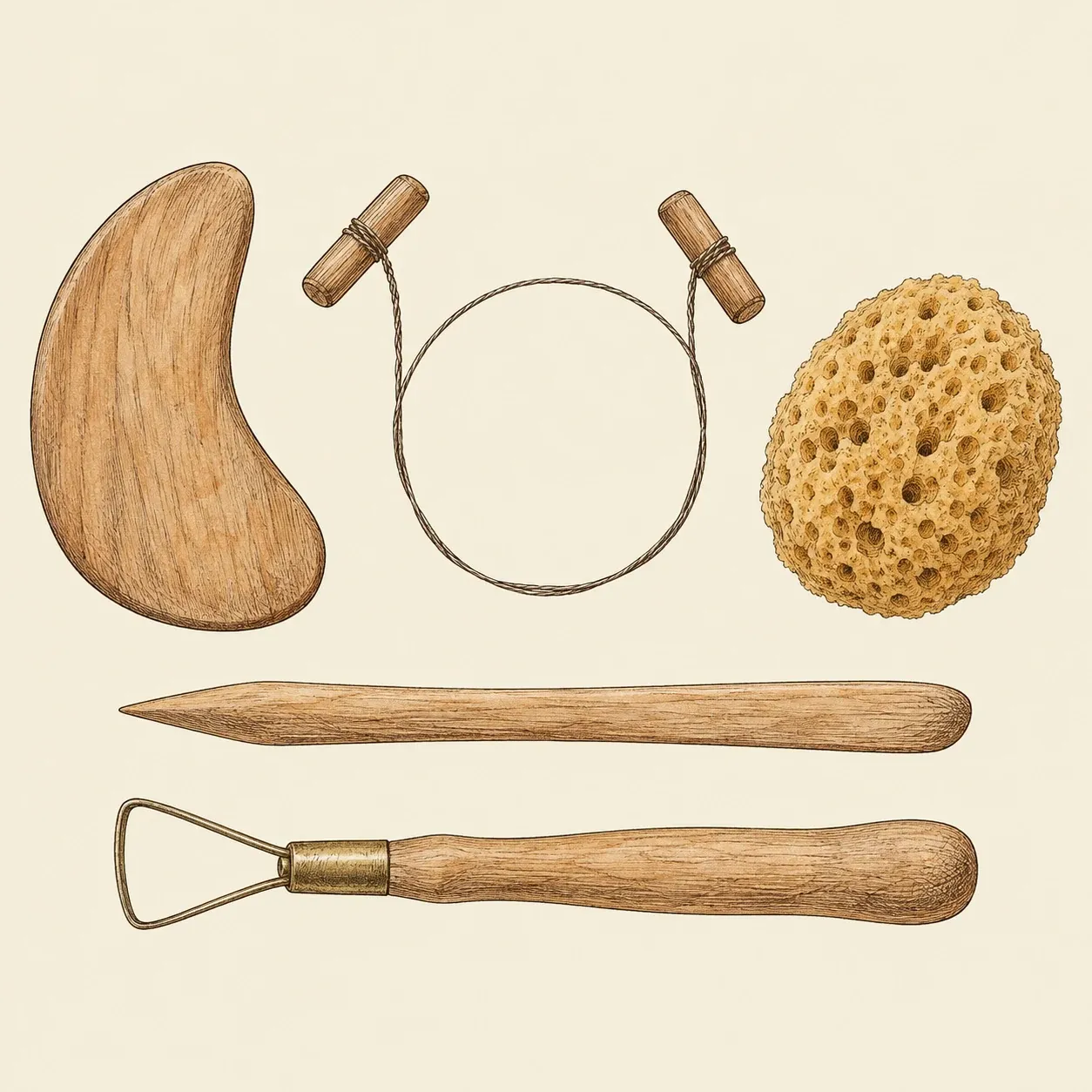 Tools of the thrower: a wooden rib to smooth the wall, a wire to cut the pot off, a sponge, a pointed stick and a trimming loop.
Clay keeps a record of how a pot was made. The ridges and marks left by fingers and tools on the inner and outer wall, and the way the clay is layered inside it, let archaeologists tell a pot thrown from a lump on a fast wheel from one built of coils and only shaped on a turning wheel. Many early wheel-made pots turn out to be of the second kind, which is how the slow growth of throwing can be traced. Tools leave traces as well: a rib leaves a smooth band, and a wire drawn under a pot that is still turning leaves a curved, shell-like pattern on its base.
How to build it
A kick wheel can be built in a workshop from timber, a steel shaft, two bearings and a home-cast flywheel. The Mother Earth News plan listed in the sources uses a frame about 75 cm (30 inches) on each side, which also carries the seat. The finished flywheel weighs roughly 60 to 75 kg, so choose bearings, hub and fixings rated for that load, or follow a complete published plan.
Build the frame. Bolt a cube-shaped frame of 10 × 10 cm posts and 5 × 10 cm rails, with a cross-rail just below the top for the upper bearing and a sturdy rail at the bottom for the lower one. Fix a plank seat at the back and a footrest at about knee height on the kicking side.
Fit the shaft and bearings. Use a straight steel shaft about 25 mm in diameter. Bolt a flange bearing flat onto the bottom rail to carry the weight, and a second flange bearing flat under a support on the top rail to keep the shaft upright; lock both to the shaft with their set screws. Self-aligning, sealed bearings are easiest. Check with a plumb line that the shaft is exactly vertical and that it turns without touching any timber.
Cast the flywheel. Cut a plywood disc about 60 cm across with a hole at its exact centre, pass the shaft through it and bolt a steel hub or collar, fixed to the shaft, to the plywood. Wrap a strip of roofing felt or sheet metal round the disc to form a mould 15 to 18 cm deep, fix bolts through the plywood so that they stand up into the mould, and fill with concrete 10 to 12 cm thick, so that it sets round the hub. Leave it at least two days before moving it, keep it damp while it cures, and do not spin it until the concrete has reached the strength its maker gives for loading.
Mount the head. Fit the shaft with its flywheel into the bearings and fix a wheel head of wood or metal, 25 to 30 cm across, to the top. Spin the wheel by hand and correct any wobble before you put clay on it.
Safety. The flywheel is heavy and keeps turning for a long time: keep fingers, feet and loose clothing out of the gap between wheel and frame, and never stop it by grabbing the rim. Never step or stand on the flywheel, which can damage its mounting. Wear eye protection and gloves when mixing concrete, which is caustic. Clay dust contains silica: clean the wheel and floor wet, never by dry sweeping.
History and evolution
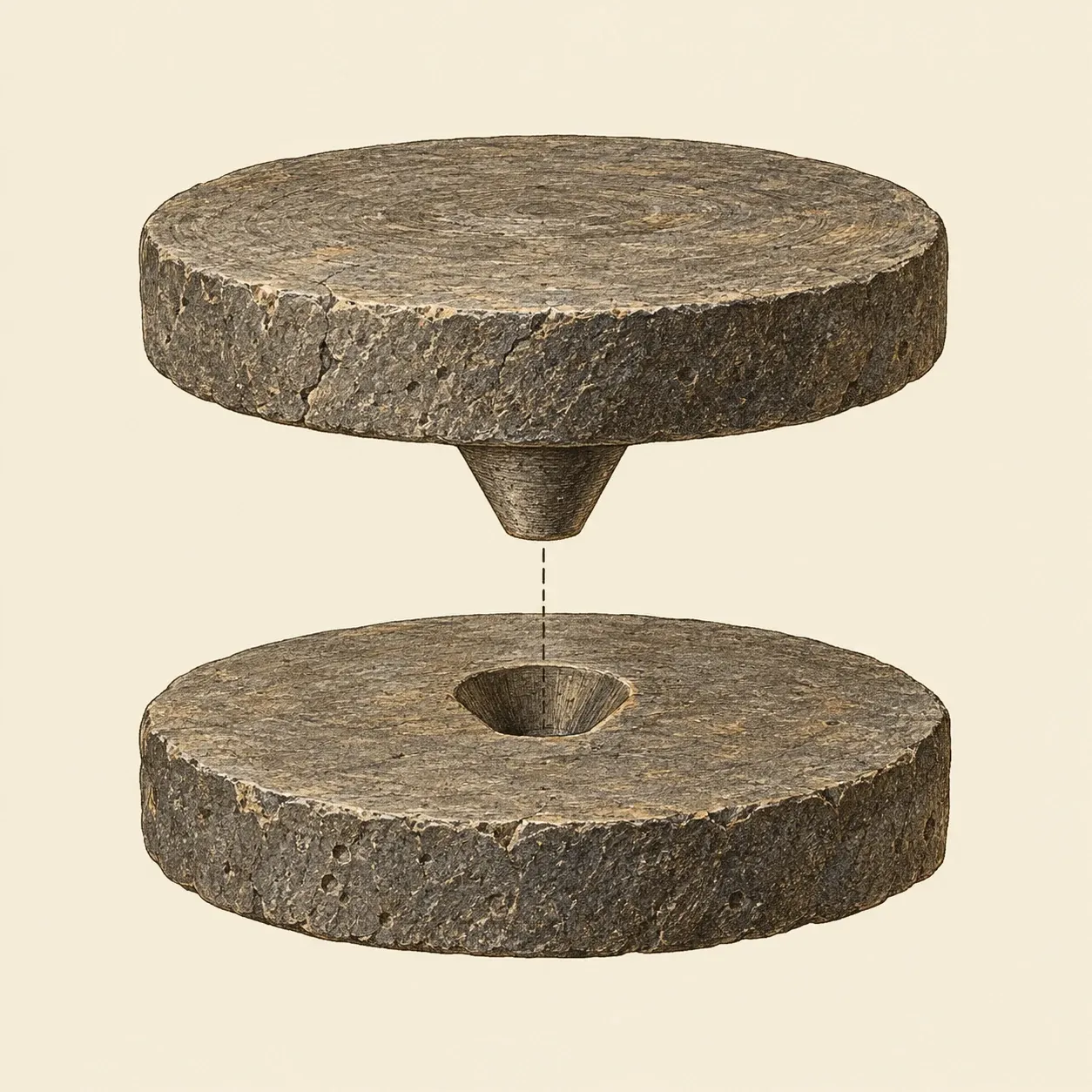 A stone turntable in two parts: the upper disc turns on its pivot, seated in the socket of the lower stone.
People made pots by hand for many thousands of years before the wheel. Some of the earliest well-studied rotary devices for pottery come from the southern Levant, in the second half of the fifth millennium BCE; claims for earlier wheels elsewhere are debated. Research by Valentine Roux and colleagues shows that potters there coiled their vessels and then shaped them on the wheel, and that only a few specialists did this work, for fine bowls with a special status. On this view the early wheel spread for prestige more than for speed.
By the Uruk period in Mesopotamia, around 3400 BCE, the fast wheel was in use, and a potter’s wheel from Ur has been dated to about 3100 BCE. The technique reached the Aegean during the third millennium BCE, although whether it came by way of Crete is debated, and Britain only in the first century BCE. In the Americas, potters made fine ware without any wheel until European contact. Egyptian myth has the god Khnum shaping the first humans on a potter’s wheel.
When the kick wheel, with its long shaft and foot-driven flywheel, first appeared is uncertain; some ancient wheels were turned by hand or with a stick. Later wheels used a treadle and crank to turn the up-and-down motion of the leg into rotation, and electric motors now drive many wheels.