Drum
A stretched skin struck over a hollow body
Contents
- 1Rawhide head
- 2Rawhide lacing
- 3Pierced lug below the rim
- 4Conical upper body
- 5Hollow foot, open at the bottom
A drum is a skin stretched over the opening of a rigid hollow body and struck with the hand or a stick. The skin vibrates, and the body and the air inside it shape the sound. Clay drums survive from the Neolithic: several hundred from Central Europe, the oldest from about 3600 BCE, and others from sites of the Dawenkou culture of eastern China.
What it is
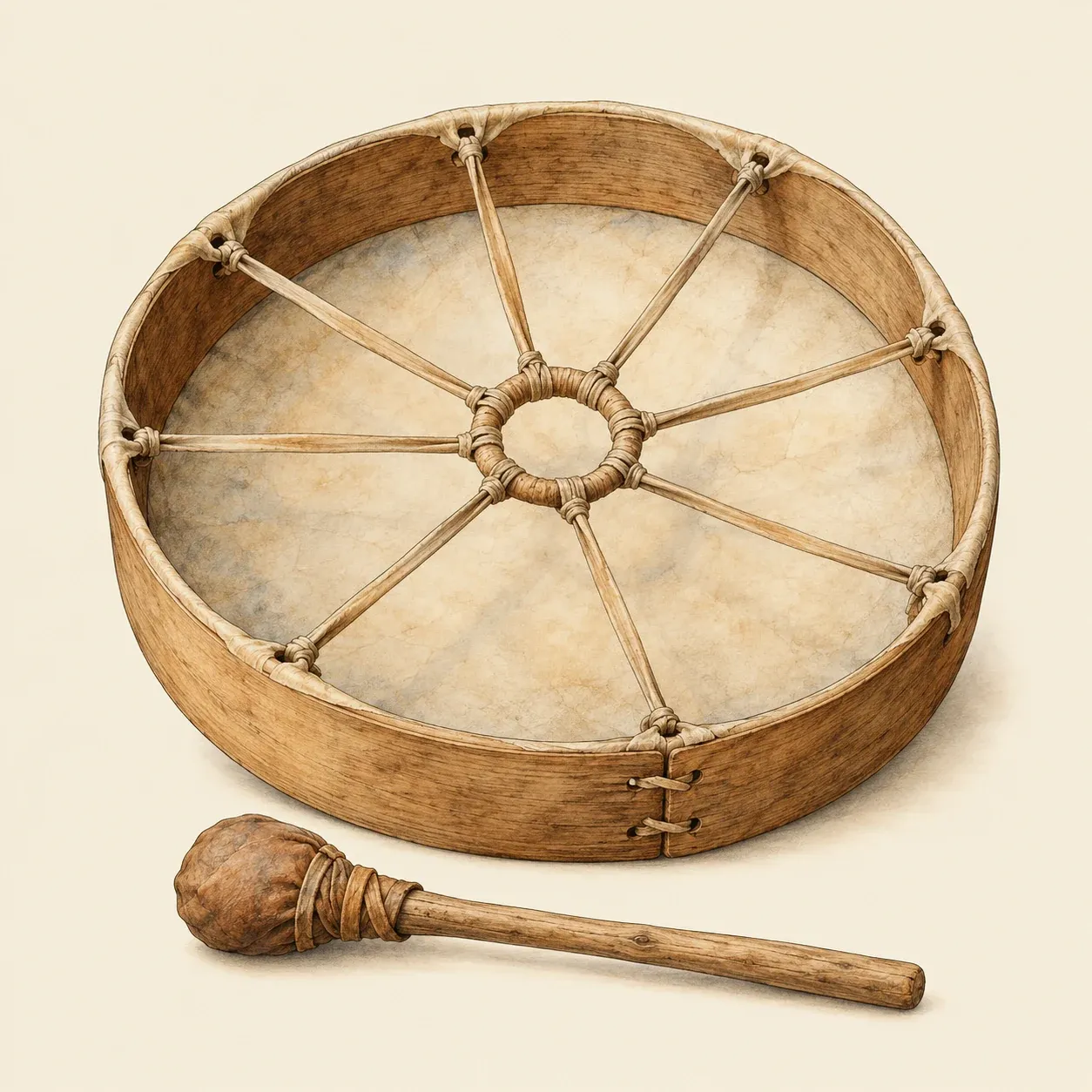 The body can be as simple as a ring of bent wood.
A drum is a skin, or membrane, held taut across the opening of a rigid body and made to sound by striking it. The body can be a clay vessel, a hollowed log, a ring of bent wood or a metal bowl. It can carry one head or two, and it can be closed at the far end or open there. Instrument classifications put drums among the membranophones, the instruments whose sound comes from a stretched membrane.
For most of their history drums used rawhide: the skin of a goat, deer, cow or other animal, cleaned of flesh and hair and dried without tanning. Rawhide is laid on wet and shrinks as it dries, so the drying itself tightens the head. Makers have held the edge of the skin in four main ways: laced with thongs or cords, tied to pegs driven into the body, glued and nailed, or clamped by a hoop that screws pull down.
How it works
A blow pushes the centre of the head inwards. The tension in the skin pulls it back, it overshoots, and it swings to and fro, pushing the air on each side and sending out sound. The skin vibrates in several patterns at once, each with its own frequency. All of them rise when the tension increases and fall when the head is larger or heavier. Tightening a head therefore raises its note, and a wide, thick head sounds lower than a small, thin one.
In a string the higher frequencies are whole multiples of the lowest, which gives a clear note. In a stretched membrane they are not: the second pattern vibrates about 1.59 times faster than the first, the next about 2.14 times, and so on. Most drums therefore give a thud or a crack without a definite pitch. The kettledrum is an exception. Thomas Rossing showed that the air on both sides of its head adds mass to the moving skin and pulls its main frequencies close to the ratios 2, 3, 4, 5 and 6, so a well-tuned kettledrum sounds a clear note.
The body changes the sound. A frame drum has no enclosure, so when the head pushes air forward on one face it draws air back on the other, and the lowest tones partly cancel. A deep body holds a column of air with its own resonance, which gives a fuller, longer sound. Many drums have a small hole in the body. It lets the pressure inside follow changes in the weather.
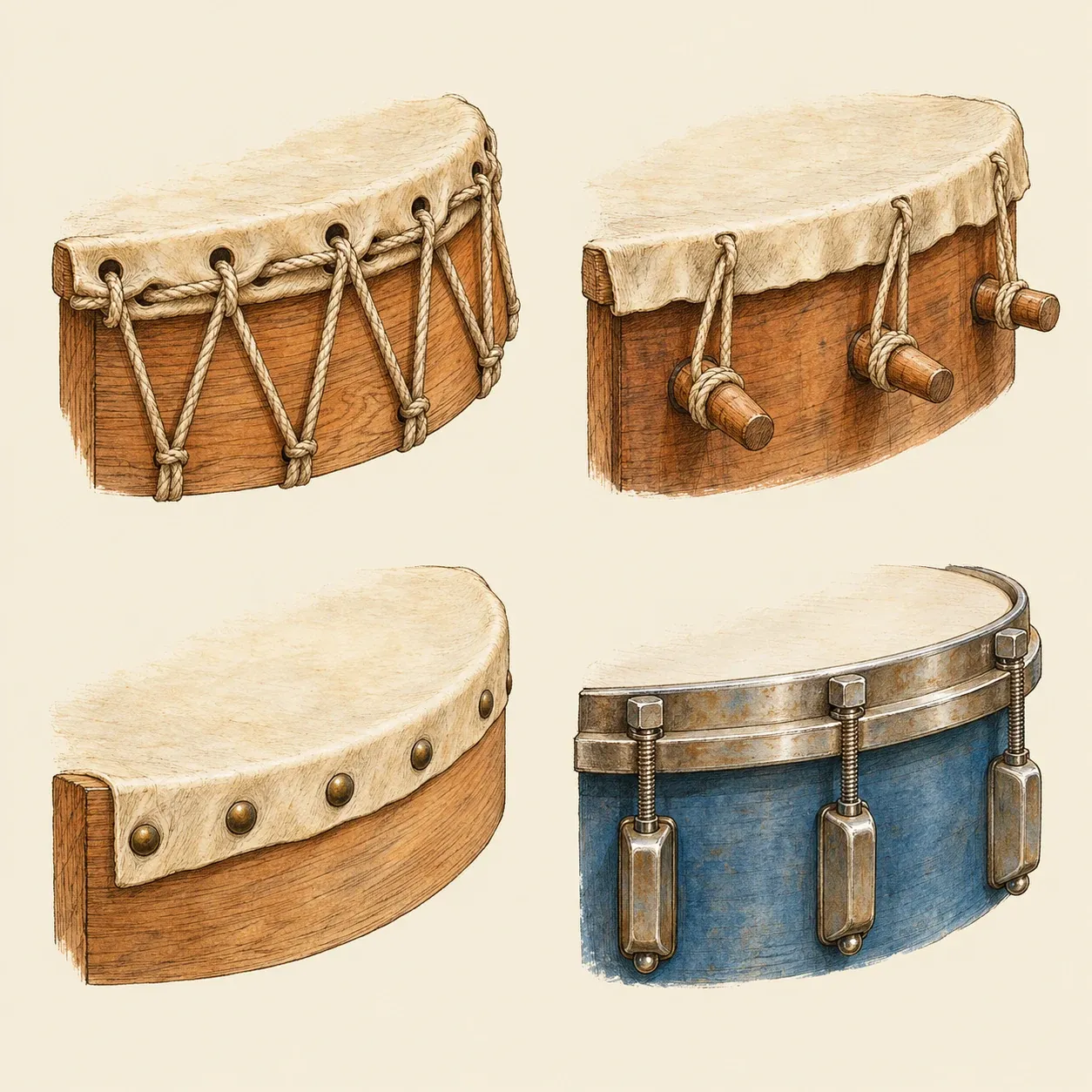 The four common ways of holding a drumhead: lacing, pegs, glue and nails, and a hoop drawn down by screws.
The hooks and lugs of the oldest clay drums suggest that their skins were tied on. In a laced drum, holes are punched near the edge of the skin and a thong runs through them to lugs on the body, to a ring below, or to the other head. On pegged drums, such as one from Ghana in the Penn Museum, cords or thongs run from the head to wooden pegs set in the body, and the pegs serve to tighten the skin. On some frame drums, such as the Egyptian riqq, the skin is glued round the frame and reinforced with a row of tacks. Modern drums grip the head with a hoop pulled down by threaded rods; orchestral kettledrums have six or eight such screws round the rim and a pedal that changes the tension while playing. Natural skins respond to humidity, which makes them harder to keep in tune. Plastic heads, which have largely replaced calfskin on kettledrums, are hardly affected.
How to do it
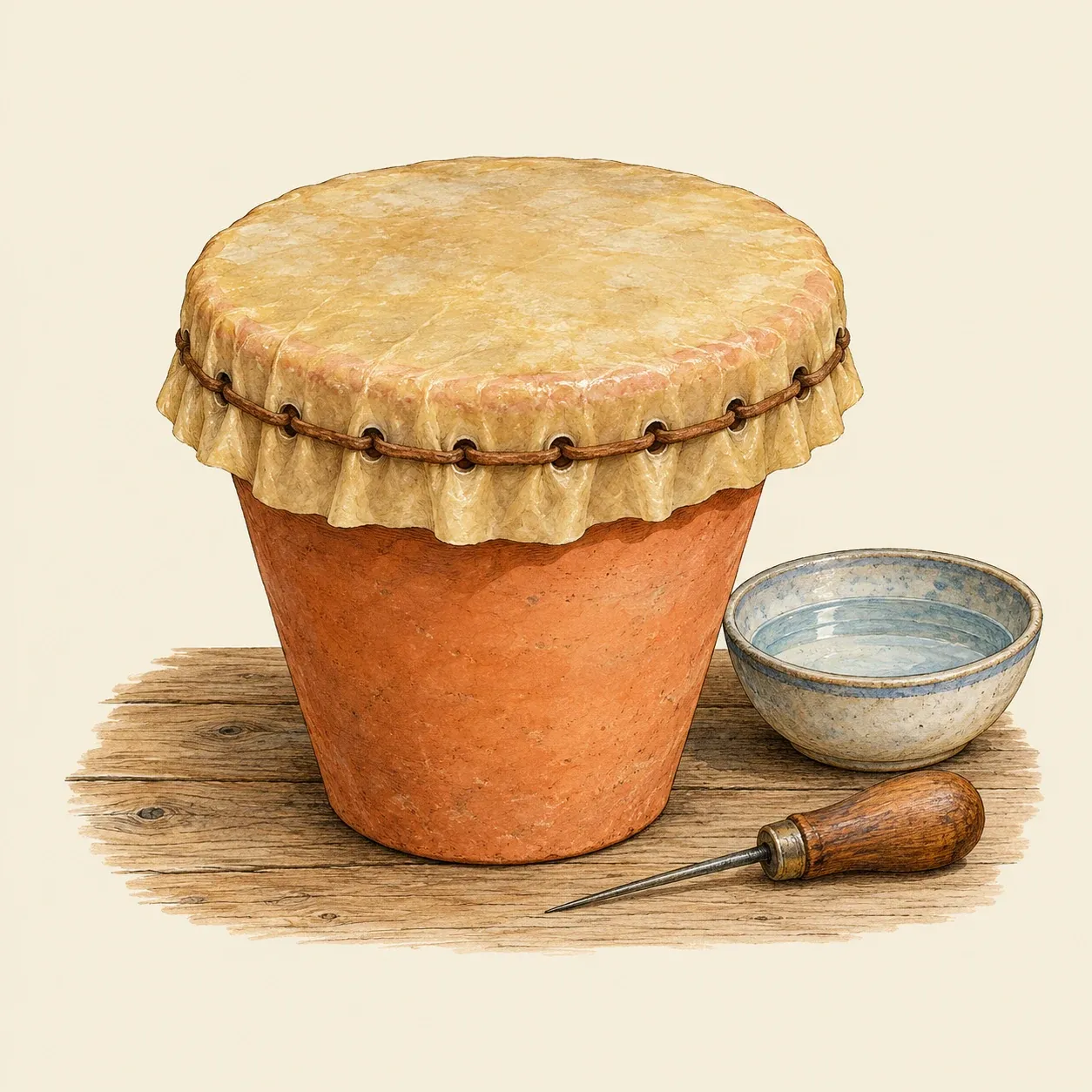 A wet skin is gathered under the rim of a clay pot; as it dries it shrinks and becomes a tight head.
A sturdy terracotta flowerpot with a thick rolled rim makes a single-headed clay drum close in principle to the Neolithic ones. Tap the pot with a knuckle before you start: a sound pot rings, a cracked one buzzes and should not be used, as the drying skin pulls hard on the rim. Leave the drainage hole open; it lets the air inside breathe.
Use goat rawhide sold for drum making. Soak it in cold water until it is soft and limp, which takes from a few hours to a day depending on its thickness. Lay it on a board and cut a disc large enough to cover the mouth and come down well below the rim all round. With an awl, punch about twenty holes evenly spaced a finger’s width in from the edge. Cut a long thong from the offcuts, or use strong cord.
Centre the wet disc on the pot and fold its edge down over the rim. Thread the thong in and out through all the holes, then pull its two ends together little by little, working round the pot so that the skin gathers evenly under the rim. Smooth out wrinkles on the top as you go. The skin should lie flat and firm but need not be drum-tight yet. Tie the ends with a secure knot.
Leave the drum upright in a dry room for about two days, away from direct sun and from heaters, which dry the skin unevenly. As it dries, the skin shrinks, the gathered edge locks under the rim and the head becomes tight. Play it with the fingertips and the flat of the hand, striking near the edge for a high, dry sound and near the centre for a low one. If the head goes slack in damp weather, leave it in a dry room. If it stays slack, soak the skin, refit it and let it dry again.
Safety: never use raw skins of unknown origin or hides that have not been treated. Untreated goat hides have carried anthrax spores to drum makers, and health authorities consider protective clothing no substitute for hides known to be free of spores. Wear gloves when handling wet rawhide, wash your hands afterwards and do not sand rawhide indoors. Cut on a board, keep the hand that steadies the skin away from the path of the blade, and push the awl away from your fingers.
History and evolution
Skins and wood rarely survive, so the oldest drums are hard to find. The archaeologist Luboš Chroustovský points out that a skin laced over a bent branch could have been made in the Upper Palaeolithic, but no such drum is known. A Neolithic wall painting at Çatalhöyük in Anatolia shows dancers or hunters; Doris Stockmann read one figure as holding up a small frame drum, a reading Chroustovský calls debatable.
The oldest objects accepted as drums are made of fired clay, because clay lasts. The Dawenkou culture spread over Shandong and northern Jiangsu from about 4300 BCE. Clay drums have been found at several of its sites, among them Dawenkou, Wangyin and Yedian in Shandong and Huating in Jiangsu, often in large graves. Bo Lawergren, who surveyed the Chinese finds, describes vessels 17 to 36 cm high with 15 to 20 hooks round the opening, presumably for tying the skin, and small holes in the sides and base. Clay drums from western China, made between about 3000 and 2000 BCE, are goblet-shaped, with hooks round the rim and a pair of lugs for a strap. At Taosi in Shanxi, rich tombs of about 2000 BCE held large drums. One was a hollowed tree trunk painted with red lacquer, and alligator bones and skin lay inside it; the Taosi museum displays it as a painted wooden drum that once had a crocodilian skin.
Central Europe has several hundred clay drums from the Neolithic, found from Denmark and the Netherlands to Bohemia and southern Poland. Most belong to the Funnel Beaker culture and related groups. Radiocarbon dates of the finds around them place them between about 3600 and 2400 BCE, and Chroustovský puts most of them between 3350 and 2700 BCE. He also notes a possibly older drum of the Lengyel culture from Großweikersdorf in Lower Austria. They are funnel, goblet or hourglass shapes, usually open at both ends, with knobs, lugs or pierced lugs below the rim to hold the skin. Replicas fitted with goat skin by Lynda Aiano and by Chroustovský give clear, loud sounds.
In Mesopotamia, stone steles carved for Gudea, ruler of Lagash, and for Ur-Namma, king of Ur, around 2100 BCE show drummers and a very large drum. In Egypt, the Metropolitan Museum holds a barrel drum of the Late Period (664–332 BCE) whose two hide heads are laced to each other along a wooden body.