Sericulture
Raising silkworms and reeling silk
Contents
- 1Mulberry leaves
- 2Silkworms on the rearing tray
- 3Cocoons spun in the straw
- 4Cocoons in hot water
- 5Reel
- 6Cocoon cut open: silk shell and pupa
Sericulture is the raising of silkworms for their silk. The caterpillars of the domestic silk moth feed on mulberry leaves and each spins a cocoon from one continuous filament, which is unwound in hot water together with the filaments of other cocoons to make a thread. Silk fabric wrapped children buried in central China around 3500 BCE, and at one of these sites, Wanggou, a team of the China National Silk Museum identified the silk as that of the domestic silkworm.
What it is
Sericulture is the raising of silkworms for their silk. The domestic silkworm, Bombyx mori, is the caterpillar of a moth that people in China bred from the wild Bombyx mandarina more than 5,000 years ago. Its caterpillars feed on mulberry leaves, and before turning into moths each one spins a cocoon from a single continuous filament. Reeling unwinds the filaments of several cocoons at once and joins them into one thread, raw silk, which can then be twisted, dyed and woven on the loom.
Breeding changed the insect. Domestic silkworms hatch, feed and mature together, so they can be reared in large numbers. The moth has lost the use of its wings, through weakened flight muscles and softer wings, and the shell of its cocoon is much heavier than that of the wild moth.
How it works
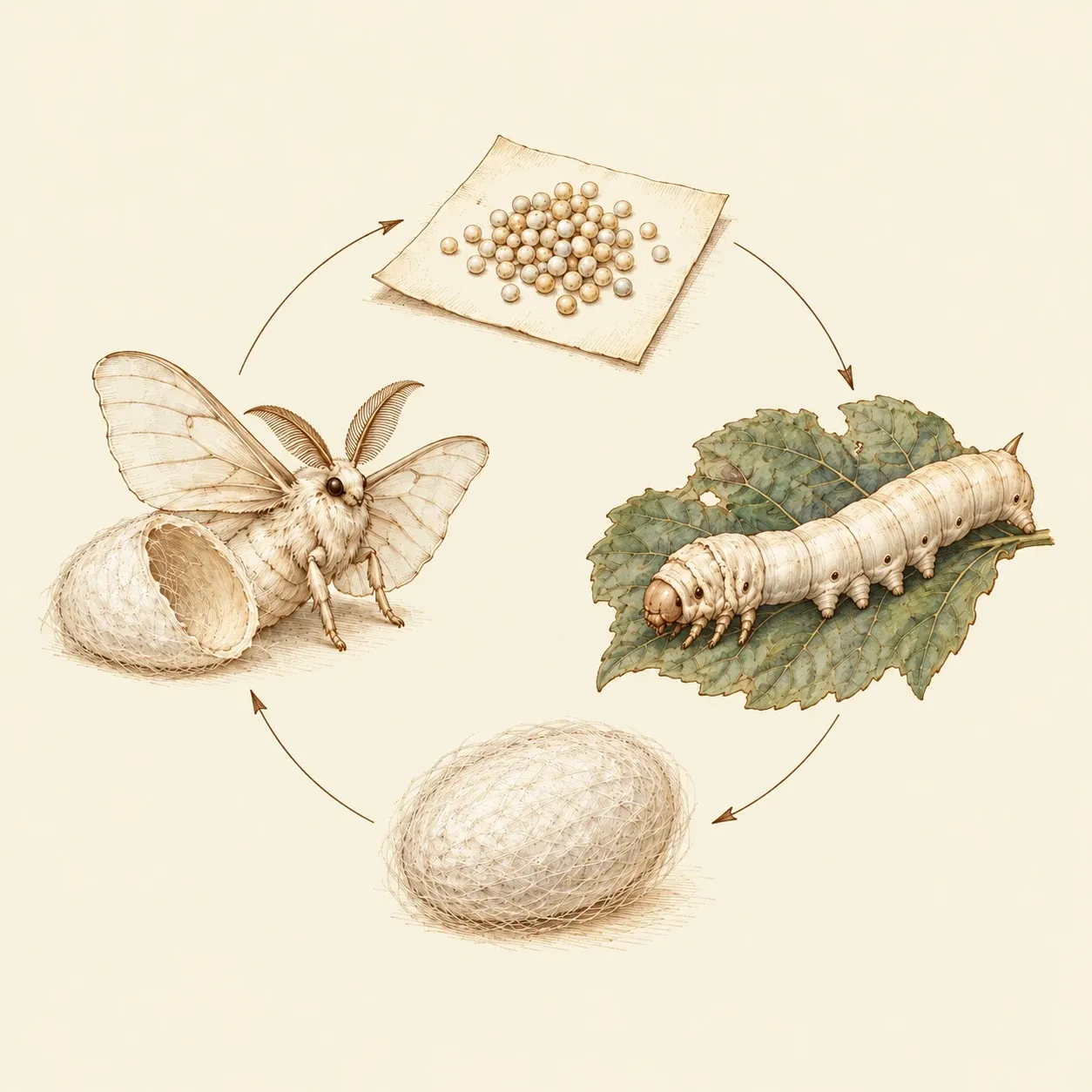 Egg, caterpillar, cocoon and moth: the moth leaves through a hole that ruins the cocoon for reeling.
The eggs hatch into tiny caterpillars that eat mulberry leaves almost without pause. They grow through five stages separated by four moults; during each moult, which lasts about a day, they stop feeding. The life of the caterpillar takes about four weeks, a little more or less with the breed and the warmth. When full grown, it stops eating and looks for a place to spin, and rearers give it a frame of straw, twigs or card. It builds its cocoon from the outside inwards and inside turns into a pupa. The cocoons are gathered about a week after spinning begins, once the pupa has turned brown and hard.
The silk comes from a pair of glands that open near the mouth. Each filament is two strands of fibroin, a protein that sets as it leaves the body, coated with sericin, a gum that sticks the turns of the cocoon together. In the shell, fibroin makes up 72 to 81% of the weight and sericin most of the remainder, with small amounts of fats, waxes, pigments and ash. The filament runs unbroken from the outside of the cocoon to the inside, coarser at first and finer towards the end. The FAO gives a total length of 600 to 1,500 m, of which about four fifths can be reeled; Britannica gives 600 to 900 m of usable filament.
If the moth is allowed to come out, it breaks through the shell and the filament can no longer be unwound in one piece. Such cocoons are pulled apart and spun like other fibres. In established practice the pupa is therefore killed by heat before it can emerge: in the sun over two or three days, in steam, in hot-air dryers, or in the boiling water of the reeling basin itself. The cocoons are then dried so that they can be stored without going mouldy.
Hot water softens the sericin so the filament comes away. The reeler stirs or brushes the floating cocoons to catch their loose ends, gathers the filaments of several cocoons, passes them through an eyelet and winds them onto a reel. As the sericin dries, it glues the filaments into one thread. When a cocoon runs out, the reeler lays the end of a new one onto the running thread to keep it even.
How to do it
Raise a few silkworms. Silkworm eggs are sold by suppliers to schools and breeders, with instructions for hatching them. Give the youngest caterpillars tender leaves chopped small, older ones whole leaves, always fresh and never yellow or diseased; some suppliers also sell an artificial diet. Remove droppings and leftover leaves from the tray regularly, and do not feed caterpillars that lie still while moulting. After about four weeks they stop eating: give them egg-box cells or paper cones to spin in. Collect the cocoons about a week after spinning begins.
Let the moths come out. If you keep these cocoons, the moths emerge about two weeks later, mate, lay eggs and live for about a week. They cannot fly, so keep them in a box indoors. Their pierced cocoons can no longer be reeled, but they can be pulled apart and spun.
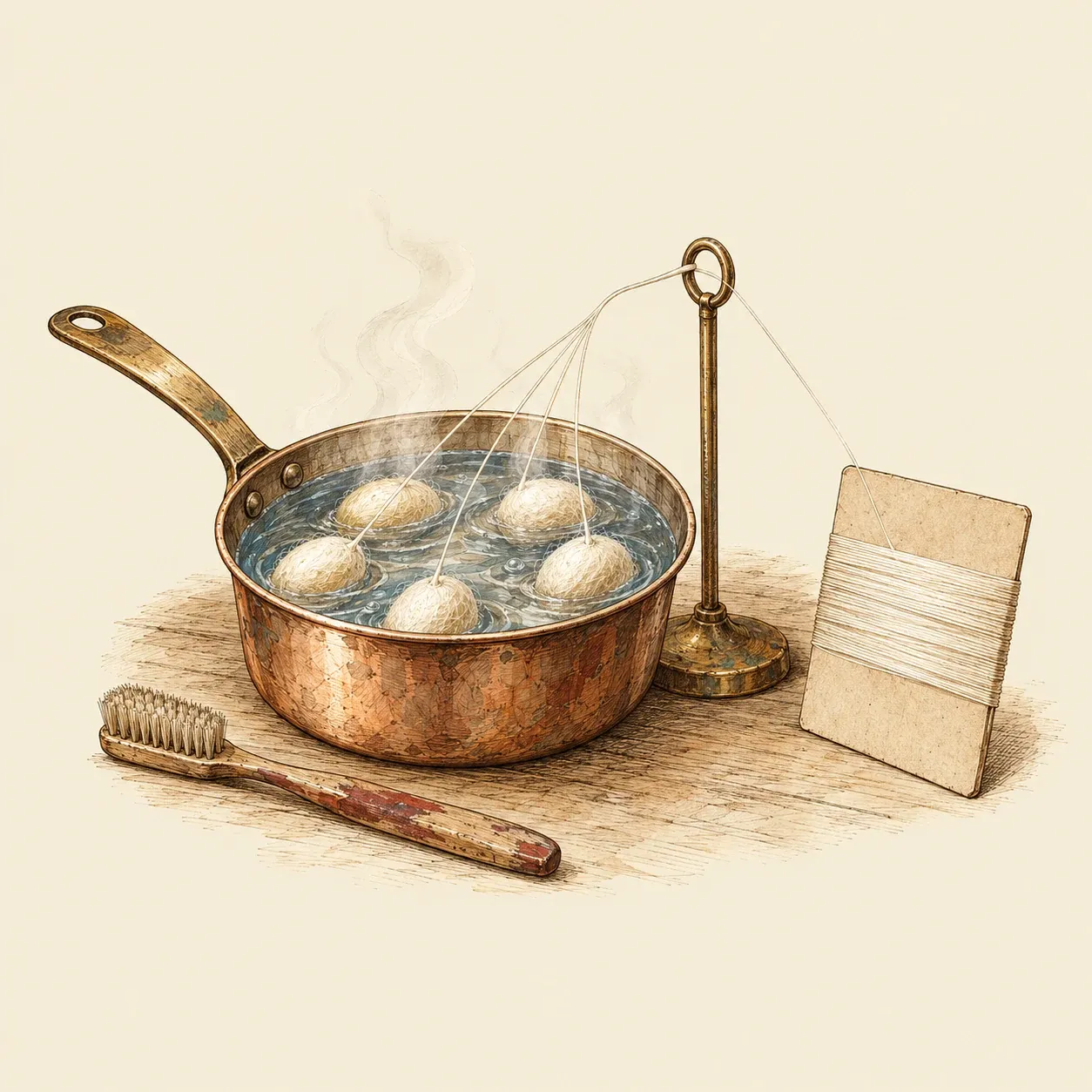 Five cocoons reeled together through a ring onto a card.
Reel a few cocoons. For reeling, buy dried whole cocoons from a supplier of silk materials; in them, as in all reeled silk, the pupa has already been killed by heat. Heat water in a small pan until it is very hot but not boiling, about 70 to 80 °C, checked with a kitchen thermometer. Drop in five or six cocoons and press them under with a spoon until they soak through. Brush the surface lightly with an old toothbrush, and loose fibres will catch on the bristles. Pull them gently until each cocoon gives a single clean filament. Gather the filaments, pass them through a small ring held above the pan and wind them steadily onto a piece of card, so that the cocoons turn as they unwind. When a cocoon is spent, its thin last layer and the pupa remain; lay the end of a fresh cocoon onto the moving thread. Leave the thread to dry on the card, where the gum sticks the filaments together.
Safety. Hot water scalds. Put the pan on a back ring with its handle turned inwards, handle the cocoons with a spoon and the toothbrush rather than your fingers, keep children under an adult’s eye, and let the water cool before you empty it. Wash your hands after handling caterpillars and cleaning their tray. Reeling a whole cocoon means that the pupa inside it has been killed; if you would rather avoid that, work only with cocoons the moths have left and spin them.
History and evolution
In 2016 Yuxuan Gong and colleagues reported peptides of silk fibroin in soil from tombs at Jiahu, in Henan province, China, about 8,500 years old. Their test shows silk, not which moth made it.
People of the Yangshao culture in Henan wrapped dead children in silk fabric. Gerard Tsang, of the Hong Kong Museum of Art, dates such wrappings from Qingtai to about 3500 BCE. At Wanggou, near Xingyang, charred fabric from a child’s burial urn is dated by its excavators to 5,300 to 5,500 years ago; the team of Zhao Feng at the China National Silk Museum found Bombyx mori fibroin in it with an immunological test, and electron microscopy showed fine yarns. Xinying Zhou and colleagues, of the Chinese Academy of Sciences, write that silk fibres of Bombyx have been reported in China from at least 5,000 years ago. In southern Shanxi, Tian Jianwen of the provincial archaeological institute links a stone carving of a silkworm chrysalis about 5,200 years old to the cocoons and chrysalises found in the same area, and reads them as a sign that Yangshao people raised silkworms.
Other peoples reeled silk too. In the Indus valley, Irene Good, Jonathan Mark Kenoyer and Richard Meadow identified threads of the middle of the third millennium BCE from Harappa as wild silk from Antheraea moths; the silk from Chanhu-daro, of the same period, may come from Antheraea or from Philosamia. The fibres had not been degummed and still carry their sericin. The authors conclude that reeling was practised, which implies that the pupae were killed before they could break out. In 2026 Zhou and colleagues, publishing in Science Advances, identified three cocoons from Sapalli Tepe, in Uzbekistan, as Bombyx mori. One of them is directly dated to 1940–1765 BCE, and the other two come from the same context. Charcoal of mulberry wood was found with them.
Shi-Wu Li and his colleagues, who studied Chinese textile machines, date the first records of a reeling wheel to the Tang dynasty (618–907). It was turned by hand and needed two people. By the Song dynasty (960–1279) at the latest, a treadle let one reeler work alone while a guide moving to and fro laid the thread evenly on the reel. Wooden treadle reeling wheels are still used in villages around Hangzhou, Jiaxing and Huzhou.
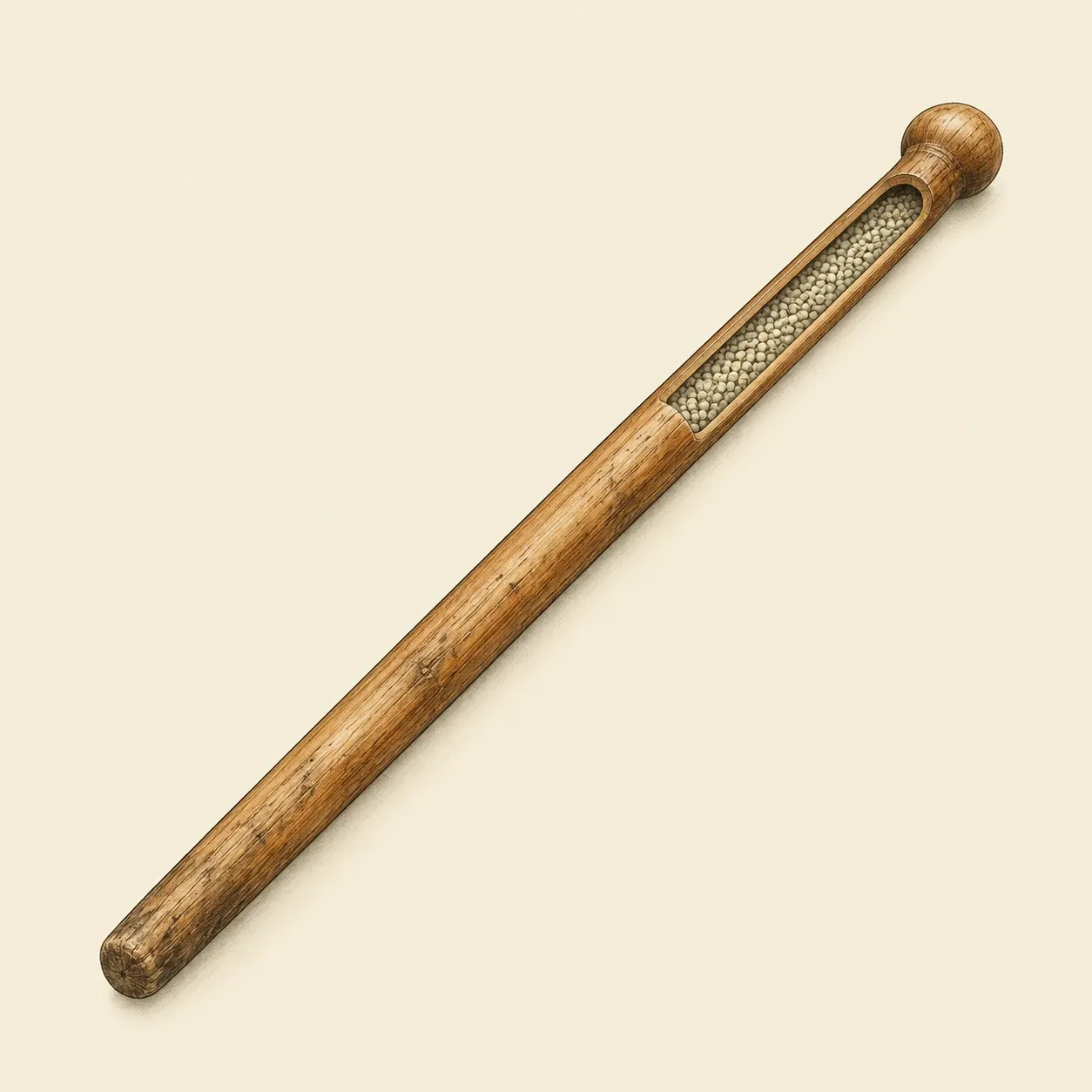 Theophanes tells of silkworm eggs hidden in a walking stick.
Byzantine writers told how silkworm eggs reached the Mediterranean. Procopius says that monks coming from India brought them to the emperor Justinian, who reigned from 527 to 565; Theophanes, three centuries later, credits a Persian who hid them in a walking stick.
In June 1865 Louis Pasteur arrived at Alès, in southern France, to study the diseases that were killing silkworms. By 1870 he had shown that pébrine was caused by a parasite and that flacherie was a separate disease. His method, examining the moths under the microscope and keeping only the eggs of healthy ones, is credited with saving French silk production.