Oil press
Crush, press and separate
Contents
- 1Crushing olives with a roller
- 2Fibre mat containing the paste
- 3Pressure plate beneath the lever
- 4Draining bed and collecting vessel
- 5Settling vessel: oil above, water and sediment below
An intact olive gives up little oil when simply squeezed. Crushing opens the flesh; a mat holds the resulting paste while a press drives out its liquid. The collected juice still needs separating before the oil can be drawn off.
What it is
An oil press squeezes crushed olive paste to release its liquid. In the Iron Age lever press, a long wooden beam is set at one end in a niche in a stone pier, and perforated stone weights hang by ropes from its free end. The beam bears on a plate above mats filled with paste, and a stone bed carries the juice through a spout into a jar below. A second jar lets the oil separate from the water naturally present in the fruit. The crushing equipment matters as much as the beam: squeezing whole olives leaves much of their contents trapped in the flesh.
The workshop brings together older crafts: stone dressed with stone tools, plant fibres plaited into mats, pottery jars and the rope that holds the weights. Its oil went into cooking, lamps and ritual. Between the fruit and clear oil come wet paste, cloudy juice and sediment, and keeping them apart is part of the work.
How it works
A stone roller turning in a round basin, or a simple pestle, breaks up the flesh and releases its contents. Workers spread the paste inside fibre mats that stop it escaping as a lump when the plate descends. The weave lets oil and water through together, along with fine particles. Liquid drains poorly if the stack is too thick or its passages clog, so preparing and spreading the paste counts as much as the load.
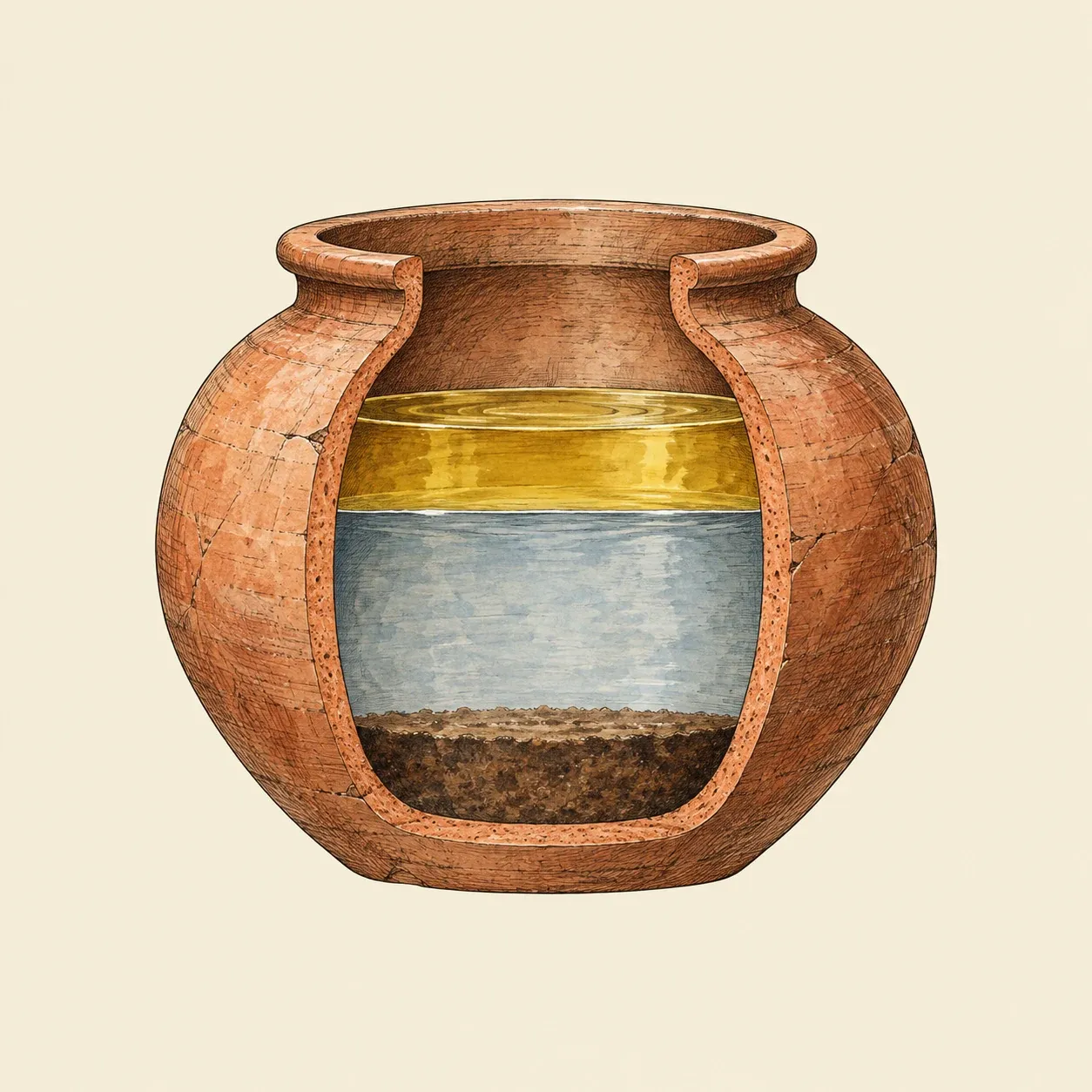 Oil rises above the water; heavier particles collect at the bottom.
The weights pull the free end of the beam down. The plate sits much closer to the pier than the weights do, so the beam multiplies their pull, and the niche in the pier takes the reaction. As the paste gives up its juice, workers can add stones or hang on the beam themselves. The bed must stay level and give the juice a clear path to the spout. Forbes and Foxhall report about one kilogram of oil from four to seven kilograms of cultivated olives on Methana.
Left undisturbed, the phases separate because oil is less dense than water. The upper layer can be skimmed off, or the water drawn from a low outlet. Heavier particles settle to the bottom. Pressing and settling do not sterilise the juice, and clear oil can still be rancid.
How to do it
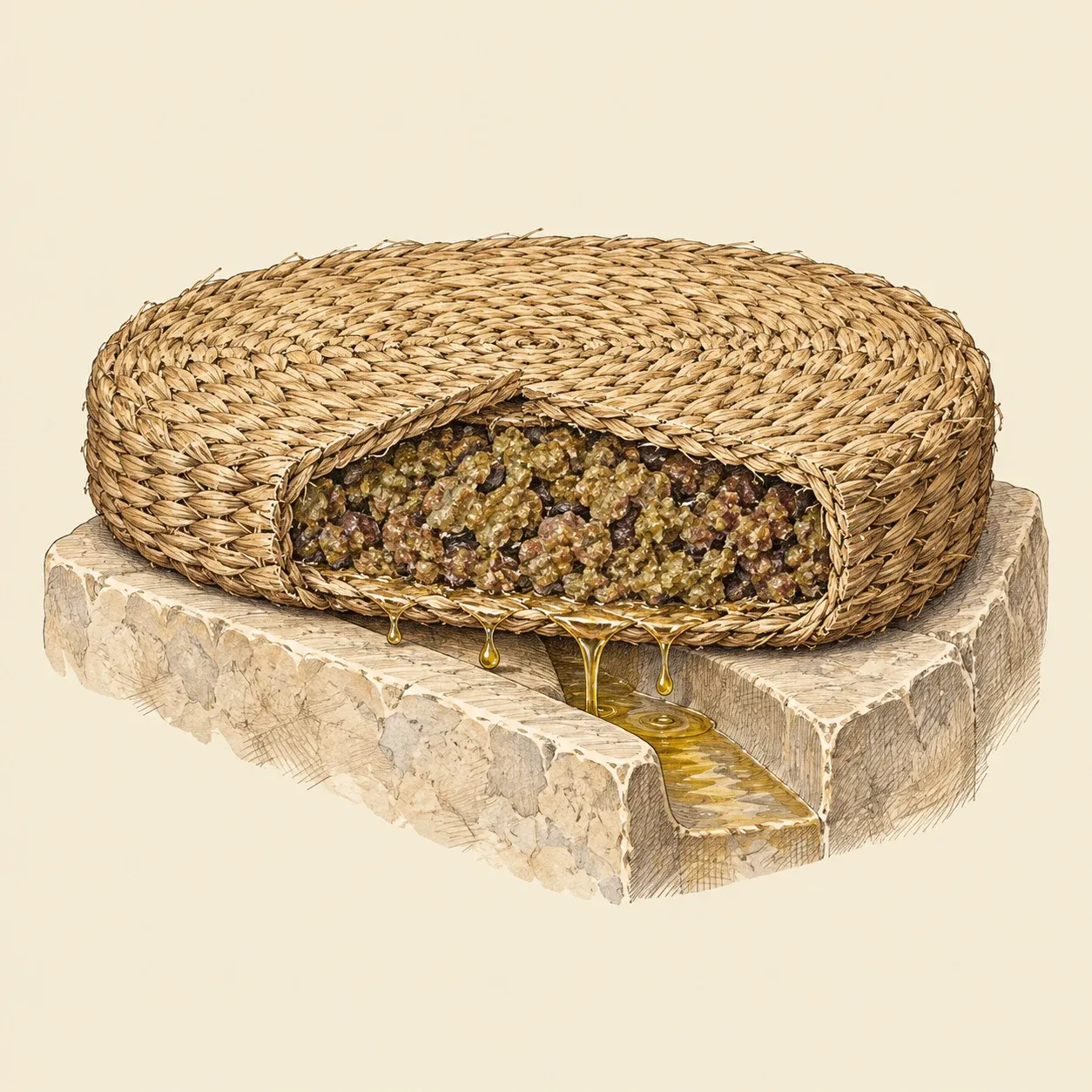 The mat holds back most solids while allowing liquid to escape.
For a practical trial, choose a small hand-operated press made for crushed olives and food contact, and follow its instructions for fixing it down and choosing accessories. A press built for dry seeds may not cope with wet olive paste. Do not hang stones from an improvised lever, use a person as a weight or trust a frame of unknown strength.
Select sound, fresh olives, remove leaves and dirt, and wash the fruit. Clean equipment and contact surfaces. Crush a small batch with a hand roller or pestle in a stable container. Spread the paste in a clean food-contact mat that fits the press. Position the bundle and collecting vessel before gradually applying pressure. Keep fingers outside the plates and release the load completely before adjusting anything. Stop if the equipment shifts, binds or shows damage.
Collect the juice in a clean, covered vessel, let it separate, then lift off the upper layer without disturbing the bottom. This demonstration needs neither solvent nor heating. Without sanitary controls, do not taste the result or keep it as food. Reject mouldy fruit and rancid or suspect oil.
History and evolution
People were using olive oil long before the lever press. Pots from Ein Zippori, in Galilee, held olive oil around 5800 BCE. At Kfar Samir, a village now under the sea off the Carmel coast, pits full of crushed olive stones and pulp show oil being extracted roughly 5000–4500 BCE. Beam pressing appears at Tell Rakan II (site WZ130), in the Wadi Ziqlab of northern Jordan, an olive works of the late fourth millennium BCE: its first installation pressed pulp layered in a pit, a method known since the Neolithic, and its last one used a beam. At Khirbet Um al-Ghozlan, in northern Jordan, an olive works stored its oil in jars and spouted vats, and the presses cut into the bedrock nearby seem to belong to it. The site was long placed around 2500 BCE; radiocarbon dates published in 2025 put its brief occupation at 2900–2850 BCE.
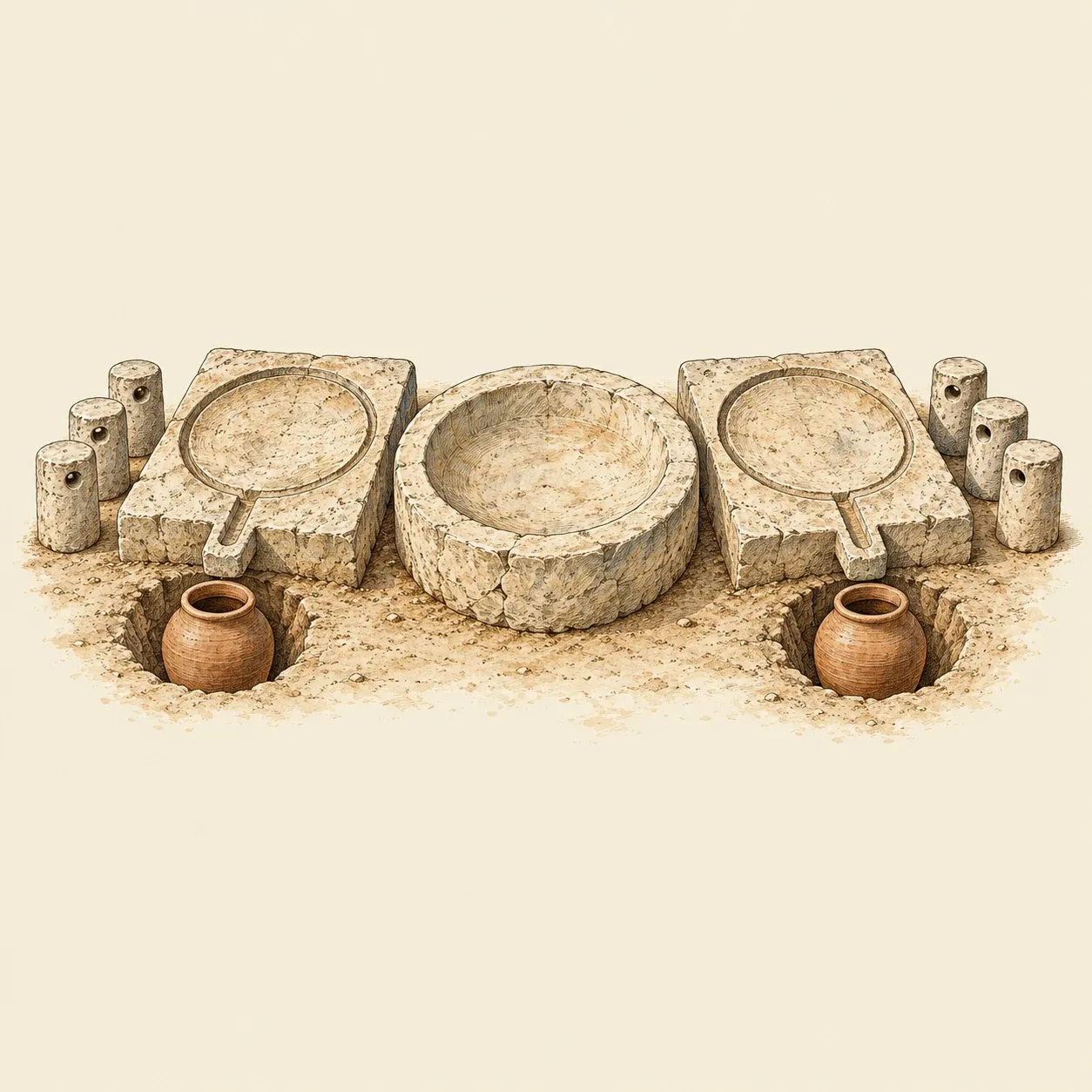 A crushing basin between two presses, with pierced stone weights beside each.
Lever presses loaded with stone weights spread in the Iron Age. At Ekron, on the coastal plain of Israel, excavators found more than a hundred oil installations of the seventh century BCE, typically a crushing basin between two presses, with perforated stone weights beside each. An Athenian black-figure cup of about 520–510 BCE, now in Boston, shows a beam weighted at its end while a worker hangs from it.
Ancient oil supplied food, lighting and ritual. Roman workshops added screw presses, later hydraulic presses raised the available force, and centrifuges now separate the phases without waiting for them to settle. Each method still begins by breaking the fruit open and ends by parting oil from water.