Instant noodles
Noodles cooked in steam, dried in hot oil or air, softened again by hot water
Contents
- 1Sheeting rollers that press the dough into a sheet
- 2Cutting rollers and the slower belt on which the strands fold into waves
- 3Steam box where the strands cook
- 4Perforated metal moulds with their lids
- 5Bath of hot oil, where the water leaves as steam
- 6Dry block of porous strands
Instant noodles are wheat noodles cooked in steam and then dried, most often by a short bath in hot oil, sometimes in hot air, so that they keep for months and turn soft again in a few minutes of hot water. Nissin put the first ones, Chicken Ramen, on sale in Japan on 25 August 1958, after Momofuku Ando had worked out the frying method in a small workshop behind his house.
What it is
Instant noodles are noodles that have already been cooked and then dried. A dough of wheat flour, water and salt is rolled out and cut into strands, the strands are cooked in steam, and they are then dried very quickly, most often by a short bath in hot oil and sometimes in a stream of hot air. The dry block keeps for months in its wrapper at room temperature. Hot water is all it needs to be eaten: within a few minutes the strands take up water again and become soft.
Two changes make this possible. Steam cooks the starch of the dough, so the noodles need no real cooking later. Drying then takes away most of the water, and with it the chance for moulds and bacteria to grow, since they cannot multiply in a food that dry, even if some survive. Frying does the drying fast and leaves the strands full of tiny holes, through which hot water later finds its way back in.
In a factory the work runs as one continuous line. Rollers press the dough into a sheet, and grooved cutting rollers slit the sheet into strands. The strands drop onto a belt that moves more slowly than they arrive, so they fold into tight waves, which keep them from sticking together once they are cooked. After a steam box the strands are cut into portions and packed into metal moulds with holes in their sides, which are closed with lids and carried through a bath of hot oil. The blocks that come out are dry, light and ready to be wrapped.
How it works
Starch, the main part of flour, is made of tightly packed grains that hot water and heat unlock. In the steam box the strands are cooked in moist steam close to the boiling point of water, and the starch grains swell and soften. This is the cooking that a pot of fresh noodles would otherwise do. At this stage the strands still hold about a third of their weight in water, far too much for them to keep.
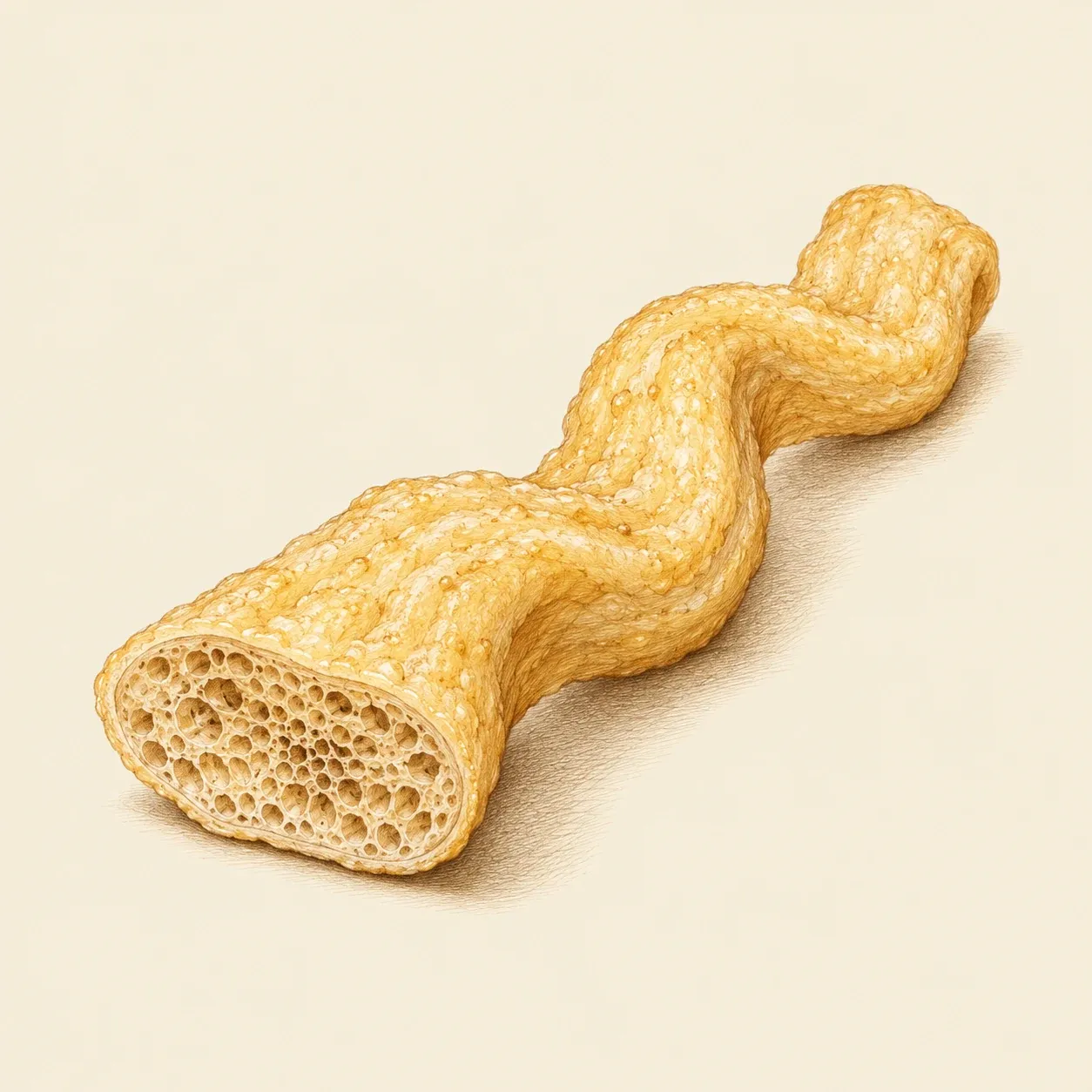 The water that boils out of a strand in the fryer leaves a network of pores behind.
The fryer removes that water in a minute or two. The strands are plunged in oil at about 140 to 160 °C, far hotter than the boiling point of water. The water in the strands boils and escapes as streams of fine bubbles of steam, and the strands set into a stiff, open sponge of cooked starch with only a few percent of water left. Some oil stays in the pores: fried instant noodles are about one fifth oil by weight. The lid of the mould holds the block flat and keeps the strands from floating apart while they harden.
Hot water undoes the drying. It runs into the pores, wets the starch from inside as well as from outside, and the strands swell and turn supple again within minutes. Noodles dried in hot air instead of oil hold much less fat, a few percent at most, but their structure is denser and their pores narrower, so they usually take a little longer to soften. Factories therefore cook them carefully in steam and blow very hot air through the blocks to open them up.
The dry block keeps because microbes need water. Moulds and bacteria cannot grow in a food holding only a few percent of it. What limits the life of fried noodles is their oil, which slowly reacts with the oxygen of the air and turns rancid.
How to do it
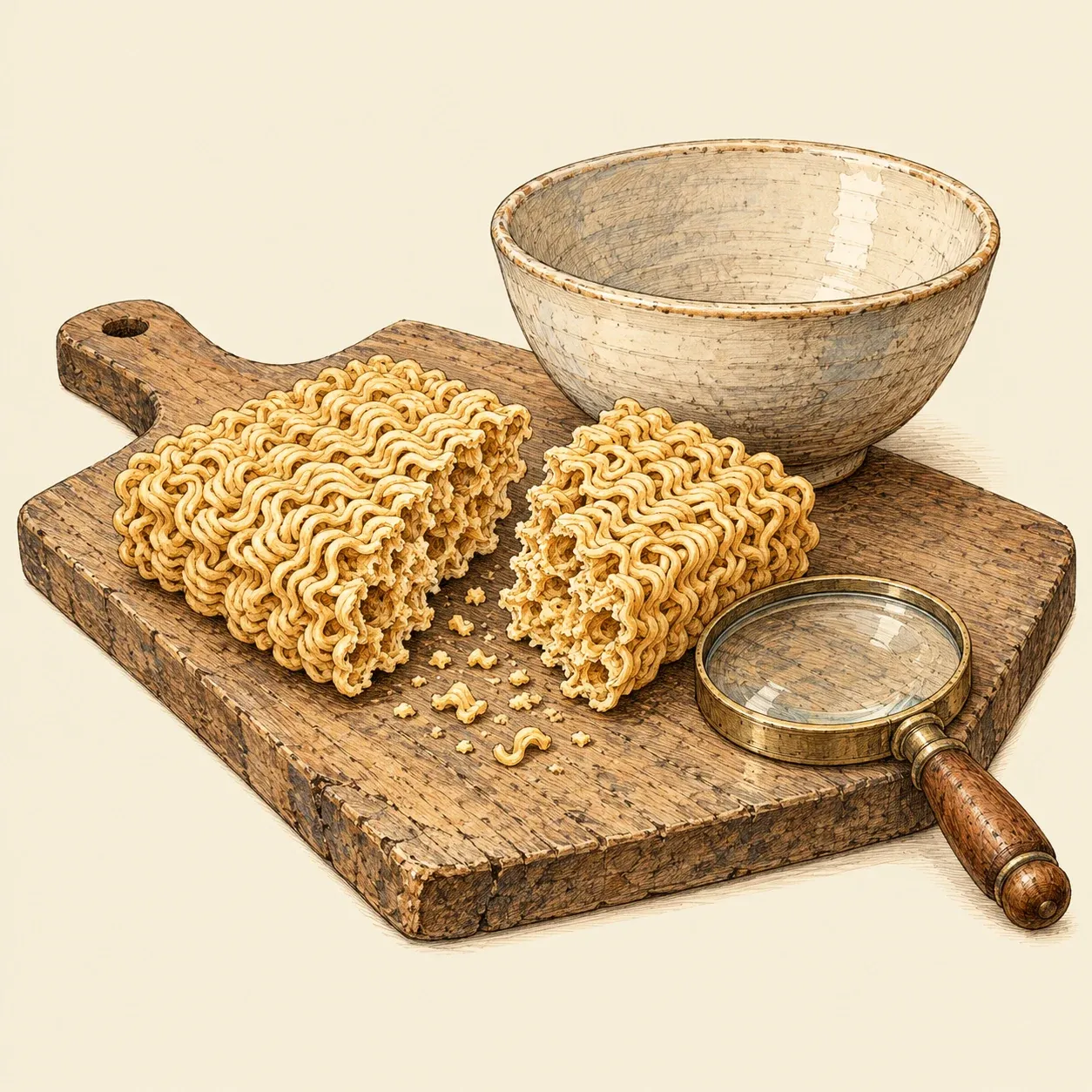 The broken face of a block shows the waves and the open spaces left between the strands.
A packet of fried instant noodles from a shop is enough to see how the method works, without frying anything. Break the block in two and look at the broken face. The strands are wavy and lie loosely, with spaces between them. Look at one strand through a magnifying glass, or snap it and look at the end: it is light, brittle and slightly rough, because it is full of small holes.
Put two pieces of the same size in two bowls. Cover the first with cold tap water. Have an adult pour water that has just boiled over the second, then cover it with a plate. Look at both every minute. The piece in hot water loosens and turns soft and pale within a few minutes, while the piece in cold water stays stiff much longer. Heat helps the water get into the pores and makes the cooked starch swell again.
Compare, if you can, a block of fried noodles with a block of noodles labelled as not fried. The air-dried one is usually more compact and softens more slowly in the same hot water.
History and evolution
Momofuku Ando was born in Taiwan, then under Japanese rule, in 1910, and went into business in Osaka. In 1957 a credit union he headed collapsed and he lost nearly everything. In a shed he built behind his house, he set out to make a noodle that could be stored, was quick to prepare, cheap and safe. Watching his wife Masako fry tempura, he saw the batter give off its water in bubbles in the hot oil. He applied the same idea to steamed noodles and found that frying dried them almost completely and left them full of small cavities that let hot water back in.
Nissin put this “Chicken Ramen” on sale on 25 August 1958 at 35 yen a portion, several times the price of fresh noodles. Wholesalers were soon flooded with orders. In 1966, on a trip to Europe and the United States, Ando watched supermarket buyers break his noodles into paper cups, pour hot water over them and eat them with forks. That gave him the idea of selling noodles already in a cup.
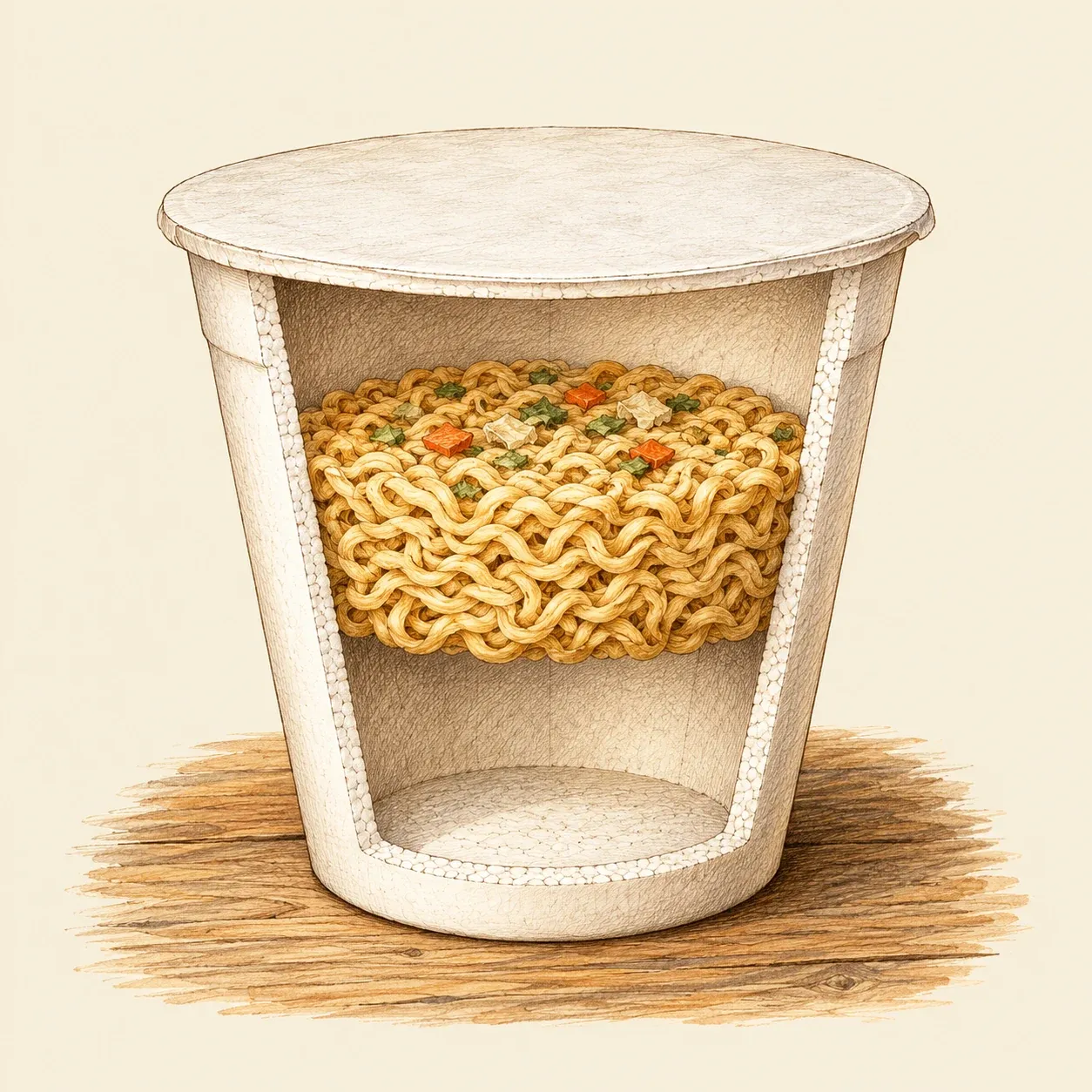 In a cup of noodles the block is wedged halfway up, with space left below it.
Cup Noodles went on sale in Japan on 18 September 1971, in a cup of expanded polystyrene, which is light and keeps heat in. The noodle block was made wider than the bottom of the cup so that it stayed wedged in the middle, held firm in transport, with room left to swell. Filling the cups was difficult until the factory turned the process upside down: the cup was lowered over the block and the two were then turned over together. The cup reached the United States in 1973.
Instant noodles then spread across Asia and far beyond, and they are now made and eaten all over the world. Makers also developed noodles dried in hot air, which hold far less fat, and kept improving how both kinds dry and soften. In July 2005, a version with thickened soup and bite-size noodles, made for weightlessness, went into orbit on the space shuttle Discovery.