Biodiesel
Vegetable oil turned into a fuel for diesel engines
Contents
- 1Oilseed: rapeseed pods and seeds
- 2Vegetable oil
- 3Upper layer: fatty acid esters, the biodiesel
- 4Lower layer: glycerol
- 5Diesel engine
Biodiesel is a fuel for diesel engines made from vegetable oils or animal fats. An alcohol, usually methanol, splits each fat molecule into three thinner molecules, fatty acid esters, and frees the glycerol that held them together. The Belgian chemist Georges Chavanne patented the use of such esters as fuel in 1937, and a bus ran on them between Brussels and Leuven the following year.
What it is
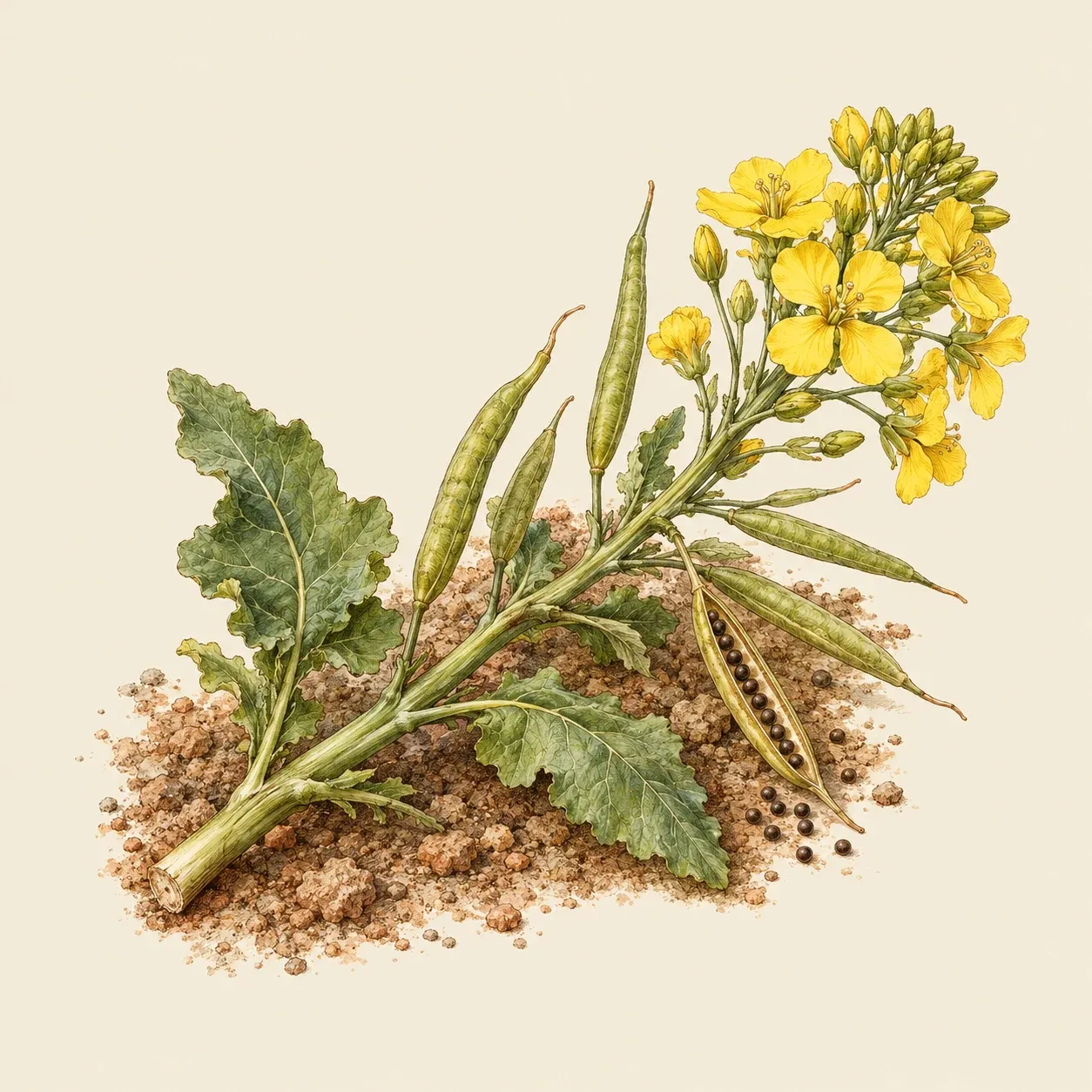 Rapeseed, the oil plant most used for biodiesel in Europe.
Biodiesel is a liquid fuel made from fats: vegetable oils such as soybean, rapeseed or palm oil, animal fats, or used cooking oil. It replaces petroleum diesel in diesel engines, either on its own or blended with it. Each country has tended to use the oil it grows most: soybean oil in the United States, rapeseed oil in Europe.
A vegetable oil can run a diesel engine, but it is too thick to be sprayed finely by the injectors, and it leaves deposits that end up choking the engine. To make biodiesel, the oil is reacted with an alcohol, usually methanol, in the presence of a catalyst. Its large molecules split into smaller ones, fatty acid esters, which flow almost like diesel, and the reaction releases glycerol as a by-product. Renewable diesel, made by treating oils with hydrogen, is a different fuel, chemically the same as petroleum diesel.
Making biodiesel is chemical processing and belongs in licensed plants run by trained staff. Methanol is highly flammable, burns with an almost invisible flame and is toxic when breathed in, swallowed or absorbed through the skin. The catalysts are corrosive and burn the skin and eyes. A review by the UK Health and Safety Executive reports plants destroyed by fire, one after a methanol spill, and two fatal accidents: a fire while biodiesel was pumped from a road tanker, and an explosion while a man was welding on a tank that held biodiesel. Never mix or heat these chemicals at home, and never pour home-made fuel into an engine.
How it works
Oils and fats are made of triglycerides. Each molecule is a small glycerol unit carrying three long chains of fatty acids, and molecules of that size make the oil viscous. In a diesel engine, fuel is sprayed into air heated by compression and must break into a fine mist to burn completely. A thick oil sprays in coarse drops, burns badly and leaves carbon on the injector nozzles.
In the reaction used to make biodiesel, called transesterification, the alcohol takes the place of the glycerol. Each of the three chains comes away as a separate ester, much smaller and thinner than the original molecule, and the glycerol is set free. With methanol the product is a mixture of fatty acid methyl esters; with ethanol, as in Chavanne’s patent, of ethyl esters.
Glycerol and the esters do not mix. Glycerol is the denser of the two, so it forms a lower layer under the esters. Left in the fuel, even traces of glycerol, alcohol or catalyst harm engines. Glycerol has other uses and is sold on, for example to make cosmetics.
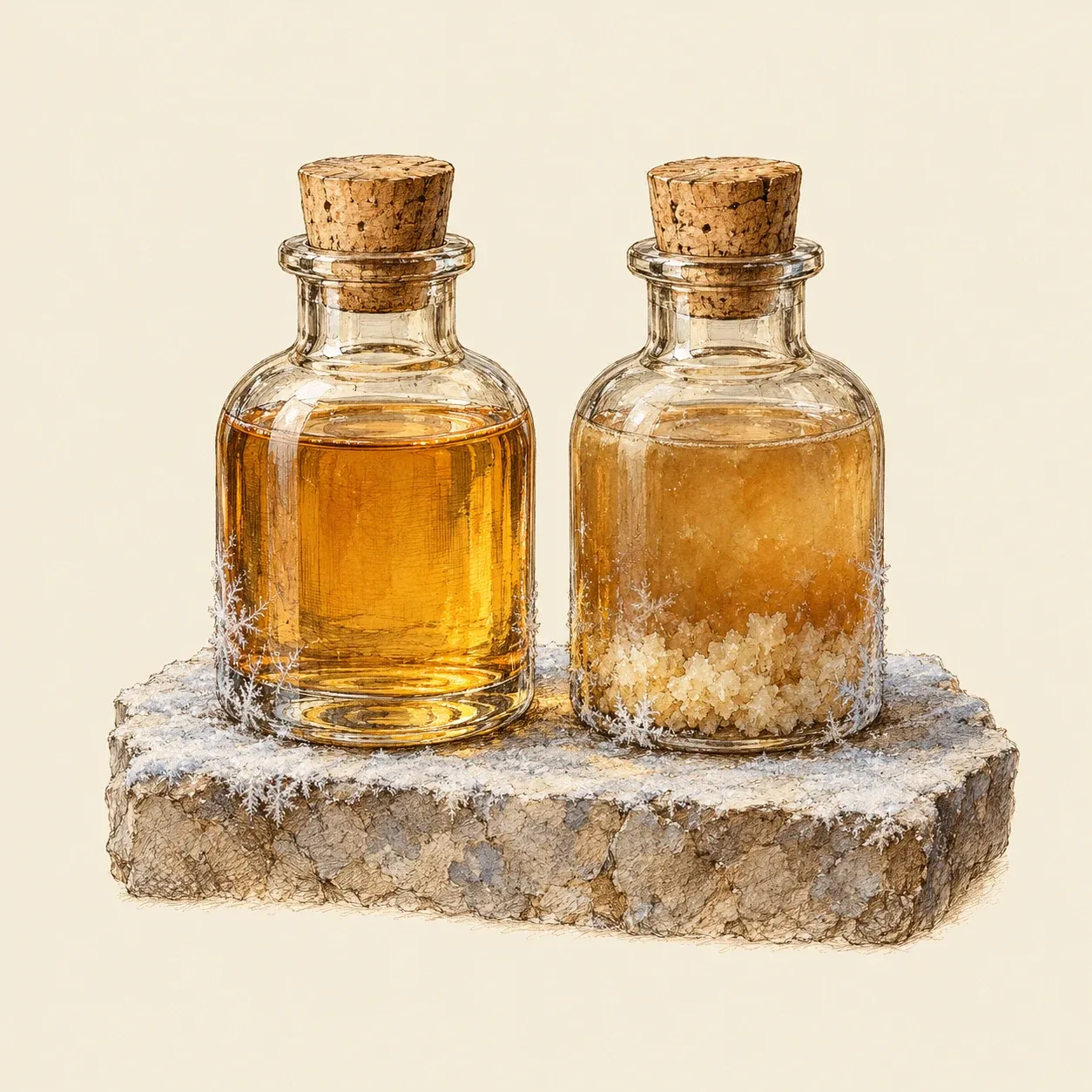 In the cold, biodiesel turns cloudy as crystals form, earlier than petroleum diesel.
Fuel sold as biodiesel must meet a standard. In the United States, ASTM D6751 defines the fuel and sets limits on the glycerol and methanol left in it. Biodiesel also behaves differently in the cold: crystals start to form in it at a higher temperature than in petroleum diesel, and in winter they can block fuel filters. The temperature at which the fuel first turns cloudy is called its cloud point; at a lower one, the pour point, it stops flowing. Engine makers recommend that the cloud point stay below the temperature at which the fuel will be used, so a fuel for winter needs a lower one.
History and evolution
Vegetable oils were tried in diesel engines from the engine’s early years, and Rudolf Diesel himself experimented with them. In the 1930s and 1940s, interest grew in countries with tropical colonies that produced oil but had no petroleum, Belgium among them with the palm oil of the Belgian Congo. Raw oils caused trouble because of their thickness and their tendency to leave deposits.
On 31 August 1937 Georges Chavanne, a professor of chemistry at the University of Brussels, was granted Belgian patent 422,877 for a process that made vegetable oils usable as fuel. It replaced the glycerol of the oil with a short alcohol, ethanol or methanol, and described in particular the ethyl esters of palm oil. It is the earliest known description of what is now called biodiesel.
 In 1938 a bus running on palm oil esters carried passengers between Brussels and Leuven.
In the summer of 1938 a bus fuelled with ethyl esters of palm oil carried passengers on a regular line between Brussels and Leuven. The report on the trial, published in 1942, found that the bus ran satisfactorily. The war, then cheap petroleum, ended this early work.
The idea returned late in the twentieth century. In Austria, pilot plants in Styria turned rapeseed oil into methyl ester, and small production sites followed. In the United States, soybean oil became the main raw material, and ASTM D6751 gave the fuel a legal definition. Biodiesel is now blended into diesel fuel in many countries.