Internal Combustion Engine
Small explosions, steady power
Plate
- 1Intake valve
- 2Exhaust valve
- 3Spark plug
- 4Piston
- 5Connecting rod
- 6Crankshaft
- 7Flywheel
Anatomy
Loading the figure…
An internal combustion engine burns fuel inside a closed cylinder and lets the hot gas push a piston, which turns a crankshaft. Nicolaus Otto's four-stroke gas engine of 1876 set the pattern still used in most car, boat and generator engines.
What it is
An internal combustion engine makes heat inside the machine itself. A steam engine burns its fuel under a separate boiler and sends steam to the cylinder. Here a small charge of fuel and air burns in the cylinder, and the gas it produces pushes directly on a piston.
The engine on this plate is a single upright cylinder of the kind built in the 1880s and 1890s: a cast-iron cylinder with cooling fins, a piston sliding inside it, a crankshaft below and a heavy flywheel to carry the shaft round between firings. Modern car engines have several cylinders and lighter alloys, but they still turn the push on a piston into rotation through a connecting rod and a crankshaft.
How it works
The piston is a close-fitting plug that slides up and down in the cylinder. A connecting rod joins it to a crank on the crankshaft, so the back-and-forth motion of the piston becomes rotation, the same way a cyclist’s knees turn the pedals.
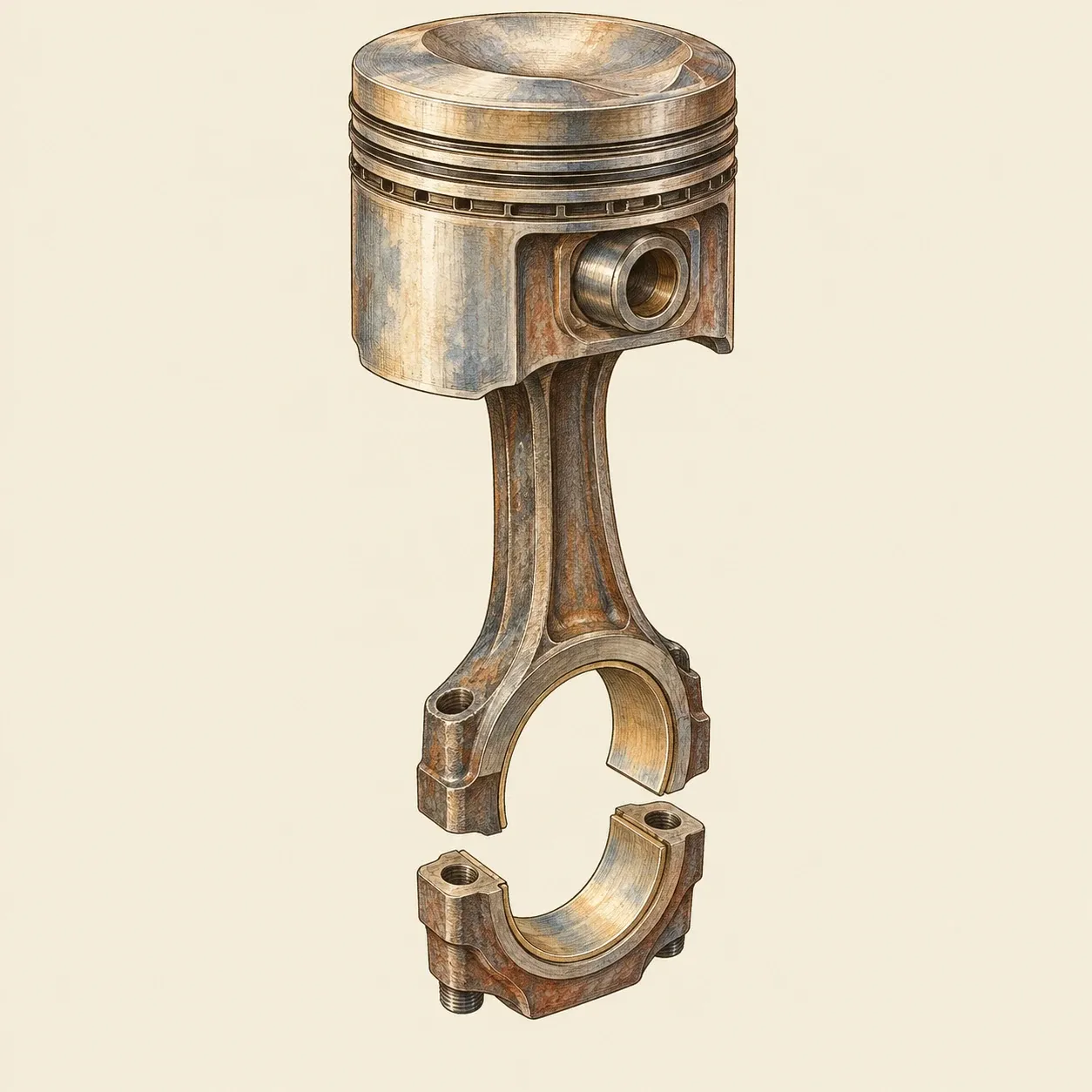 Springy rings in grooves round the piston seal it against the cylinder wall.
Most engines follow the four-stroke cycle that Otto made practical. In a spark-ignition engine like the one drawn here, it runs as follows. In the first stroke the piston moves down with the intake valve open and draws in a mixture of air and fuel. In the second, both valves are shut and the piston rises, squeezing the mixture into a small space at the top. Near the top a spark (or, in early engines, a flame or a glowing tube) ignites it. The gas heats up very quickly and drives the piston down: this third stroke is the only one that delivers work. In the fourth the exhaust valve opens and the rising piston pushes out the burnt gas.
The crankshaft turns twice for each power stroke, and the flywheel stores enough energy to carry it through the other three strokes. A camshaft geared to turn at half the crankshaft’s speed opens each valve at the right moment.
Compression is what made Otto’s engine better than its rivals. A charge squeezed before it burns releases its heat at a higher pressure, so more of that heat turns into work. Rudolf Diesel pushed the idea further in the 1890s: he compressed air alone until it was hot enough to ignite fuel sprayed into it, with no spark at all.
How to build it
A working engine is precision work. It needs a foundry, a lathe and a boring machine, measuring tools that read to a hundredth of a millimetre, and a reliable fuel. What follows describes how the parts were made historically. It is not a plan for building one.
Cast the cylinder and frame. Early makers cast the cylinder and base in grey iron, which machines well and resists wear. The cylinder was then bored perfectly round and straight. The water jacket or cooling fins were cast in the same piece.
Make the piston and rings. The piston was cast iron, later aluminium, turned slightly smaller than the bore. Split rings of springy iron sit in grooves round it and press outwards against the wall, so the gas cannot leak past.
Forge the crankshaft and rod. These carry the hardest loads and were forged in steel, then turned and fitted with bearings of bronze or white metal.
Time the valves and ignition. The cams, and later the magneto or coil that makes the spark, have to act at the right point in the cycle. A fault here makes the engine run badly or kick back.
Feed it fuel and cool it. Otto’s engines ran on town gas. Petrol engines needed a carburettor to mix fuel and air in the right proportion. Every engine needs cooling by water or air, and oil to keep the moving parts from seizing.
Safety. Fuel and its vapour catch fire easily and can explode in a closed space. Exhaust contains carbon monoxide, which kills without smell or warning: never run an engine indoors or in a partly enclosed space, even with doors and windows open. The flywheel, belts and starting handle can break bones, and a kickback during hand starting can cause serious injury. Hot parts and cooling water under pressure cause burns.
History and evolution
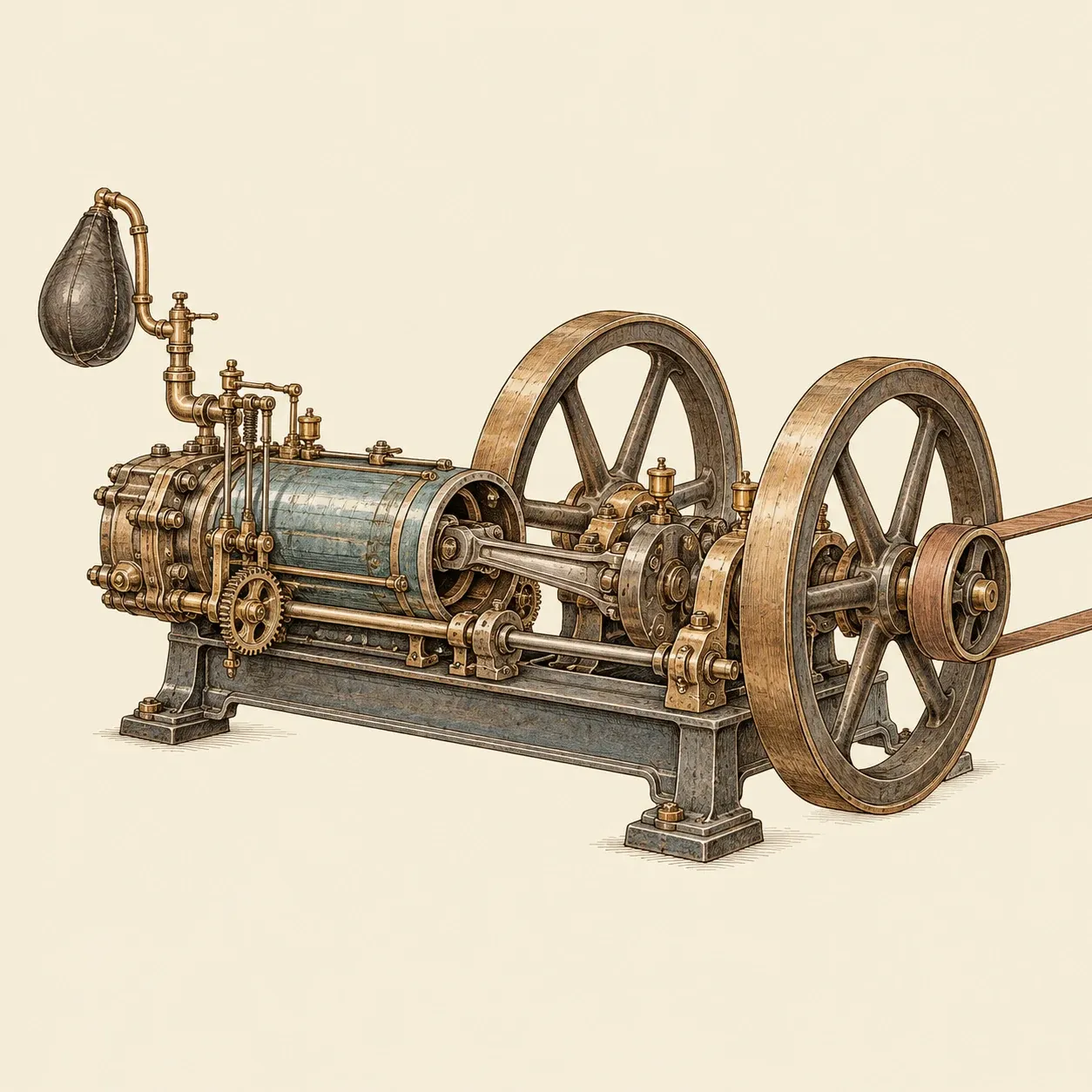 Stationary gas engines like this one drove workshop machinery before motor vehicles became common.
People had tried for two centuries to drive a piston with an explosion. Christiaan Huygens experimented with gunpowder in the 1670s, and in 1807 the Swiss inventor François Isaac de Rivaz patented a hydrogen engine, which he later fitted to a small cart. The first engine sold in numbers was Étienne Lenoir’s gas engine of 1860. It looked like a double-acting steam engine, but it burned the mixture without compressing it and wasted most of its fuel.
Nicolaus Otto, a travelling salesman from Cologne, had a local mechanic, Michael Zons, build him an engine on Lenoir’s pattern in 1861 so that he could study it. With the engineer Eugen Langen he built an “atmospheric” engine that won a gold medal at the Paris Exhibition of 1867. Several thousand were built. In 1876 Otto built his four-stroke engine with compression. The Frenchman Alphonse Beau de Rochas had described the same cycle in an 1862 pamphlet, and in 1886 Otto’s German patent was annulled on that ground, leaving other firms free to build the design.
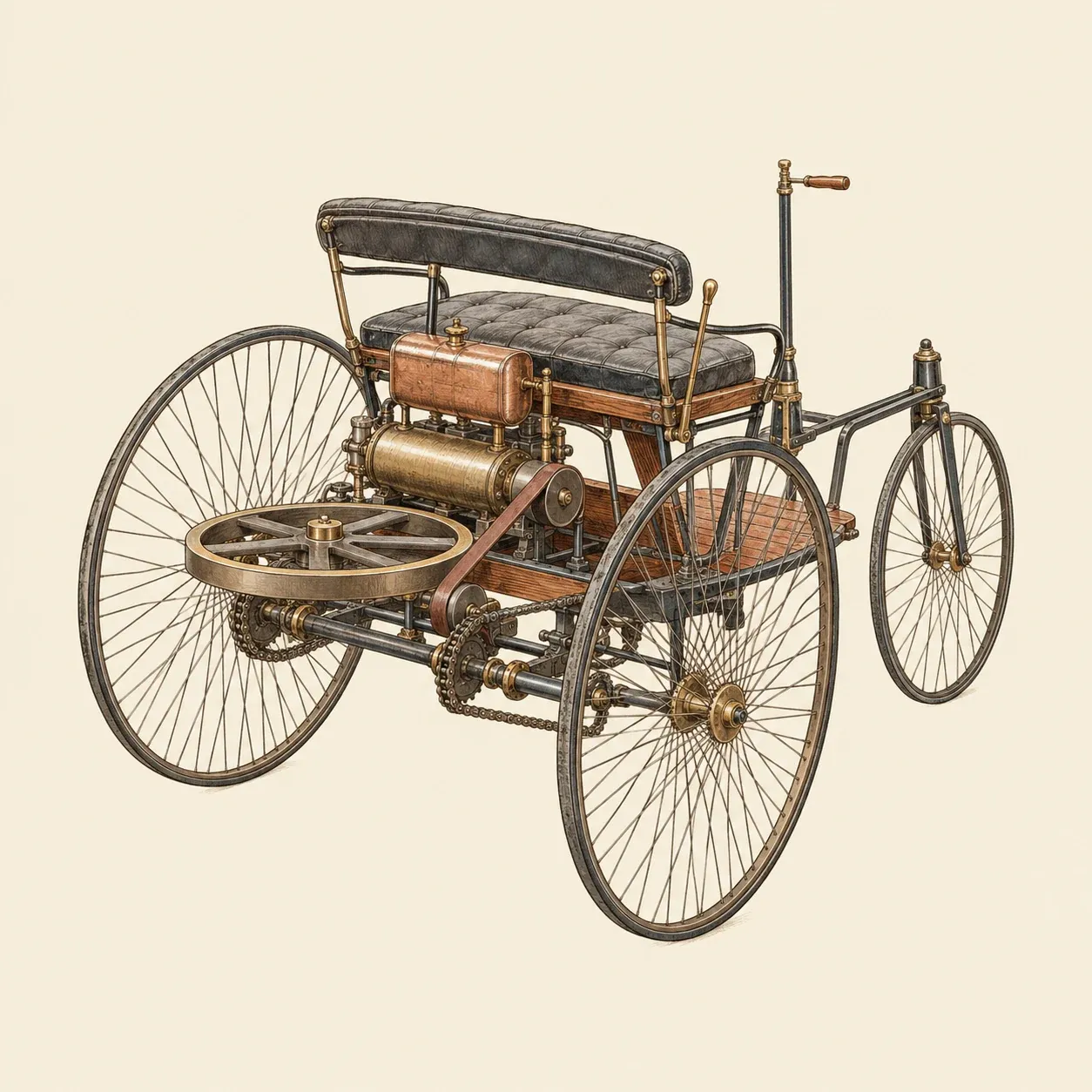 Benz’s car used a single-cylinder four-stroke engine of under one litre.
Gottlieb Daimler and Wilhelm Maybach, who had both worked for Otto’s company, built a small fast engine in 1885 that turned several hundred times a minute. That made engines light enough for vehicles. The same year Carl Benz completed his three-wheeled motor car and filed the patent for it in January 1886.
Diesel’s engine reached 26.2% efficiency in a test at Augsburg in 1897, more than twice what the steam engines of the time managed. In the twentieth century internal combustion engines took over road transport, farming, shipping and the first aircraft. Electric motors are replacing them in many cars, yet most combustion engines built today still use the four-stroke sequence Otto put to work in 1876.