Telephone
A voice carried down a wire
Plate
- 1Mouthpiece and earpiece
- 2Iron diaphragm
- 3Coil
- 4Bar magnet
- 5Terminals
- 6Line wire
Anatomy
Loading the figure…
A telephone turns the vibrations of the voice into a varying electric current, sends it along a wire, and turns it back into sound at the other end. Alexander Graham Bell patented it in March 1876; within two years Bell's magnet telephones were in commercial use, and carbon microphones and exchanges soon made it a public service.
What it is
A telephone carries the voice itself along a pair of wires. A transmitter turns the pressure waves of the voice into an electric current whose strength rises and falls in the same pattern; a receiver at the other end uses that current to move a thin plate and recreate the sound.
The plate shows one of Bell’s hand telephones of 1877 and 1878, a turned wooden instrument nicknamed the butterstamp. The same instrument served for speaking and listening, and it worked without a battery: the voice itself produced the current.
How it works
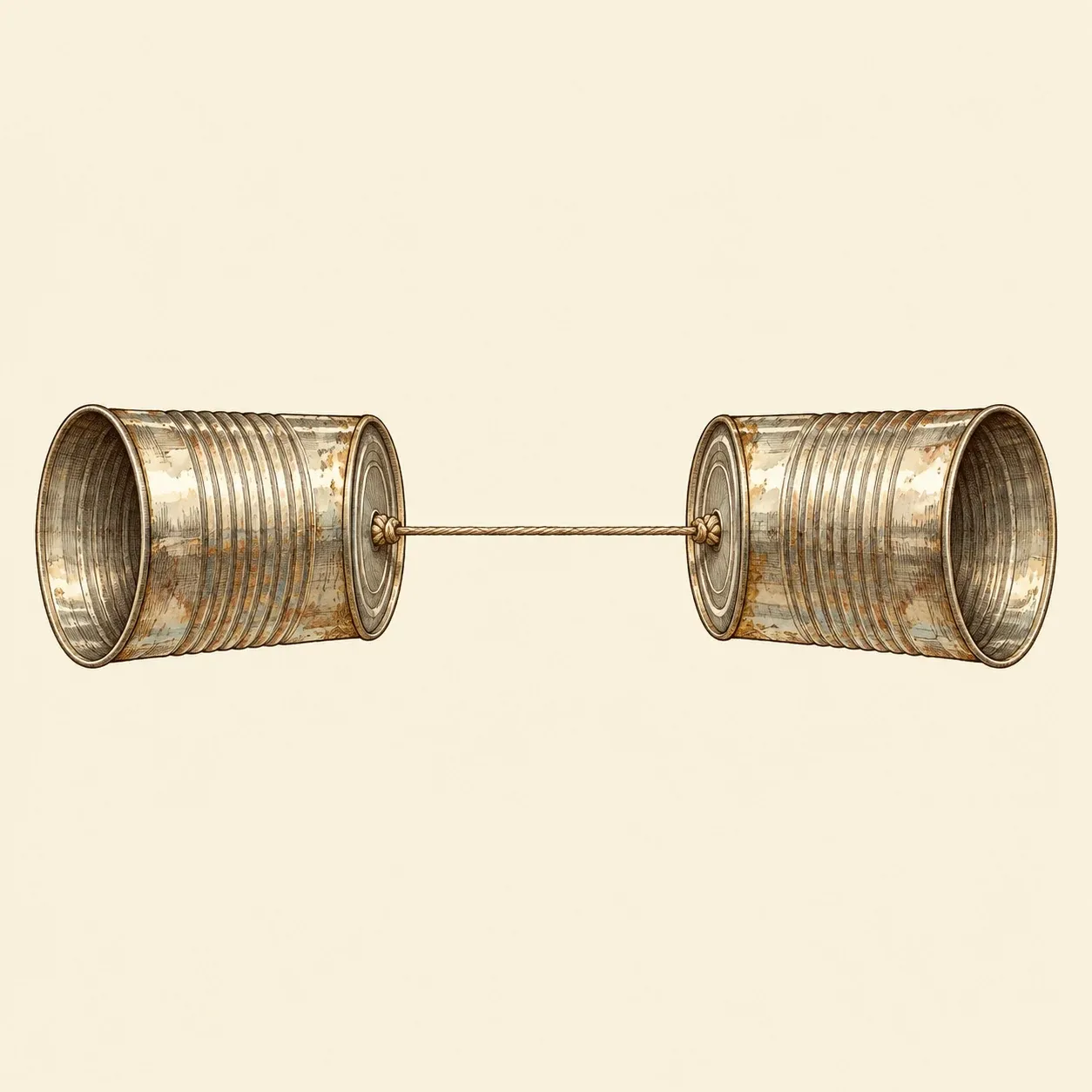 A string telephone carries sound mechanically: the voice shakes one can’s bottom, and the taut string shakes the other.
Inside the wooden case of the butterstamp, a steel bar magnet runs the length of the handle. At its front end sits a short soft-iron pole piece wound with a coil of fine insulated copper wire. Just in front of the pole, separated from it by a gap a fraction of a millimetre wide, is a thin disc of iron, the diaphragm, clamped at its edge behind the mouthpiece. The two ends of the coil come out to terminals at the back, and from there a pair of wires runs to the other telephone.
When someone speaks into the mouthpiece, the air pressure on the diaphragm rises and falls, and the disc bends in and out by a tiny amount. Each time it comes closer to the pole, more of the magnet’s field passes through the iron; each time it moves away, less. A changing magnetic field through a coil produces a voltage in it, so the coil sends along the line a small alternating current that follows the shape of the sound wave.
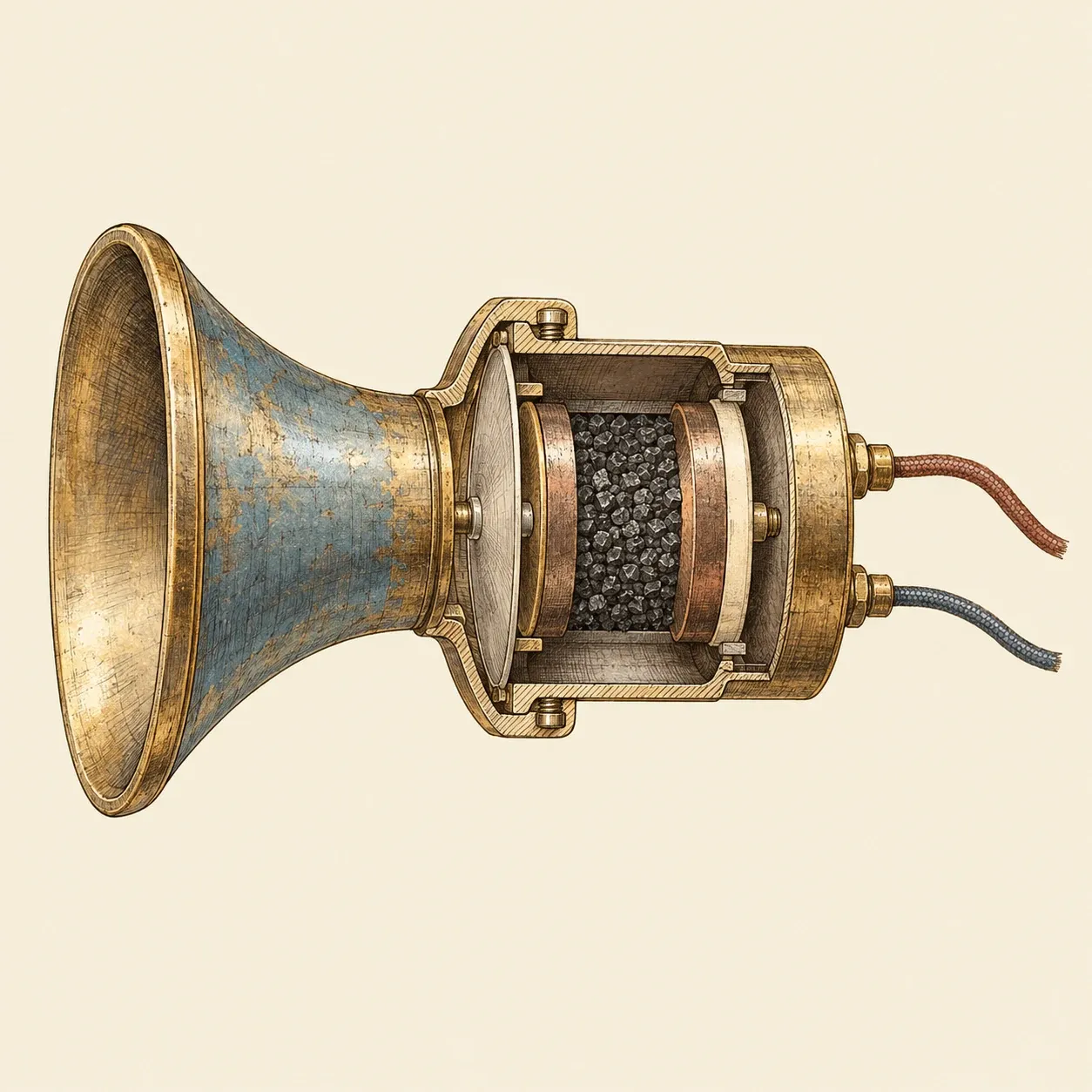 In the carbon transmitter, the diaphragm squeezes a cell of carbon granules, so the current from a battery rises and falls with the voice.
At the far end the same current flows through the coil of the second telephone. It adds to or subtracts from the pull of the permanent magnet on that instrument’s diaphragm, which therefore moves in step with the speaker’s diaphragm and sets the air in front of it vibrating. The energy comes entirely from the voice, so the sound is faint and the range short. From the late 1870s, telephones added a carbon transmitter: the diaphragm presses on carbon, whose electrical resistance falls as it is squeezed, so the current from a battery is varied by the voice instead of being made by it. That gave a much louder signal.
How to build it
Two small loudspeakers show the same principle, the reversible link between sound, movement and current. They are built differently from Bell’s instrument: in a loudspeaker the coil is fixed to the cone and moves with it in the field of a magnet, whereas in the butterstamp the coil and magnet stay still and only the iron diaphragm moves. Wired together, two loudspeakers make a telephone with no battery.
Gather the parts. You need two small loudspeakers of the same kind, 8 ohms, 5 to 8 cm across, bought loose or taken from battery-powered toys with the batteries removed (never take them out of radios or other mains-powered sets, even unplugged: some parts stay charged), and a few metres of twin bell wire or speaker cable.
Wire them. Strip a centimetre of insulation from each end of the cable. Connect one wire to the first terminal of each speaker and the other wire to the second terminal of each, either with screw terminals or by twisting and taping the joints.
Talk. Start with a short cable, then run it between two rooms with the door closed, so that your partner cannot hear you directly. Speak loudly and close into one cone while your partner holds the other speaker to an ear; then disconnect one wire and try again to check that the sound comes through the line. Expect a faint voice; results vary with the speakers, so if nothing comes through, try a shorter cable or speakers of another size. Swap roles: each speaker works as both transmitter and receiver, as the butterstamp did.
Compare. Make a string telephone too, with two cans or paper cups and a few metres of string knotted through a hole in each bottom. Keep the string taut and away from obstacles, and compare the two.
Safety. This circuit needs no battery and must never be connected to mains electricity or to a telephone line, both of which carry dangerous voltages. Open cans have sharp edges, so file or tape them. Do not shout directly into someone’s ear through either telephone.
History and evolution
Several people worked on sending speech electrically before Bell. In 1861 Philipp Reis demonstrated an instrument in Frankfurt and gave it the name telephone, but it remained a curiosity. Antonio Meucci filed a caveat for a “sound telegraph” in 1871 and let it lapse in 1874; his claim to priority is still argued.
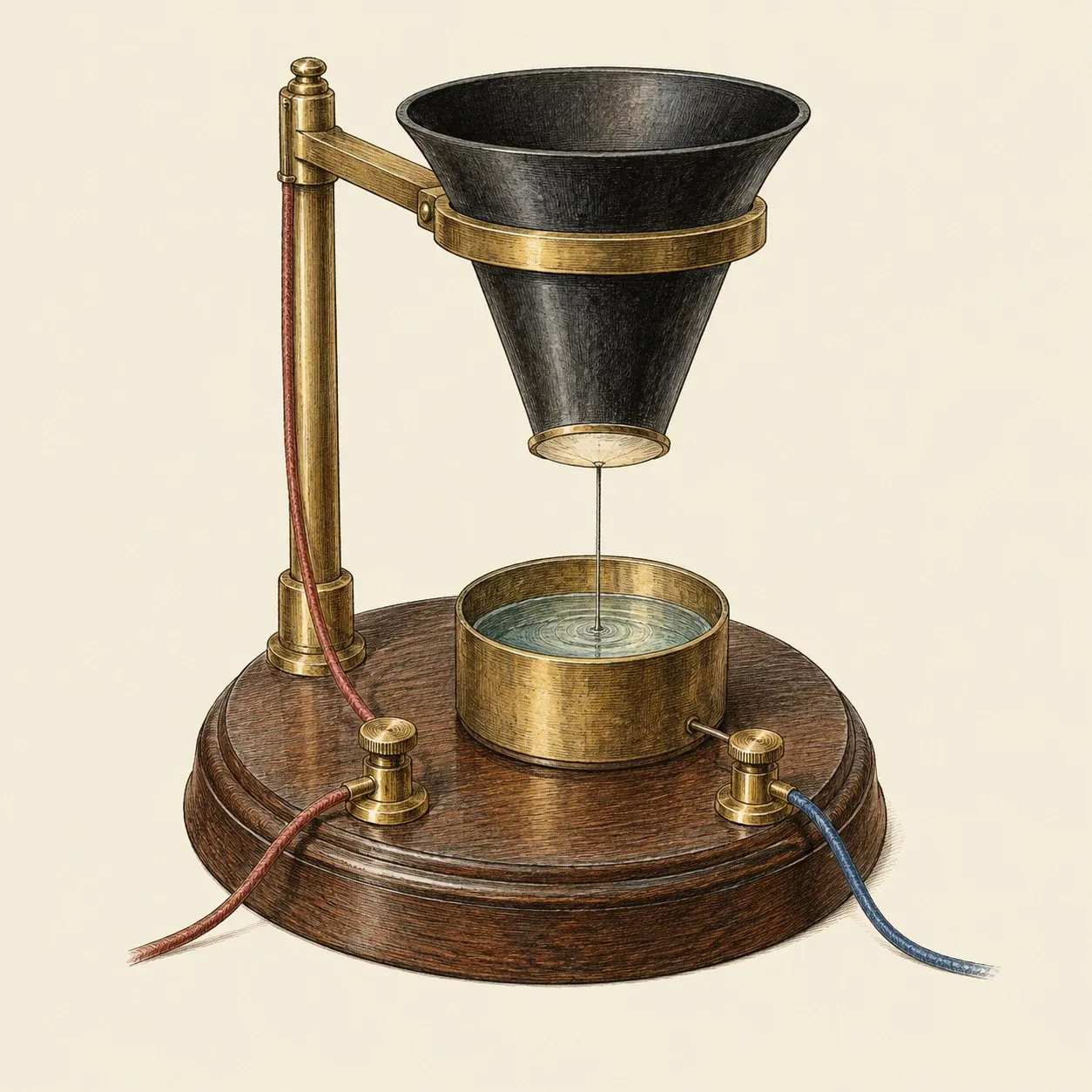 Bell’s liquid transmitter of March 1876: the voice shakes the membrane, the wire dips more or less deeply into acidified water, and the current varies.
Bell, then working in Boston, filed his patent application on 14 February 1876, the same day Elisha Gray filed a caveat describing a similar idea, and which of the two arrived first is disputed. Patent 174,465 was issued on 7 March. Three days later, with a liquid transmitter, Bell spoke his first clearly intelligible sentence to his assistant Thomas Watson. He soon abandoned the liquid transmitter for the magnet telephone, patented on 30 January 1877. On 12 February 1877 a speaker in Boston was heard by an audience in Salem, about 26 km away.
Thomas Edison devised a carbon transmitter in 1877, and Henry Hunnings in England used loose carbon granules. The first commercial exchange opened in New Haven, Connecticut, on 28 January 1878, with 21 subscribers connected by hand at a switchboard. Almon Strowger’s automatic exchanges later let subscribers make their own connections, and from 1896 a numbered dial made that easier. By the 1950s the United States had more than half of the world’s telephones.