Bagh chal
Four tigers hunting twenty goats
Contents
- 1Grid of 5 × 5 points with its diagonals
- 2Centre point, where four lines cross
- 3Tiger on a corner point
- 4Goat
- 5Tiger jumping over a goat to the empty point beyond
- 6Goats hemming in a tiger
Bagh chal, the tiger's move, is a hunt game from Nepal for two unequal sides: four tigers against twenty goats on a grid of 5 by 5 points joined by straight and diagonal lines. A tiger captures by jumping over a goat, and the goats win by hemming in all four tigers. The oldest dated description was written down in 1933 by the zoologist Sunder Lal Hora, from an old man of Nepali origin in the Teesta valley below Darjeeling.
What it is
Bagh chal is a board game for two players with unequal forces: one has four tigers, the other twenty goats. The name is Nepali, bagh meaning tiger and chal a move. The board is a square grid of five lines by five, which cross at 25 points, and some of the points are also joined by diagonal lines: the two long diagonals of the square and a diamond that links the middles of its four sides. The pieces stand on the points and move along the lines.
The tigers try to eat goats by jumping over them. The goats cannot capture anything; they win by crowding the tigers until none of them can move. Games of this kind, in which many weak pieces try to corner a few strong ones, are called hunt games, and Lim Yew Jin and Jürg Nievergelt compare bagh chal with fox and geese. In 1933 Sunder Lal Hora counted several tiger games in India, with one, two or four tigers against three, twelve, twenty or twenty-four goats, each with its own rules. Unlike mancala, where seeds are sown into pits, bagh chal moves pieces from point to point along lines, as nine men’s morris does.
How it works
The four tigers start on the four corners. The goat player moves first. As long as goats remain in hand, each goat turn places one new goat on any empty point, and the goats already on the board must stay where they are. On each of their turns the tiger player moves one tiger, either sliding it along a line to a neighbouring empty point or jumping in a straight line, along a line of the board, over a single neighbouring goat to the empty point just beyond. The goat jumped over is eaten and leaves the board. Only one goat may be taken in a turn.
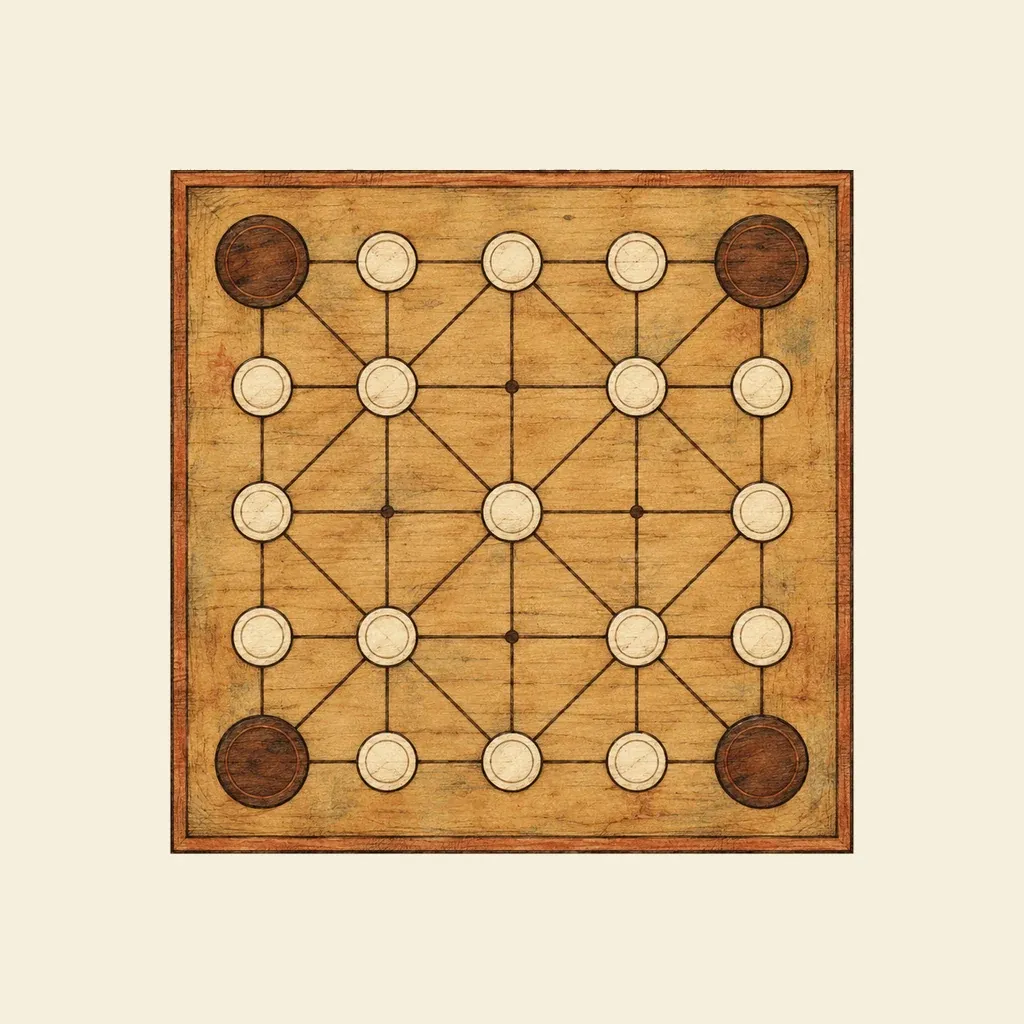 Hemmed in at the corners, no tiger has a move left, and the goats win.
Once the twentieth goat has been placed, even if some have already been eaten, the goats move too, one step along a line to an empty neighbouring point. A goat never jumps. It is in danger only when a tiger stands next to it and the point on the far side, on the same line, is empty, so the goats advance as a compact herd, filling the edges and corners and leaving the tigers no gaps to land in. The tigers usually win once they have eaten five goats, while in the rules recorded by Hora in 1933 and by the games writer David Parlett in 1976 they had to eat every goat. The goats win when no tiger has a legal move. In the rules analysed by Lim Yew Jin and Jürg Nievergelt, the goats also lose if they cannot move on their turn, which can only happen when the tigers seal off a corner of a crowded board. In 2009 these two computer scientists reported that, with the five-goat rule, the game is a draw if both sides play perfectly. Cameron Cheung, at Berkeley, reached the same result in 2023.
How to do it
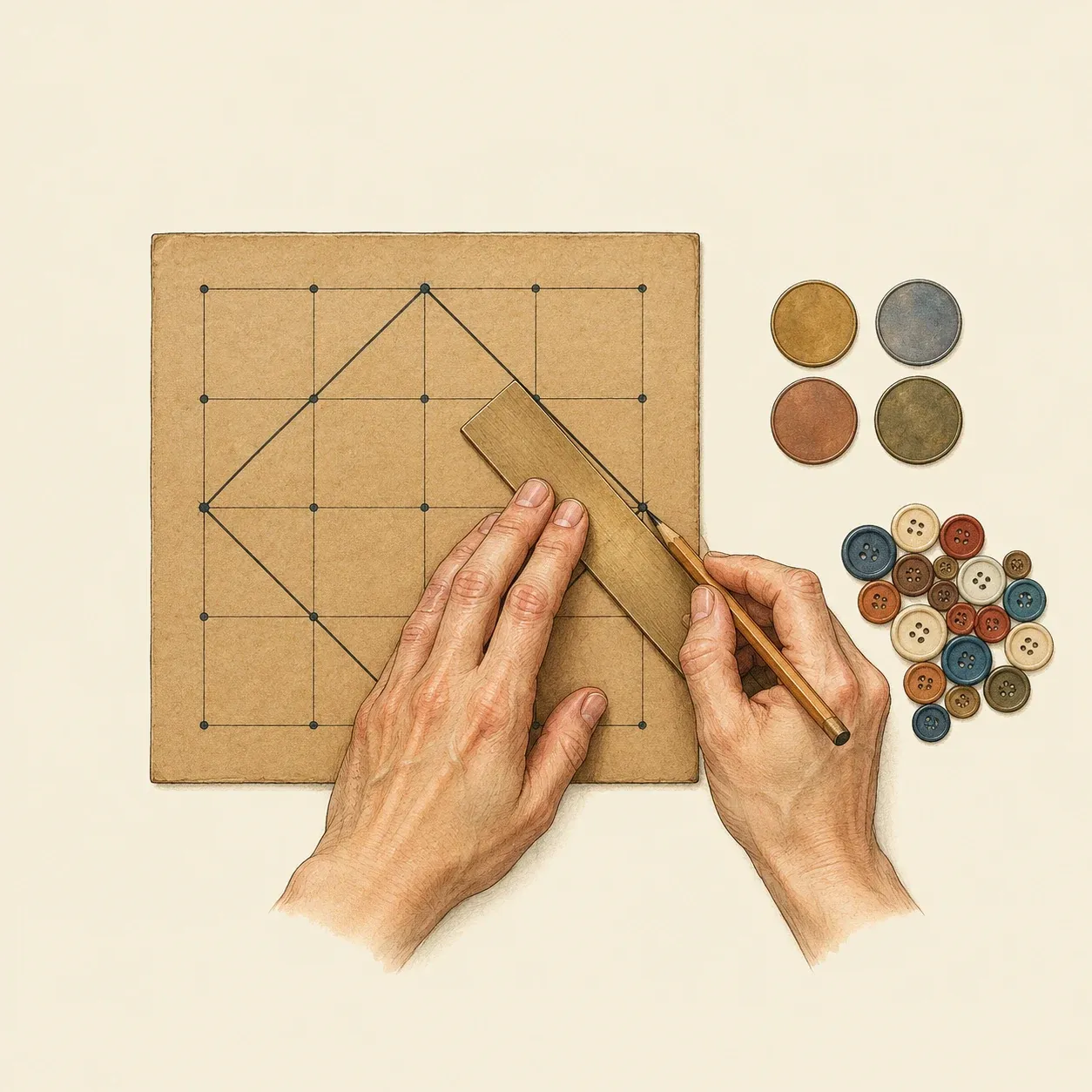 The grid comes first, then the long diagonals and the diamond that joins the middles of the sides.
Take a square of stiff card or a thin plank about 25 cm on a side. Draw a square 20 cm wide in the middle and mark every 5 cm along its sides. Join the marks on opposite sides with straight lines, which gives five lines each way and 25 points. Draw the two long diagonals from corner to corner through the centre. Then join the middles of the four sides with four lines that form a diamond; each of them passes through a grid point halfway along. The corners, the centre, the middles of the sides and the points halfway between centre and corners now carry diagonal lines, while the other points connect only along the straight lines. Go over the lines in ink or paint.
The four tigers must look different from the goats: use coins, large dark pebbles or bottle caps for the tigers and buttons, small pebbles or dried beans for the twenty goats. Each piece should sit on a point without touching the pieces on the neighbouring points, so keep them under about 3.5 cm across. Sets sold in Nepal are cast in brass, with small figures of tigers and goats, but the grid can just as well be scratched on the ground and played with stones.
To play, set the tigers on the corners and keep the goats in hand. The goat player starts by placing one goat on an empty point, and the players then take turns. A tiger moves one step along a line or jumps over one goat to the empty point behind it, taking that goat. The goats are placed one per turn until the twentieth is down, even if some have been eaten, and only then begin to move, one step at a time. Agree before starting whether the tigers win with five goats eaten or must eat them all. The goats win as soon as the tigers are stuck, and lose if none of them can move.
Safety: when cutting the card with a craft knife, work on a cutting board and draw the blade away from the hand that holds the ruler. Buttons, beans and small pebbles can choke a young child, so keep the set out of reach of small children.
History and evolution
The historian Tri Ratna Manandhar, of Tribhuvan University in Kathmandu, told the Kathmandu Post in 2021 that he had never seen the game mentioned in historical texts; it has been passed on by imitation and by word of mouth. The oldest dated description comes from the zoologist Sunder Lal Hora. In April 1933, on a survey in the Teesta valley below Darjeeling, he had three local games explained to him by an old man of Nepali origin, and a friend in Kalimpong checked his account with other workers there. One of them was called Bhagchal, Bhagchakar or Chakrachal: four tigers began on the corners and twenty goats were brought on one by one, none of them moving until all were placed. Hora published the account in the Journal of the Asiatic Society of Bengal the same year.
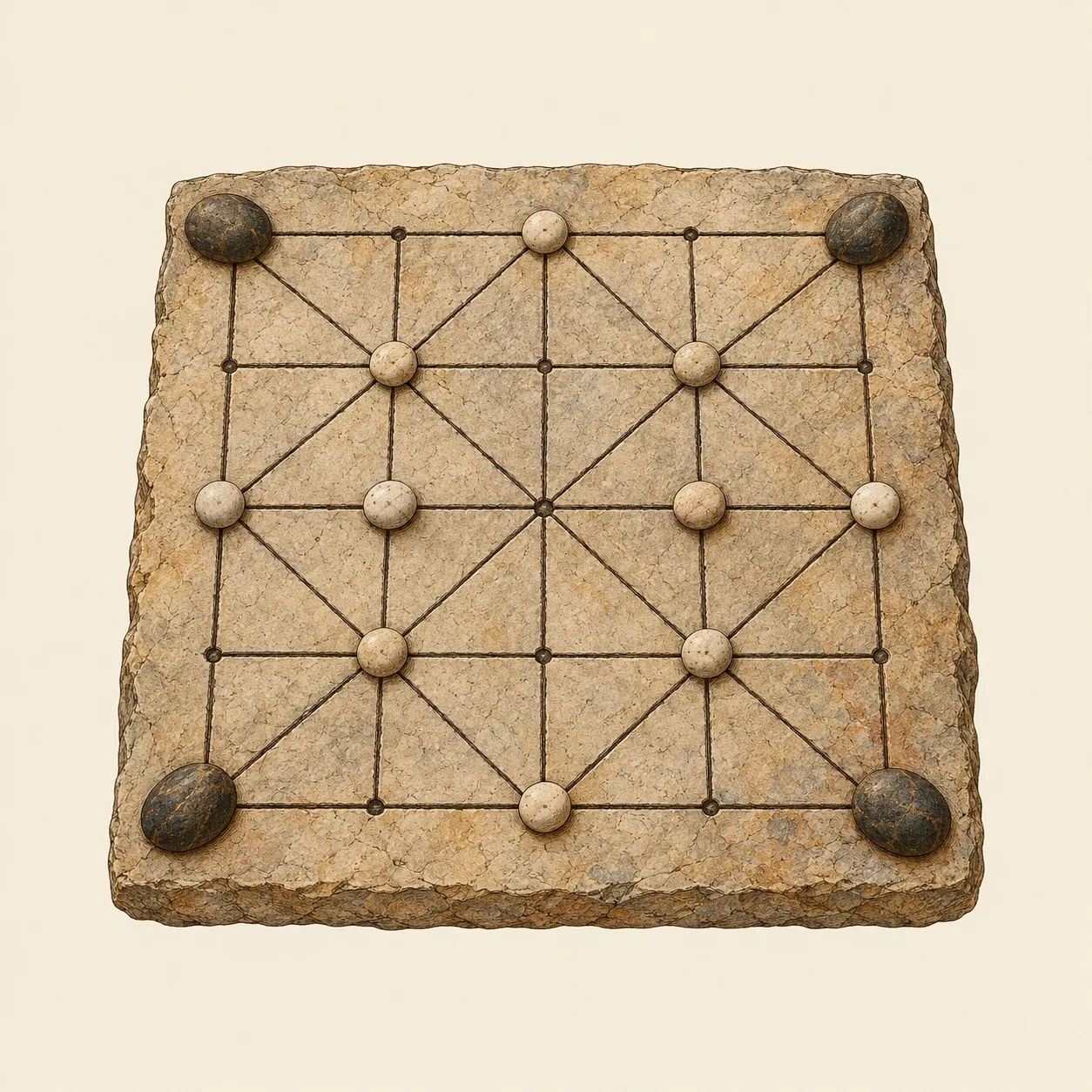 A board scratched on a stone slab, with stones for tigers and pebbles for goats.
The board is older than these records. A grid of five by five points with the same diagonals is the board of alquerque, whose rules appear in the Libro de los juegos made for King Alfonso X of Castile in 1283; there each player has twelve pieces, which capture by jumping, and no dice are used. In India, hunt-game boards are scratched into temple floors. The Ancient Indian Boardgames documentation project records one cut into the basalt floor of the Kailasa temple at Ellora, beside a row of fire altars. The temple was carved in the reign of Krishna I, between 756 and 774, but the carving itself bears no date, and its layout resembles a board from Orissa used for one tiger against twelve goats. In the 1920s Hem Chandra Das-Gupta described tiger games from Orissa and from the Central Provinces, among them kaooa, played by one tiger against seven pieces.
In 1976 David Parlett, describing games of the Himalayas, found bagh chal especially popular with Buddhist monks, who played with pebbles on a pattern scratched in the ground. Nepali players still sketch the board on the ground near temples and wayside shelters. A stallholder in Kathmandu told the Kathmandu Post that the brass sets were bought mostly by foreigners, and the paper described a decline of the game after the 1990s, followed by a revival that included a national competition in 2019.