Nine men's morris
Making mills on a board of three squares
Contents
- 1Outer square
- 2Inner square
- 3Line joining the middles of the three squares
- 4Counter standing on a point
- 5Mill: three light counters in a line
- 6Path of a counter to the next empty point
Nine men's morris is a game for two players on a board of three nested squares joined at the middle of their sides, which gives 24 points. Each player places nine counters, then moves them along the lines, and three in a row, called a mill, removes an enemy counter. The oldest dated boards come from the floor of a Buddhist stupa of the 2nd or 3rd century CE in the Swat valley of Pakistan and from a slab reused in a burial of the 3rd or 4th century near Van, in Turkey.
What it is
Nine men’s morris is a board game for two players, each with nine counters of their own colour. The board is made of three squares drawn one inside the other, with four short lines joining the middle of each side of the outer square to the middle of the matching side of the inner one. Counters stand on the 24 points where lines meet or turn a corner, eight on each square. The centre of the board is not used. There are no dice, and as in go the game depends only on the players’ choices.
The aim is to form a mill: three counters of one colour on the same straight line, either along one side of a square or across the three squares on a joining line. Each mill lets its maker take one of the opponent’s counters off the board. A player who is reduced to two counters, or who cannot move, loses. The game is called merels in older English, marelle or jeu du moulin in French, Mühle in German and filetto in Italian. According to Friedrich Berger, merels and marelle come from a Latin word for a counter. In German, the linguist Jonas Richter finds names built on the number nine first. Words built on Mühle, “mill”, appear in a figurative sense in the late 15th century. In 1575 Fickmül may name either the game or only the row of three; Mühlespil, in 1617, clearly names the game.
How it works
The game has two phases. In the first, the players take turns placing one counter on any empty point until both have played all nine, even if some counters have already been taken. In the second, a turn consists of sliding one counter along a line to the next point, if that point is free. A counter never jumps over another and never moves diagonally, since the usual board has no diagonals.
Whenever a placement or a move completes a mill, the player removes one enemy counter, and only one even when a single move closes two mills. Under the rules given by the Viking Ship Museum at Roskilde and by the computer scientist Ralph Gasser, a counter that stands in a mill may not be taken unless every enemy counter is in one, and a removed counter never returns. A mill can be opened by moving one counter out of the line and closed again by moving it back, and each closing counts as a new mill. A favoured position is one in which a single counter can swing between two mills and close one at every turn.
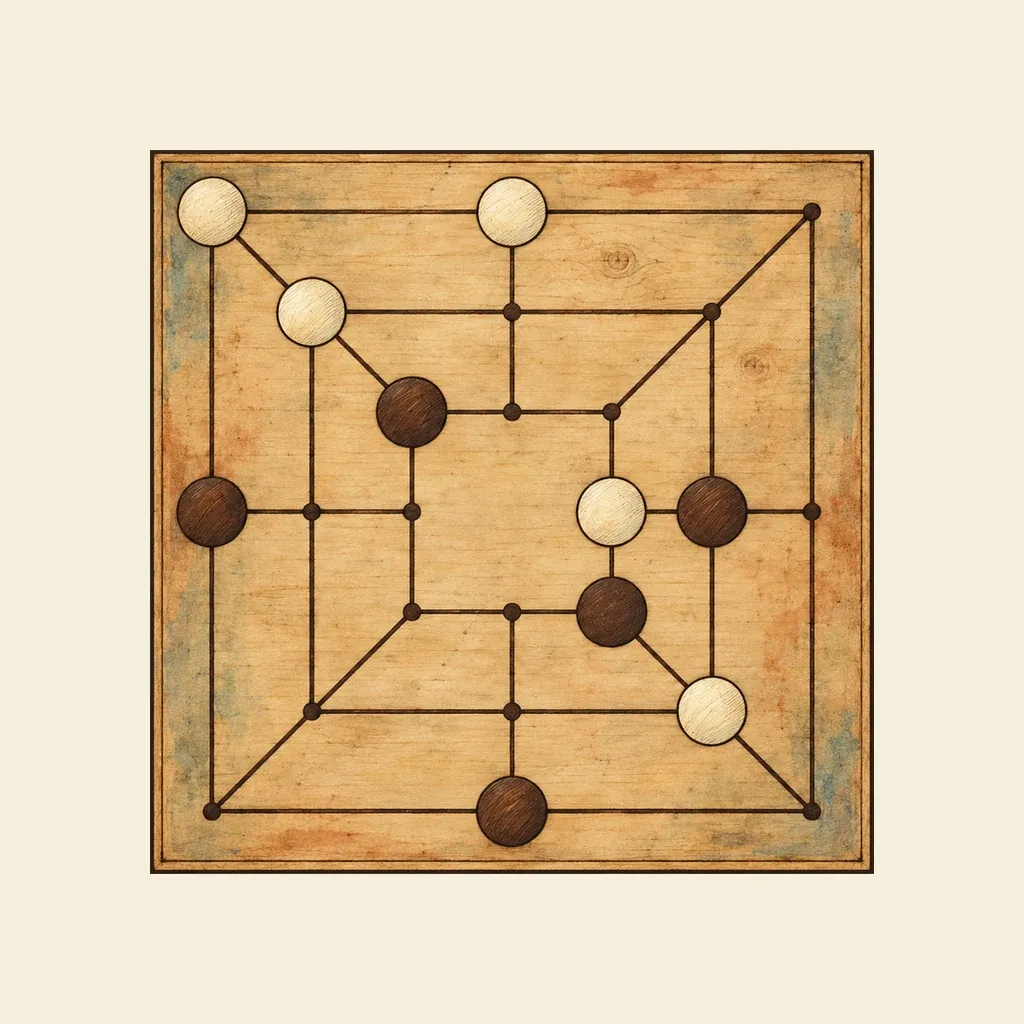 On a board with added diagonals, the counters may also move along the diagonals.
When a player is down to three counters, these may jump to any empty point, which gives the weaker side a chance to make a last mill. The game ends when a player has only two counters left or no legal move. Rules vary from place to place: Berger records games with twelve counters in Morocco, where the last three may not jump, and in New England a player could start jumping with four. On a board with added diagonals, played with eleven or twelve counters each, the counters may also move along the diagonals. Hunt games such as bagh chal use a grid of points too, but give the two sides different pieces and goals.
In 1993 Gasser, then at ETH Zurich, computed about ten billion positions of the middle and end game and searched the opening from the empty board. He showed that with perfect play on both sides the game ends in a draw.
How to do it
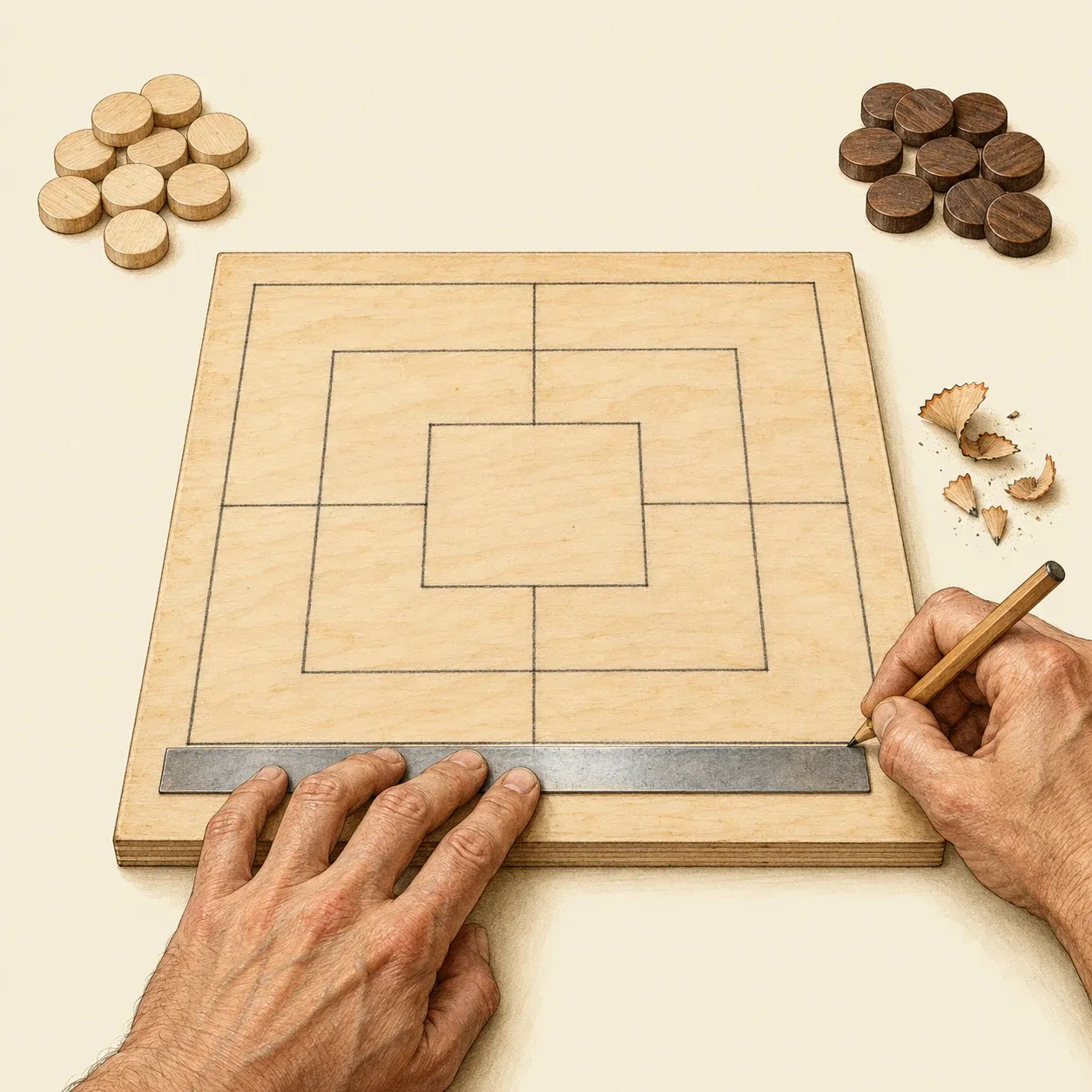 Ruling the board: three squares 4.5 cm apart, joined at the middle of their sides.
A board can be scratched in the earth with a stick, but a flat board lasts longer. Take a square of plywood, hardboard or stiff card about 30 cm on a side and find its centre by drawing the two diagonals lightly in pencil. Draw three squares centred on that point, 27, 18 and 9 cm wide, so that their sides lie 4.5 cm apart. Then draw the four joining lines from the middle of each side of the outer square to the middle of the matching side of the inner square, and stop them there, leaving the inner square empty. Rub out the diagonals, check that there are 24 points, eight on each square, and go over the lines with a fine marker or paint. A dot at each point shows the players where counters go.
Any 18 flat objects of two colours will serve as counters, as long as they are smaller than the 4.5 cm gap between the squares: buttons, coins, pebbles or draughts pieces. Wooden counters can be sawn from a round dowel about 2.5 cm across, in slices about 8 mm thick, then sanded, with half of them painted or stained dark.
To play, decide who starts, then place counters in turn on empty points. Close a mill whenever you can, and block the opponent’s when two of their counters stand on a line with the third point free. Once both players have played all nine counters, move them one step at a time along the lines. Remove one enemy counter each time you close a mill, never two in one turn, and never one that stands in a mill unless there is no other choice. With three counters left you may jump to any empty point, and you lose when you are down to two counters or cannot move.
Safety: clamp the dowel in a vice or against a bench hook when sawing, and keep the hand that holds it well away from the blade. Sand outdoors or wear a dust mask, since wood dust irritates the airways, and use paint in a well-aired room. Keep small counters out of reach of young children, who can choke on them.
History and evolution
Many books repeat that the oldest board was cut into the roofing slabs of a temple at Kurna, near Luxor in Egypt, around 1400 BCE. Henry Parker reported the figures in 1909, and the games historians H. J. R. Murray and R. C. Bell dated them from the building of the temple. Friedrich Berger, following the French researcher C. Wagneur, notes that Parker recorded 34 figures there, many of them Coptic crosses, one of which is drawn inside a morris board, and concludes that they cannot be dated. Walter Crist, Anne-Elizabeth Dunn-Vaturi and Alex de Voogt also call the date problematic, since a game scratched on a monument can be centuries younger than the monument. Claims for prehistoric Ireland rest on excavation reports that were lost, and no source is given for the 1st-century date of two boards in Sri Lanka.
The Roman poet Ovid, writing around the turn of the era, mentions a smaller game played on a little board with three counters on each side, won by the player who gets them into a line. Boards for this three men’s morris are cut into the pavements of Roman towns.
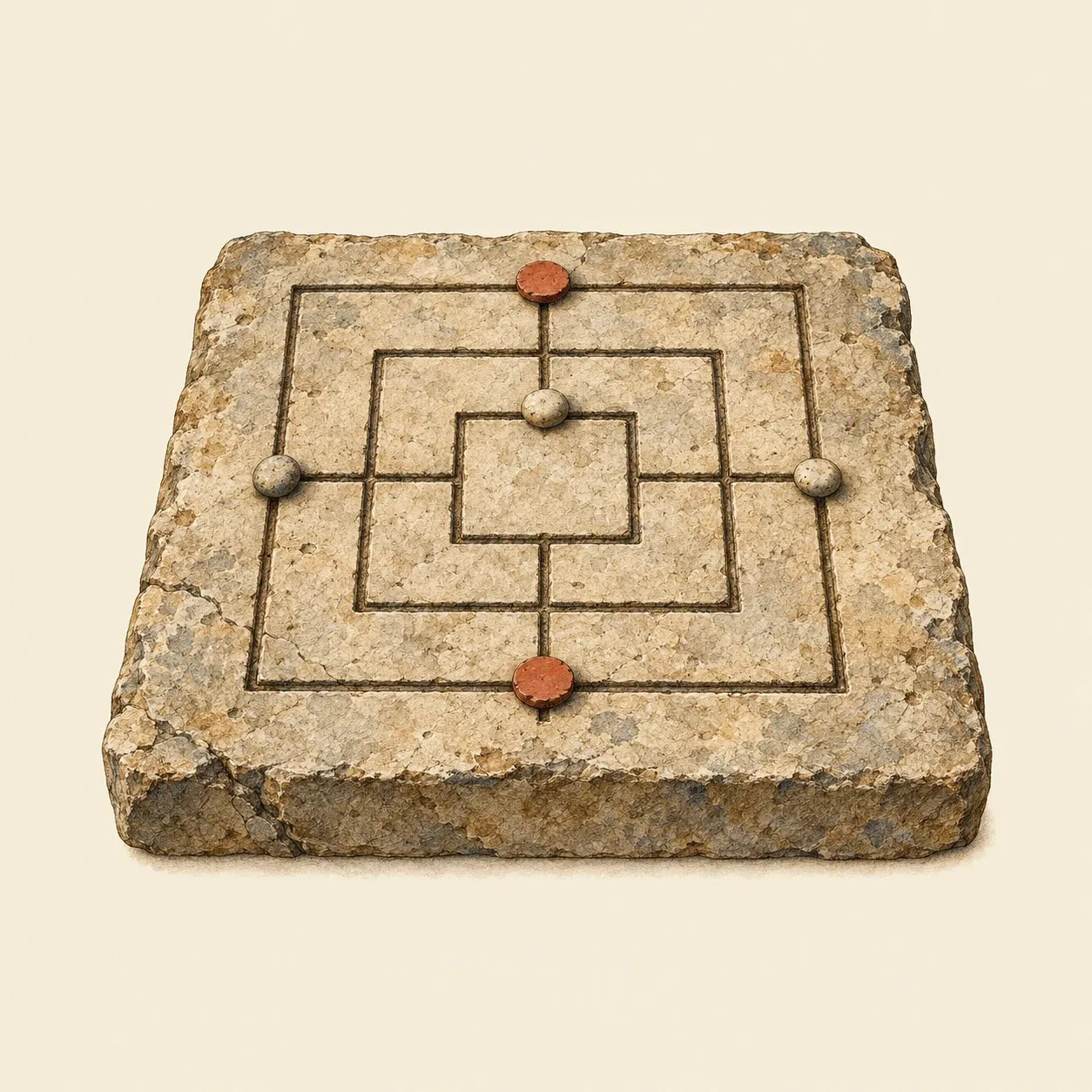 A board cut in stone, played with pebbles and discs of broken pottery.
The board of three squares is harder to date. Berger lists a tile from the last level of the hill town of Ensérune, in southern France, occupied until about 40 CE, known from an unpublished report. A tile kept at Brühl, in Germany, whose findspot is uncertain, carries the board and the stamp of the Thirtieth Legion, which the archaeologist Norbert Hanel links to the legion’s brickworks at Xanten. Hanel holds that the board was drawn in the wet clay before firing, which would give it the date of the tile, after 196 CE according to Berger; the archaeologist Dirk Schmitz doubts that it was cut before firing. Berger also reports a slab from a Hellenistic building with the board on it, found in a Christian burial of the 3rd or 4th century at Toprakli, near Van, in eastern Turkey. At Amluk-Dara, in the Swat valley of Pakistan, two slabs from the original floor of a Buddhist stupa of the 2nd or 3rd century CE carry the same pattern, and more than two dozen counters of black stone and red potsherd were found on the site. The games historian Ulrich Schädler published them in 2018. Crist, Dunn-Vaturi and de Voogt, writing in 2016 after an earlier summary by Schädler, held that the large board does not appear before Byzantine times. Many boards scratched on Roman buildings, such as the theatre at Bosra in Syria, cannot be dated, because the stones remained within reach for centuries.
In Arabic the game was called qirq. The Book of Songs, the Kitab al-Aghani compiled in the 10th century, mentions sets of it kept for guests in a house in Mecca, and a board with added diagonals was cut into a floor at Samarra, in Iraq, in the 9th or 10th century. In Norway the Gokstad ship burial, made around 900, held a wooden board with a morris board on one face and a board for the game hnefatafl on the other. Another morris board was cut into a strake of the boat buried at Årby, in Sweden, and a ship’s deck plank carrying one was reused in a well at Aarhus, in Denmark, early in the 13th century. Wooden boards of the 12th and 13th centuries have also been found at Riga.
The Libro de los juegos, completed in 1283 for King Alfonso X of Castile, describes the game as alquerque de nueve, with nine counters each. A mill lets the player take any enemy counter he chooses, and the book adds a version played with dice. The Latin poem De Vetula, written in France in the 13th century, also names the game. In Shakespeare’s A Midsummer Night’s Dream, written in the 1590s, a morris board cut in the turf of a field lies filled with mud after a season of rain.