Multitool
Several tools folding into one handle
Contents
- 1Handle scales
- 2Main blade
- 3Pivot pin
- 4Backspring
- 5Squared heel of the tang
- 6Screwdriver and bottle opener
A multitool gathers several small tools in one handle that fits in a pocket. Each tool turns on a pin and folds into the handle when it is not needed, and in most folding knives a flat steel spring holds it open or shut. Roman craftsmen of the 3rd century CE already made folding sets with a knife, a spoon, a fork and a spike, and the idea was taken up again by the Swiss officer's knife of 1897 and by pocket tools built around pliers from 1983.
What it is
A multitool puts several tools in one handle small enough to carry in a pocket. The tools are flat, turn on pins at the end of the handle and fold away between its sides, so that a blade, a screwdriver, an awl and a can opener take up little more room than a single knife. The user pulls a tool out by a nail nick or a notch, and it stays open until it is folded back.
There are two main families. In the folding knife with several tools, the handle is a stack of thin metal plates, the liners, riveted together and covered on the outside by the scales. The tools lie between the liners, on one or both sides, and flat springs along the back of the handle hold each of them open or closed.
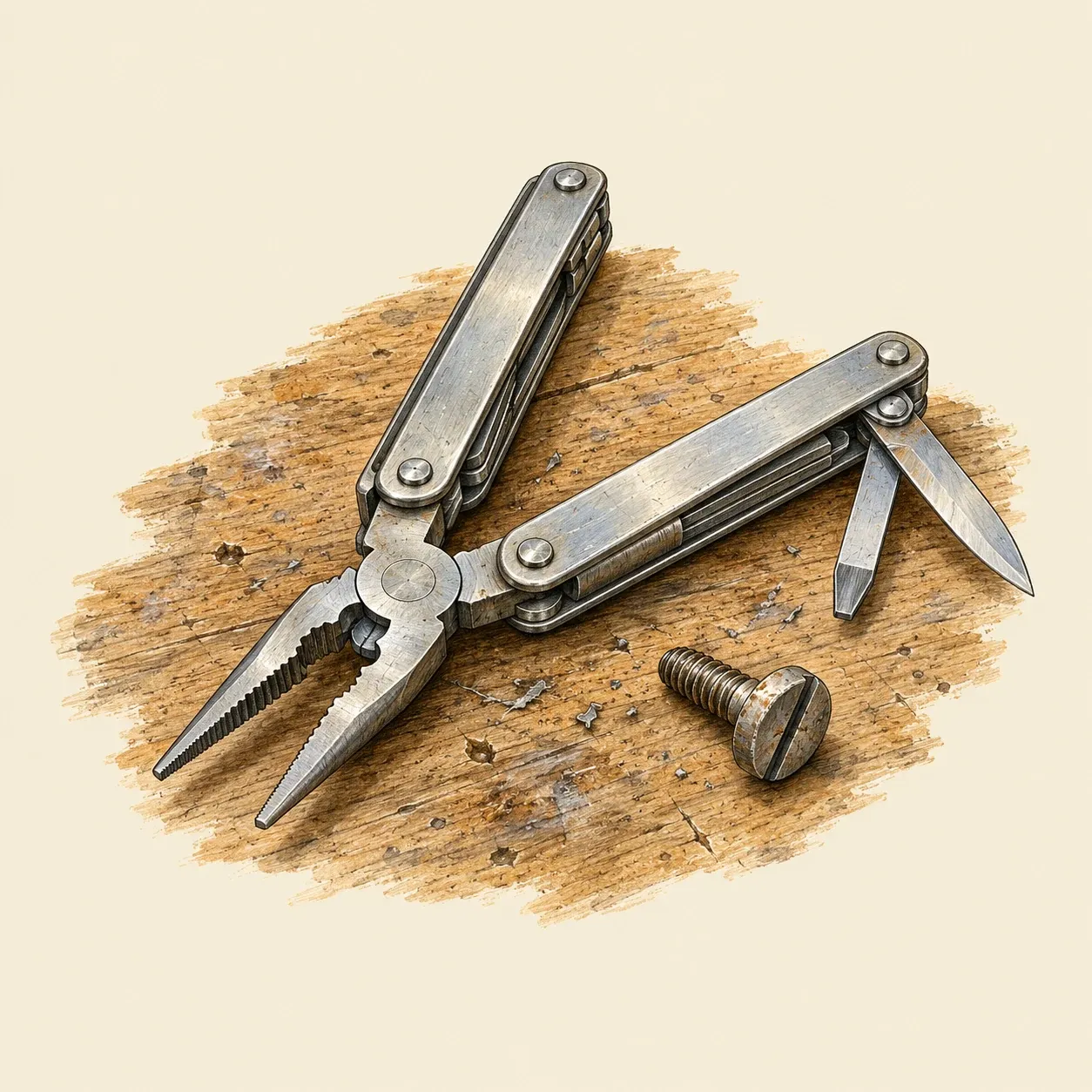 In a tool built around pliers, the folding handles close over the jaws and carry the other tools inside them.
In the second family the handles themselves fold. Each handle is a steel channel, a strip with both edges turned up, joined by a pin to one jaw of a pair of pliers. For carrying, the two handles turn about these pins until they face each other and close over the jaws, which disappear inside. Swung back through about half a turn, they become the handles of the pliers, and the knife, file, screwdrivers and openers stored in the channels can be swung out one at a time. Tim Leatherman’s patent, filed in 1978 and granted in 1980, describes this arrangement, with some tools that open out beyond the ends of the handles to give the pliers more leverage.
How it works
Each folding tool turns on a pivot pin, a steel rivet that passes through the liners and through a hole in the tang of the tool, the short base behind the working part. The rivet is spread at both ends, tight enough to hold the stack together and loose enough to let the tools turn.
The tool is held by a backspring, a flat strip of hardened and tempered steel that lies along the back of the handle. It is fixed at the far end and its free end presses on the tang. The end of the tang, the heel, is not round. It is squared off, with one flat face that meets the spring when the tool is shut and another that meets it when the tool is open. Between these two positions a corner of the heel lifts the spring. The user feels a resistance that rises to a peak, then the spring drops onto the next flat face and snaps the tool home. Many knives add a third face that stops the blade at a right angle to the handle, the half stop.
Such a joint does not lock. A hard push on the back of an open blade, or a sideways twist, can force it past the spring and fold it onto the fingers. Knives with tools on both sides have a central liner that divides the handle in two, and each half has its own spring. Several tools may share one pivot and one spring, each pressing on it with its own heel. In Leatherman’s patent the handles are held closed by friction against cam faces on the shanks of the jaws, and the same cams help to open the pliers.
How to do it
This simple pocket tool has two tools and no cutting edge: a flat screwdriver and a bottle opener, held by friction between wooden scales. You need two strips of hardwood about 100 mm by 20 mm by 6 mm, a flat bar of mild steel 3 mm thick and 15 mm wide, two bolts 5 mm in diameter and 35 mm long, each with a nylon-insert locking nut, four steel washers, a piece of brass tube 10 mm long as a spacer, a hacksaw, flat and half-round files, a drill with a 5 mm bit, a bench vice, a ruler, a scriber, sandpaper, safety glasses and work gloves.
Cut two pieces of steel 70 mm long. Round one end of each with the file and drill a 5 mm hole 8 mm from that end. File the other end of the first piece into a flat screwdriver tip about 5 mm wide, thinning both faces evenly towards it, and blunt its corners. In the second piece, file a notch with a hooked lip that can catch under the edge of a bottle cap, and round off every corner and edge.
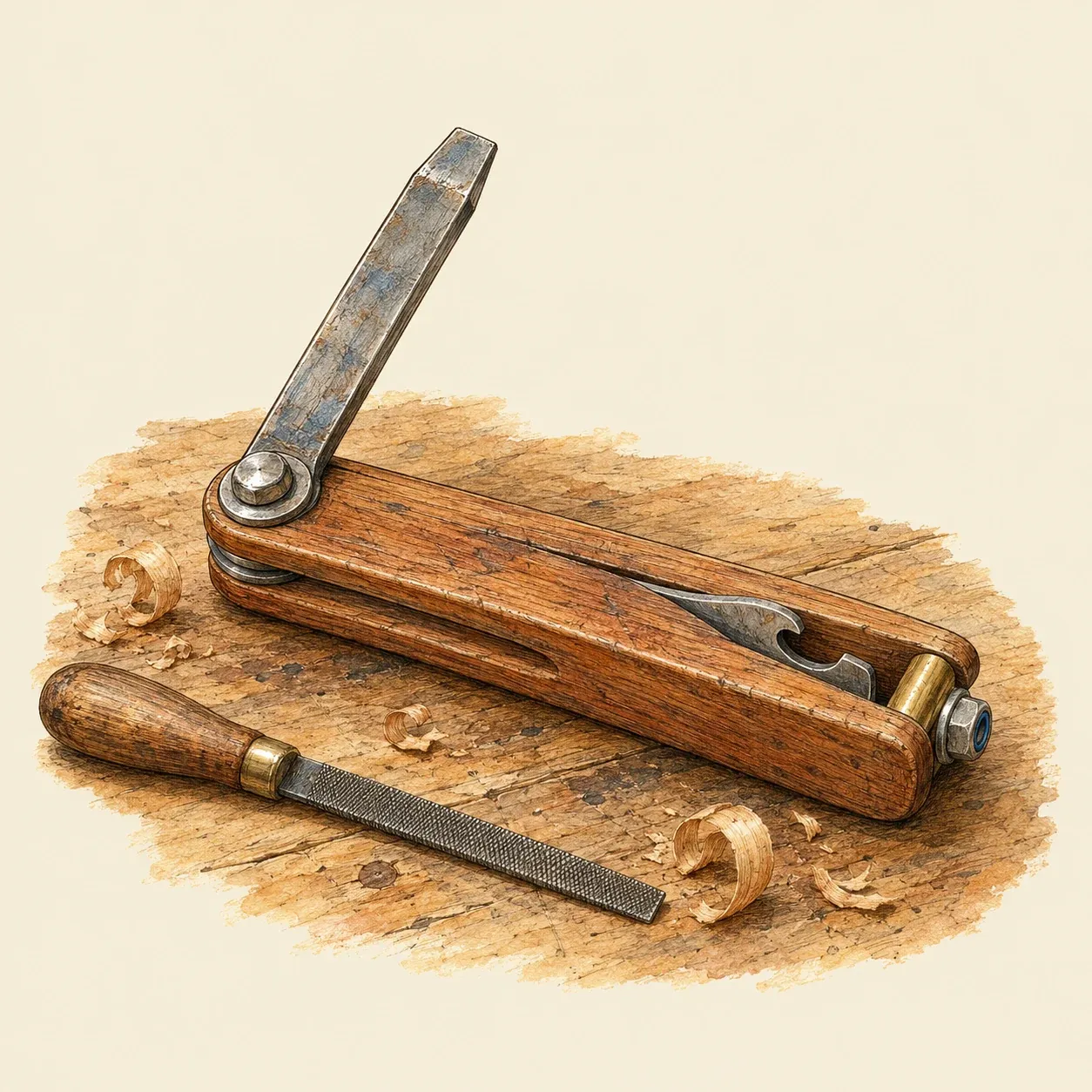 Two steel tools turn on one bolt between the wooden scales, held by the friction of the washers.
Clamp the two wooden strips together and drill a 5 mm hole through both, 8 mm from one end, so that the holes line up, then a second hole 8 mm from the other end. Assemble the pivot end in this order: scale, washer, screwdriver, washer, washer, bottle opener, washer, scale, and pass the first bolt through. This stack is about 22 mm thick, so the 35 mm bolt leaves room for the whole locking nut, nylon ring included. At the other end, put the brass tube between the scales on the second bolt, so that the scales stay parallel and the folded tools rest against it. Tighten the locking nut on the pivot bolt a little at a time until each tool turns under firm finger pressure and stays where you leave it. The friction of the washers on the tools does the work of the spring in a folding knife. Sand the scales and round their corners.
Try the screwdriver on a large slotted screw, pressing along the line of the tool and not sideways, since nothing but friction holds it open.
Safety. Wear safety glasses when sawing, drilling and filing, and gloves when handling cut steel. Hold the steel in the vice and clamp the wood down for drilling, never in your hand, and keep your fingers away from the bit. Freshly cut and filed steel has sharp edges and burrs: file every edge smooth before assembling. Keep the tool without a cutting edge, and children should make it only with an adult.
History and evolution
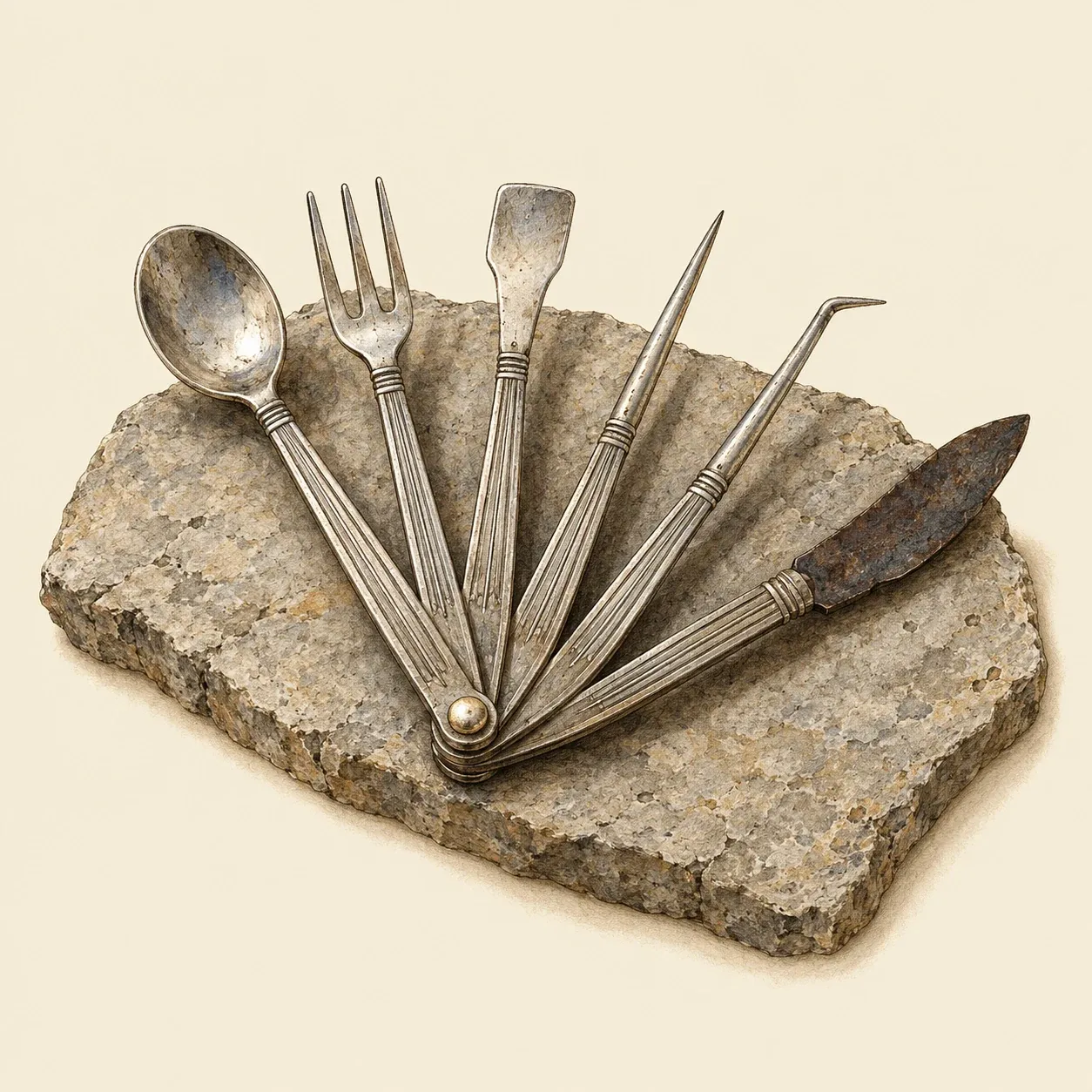 A Roman folding set: several eating tools turning on one hinge, with a blade of iron.
Roman craftsmen made folding sets that carried several implements on one hinge. The Fitzwilliam Museum in Cambridge holds one in silver, dated between 201 and 300 CE, with a knife blade of iron, a spoon, a three-pronged fork, a spatula, a spike and a small pick. The museum suggests that the spike served to draw snails from their shells and the spatula to reach sauce at the bottom of narrow bottles, and notes that simpler folding knives of bronze survive in greater numbers. At Wallsend, beside Hadrian’s Wall, excavators found a bronze folding spoon whose handle was held by an iron rivet, and the Tyne and Wear historic environment record says that other implements, probably a knife and a spike, turned on the same rivet. David Sherlock, who has studied Roman folding spoons, describes types with spikes along the sides of the handle and others combined with knives.
In Switzerland the knife maker Karl Elsener of Ibach and other Swiss cutlers delivered the first soldier’s knives made in the country to the army in 1891. Elsener then designed a lighter knife with more tools, intended for officers, and had this officer’s and sports knife legally protected in 1897.
Tim Leatherman, an American engineer, had the idea for a folding tool built around pliers during a long trip through Europe in 1975. He filed his patent in 1978 and received it in 1980, and his company began selling its Pocket Survival Tool in 1983.