Wheelbarrow
Sharing the weight with a wheel
Contents
- 1Front wheel with an iron tyre
- 2Axle carried by the front ends of the shafts
- 3Box set on the shafts
- 4Shafts ending in handles
- 5Rear legs
A wheelbarrow carries its load on one wheel and two handles: the wheel takes part of the weight, and the person at the handles lifts the rest, balances the load and pushes. The oldest secure images of it come from Han China in the early second century CE, and western Europe used it from the late twelfth century.
What it is
A wheelbarrow carries a load on one wheel and two handles. In the common European layout, a wooden box sits on two long shafts, the wheel turns on an axle between their front ends, and the rear ends of the shafts are the handles. Two legs under the back of the box hold it level when it is set down. To move it, the operator lifts the handles until the legs clear the ground, then pushes.
One wheel lets a barrow run along a plank, a narrow path or the bank between two fields, where a cart would not fit. It also makes the barrow easy to empty: lifting the handles high tips the load out over the wheel. The cost is balance. With a single point on the ground in front, the barrow falls to one side unless the operator keeps the load centred over the line between the wheel and the hands.
How it works
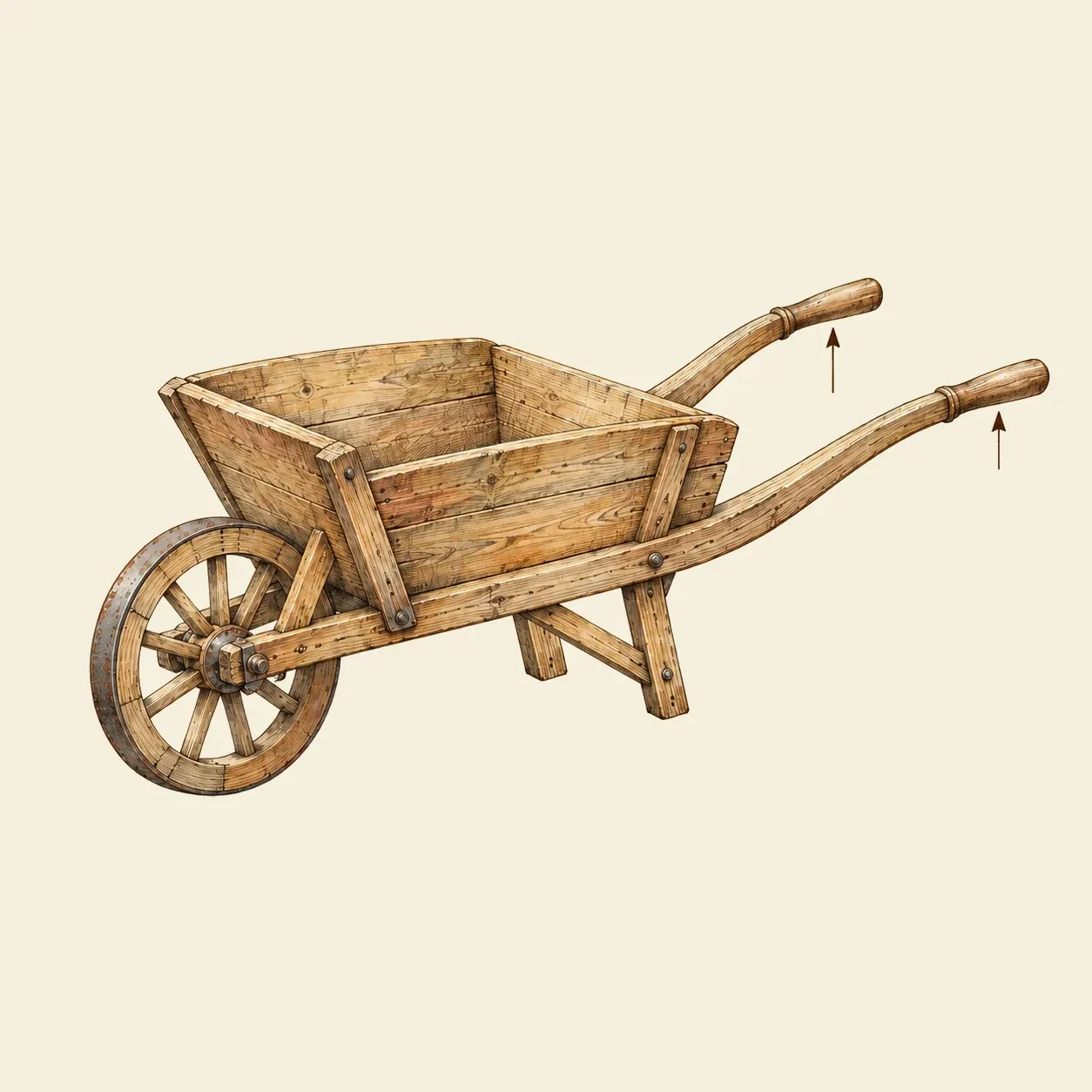 The hands lift the handles; the wheel carries the rest of the weight.
A wheelbarrow is a lever of the second class. The axle of the wheel is the pivot, the load sits between the axle and the hands, and the hands lift at the far end. The weight is shared according to these distances. If the centre of the load lies 30 cm behind the axle and the hands hold the handles 120 cm behind it, the hands lift a quarter of the weight and the wheel carries the other three quarters: 25 kg of a 100 kg load. Put the same load at the back of the box, 60 cm from the axle, and the hands lift half of it.
This is why a barrow is loaded towards the wheel, and why long handles make it lighter to hold. The hands do more than lift, though. They push the wheel forward, steer it and keep the load upright. A wheel rolls easily on boards or hard ground, but it sinks into soft earth, and a stone or a step in its path has to be lifted over. Going downhill, the operator holds the barrow back.
Chinese barrows often have a large wheel in the middle of the vehicle, with the load arranged around it. The centre of the load then sits almost above the axle, so the wheel carries nearly all of the weight and the hands mainly push and balance. This layout suits heavy loads moved over long distances on narrow paths.
How to do it
A small model is enough to measure the lever. You need a wooden batten about 2 × 1 cm, a wooden wheel 8 cm across with a central hole, a dowel that fits that hole, thin plywood, wood glue, small nails or screws, washers and a kitchen scale.
Make the frame. Cut two shafts 45 cm long and stand them on edge, so that each is 2 cm high. Join them with two crosspieces glued and nailed across their top edges, the first 8 cm from the front ends and the second 18 cm behind it, leaving a gap between the shafts about 1 cm wider than the wheel is thick. Drill a hole across each shaft, halfway up and 2 cm from its front end, slide the dowel through one shaft, the wheel and the other shaft, and glue the dowel into the shafts only. Fill the space on each side of the wheel with washers, so that it stays centred and turns freely.
Add the box and legs. Glue a small open plywood box, about 10 × 20 cm, onto the crosspieces, its front edge just behind the wheel. An 8 cm wheel holds the axle 4 cm above the table, and the underside of the level shafts 3 cm above it. Glue two legs 3 cm long under the shafts at the back of the box; with another wheel, make the legs 1 cm shorter than half its diameter. Set the model down: it should stand level on its wheel and its legs.
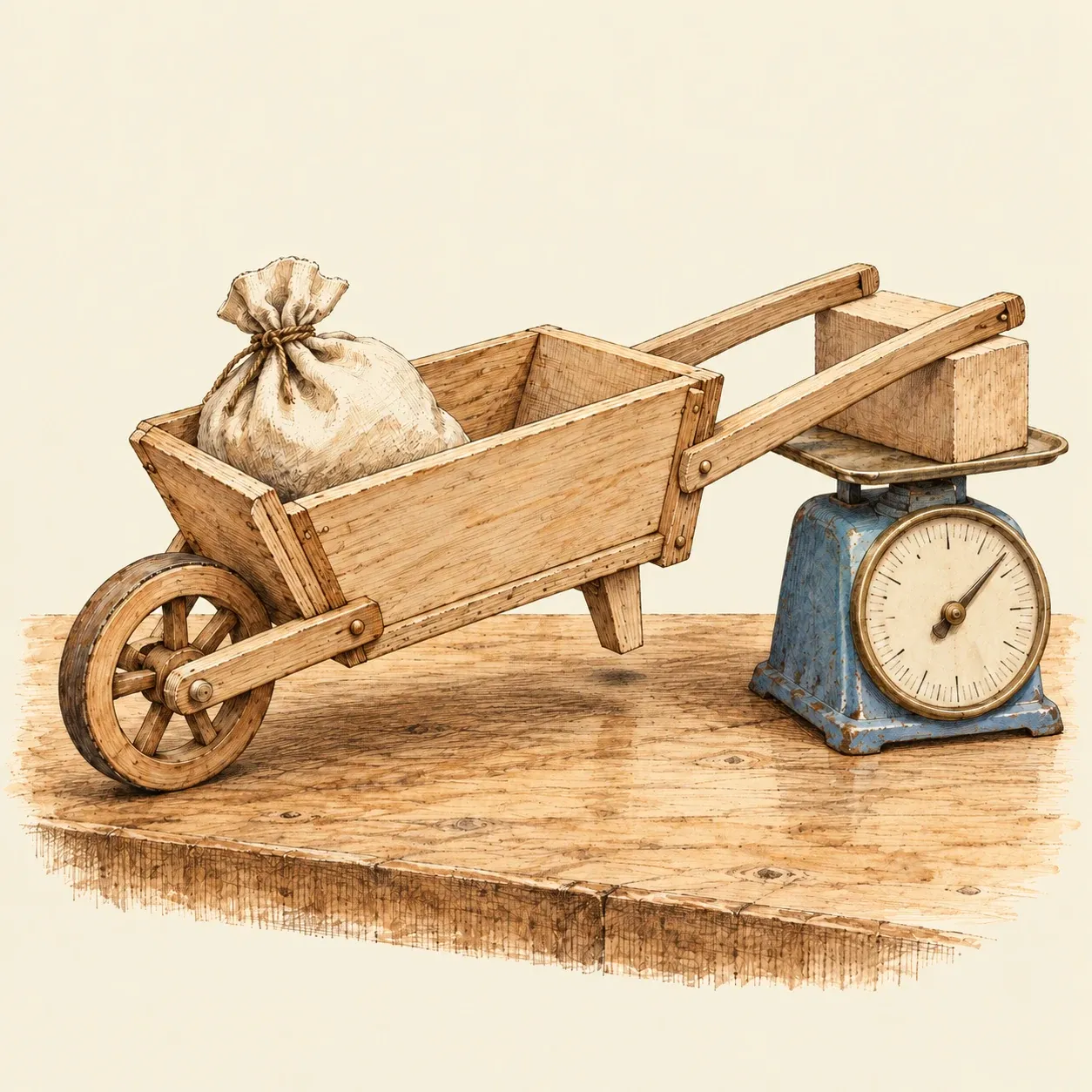 The scale under the handles weighs the share of the load the hands would lift.
Measure the share of the hands. Put a block on the scale and rest the ends of both handles on it, with the wheel still on the table. The block must be high enough for the shafts to rise a little towards the handles and for the legs to hang 1 to 2 cm above the table. Note the reading with the box empty. Then place a 500 g bag of rice or sand in the front of the box, near the wheel, and read the scale again. Move the bag to the back of the box and read once more. The reading rises as the load moves towards the handles. Measure along a shaft the distances from the axle to the middle of the bag and from the axle to the point where the handles touch the block: the extra reading is close to 500 g multiplied by the first distance and divided by the second.
History and evolution
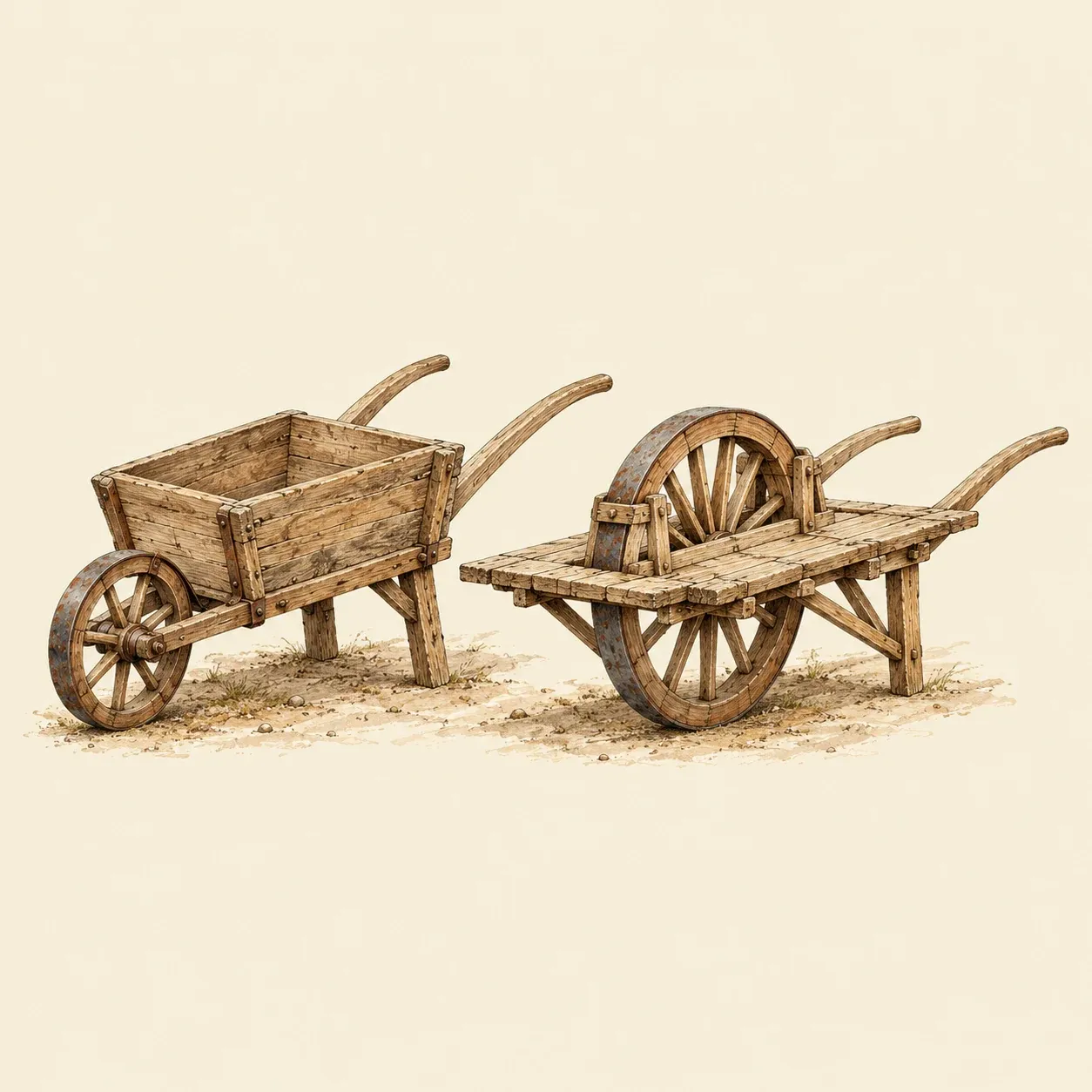 The European front-wheel barrow and the Chinese central-wheel barrow share the weight in different ways.
The oldest secure images of wheelbarrows come from Han China in the early second century CE. A carving on the Shen Fujun pillar gate at Qu County, in Sichuan, shows a wheelbarrow in the story of the filial son Dong Yong, who cared for his old father. The Qu County museum dates the gate to the Yanguang era, 122 to 125; Needham places it about 150. By the end of the Han and in the following Wei period, the wheelbarrow was in wide use in China.
Later Chinese tradition named inventors. The Records of the Three Kingdoms say that Zhuge Liang’s army carried its grain through the mountains around 231 CE with “wooden oxen”, which most historians take to be wheelbarrows. An older legend credits a figure called Ko Yu.
A Greek record is older and less clear. The building inventories of the sanctuary at Eleusis for 408/407 and 407/406 BCE list the body of a “one-wheeler” (monokyklos) among the parts of four-wheeled wagons. The historian of technology M. J. T. Lewis, who translated these lists, argued that it was a wheelbarrow used on the building site. Sean Manning, who works from Lewis’s translation, accepts that labourers in Attica may have used one-wheeled carts.
In western Europe the wheelbarrow appears in the late twelfth century. Lewis lists four written mentions in English and French sources between 1172 and 1222, three of them under other names. Matthew Paris drew wheelbarrows in his English manuscripts around 1240 to 1250. Lewis sees the European barrow as a handbarrow, the stretcher carried by two people on building sites, with a wheel in place of the front bearer. European barrows kept their wheel at or near the front, and the barrows painted in fifteenth-century manuscripts still look like wheeled stretchers, with a low, curved tray close to the ground.