Sword
A long blade fixed to a hilt
Contents
- 1Blade, with its two edges and point
- 2Fuller, a groove that lightens the blade
- 3Cross-guard
- 4Grip
- 5Pommel
- 6Tang, running through the hilt
A sword is a long blade fixed to a hilt, made to cut, to thrust or both. The blade carries the edges and the point, and the hilt gives the hand a grip, a guard and a counterweight. The oldest swords known, of copper alloyed with arsenic, come from Arslantepe in eastern Turkey: some from a palace in levels dated to about 3400–3000 BC, others from a royal tomb of about 3000–2900 BC.
What it is
A sword is a hand weapon with a long blade, sharpened along one or both edges and usually ending in a point. It is longer than a dagger, and most swords are held in one hand, leaving the other free for a shield, a dagger or nothing at all. Some blades were shaped mainly for cutting, others for thrusting, and many for both.
A European sword of the 14th century has a straight blade with two edges and a hilt in three parts: a cross-guard, a grip and a pommel.
How it works
The blade does the work, and its cross-section decides how it behaves. A thin edge cuts well but chips and bends easily, so most blades are thin at the edges and thicker along the middle, like a lens in section. That thicker spine keeps the blade stiff from hilt to point.
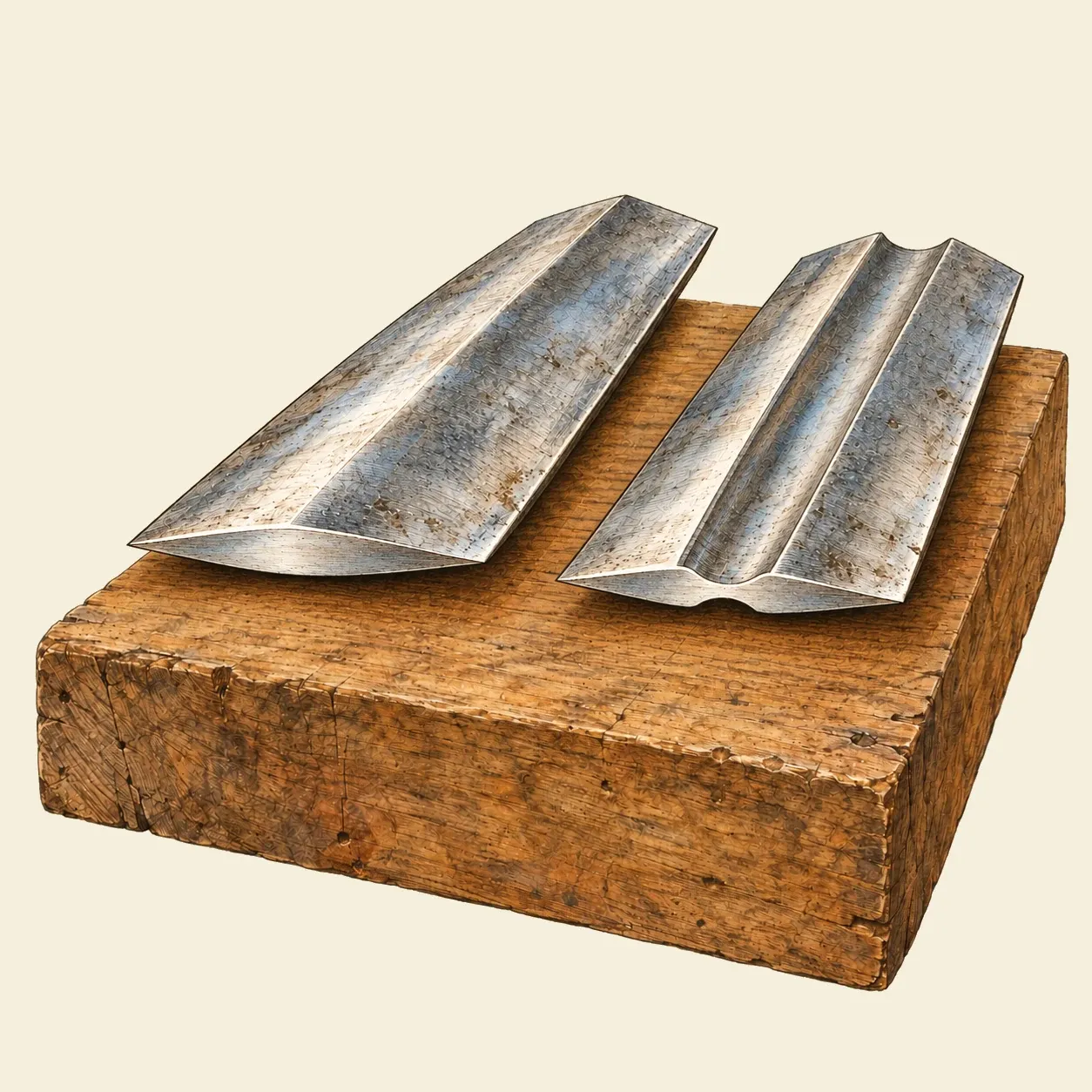 A fuller removes metal from the middle of the blade, where it adds weight but little strength.
Many blades have a fuller, a shallow groove running down each face from the hilt. It is often called a blood groove, a name that misleads. Dirk Breiding of the Metropolitan Museum of Art explains that it lightens the blade, taking off mass without weakening the blade or reducing its flexibility.
The hilt holds the blade in the hand. The blade continues into a narrower bar, the tang, which passes through the cross-guard and the grip. The grip is a wooden core built around the tang and covered with leather or cord. The pommel, a metal weight fixed on the end of the tang, holds the hilt together and balances the length of the blade. The cross-guard stops an opponent’s blade from sliding down onto the hand. Over the centuries, side rings, knuckle-guards and baskets were added to protect the hand further.
A good balance makes the sword quick to move. According to the Metropolitan Museum, a one-handed sword of the Middle Ages and the Renaissance weighed 2 to 4 pounds (0.9 to 1.8 kg) on average. Ewart Oakeshott gives 2.5 to 3.5 pounds (1.1 to 1.6 kg) for a sword of normal size.
How to do it
A display model in card and foam shows the parts of a hilt and how they fit, with nothing hard, sharp or pointed. It needs a length of foam pipe insulation about as long as your arm, sheets of corrugated cardboard, a foam ball, string, strong tape and glue, with scissors and a craft knife.
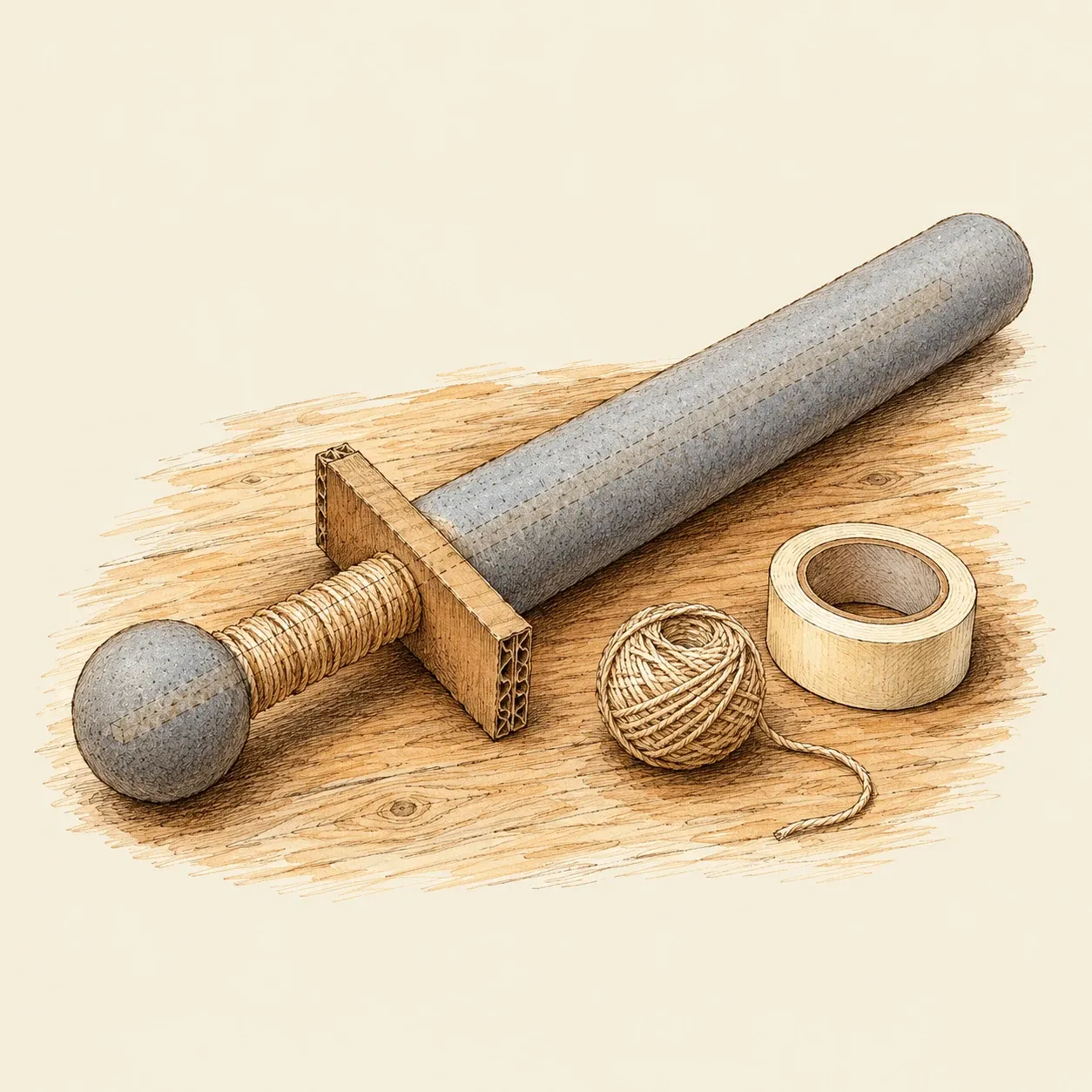 A strip of card plays the part of the blade’s core and tang, and the foam covers it everywhere.
Cut a strip of corrugated cardboard as wide as the hole in the foam tube and about a hand’s length longer than the tube, and glue two layers of it together. Slide the strip into the tube so that it stops a few centimetres short of the tip, and close that end with a rounded plug of foam and tape. The card sticking out of the other end is the tang. Cut a rectangle of cardboard, glue two or three layers together and make a slot in the middle: this is the cross-guard, which slides onto the tang against the end of the foam. Wrap the tang behind the guard with string to make the grip, leaving the last few centimetres bare. Make a slit in the foam ball, glue it over the end of the tang as a pommel, and tape the joint.
Safety. This sword is a display model: keep it on a shelf or a wall and never use it to hit anyone, even in play. Never put wood or any other hard or pointed material inside, and never make a version with an edge.
History and evolution
The oldest swords known come from Arslantepe, near Malatya in eastern Turkey. In a palace there, in levels that Ünsal and Gönül Yalçın date to about 3400–3000 BC, archaeologists found swords and spearheads made of copper enriched with arsenic, and a royal tomb of about 3000–2900 BC held more swords and spearheads of the same metal; some of the swords were decorated with strips of silver. A short sword and five spearheads of the same type were found by chance at Tülintepe, about 80 km away, in 1966. Another sword of this type, kept among medieval objects in the museum of the Armenian monastery of San Lazzaro in Venice, was recognised in 2017. According to an envelope in the archives, it came from Trabzon, on the Black Sea, in the 19th century.
Swords of bronze were then made throughout the Near East and Europe. In the Aegean of the Bronze Age they survive in large numbers, and Barry Molloy used measurements, marks of wear and experiments with copies to study how they were used in combat. From the start of the first millennium BC, iron and later steel gradually replaced bronze for weapons.
From the 16th century, the rapier, long and slender and made mostly for thrusting, was worn by civilians for self-defence, and its lighter successor, the smallsword, remained part of a gentleman’s dress until the early 19th century. On the battlefield, men-at-arms in armour relied as much on the lance and the spear as on the sword.
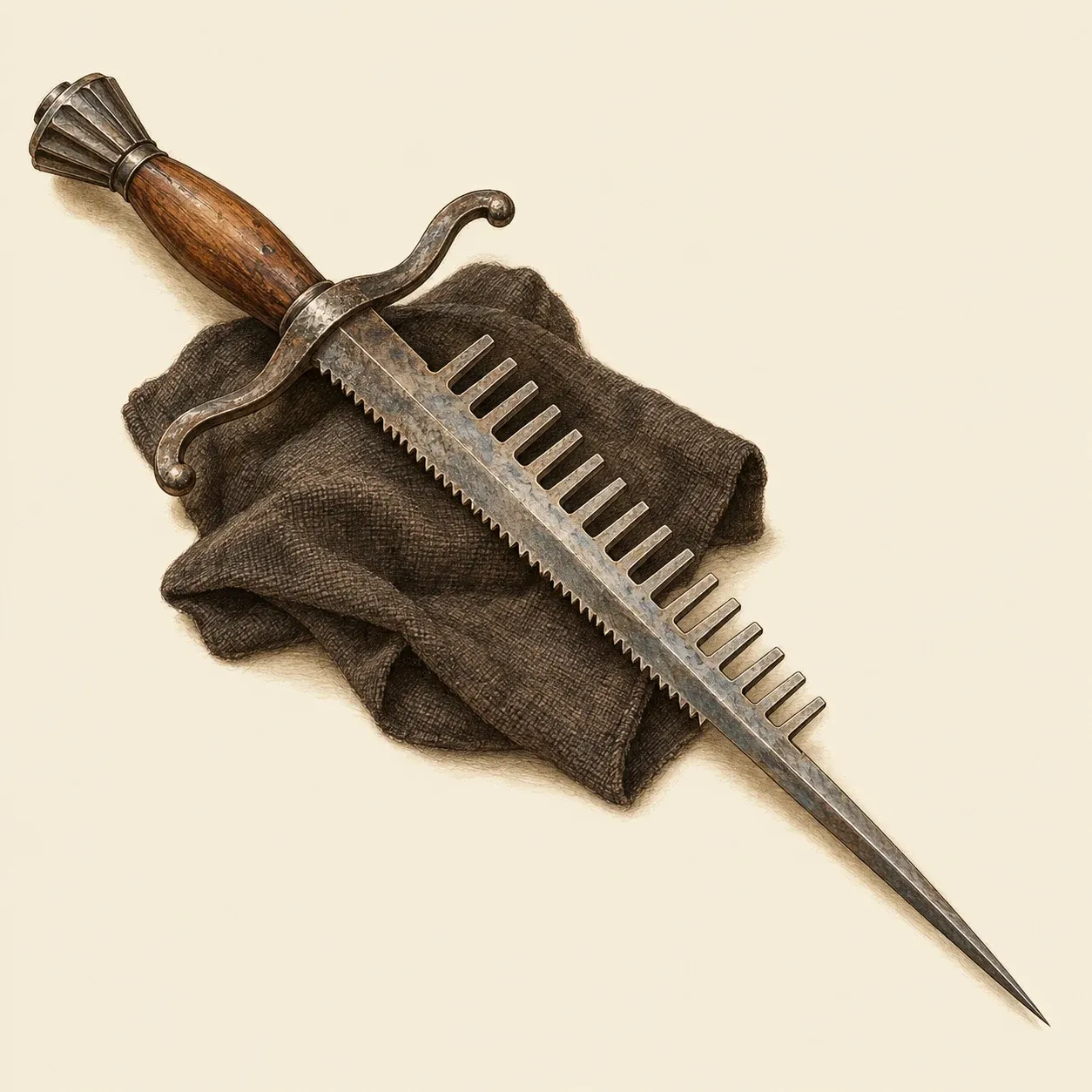 The long teeth of a sword-breaker were made to trap an opponent’s blade.
Some swords took unusual forms. Two-handed swords with a waved, flamboyant blade were carried by the German mercenaries called Landsknechts; the Fitzwilliam Museum in Cambridge holds one from about 1600, and adds that long, decorated swords were also carried upright before important people in processions. The sword-breaker was a dagger for the other hand. One in the Palazzo Venezia museum in Rome, made in northern Italy in the late 16th or early 17th century, has eighteen long teeth along one edge. A fighter could trap an opponent’s blade between them and twist, to pull the sword out of the opponent’s hand or break it.