Spear and leister
A point at the end of a shaft
Contents
- 1Point carved to a long taper
- 2Widest part of the shaft, a third of the way from the point
- 3Shaft from a thin spruce trunk, bark removed
- 4Central point of the leister
- 5Barbed side prong lashed to the shaft
A spear is a long shaft with a point at one end, held in the hands to thrust or thrown by hand. The oldest surviving one is the carved tip of a yew spear from Clacton-on-Sea in England, about 400,000 years old. For fishing, people made the leister, a spear with a central point between barbed side prongs that hold the fish.
What it is
A spear is a straight shaft, usually of wood, with a point at the front. It is either held in both hands and thrust, or thrown by hand. The simplest kind is a single piece of wood carved to a point, like the spear drawn on the left, modelled on those found at Schöningen in Germany. Many later spears carry a separate head of stone, bone or metal fixed to the shaft, which archaeologists call hafting. The stone tools that shaped the first spears also gave them their first stone points.
The leister, on the right, is a spear for fishing. Its head has a central point between two side prongs that carry barbs, and the prongs are lashed to the shaft with a thong. Inuit fishers of the Canadian Arctic call it kakivak and used it to spear salmon in rivers. Barbed bone prongs from leisters also turn up at Stone Age sites around the lakes of Denmark.
How it works
A spear concentrates the push of the arms and body on the very small area of its point, enough to pierce a hide. Its length keeps the hunter or fisher at a distance from what is struck. A thrusting spear stays in the hands. A thrown spear carries the energy that the arm gave it at the moment of release.
For a throw, the weight has to lie towards the front. The Schöningen spears are widest about a third of the way back from the point, so their centre of gravity sits forward, as on a modern javelin, and the point leads in flight. In 2019 Annemieke Milks and her colleagues asked six javelin athletes to throw two spruce replicas weighing 760 and 800 g. They hit targets at up to 20 m and struck hard enough to kill an animal. Archaeologists still argue over whether the Schöningen hunters threw their spears, thrust them, or did both.
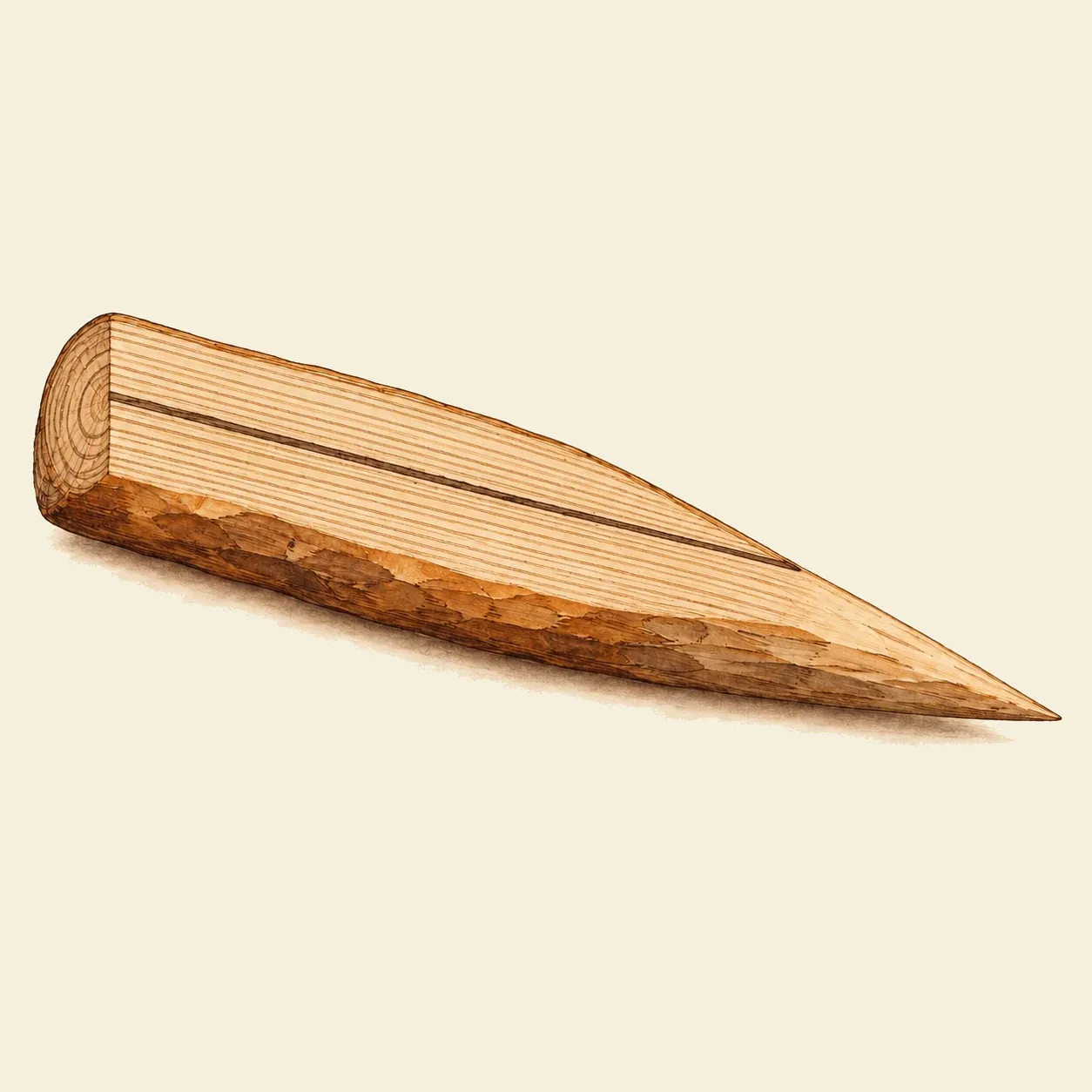 The point is carved so that the soft pith lies to one side of its tip.
A point is weakest where the soft core of the stem, the pith, runs out at the tip. On a double-pointed throwing stick from Schöningen, the maker shaped each end so that the pith lay to one side of the point.
A fish moves fast and slips easily off a single point. The central point of a leister pierces it, the side prongs close on either side, and their barbs stop it sliding off when the spear is lifted out of the water. The thong lashing leaves the prongs a little spring as they take the fish. Water also bends light at its surface, so a fish seen from the bank looks shallower than it is, and a fisher learns to strike below where it seems to be.
How to do it
A fish gig, a pronged spear for small fish, can be split from a green sapling with a knife, a wooden baton and some cord. Choose a straight young hardwood about as tall as you and about 2.5 cm thick, with few side branches. Trim the branches flush and peel the bark from the thick end, which will become the head.
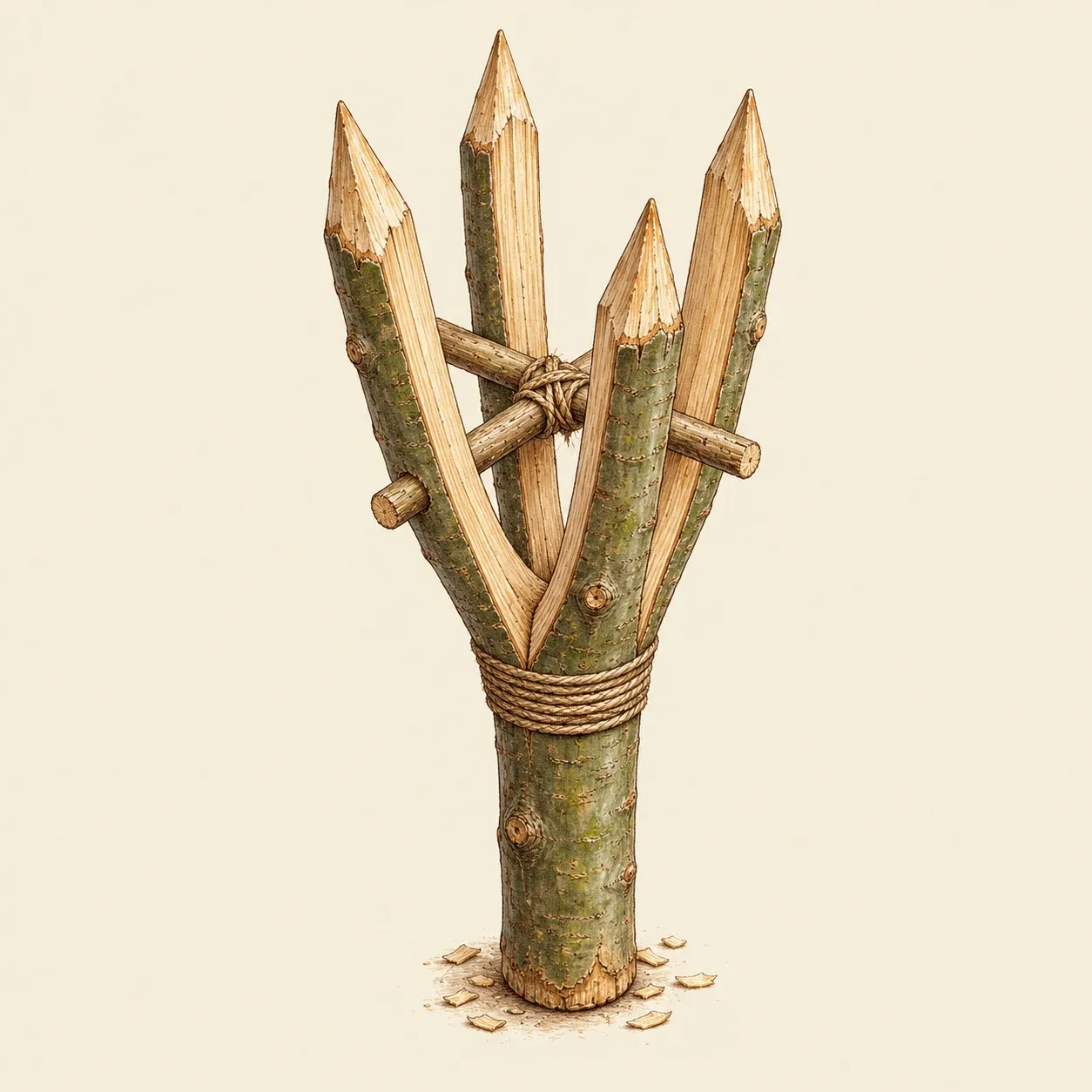 Two crossed sticks spread the four prongs, and the cord binding stops the split from running down the shaft.
Wind cord tightly round the pole about 20 to 30 cm from the thick end: this binding stops the split from running further down the shaft. Stand the pole on a block, set the knife across the centre of the end and tap the back of the blade with the baton until the split reaches the binding. Turn the blade a quarter turn and make a second split at right angles to the first, which gives four prongs. Push two small sticks into the splits, one across the other, to spread the prongs, and hold them in with a few turns of cord in a figure of eight. Bevel the inside edges of the fork so they do not splinter, then whittle each prong to a point, always cutting away from your body. To harden the tips, turn them in hot ash, away from the flames, until they are dry and lightly browned, without letting them char. Green wood shrinks as it dries, so tighten the binding again after a few days.
A pronged gig suits small fish only, and it works by pinning the fish against the bottom so that it can be picked up by hand.
Safety. Cover the points with a leather sleeve when the gig is not in use, carry it point down, and never aim it at anyone or throw it where people or animals may be. Put out the fire and the hot ash fully after hardening the tips. Spearing fish is banned or restricted in many waters: in England and Wales the Salmon and Freshwater Fisheries Act 1975 forbids using a spear to take freshwater fish. Check the local rules before using a gig, and where it is forbidden keep it as a model.
History and evolution
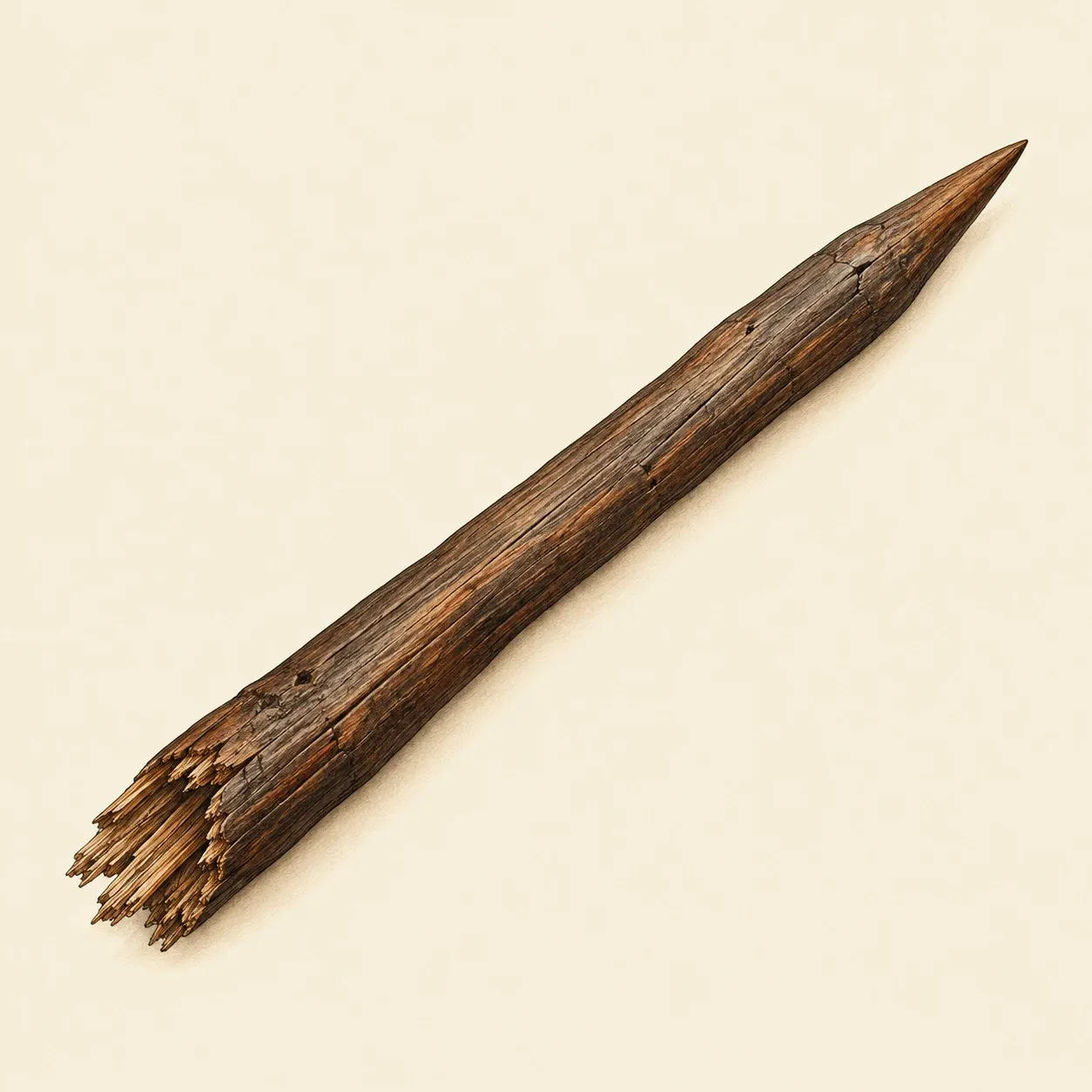 The Clacton spear point, carved in yew about 400,000 years ago.
Wood rots, so very few spears survive from the Old Stone Age. The oldest is the tip of a yew spear that Samuel Hazzledine Warren dug out of old river sediments at Clacton-on-Sea, in Essex, in 1911. It dates from a warm period about 400,000 years ago, and the Natural History Museum in London, which holds it, gives an age of 420,000 years. Over a century it has been read as a throwing spear, a thrusting spear, a digging stick, a snow probe and a stake. Researchers at the University of Reading and the museum study it as a weapon shaped with flint tools.
Stone points may be older still. At Kathu Pan 1 in South Africa, Jayne Wilkins and her colleagues reported in 2012 that stone points about 500,000 years old bear damage like that on replica points mounted on spears. Veerle Rots and Hugues Plisson disputed that reading of the fractures and the Wilkins team defended it in 2015. Sally McBrearty, who took no part in the study, accepted the points as spear tips but was less sure of their date. Stone points hafted on shafts became common after about 300,000 years ago.
The oldest complete spears come from a former lakeshore at Schöningen, in Lower Saxony. Hartmut Thieme’s team found them in an open-cast lignite mine in the 1990s, among the butchered remains of more than 50 horses. The excavations up to 2008 gave nine spears, a thrusting lance and six shorter sticks pointed at both ends, and later digs a seventh such stick. The spears were made from thin trunks of spruce or pine. Their makers stripped the bark and shaped the wood by cutting and scraping. The spears are 1.8 to 2.5 m long. They were first dated to about 400,000 years ago, then to about 300,000. In 2025 Jarod Hutson and his colleagues dated the remains of water snails from the same layer to about 200,000 years, which would point to Neanderthals as their makers. A study of the mitochondrial DNA of the horses from the site, published the same year, keeps the older age of about 300,000 years, and the date of the spears is still debated. At Lehringen, also in Lower Saxony, a complete yew spear was found in 1948 between the ribs of a straight-tusked elephant, in lake sediments about 125,000 years old. A study published in 2026 found cut marks on the elephant’s ribs and vertebrae, left when it was butchered on the spot.
Hunter-gatherers of the Maglemose culture around the Danish lakes mounted notched or barbed bone points as leister prongs; the earliest are dated to about 9000 BC. A Neolithic leister found in the seabed off the island of Lolland still had its side prongs and central bone point in place. Inuit fishers made the kakivak from wood, caribou antler or bone and hide thong, as late as the twentieth century. Other ways of taking fish, with hooks or with nets and traps, spread alongside the spear.
Spears also armed foot soldiers for thousands of years. In Europe the pike, a long spear carried by massed infantry, kept its place until the socket bayonet, which fitted round the barrel of a musket and let it still fire, made the pike redundant at the start of the eighteenth century.