Body Armour
Scales, mail, plate and fibre to stop a blow
Contents
- 1Short sleeve
- 2Bronze scale
- 3Strengthening ridge
- 4Lacing
- 5Linen or leather backing
Body armour is clothing that takes a blow in place of the body. The oldest known pieces are armour plates of bone and horn from graves at Rostovka, in western Siberia, dated to about 2100 BC. Coats of bronze scales laced onto linen or leather were worn by chariot warriors in the Near East in the 15th century BC. Mail of interlinked iron rings followed around 300 BC, then suits of steel plate in late medieval Europe, and in the 1970s vests of synthetic fibre tested against firearms to official standards.
What it is
Body armour is a garment that takes the force of a weapon so that the body behind it does not. It has been made of many materials: small plates of bone, bronze or iron sewn onto cloth, rings of iron wire linked into a flexible mesh, shaped plates of steel, quilted cloth, and in recent decades woven synthetic fibres. Soldiers have usually combined several of these, with a soft padded layer under a hard one.
A coat of bronze scales of the type worn in the Near East in the 15th century BC, known from scales found at Nuzi in Iraq and coats painted in Egyptian tombs, reaches the knees and has short sleeves. Each scale is a small bronze plate, square at the top and rounded at the bottom, with a ridge pressed along its middle to stiffen it and small holes for the laces. The scales are laced side by side into rows, and the rows are sewn onto a garment of linen or leather so that each row hangs over the top of the row below.
How it works
A hard surface turns or spreads the point of a weapon: an arrow or a blade that strikes a bronze scale or a steel plate either glances off or has its force spread over a larger area. In a scale coat the scales overlap, so a weapon meets several thicknesses of metal, and the laces lie hidden under the scales and under the row above, where they are hard to cut. A coat took a great many scales: Thomas David Hulit cites Walter Ventzke’s estimate of about 1,300 for a short sleeveless corslet and more than 3,300 for a long coat.
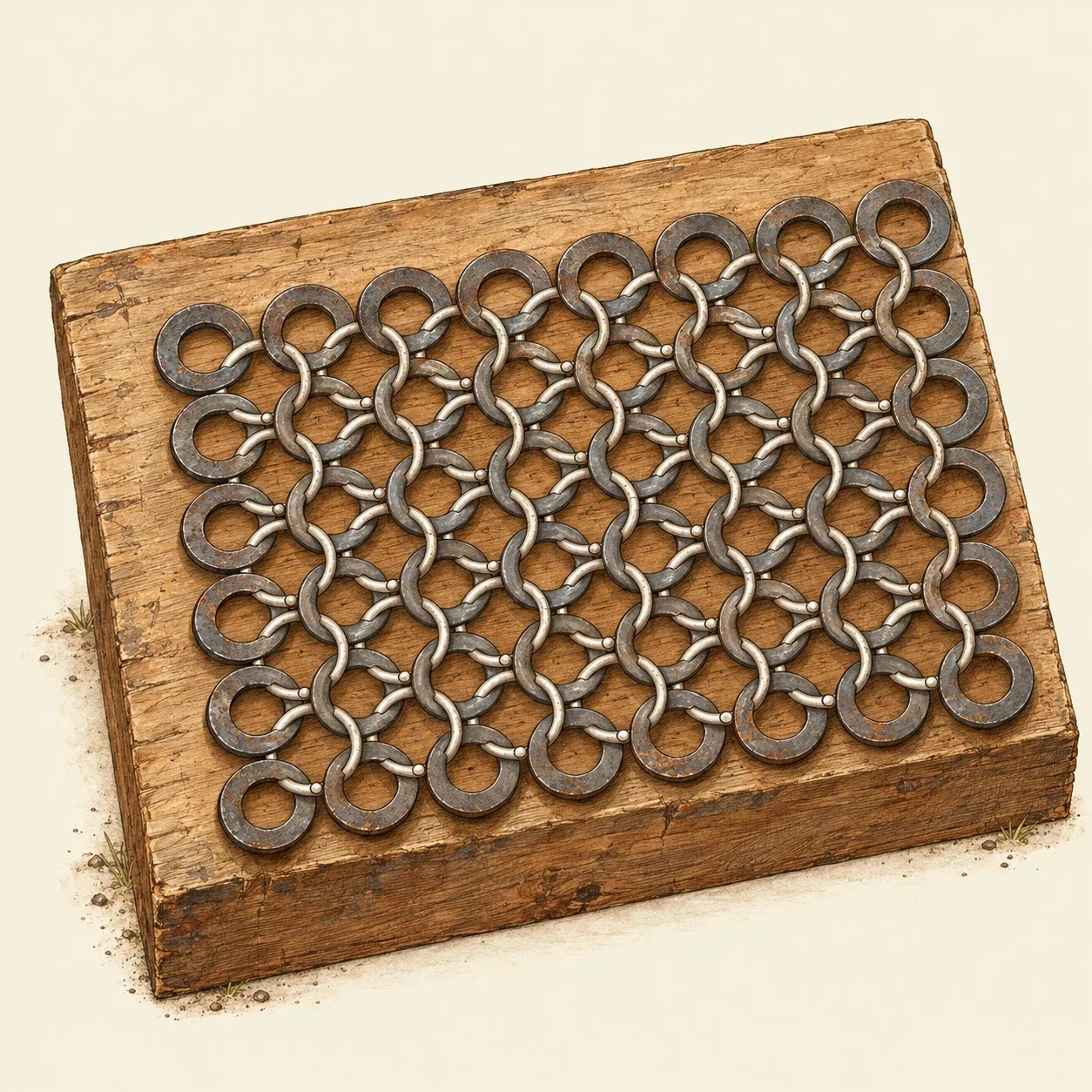 In this riveted mail, rows of solid rings alternate with rows of rings closed by a rivet.
Mail is a mesh of small iron rings, each passing through its neighbours. Some rings were closed with a rivet, others were forge-welded or punched whole from sheet metal. Mail bends with the body and resists cuts. It was worn over a padded tunic of cloth stuffed with wool or cotton, which softened the blows. Egyptian soldiers of the New Kingdom also wore armour of padded linen on its own.
Plate armour shapes steel to the body. Where the body bends, at the elbows, knees and waist, narrow overlapping strips of steel called lames are joined by rivets and leather straps so that they can slide over one another. The Metropolitan Museum of Art gives 20 to 25 kg for a complete field armour, spread over the whole body instead of hanging from the shoulders. In 2024 a team led by Andreas Flouris had Greek marines wear a replica of the Bronze Age Dendra armour through an 11-hour simulated battle and found it allowed full movement without excessive physical strain.
Modern vests use many layers of very strong synthetic fibre. In the United States they are tested in independent laboratories against the standard of the National Institute of Justice, and each model is certified for stated threats. The institute warns that no armour is bulletproof: a vest protects only against the threats it was chosen and tested for.
How to do it
A small sample of scale armour made of card shows how the scales overlap and hide their laces. It protects against nothing. You need thin card such as a cereal box, a ruler and pencil, scissors, a hole punch, thin string or embroidery thread, a darning needle and a piece of felt about 15 cm square.
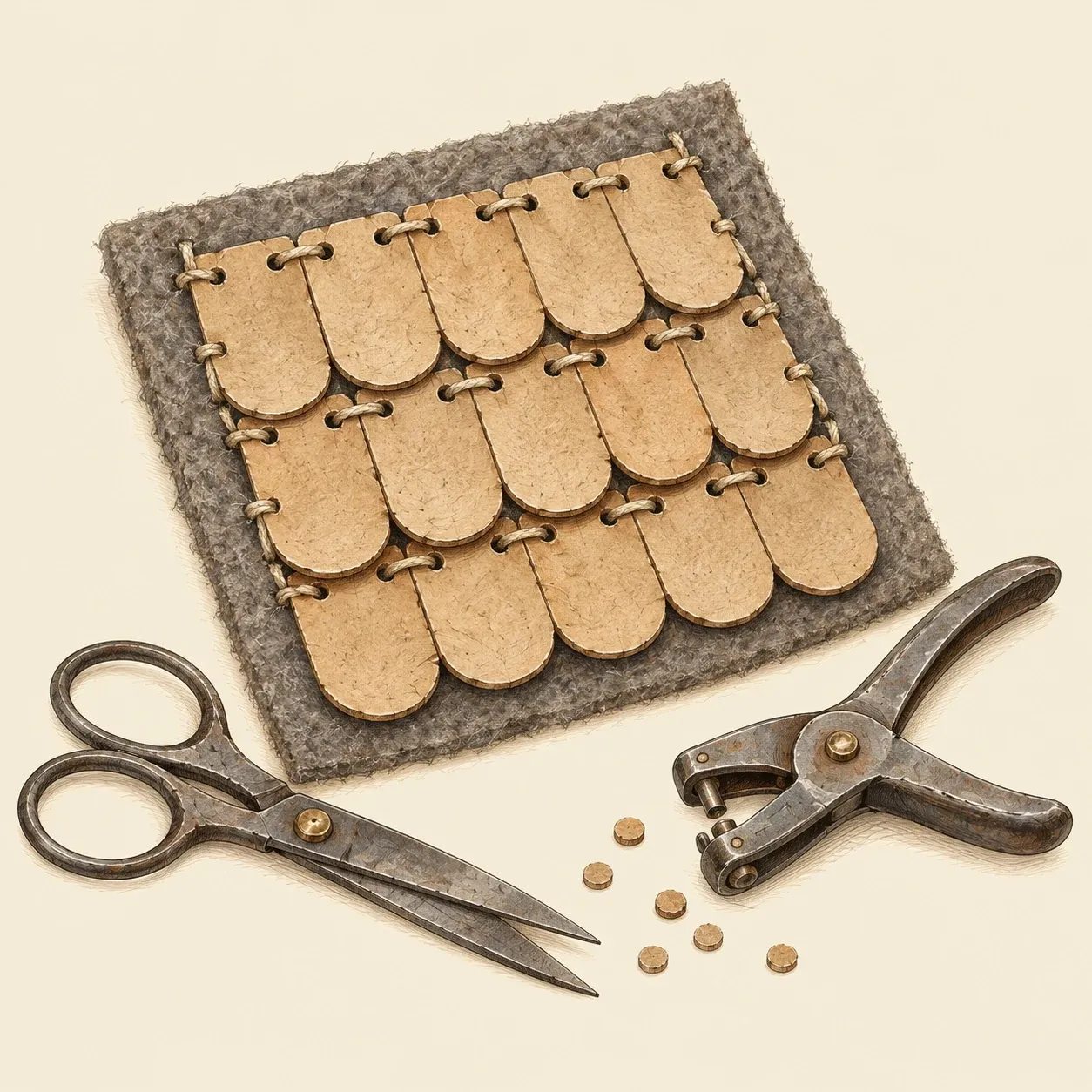 On the card sample each row of scales is laced through its holes and overlaps the row below.
Cut about thirty card scales, each 2 cm wide and 4 cm long, square at the top and rounded at the bottom. Punch two holes side by side near the top of each scale. Lay ten scales in a row, edges slightly overlapping, and thread the string through the holes to lace them together. Make three rows this way. Sew the lowest row to the bottom of the felt through its lacing, then sew the next row about 2 cm higher so that its scales cover the top of the first row and its laces, and do the same with the third row. Bend the felt and see how the scales slide over one another.
Safety. A card or metal sample of this kind gives no protection at all; only equipment certified to a recognised standard, worn as its maker instructs, protects against weapons.
History and evolution
The oldest known body armour comes from western Siberia. At Rostovka, near Omsk, graves furnished with bronze weapons of the Seima-Turbino type also held stone casting moulds and armour plates of horn, and grave 34 contained body armour of bone. Radiocarbon dates published in 2017 by Zinaida Marchenko and colleagues place these graves between the 22nd and the 20th centuries BC. The authors warn that human bone from the region can give dates that are too old, and earlier studies based on the style of the bronzes had put them in the 16th and 15th centuries BC.
The oldest armour scales found with written records come from Nuzi, near Kirkuk in northern Iraq. Excavators found bronze scales in houses of the town, dated to about 1475 to 1450 BC, together with clay tablets listing the armour issued to the soldiers of the palace: coats of large and small copper scales, sleeves, skirts, helmets and also corslets of leather. Scale armour was costly, and Timothy Kendall, who studied the tablets, thought that only elite units, officers and the wealthy owned coats with metal scales. When Thutmose III of Egypt defeated a coalition of Syrian and Canaanite princes at Megiddo in the 15th century BC, his annals list among the booty one fine bronze coat of armour belonging to the enemy leader, one belonging to the prince of Megiddo, and 200 coats of the defeated army. The Metropolitan Museum of Art holds bronze armour scales excavated at Malqata, the palace of Amenhotep III, from about 1386 to 1347 BC.
In Greece a different kind of armour has survived. The Dendra panoply, found in 1960 in a chamber tomb near Mycenae and about 3,500 years old, is a full suit of large shaped bronze plates. Its original weight is estimated at about 18 kg.
Mail appeared much later, among the Celts of central Europe. A chieftain’s grave found by chance in 1961 at Ciumeşti in Romania held an iron helmet crowned with a bird of prey, a coat of iron mail and bronze greaves, from the 3rd century BC. Czech researchers now place the invention of mail at the turn of the 4th and 3rd centuries BC and treat the Ciumeşti coat, whose rings are simply butted together, as an early example but not the earliest.
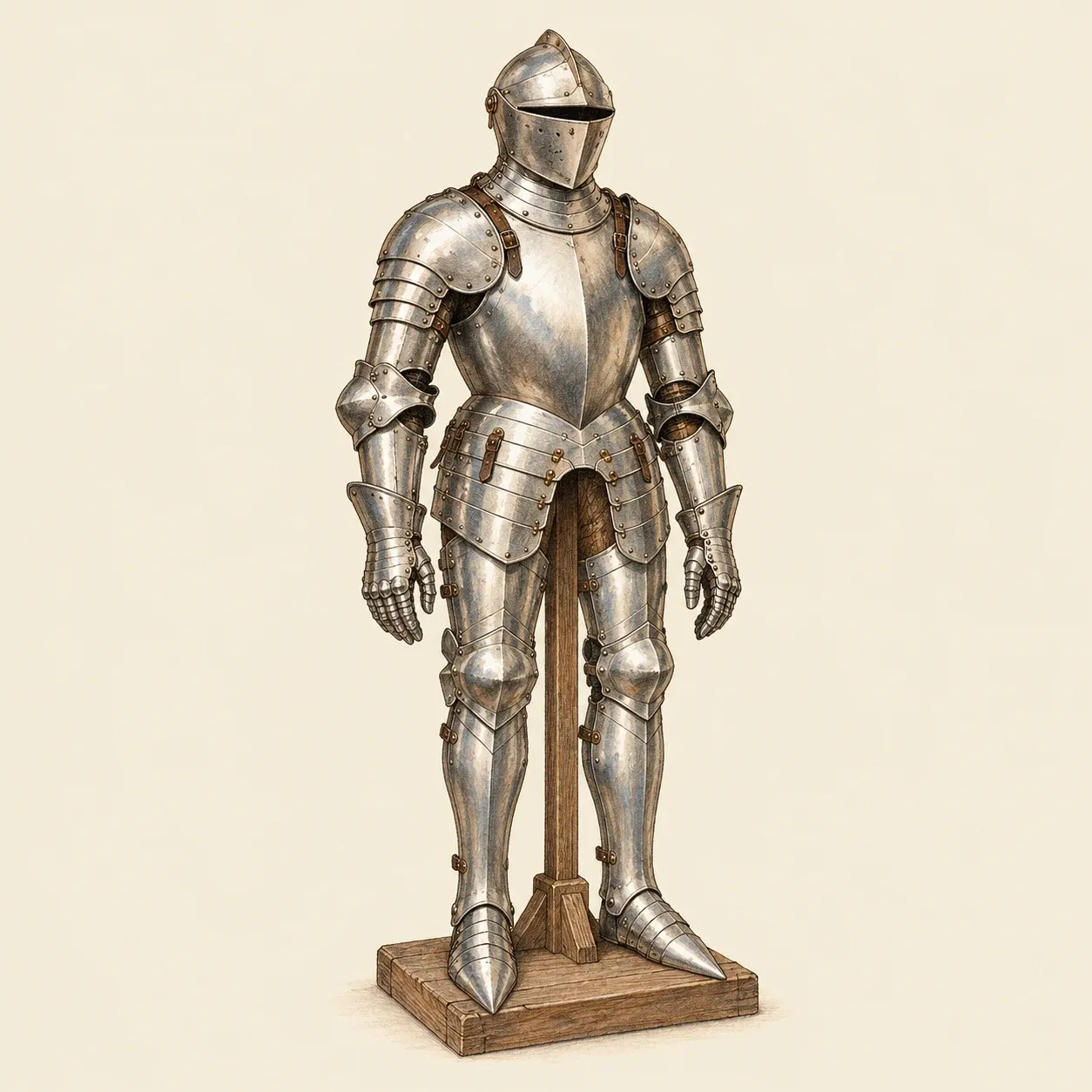 By the second quarter of the 15th century a knight could be covered in steel from head to foot.
In medieval Europe riveted mail over a padded tunic was the main armour for centuries. Steel plates were added over the mail during the 14th century, and from the second quarter of the 15th century a fully armed knight was covered in plate from head to foot, with a padded arming doublet underneath.
In 1965 the chemist Stephanie Kwolek at DuPont discovered the fibre later sold as Kevlar. In 1972 the predecessor of the US National Institute of Justice published the first performance standard for police body armour. In 1975 and 1976 about 5,000 Kevlar vests were tried in the field by 15 police agencies in cities across the country, and in 1978 the institute set up compliance testing: a maker may not label a model as meeting the standard until it has passed the tests. The standard has been revised several times since, most recently as NIJ Standard 0101.07, published in 2023.