Copper Smelting
Copper won from ore with charcoal and a blast of air
Contents
- 1Leather bag bellows
- 2Clay tuyère
- 3Crucible
- 4Charge of crushed malachite and charcoal
- 5Slag
- 6Copper gathered at the bottom
Copper smelting draws the metal out of ore heated with charcoal in a strong blast of air. Green ores such as malachite give up their copper in one step, while sulphide ores must first be roasted and melted into an intermediate called matte. The oldest analysed traces of the process, slag from Belovode in Serbia, date from about 5000 BCE.
What it is
Copper is one of the few metals that can be found as metal in nature, in nuggets and thin sheets called native copper. People hammered it into beads and awls long before they smelted anything. Native copper is scarce, though, and most copper sits in minerals: bright green malachite and blue azurite near the surface, and deeper down brassy sulphides such as chalcopyrite.
Smelting takes the copper out of these minerals. Ore and charcoal are heated together with air blown in by bellows or blowpipes, the charcoal takes away the oxygen bound to the copper, and the rest of the rock melts into slag. The copper made this way was cast into tools and, alloyed with tin, became bronze. Copper was among the first metals won from ore, thousands of years before iron.
How it works
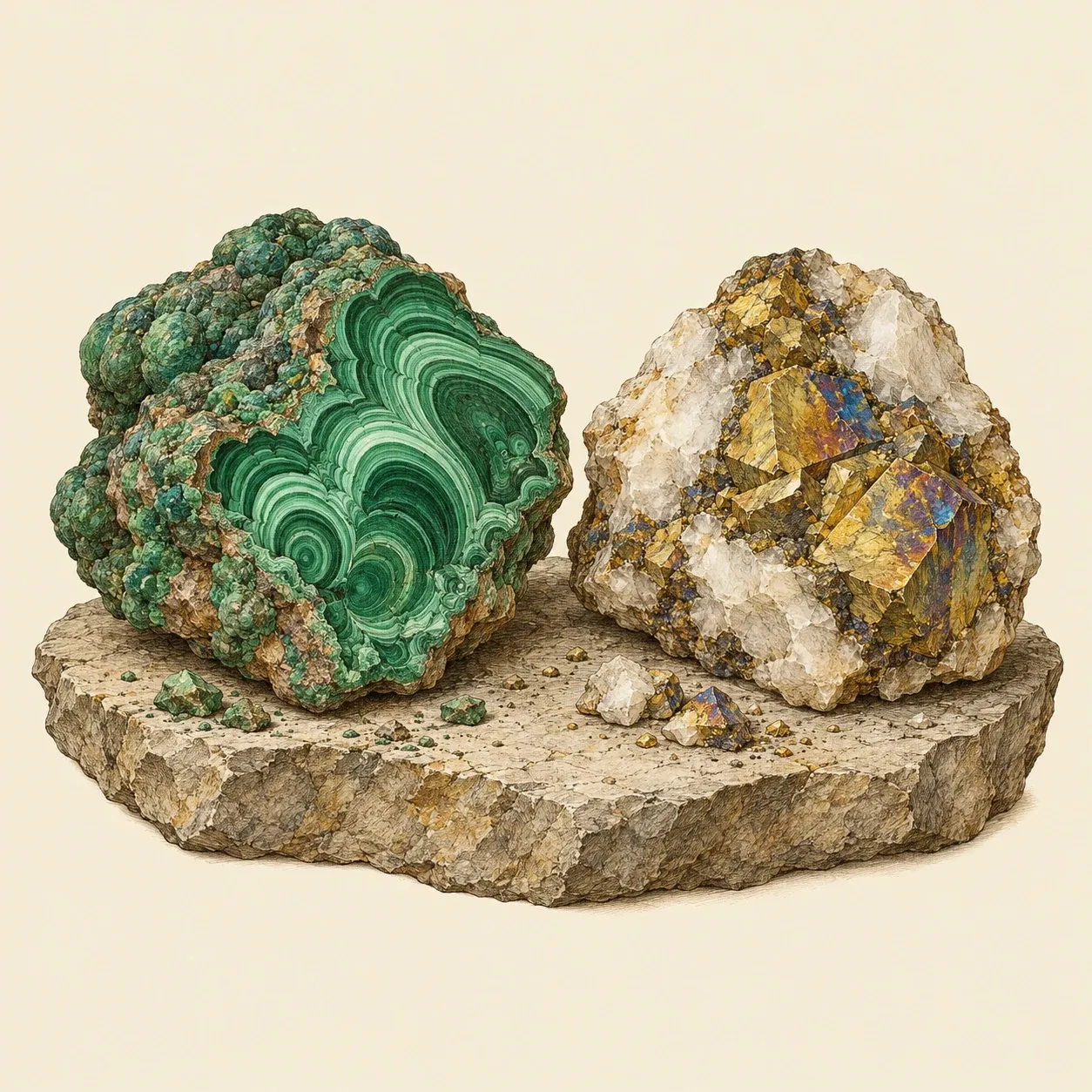 Malachite, a green carbonate, gives up its copper in one step. Chalcopyrite, a sulphide of copper and iron, must first be roasted.
In a fire blown hard with air, burning charcoal forms carbon monoxide where oxygen runs short. This gas takes oxygen away from copper oxides, and malachite breaks down into copper oxide when heated. Copper then forms as small grains. Above 1,085 °C they melt and run together into droplets, called prills, or into a lump at the bottom of the furnace or crucible. The rest of the ore, mostly silica and iron oxide, melts into a glassy slag, which is lighter than the metal and stays on top.
Early smelts left much of the copper trapped in the slag as prills. In the Chalcolithic southern Levant, in the fifth millennium BCE, smiths smelted ore in pit furnaces, broke the cooled slag to pick out the prills, then melted them together in a crucible and cast them.
Sulphide ores lie deeper and later became the main source of copper, but charcoal alone cannot free their copper. They are first roasted, heated with plenty of air, which burns part of the sulphur away as sulphur dioxide and turns iron into oxide. Smelting the roasted ore then gives matte, a molten mixture of copper and iron sulphides heavier than the slag. Matte is roasted and smelted again, once or several times, until little iron and sulphur remain and copper comes out. Experiments based on Bronze Age sites in the Alps found that two cycles of matte roasting and smelting removed most of the sulphur and iron.
How to do it
The steps below follow a university laboratory exercise on direct smelting of malachite. You need a coal or charcoal forge with a blower, a clay-graphite crucible with tongs, crushed charcoal a piece of malachite of known origin, and a thermocouple to measure the temperature of the charge.
Prepare the charge. Crush the malachite and the charcoal separately to pieces of 3 to 5 mm and sieve out the dust. Weigh 90 g of ore and 30 g of charcoal, mix them well and fill the crucible. Malachite holds about 57% copper by weight, so this charge contains about 52 g of copper.
Heat it. Set the crucible on a bed of hot coals in the forge and heap fuel around it so that it heats evenly. Raise the air supply and read the thermocouple often. The laboratory exercise takes the crucible out of the fire when the charge reaches about 1,250 °C and warns against going higher. In experiments carried out in Moravia in 2023 and 2024, the reaction needed about an hour at around 1,200 °C.
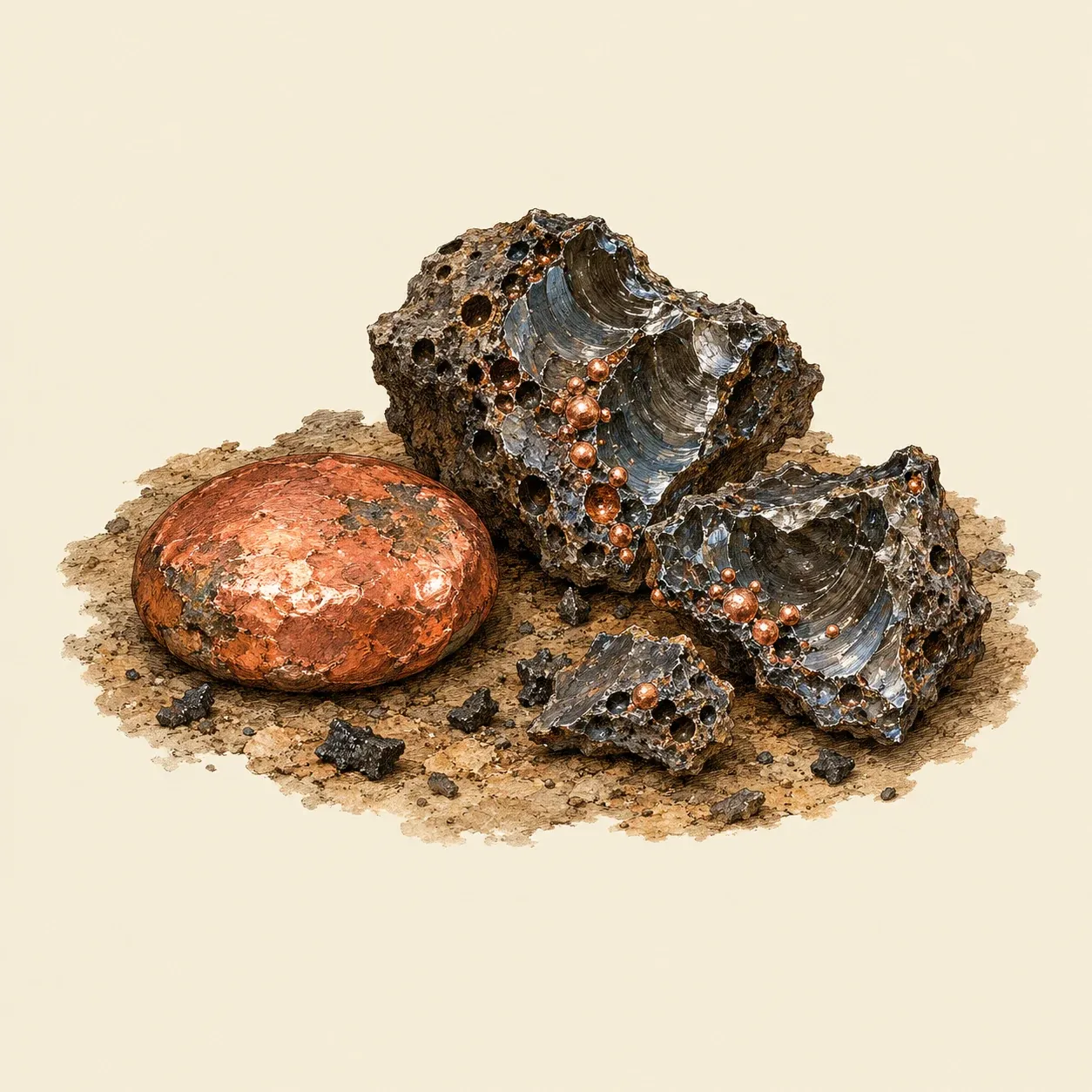 Once the crucible has cooled, the copper is picked out of the slag: a small button and scattered beads.
Recover the copper. Lift the crucible out with tongs and let it cool on a firebrick. Tip out the contents and separate the copper from the charcoal and slag: a small ingot, scattered prills or both. Weigh it and compare with the copper in the ore. In the Moravian tests nearly pure malachite gave on average about two thirds of its copper, and the metal was more than 99% pure.
Safety. Every tool, firebrick and patch of ground must be bone dry: water under molten metal or slag turns to steam and throws it out. A charcoal fire gives off carbon monoxide; never smelt indoors. Never heat chalcopyrite or other sulphides, which release sulphur dioxide, or ore you cannot identify: some copper minerals contain arsenic, whose fumes are poisonous.
History and evolution
At Çatalhöyük in Anatolia, beads of the seventh millennium BCE were hammered from native copper. A green “slag” found there was long taken as the oldest sign of smelting; a study published in 2017 showed it to be copper mineral burnt by accident. The oldest smelting so far is at Belovode in Serbia, where analysed copper slag dates from about 5000 BCE, the same age as the first cast copper objects. At Tal-i Iblis, in south-eastern Iran, hundreds of crucible fragments show copper smelted in crucibles in the late sixth or early fifth millennium BCE.
The air supply limited the heat: the Moravian experiments with elder blowpipes reached only 1,000 to 1,100 °C and the team had to finish with bellows. At Abu Matar, near Beersheba, fragments re-examined in 2024 point to bellows and to furnaces covered with large potsherds, probably the oldest evidence of bellows in the region.
In the Bronze Age, miners turned to sulphide ores. At the Mitterberg in the Austrian Alps, smelting sites of the second millennium BCE, mostly from the Middle Bronze Age, combine roasting beds, furnaces often built in pairs below them, and heaps of slag.
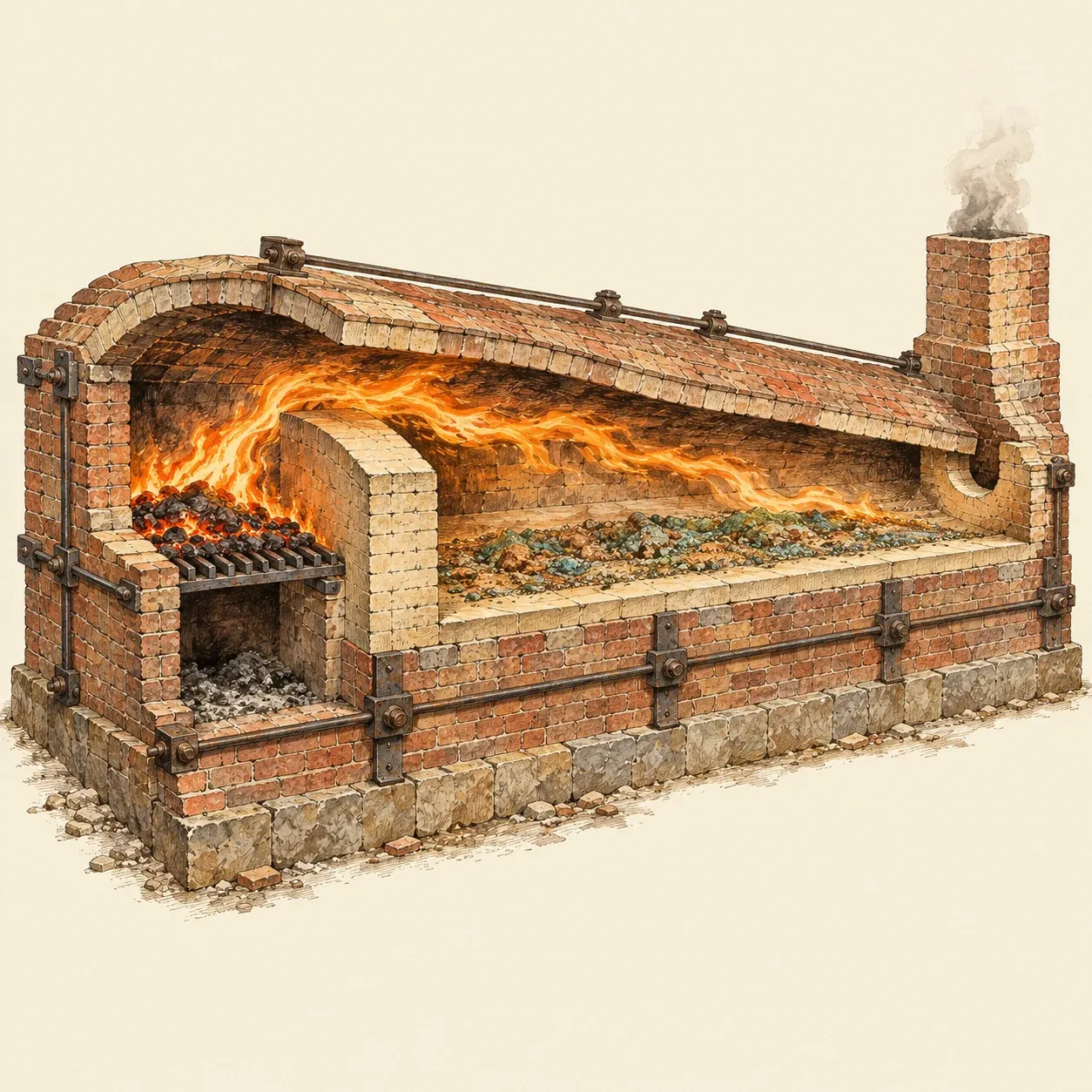 In a reverberatory furnace the flame passes over the charge and the roof throws its heat down; the coal never touches the ore.
By the end of the eighteenth century the Lower Swansea Valley in Wales was the world centre of copper smelting. Its works burned coal from the nearby South Wales coalfield in reverberatory furnaces, where the fire burns on a separate grate and only the flame passes over the ore, and they treated ore shipped from Cornwall and later from across the world. The Welsh process roasted and melted the ore again and again to concentrate the copper in a matte, then turned the matte into blister copper.
In 1880 Pierre Manhès and Paul David adapted the Bessemer converter to copper matte: air blown through the molten matte burns off its sulphur and iron and leaves blister copper. The first commercial electrolytic copper refinery had started at Pembrey, in Wales, in 1869, on patents taken out by James Elkington from 1865, and gave copper of high purity. In 1949 the Outokumpu company started the first industrial flash smelting furnace at Harjavalta in Finland, where fine sulphide concentrate burns in a stream of air and is heated by its own reaction.